
About
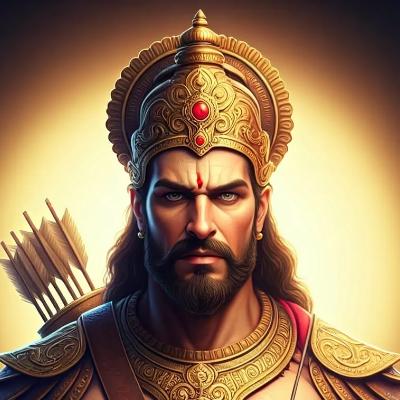
Riksha — King of Hastinapura, Son of Ajamidha and Father of Samvarana
Riksha · Riksha son of Ajamidha · Riksha of the Kuru line
Riksha is a king of Hastinapura in the Puru branch of the Lunar dynasty and one of the key links connecting the broad Bharata lineage to the specific Kuru dynasty. He is the son of Ajamidha — the great ancestor from whom the Kuru, Panchala, and numerous other northern Indian royal lines claim descent — born to Ajamidha's wife known as Dhumini (or Riksha, depending on the recension). Riksha became king of Hastinapura in succession and is the father of Samvarana, through whom the dynastic line passes directly to Kuru, the founder of the Kuru vamsha. He appears in the Mahabharata's Adi Parva genealogical chapters, in the Panchala Kingdom narratives, and is referenced in the Rigveda, which provides one of the earliest textual attestations of a figure by this name in the broader Kuru ancestral tradition.
✦ The Name
Riksha in Sanskrit primarily denotes a bear, and the name is shared by several figures across the epics and Puranas — most notably Riksha the ancestor of Jambavan in some Puranic traditions, and various mountains named Rikshavan. As a personal name for a king, Riksha connotes strength and durability. The name also appears as the name of one of Ajamidha's wives in some recensions of the Mahabharata genealogy (Book I, Chapter 90), which has led to a minor textual ambiguity: in some passages Riksha is listed as a wife of Ajamidha, while in others Riksha is clearly named as a son of Ajamidha born to the wife Dhumini. The Adi Parva Chapter 94 resolves this by specifying that Riksha was born from the womb of Dhumini, one of Ajamidha's wives.
✦ Lineage
- Father: Ajamidha — the great ancestor of the Kuru and Panchala royal lines, a descendant of Puru (youngest son of Yayati of the Lunar dynasty) through the Bharata line. Ajamidha had multiple wives and is recorded in the Mahabharata as having fathered two thousand and four hundred sons across them, from whom the Panchalas, Kushikas, and numerous other lineages descended.
- Mother: Dhumini — one of the wives of Ajamidha; identified as Riksha's mother in Mahabharata Adi Parva Chapter 94. Some recensions of Chapter 90 list Riksha as a wife rather than the mother, which is a textual inconsistency discussed below.
- Son: Samvarana — king of Hastinapura, who was exiled by the Panchalas and restored by Vasishtha, and whose marriage to Tapati (daughter of Surya) produced Kuru, the founding king of the Kuru dynasty.
✦ Succession to the Throne
Among Ajamidha's many sons, the Mahabharata identifies Riksha as the one who became king and perpetuated the primary royal line. The Panchala Kingdom narrative in the Mahabharata records that a prolonged war between the Kurus and the Panchalas led to the defeat of the Kuru royal house, and that it was during this turbulent period that Riksha — described as older than the brothers Jala and Rupina — became king of the restored Kuru seat. His son Samvarana then inherited a kingdom still in conflict with the Panchalas. The Rigveda's reference to Riksha (RV VIII.68.15) in a context associated with the Bharata-Kuru genealogical tradition is cited by historians as an early attestation, though the Vedic reference does not provide biographical detail.
✦ Textual Variants and Inconsistencies
The principal textual inconsistency surrounds the dual appearance of the name Riksha in the Adi Parva Chapter 90, where it appears once as a wife of Ajamidha and once (in Chapter 94) as a son of Ajamidha born to Dhumini. This is most plausibly explained as a scribal or redactional conflation, with Riksha the son (born of Dhumini) being the figure who became king. All genealogical passages that continue the king-list treat Riksha as a male king and the father of Samvarana, consistent with the Chapter 94 reading. Additionally, the Indiadivine.org Panchala Kingdom article, drawing on the Mahabharata, states that Riksha was older than both Jala and Rupina — the latter two being sons of Ajamidha by another wife (Kesini) — and that this seniority gave Riksha the succession. This textual clarification supports the understanding of Riksha as a ruling king rather than merely a genealogical link.
✦ Connection to the Wider Genealogy
Riksha stands two generations below Ajamidha and one generation above Samvarana. Through Samvarana and Tapati's son Kuru, Riksha is the great-grandfather of the dynasty-founder from whom all Kauravas and ultimately the Pandavas trace their male-line descent. His position as the son of Ajamidha — the great branching-point ancestor from whom the Panchalas, Kushikas, and Kuru lines all descend — makes him the specific link through which the primary royal succession of Hastinapura continued beyond the extensive branching of Ajamidha's enormous progeny.
✦ References
- Mahabharata, Adi Parva, Chapter 94 (Sambhava Parva): Primary source naming Riksha as born of Dhumini (wife of Ajamidha) and as the father of Samvarana the perpetuator of the dynasty.
- Mahabharata, Adi Parva, Chapter 89 (Sambhava Parva): Additional genealogical passage stating that Riksha, older than Jala and Rupina, became king and fathered Samvarana.
- Sacred Texts Archive, Mahabharata Book I, Section XCIV (K.M. Ganguli translation): English translation establishing Riksha's genealogical position between Ajamidha and Samvarana.
- Rigveda, VIII.68.15: Vedic reference cited by historians as an early attestation of Riksha in the Bharata-Kuru genealogical tradition.
- Jatland Wiki, Riksha entry: Secondary genealogical compilation quoting the Adi Parva passage on Riksha's role as Samvarana's father and citing Riksha's Vedic attestation.
- Indiadivine.org, Panchala Kingdom article: Secondary source reproducing the Mahabharata account of the Panchala-Kuru war and Riksha's succession as the eldest surviving heir.
- Pranasutra (Puru Vamsha Kathana): Sanskrit genealogical text confirming Riksha as the son of Ajamidha born to the wife Riksha/Dhumini, whose son Samvarana married Tapati.