
About
Trishiras — Son of Vishrava and Raka, Three-Headed Commander at Janasthana
Trishiras · Trishira · Tri-shiras · The Three-Headed One · General under Khara
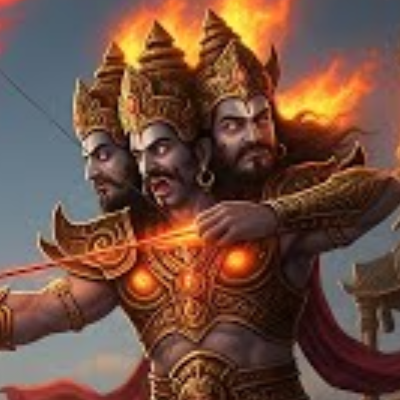
Trishiras is a Rakshasa warrior and military commander named in the Valmiki Ramayana as one of the three senior generals of the Janasthana garrison in the Dandaka forest. He is the brother of Khara and Dushana, sons of the sage Vishrava by the Rakshasi Raka, and is thereby the half-brother of Ravana and his siblings through Vishrava's other wife Kaikesi. Trishiras is distinguished from other Rakshasa figures by his physical characteristic of three heads, from which his name derives directly. He served under Khara's command at Janasthana and was killed by Rama in the same battle that destroyed the entire Dandaka garrison, alongside Khara and Dushana. A point of disambiguation is essential: the name Trishiras is shared by at least two distinct figures in the Ramayana tradition — the Trishiras who is the brother of Khara and the subject of this profile, who appears in the Aranya Kanda; and a separate Trishiras who is a son of Ravana by his wife Dhanyamalini, who appears in the Yuddha Kanda of the Lanka war and was killed by Hanuman in that context. These are two different figures who share only a name. A third, entirely unrelated Vedic figure named Trishiras — the three-headed son of Tvashta, whose beheading by Indra is narrated in the Mahabharata and other texts — belongs to a wholly separate mythological tradition.
✦ The Name
The name Trishiras is a Sanskrit compound of tri, meaning "three," and shiras, meaning "head" or "heads." The name therefore means straightforwardly "the three-headed one." This is a descriptive personal name that directly references a physical characteristic attributed to the figure in the Valmiki Ramayana, where the Aranya Kanda describes Trishiras with imagery evoking a three-peaked mountain. The convention of naming Rakshasa warriors after their physical attributes or their characteristic powers is widespread in the Ramayana tradition, and Trishiras belongs to a recognisable class of multi-headed or multi-limbed demonic beings whose physical abnormality is presented as both a mark of Rakshasa nature and a source of exceptional power. The same name — with the same literal meaning and the same physical implication — was independently applied to other figures across the Sanskrit tradition, which accounts for the multiplicity of distinct "Trishiras" figures noted above.
✦ Lineage
- Father: Vishrava — a sage of great power, son of Pulastya and grandson of Brahma; father of multiple Rakshasa children across different wives
- Mother: Raka — a Rakshasi given to Vishrava as an attendant by Kubera; named in the Mahabharata and Uttara Ramayana tradition as the mother of the Janasthana commanders
- Brothers: Khara — the governor of Janasthana and overall commander of the Dandaka garrison, killed by Rama in the same battle; Dushana — the twin of Khara and senior commander, likewise killed by Rama
- Half-brothers (by Kaikesi): Ravana, Kumbhakarna, and Vibhishana
- Half-sister (by Kaikesi or Raka, variant): Surpanakha — whose humiliation initiated the chain of events ending in Trishiras's death
- Half-brother (by Ilavida): Kubera — god of wealth, whose gift of Raka to Vishrava enabled Trishiras's birth
✦ The Battle of Janasthana
Trishiras's narrative role in the primary sources is confined to the battle of Janasthana in the Aranya Kanda of the Valmiki Ramayana, specifically Sarga 26 and surrounding sargas. When Khara marshalled his army of fourteen thousand Rakshasas to avenge Surpanakha's humiliation, Trishiras served alongside Dushana as a senior commander in the advancing force. The Aranya Kanda describes the three commanders — Khara, Dushana, and Trishiras — as deploying against Rama from three directions simultaneously, a tactical formation that reflects Trishiras's standing as a general of equivalent rank to Dushana within the Janasthana command structure. The Puranic Encyclopaedia's entry records that Trishiras arrived at the battle in a chariot drawn by four horses and engaged Rama directly, wounding him in the forehead with an arrow. Rama responded by shooting Trishiras with an arrow that killed him. The Valmiki Ramayana's Aranya Kanda, Sarga 26, is specifically titled in the Hari Prasad Shastri translation as the chapter recording the combat between Rama and Trishiras and Trishiras's death. Rama's retrospective account of the battle, delivered to Sita in the Yuddha Kanda, names Trishiras alongside Khara and Dushana as the three killed at Panchavati.
✦ Disambiguation: The Two Trishiras of the Ramayana
The name Trishiras appears in two entirely separate narrative contexts within the Ramayana tradition and must be carefully distinguished. The first Trishiras — the subject of this profile — is the son of Vishrava and Raka, the brother of Khara and Dushana, who served as a commander at Janasthana and was killed by Rama in the Aranya Kanda. The second Trishiras is a son of Ravana by his wife Dhanyamalini, whose brothers are Atikaya, Narantaka, and Devantaka, and who fought in the Lanka war of the Yuddha Kanda. This second Trishiras is killed during the battle of Lanka — some accounts attribute his death to Hanuman, while the Valmiki Ramayana's Yuddha Kanda, Sarga 70, records his death alongside those of Devantaka, Narantaka, Mahodara, and Mahaparshva. These two figures are not the same person; they share a name because the name Trishiras — "the three-headed one" — was a recurring descriptive designation applied to multiple Rakshasa beings with this physical characteristic across the Ramayana tradition. Rama's own retrospective account in Yuddha Kanda, Sarga 123, where he names the Trishiras killed alongside Khara and Dushana at Panchavati, confirms that the Aranya Kanda Trishiras and the Yuddha Kanda Trishiras are two distinct figures.
✦ References
Primary Sources
- Valmiki Ramayana, Aranya Kanda, Sarga 26: The specific chapter recording the single combat between Rama and Trishiras and Trishiras's death; titled in translation as "Rama and Trishiras meet in combat: Trishiras is slain."
- Valmiki Ramayana, Aranya Kanda, Sargas 18–29 broadly: The encompassing narrative of the Janasthana battle within which Trishiras functions as one of the three Rakshasa commanders.
- Valmiki Ramayana, Yuddha Kanda, Sarga 123, Verses 44–45: Rama's retrospective account naming Khara, Dushana, and Trishiras as the three killed at Panchavati; confirms the identification of the Aranya Kanda Trishiras as a distinct figure from the Yuddha Kanda Trishiras.
- Uttara Ramayana (Uttarakanda): Records Dushana and Trishiras as Khara's brothers, the source most directly confirming Trishiras's fraternal connection to Khara within the Ramayana tradition.
- Mahabharata, Vana Parva, Chapter 275: The genealogical source naming Raka as the mother of Khara's line; the basis for attributing Trishiras to the same maternal lineage.
Modern Reference Works
- Vettam Mani, Puranic Encyclopaedia (via Wisdomlib): Records Trishiras's role in the battle, his chariot drawn by four horses, his wounding of Rama in the forehead, and his death by Rama's arrow; cites Aranya Kanda, Sarga 26 of the Valmiki Ramayana.
- Wisdomlib, "Trishiras — 12 definitions": Aggregates references to the name Trishiras across multiple texts and traditions, useful for establishing the disambiguation between the two Ramayana figures and the unrelated Vedic Tvashta's son.
- Wisdomlib, "Dushana and Trishiras: Significance and symbolism": Confirms both as generals in Khara's army who were slain in the Janasthana engagement.
- Grokipedia, "Trishira": Provides a detailed discussion explicitly distinguishing the Aranya Kanda Trishiras from the Yuddha Kanda Trishiras, confirming that these are two separate figures sharing a name within the Ramayana tradition.
- Wikipedia, "Trishira" and "Trisiras": The two separate Wikipedia articles for the two distinct figures — one for the son of Ravana (Yuddha Kanda) and one for the Vedic Trishiras son of Tvashta — are useful in triangulating the disambiguation discussed in this profile.