
About
Sukumari — Kekaya Princess and Queen of the Puru Line
Sukumari · Kumari · Sukumara · Kaikeyī
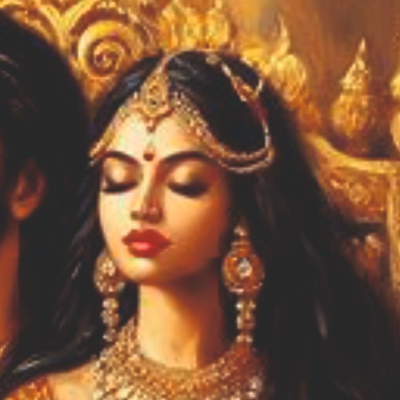
Sukumari is a princess of the Kekaya kingdom and the wife of Bhimasena I, an early king of the Puru dynasty of the Lunar lineage. She is the mother of Paryashravas, also known as Pratipa, through whom the Puru royal succession continued toward the Kuru kings of the later epic age. Sukumari is attested exclusively in the prose genealogical recitation of the Puru dynasty contained in the Adi Parva of the Mahabharata, the passage known as the Puru Vamsha Kathana, which was recited at the snake sacrifice of King Janamejaya. Her profile is necessarily brief, as the text records her identity and maternal role in a single genealogical statement without further narrative elaboration.
✦ The Name
The name Sukumari is a Sanskrit compound formed from the prefix su, meaning well, good, or auspicious, and kumari, meaning a young girl, maiden, or princess. The compound carries the sense of a fine or noble maiden, and reflects the convention in the Puru Vamsha Kathana of assigning auspicious compound names to the queens of this lineage. The shortened form Kumari, attested as an alternate rendering in some recensions, is simply the second element of the compound used independently. She is also identified by the gentilic epithet Kaikeyī, meaning a woman of the Kekaya people or kingdom, which in this context designates her paternal origin rather than functioning as a personal name. The Kekaya kingdom is a well-attested polity in the epic and Puranic geographical tradition, generally located in the northwestern region of the Indian subcontinent, in the area associated with the modern Punjab. The same gentilic Kaikeyī is borne by the most prominent Kekaya princess in the wider tradition — the third wife of King Dasharatha of Ayodhya in the Ramayana — but there is no textual connection between that figure and Sukumari beyond the shared regional designation.
✦ Lineage
- Origin: A princess of the Kekaya kingdom; her parents are not named in the text.
- Father-in-law: Parikshit I, a king of the Puru dynasty and son of Anashvan and Suvesha, a princess of Magadha. This Parikshit I is an early ancestor in the Puru line and is entirely distinct from the later Parikshit, son of Abhimanyu and grandson of Arjuna, who figures centrally in the post-war narrative of the Mahabharata.
- Mother-in-law: Suyasha, a princess associated with the Bahuda river-region and wife of Parikshit I.
- Husband: Bhimasena I, a king of the Puru dynasty and son of Parikshit I and Suyasha. This figure is entirely distinct from Bhima, the second of the five Pandava brothers, who bore the same name many generations later.
- Son: Pratisravas, born of Sukumari and Bhimasena I. His son Pratipa is a significant figure in the later Mahabharata narrative as the father of King Shantanu, the grandfather of Bhishma.
✦ Textual Variants and Inconsistencies
The Puru Vamsha Kathana passage names the son of Bhimasena I and Sukumari as Paryashravas and immediately glosses this name with the identification that he is the figure known as Pratipa. This dual naming — Paryashravas as the given name and Pratipa as the name by which he is known in the wider tradition — is embedded in the Sanskrit text itself and is not a discrepancy between recensions. The name Pratipa, meaning one who goes against the current or one who opposes, is the name under which this king appears in all subsequent Mahabharata passages dealing with Shantanu's parentage. Paryashravas does not recur as a name for this figure outside the genealogical prose of Adhyaya 95. Some regional recensions of the Adi Parva render the mother's name as Kumari rather than Sukumari, but the critical edition reads Sukumari.
✦ Connection to the Wider Genealogy
Sukumari occupies a pivotal position in the Puru genealogy as the mother of Paryashravas-Pratipa, who stands only one generation removed from King Shantanu. Shantanu's own marriages to Ganga and to Satyavati produce the two branches whose conflict drives the entire Mahabharata narrative: from Ganga is born Devavrata, later known as Bhishma, the patriarch and regent of the Kuru realm; from Satyavati are born Chitrangada and Vichitravirya, and through the latter's sons Dhritarashtra and Pandu the Kauravas and Pandavas respectively descend. Sukumari is thus, through her son Pratipa and grandson Shantanu, a direct matrilineal ancestress of the entire Kuru house of the epic's central narrative.
The Kekaya alliance represented by Sukumari's marriage to Bhimasena I also marks a notable geographical shift in the matrimonial pattern of the Puru royal house at this phase of the lineage. The immediately preceding queens — Sampriya and Suvesha — were both Magadha princesses from the eastern Gangetic region, and Suyasha was associated with the Bahuda river-region. Sukumari's Kekaya origin extends the alliance network of the Puru court westward toward the northwestern kingdoms, reflecting the broad geographical range of matrimonial diplomacy encoded in the Puru Vamsha Kathana.
✦ References
- Mahabharata, Adi Parva, Adhyaya 95 (critical edition; corresponding to Adhyaya 90 or 94 in some regional recensions including the Kumbakonam and Ganguli editions): The sole primary source for Sukumari. The Puru Vamsha Kathana prose passage names her as a Kekaya princess, wife of Bhimasena I, and mother of Paryashravas, identified in the same passage as Pratipa. All genealogical facts in this profile derive from this passage.
- Kisari Mohan Ganguli (trans.), The Mahabharata of Krishna-Dwaipayana Vyasa, Adi Parva, Chapter 95: English translation of the Puru Vamsha Kathana, used for cross-reference of the genealogical sequence involving Bhimasena I, Sukumari, and Paryashravas-Pratipa.