
About
Shibi — Son of Usinara and Madhavi, King of the Sivis, Exemplar of Righteous Protection
Shibi · Sivi · Siboi · son of Usinara · Aushinara · Chakravartin
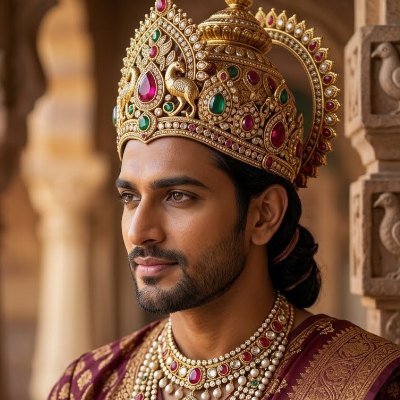
Shibi is the son of Usinara — a king of the Bhoja country of the Chandravamsha — and Madhavi, the daughter of King Yayati of the Lunar dynasty, born as the third of Madhavi's four sons through the arrangement of the Galavacharita. He is one of the most celebrated figures in the Mahabharata and Puranic tradition, renowned above all others for the depth and completeness of his commitment to the duty of protecting those who seek refuge. The Mahabharata's Vana Parva preserves the episode — narrated by the sage Markandeya — in which Shibi was tested by the gods Indra and Agni, who assumed the forms of a hawk and a dove respectively, and in which Shibi offered successive pieces of his own flesh, and ultimately his entire body, to protect the dove. The gods, revealing their true forms, pronounced him unparalleled among men. In the Udyoga Parva, Narada assessed Shibi as the most meritorious of the four sons of Madhavi, the one whose giving was the most complete and the most free of pride. Shibi participated with his half-brothers in the restoration of Yayati to the heavenly realm, and his son Kapotaroma — born, according to the Vana Parva, directly from the wound in Shibi's side — went on to become a king of the Saurathas.
✦ The Name
The name Shibi — also rendered Sivi, Sibi, or Shibee — functions both as a personal name and as the name of the people and kingdom associated with this lineage. The Sivi or Sibi people are mentioned in ancient Greek sources as the Siboi — a tribe encountered by Alexander of Macedon's forces in the northwest of the Indian subcontinent during the fourth century BCE — indicating that the Shibi-Sivi kingdom had a historical correlate in that region. The name is thus one of the points of contact between the Puranic genealogical tradition and external historical testimony. The patronymic Aushinara — son of Usinara — is applied to Shibi in several Mahabharata passages. The Mahabharata also refers to him as the son of Usinara in Dhritarashtra's declaration that no second such person had ever existed in the three worlds.
✦ Lineage
- Father: Usinara — king of the Bhoja country of the Chandravamsha, described in the Mahabharata as a king of genuine dharmic awareness who declared that his wealth existed for his subjects rather than for himself. He possessed two hundred of the rare white horses with black ears required by Galava and received Madhavi through the Galavacharita arrangement.
- Mother (Galavacharita account): Madhavi — the daughter of King Yayati of the Lunar dynasty, endowed with the divine boon of restored virginity after each birth and destined to bear sons who would become great kings. Shibi was her third son.
- Maternal grandfather: Yayati — great king of the Lunar dynasty, ancestor of both the Yadava and Paurava lines, who was expelled from the heavenly realm through pride and later restored to it through the merit of his four grandsons through Madhavi.
- Half-brothers through Madhavi: Vasumanas — son of Haryashva, renowned for generosity and the title Danapati; Pratardana — son of Divodasa, renowned for martial courage; and Ashtaka — son of Vishvamitra, renowned for great sacrifices. Shibi is assessed by Narada as the most meritorious of the four.
- Son: Kapotaroma — the Mahabharata's Vana Parva, at the conclusion of the dove and hawk episode, records Agni's blessing upon Shibi that a son would be born to him from his side — directly from the wound caused by the cutting of his flesh — who would be named Kapotaroma, meaning one with the feathers of a pigeon, and who would become a foremost hero of the Saurathas, blazing in fame and beauty. The Puranic Encyclopaedia also mentions another son named Gopati, raised in the forest among cattle.
- Further descendants (Bhagavata Purana account): The Bhagavata Purana, Book IX, Chapter 23, records that Shibi had four sons — Vrsadarbha, Sudhira, Madra, and a son who knew the truth of the self, from whom the Madra and Kekaya royal houses descended. This genealogical tradition makes the Madras — whose princess Madri became the second wife of King Pandu and the mother of Nakula and Sahadeva — descendants of Shibi.
✦ The Episode of the Dove and the Hawk
The foundational narrative of Shibi's fame is preserved in the Mahabharata's Vana Parva, Chapters 130 and 131, within the section called the Markandeya Samasya — the discourses of the sage Markandeya, narrated to the Pandavas during their forest exile. The episode is also referenced at Mahabharata 3.196–197 and 1.93.
The gods Indra and Agni, having heard of the extraordinary fame of Shibi and desiring to test whether he was truly as great as his reputation suggested, came to his court in disguise. Agni assumed the form of a dove, terrified and exhausted. Indra assumed the form of a fierce hawk in pursuit of the dove. The dove flew to Shibi's side and fell trembling into his lap, seeking refuge and protection for its life. The dove declared to the king that it was truly a sage in a bird's form, and that it came under his protection. Shibi's priest told the king that it was his sworn duty to protect any creature that had sought his refuge.
The hawk arrived and addressed Shibi, demanding that the dove be surrendered as its rightful prey. Shibi refused, offering instead to provide the hawk with any alternative food it required. The hawk countered that it could only eat prey that it had itself hunted, and that depriving it of the dove would cause it to starve. Shibi then offered to give the hawk flesh cut from his own body equal in weight to the dove, so that the hawk could be fed without the dove being surrendered. The hawk agreed to this substitute — but specified that the flesh must be cut from Shibi's own right thigh.
Shibi accepted without hesitation. He cut a piece of flesh from his right thigh and placed it on a scale against the dove. The dove's weight exceeded it. He cut more flesh and added it to the scale. Still the dove outweighed it. By pieces he cut flesh from his entire body, yet the dove's weight always exceeded the flesh he had offered. The gods and sages gathered in the sky to witness this, filled with wonder. Finally, understanding that nothing short of his whole self could balance the scale, Shibi climbed onto the pan of the scale himself, offering his entire body in place of the dove.
At this point, the hawk and the dove shed their assumed forms and stood before Shibi as Indra and Agni in their radiant divine bodies. The gods praised Shibi with extraordinary words: that he was the foremost of men, that his glory would endure as long as the sun and moon remained in their courses, that no second such person had ever existed or would exist in the three worlds. Agni blessed Shibi that the wounds in his body — made auspicious by the fire-god's touch — would become golden-coloured and sweet-scented, and that a son would be born from his side named Kapotaroma — the pigeon-feathered — who would become a great king of the Saurathas. The Mahabharata notes that when the cutting of flesh had been done, a single tear had fallen from Shibi's left eye, and the hawk had immediately declared that he would not accept an unwilling sacrifice — the tear being the only moment of hesitation in Shibi's offering, which the hawk measured with perfect precision.
✦ Participation in the Restoration of Yayati
Shibi participated with his three half-brothers — Vasumanas, Pratardana, and Ashtaka — in the act of transferring their accumulated merit to their maternal grandfather Yayati, thereby restoring him to the heavenly realm from which he had been expelled. In the aerial journey episode narrated in the Udyoga Parva, where Narada assessed the merits of the four brothers, Shibi was placed first — above all three of his half-brothers. Narada's reasoning was that Shibi had given away everything he possessed without reservation and without any admixture of pride or calculation, making his generosity the most complete and most spiritually meritorious of the four. The Mahabharata records that during the aerial journey, Shibi's chariot moved faster than those of his brothers and arrived in heaven ahead of them — a physical manifestation of the superiority of his accumulated merit.
✦ Other Appearances in the Mahabharata
The Mahabharata's Adi Parva records that a prince named Shibi, son of Usinara, attended the swayamvara of Draupadi along with kings from neighbouring kingdoms. This raises a question about whether this is the same Shibi as the hero of the dove episode — in which case he would have been alive during the period of the Pandavas — or a later king of the same name in the Sivi royal line. The Puranic tradition generally treats the famous Shibi of the dove episode as a figure of a much earlier era, and scholarly opinion recorded at Quora notes that the Draupadi swayamvara Shibi may be a different, later king of the same dynasty bearing the same name. The Vana Parva episode is narrated by Markandeya as a story from the past, not as a contemporary event.
The Shanti Parva records that Shibi gave the sword — a gift of royal and warrior significance — to his half-brother Pratardana. The Vana Parva, Chapter 194, contains an episode in which the king Suhotra, on the advice of Narada, gave way to Shibi and stepped aside, acknowledging Shibi's superior virtue.
✦ Theological Significance
Shibi's story is the Mahabharata's most fully developed narrative illustration of the dharmic duty of sharanagati — the protection of those who have sought refuge. This duty, which in Vedic and Puranic ethics is among the most sacred obligations of a king, is tested in the dove and hawk episode to its absolute limit: Shibi is required to choose between the duty to protect the dove and the duty not to let the hawk starve, and he resolves the dilemma not by choosing one over the other but by substituting himself as the object of sacrifice. This resolution — offering himself rather than the being under his protection — is the act that Indra and Agni judge as unparalleled among humans.
The story also encodes, in the tear from Shibi's left eye, a precise and demanding theological point: the hawk's immediate refusal to accept an unwilling sacrifice shows that merit in giving is measured not only by the magnitude of the gift but by the complete absence of reluctance or grief in the giving. The one tear — which the hawk observes instantly — serves as the text's way of honouring Shibi's extraordinary virtue while also acknowledging his humanity, the tension between which the gods immediately resolve by revealing themselves and restoring him.
In the Narada assessment of the four sons of Madhavi in the Udyoga Parva, Shibi represents the highest grade of giving — that which is most free of pride and most complete in self-abnegation. Ashtaka had given with pride at his own generosity; Vasumanas and Pratardana each had specific qualities of giving that placed them below Shibi. Shibi alone gave everything without reservation, and the tradition identifies this as the quality that earned him the most accumulated merit and the fastest passage to the heavenly realm.
✦ References
- Mahabharata, Vana Parva, Chapters 130–131 (Markandeya Samasya): The primary and most elaborated source for the dove and hawk episode; narrates the divine test by Indra and Agni, Shibi's progressive offering of his flesh, his mounting of the scale, the gods' revelation of their identities, the pronouncement of his unparalleled virtue, Agni's blessing, and the promise of the son Kapotaroma.
- Mahabharata, Vana Parva, Chapter 194: Records the episode in which Suhotra, on Narada's advice, gave way to Shibi acknowledging his superior virtue.
- Mahabharata, Udyoga Parva, Chapters 118–122: Records Shibi's birth to Usinara and Madhavi; contains Narada's assessment placing Shibi first among the four sons of Madhavi in the aerial journey episode; and records the collective restoration of Yayati to heaven.
- Mahabharata, Drona Parva, Chapter 7, verse 10: Contains Dhritarashtra's declaration that in the three worlds there had never been and would never be a second person equal to the son of Usinara.
- Mahabharata, Shanti Parva: Records Shibi's gift of a sword to his half-brother Pratardana, and references Shibi's example of giving in the context of dharmic discourse.
- Mahabharata, Adi Parva: Mentions a prince named Shibi, son of Usinara, at Draupadi's swayamvara — a reference that may indicate a later king of the same name rather than the hero of the dove episode.
- Bhagavata Purana, Book IX, Chapter 23, verses 1–4: Names Shibi as a son of Usinara in the Anu lineage; lists his four sons as Vrsadarbha, Sudhira, Madra, and a fourth, making him an ancestor of the Madra royal house.
- Vettam Mani, Puranic Encyclopaedia (Motilal Banarsidass, 1975): Entry on Shibi providing the most comprehensive compilation of his Mahabharata appearances, the specific Parva and chapter references, and the theological significance of the dove and hawk episode.
- Wikipedia, Shibi (king) article: Used for cross-referencing the dove and hawk episode, the identification of Kapotaroma as his son, and the connection between the Sibis and the Siboi of Greek sources.
- AncientVoice, Sivi entry: Used for the Mahabharata chapter references to Shibi's identity as son of Usinara and Madhavi, and for the note on Shibi's son Kapotaroma and the Sauratha connection.