
About
Dushmanta — Prince of the Puru Line, Son of Ajamidha and Nili, Progenitor of the Southern Panchala Branch
Dushmanta · Dushyanta (variant transliteration) · Dushmanta Ajamidhaputra
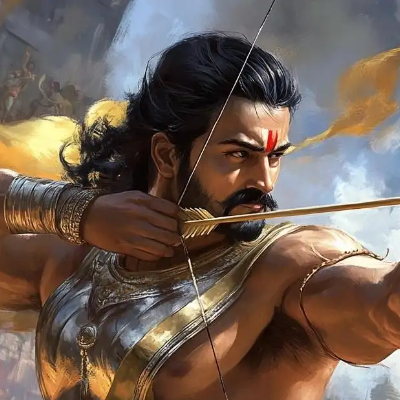
Dushmanta is a prince of the Puru line within the Chandravamsha, son of Ajamidha — the great Puru king descending through Hastin, Suhotra, Bhumanyu, and Bharata Daushyanti — by his wife Nili. He is attested in the Mahabharata (Adi Parva, chapter 94) alongside his brother Parameshthin as one of two sons born to Ajamidha by Nili, and the text states that the Panchala tribes collectively descend from Dushmanta and Parameshthin. He has no independent narrative episode in any primary source and his profile is accordingly brief. The critical disambiguation that must be stated for any profile of this figure is the distinction between this Dushmanta and the celebrated king Dushyanta — husband of Shakuntala, father of the emperor Bharata, and the figure whose love story is narrated at length in the Mahabharata's Adi Parva and is the subject of Kalidasa's Abhijnanasakuntalam. These are entirely distinct figures who share only a name.
✦ The Name and Critical Disambiguation
The name Dushmanta — also rendered Dushyanta in some transliterations, both forms representing the same Sanskrit name — is a compound admitting more than one interpretation. One reading connects it to dus (difficult or adverse) and manta or yanta (one who restrains or governs), yielding the meaning the difficult restrainer or one who is hard to govern — a Kshatriya name expressing unyielding power. The celebrated king Dushyanta — with whom this figure must not be confused — is placed in the Mahabharata and Puranic tradition as a descendant of Puru through an earlier branch of the Paurava line, several generations before Ajamidha. He is the king who encountered the hermit girl Shakuntala — foster daughter of the sage Vishvamitra, born of the apsara Menaka — married her in the forest, forgot her through a sage's curse, and eventually recognised her and their son Bharata, who became the great emperor from whom the subcontinent takes the name Bharatavarsha. This Dushyanta belongs to a period earlier than Ajamidha in the lunar dynastic sequence and has no relationship to Ajamidha's son Dushmanta beyond the shared name.
✦ Lineage
- Father: Ajamidha — king of the Puru line, son of Hastin son of Suhotra son of Bhumanyu son of Bharata Daushyanti; progenitor of multiple major royal and Brahminical lines of the Puranic tradition
- Mother: Nili — second wife of Ajamidha; the Mahabharata Adi Parva chapter 94 names her as the mother of Dushmanta and Parameshthin and states that all the Panchala tribes descend from these two sons; no parentage, epithet, or further narrative is recorded for her in any primary source
- Brother: Parameshthin — son of Ajamidha and Nili; co-progenitor with Dushmanta of the Panchala peoples according to the Mahabharata's genealogical account
- Half-brothers: Riksha — son of Ajamidha by Dhumini, progenitor of the Kuru royal line through Samvarana; Nila — son of Ajamidha by Nalini, progenitor of the northern Panchala line; Jahnu — son of Ajamidha by Kesini, progenitor of the Kushika lineage and the figure famous for drinking the Ganga
✦ Textual Limitations
Dushmanta son of Ajamidha and Nili has no independent narrative episode in any primary source consulted. He is attested exclusively in the genealogical passages of the Mahabharata Adi Parva chapter 94, where the sole significant statement made about him beyond his parentage is that the Panchala peoples descend from him and his brother Parameshthin. No descendants are individually named for this Dushmanta in the primary texts with sufficient clarity to extend his branch further in this genealogical tree. His line is recorded as a terminal branch at this node in the southern Panchala descent tradition.
✦ References
Primary Sources
- Mahabharata, Adi Parva, chapter 94 — Names Dushmanta as a son of Ajamidha by Nili alongside his brother Parameshthin; states that all the Panchala tribes descend from these two sons; separately narrates the story of the celebrated Dushyanta and Shakuntala elsewhere in the same Parva, confirming that the two figures are distinct.
- Harivamsha, genealogical sections — Names Dushmanta as a son of Nili within the expanded account of Ajamidha's household.
Secondary Sources
- Pargiter, F. E., Ancient Indian Historical Tradition (Oxford University Press, 1922) — Places Dushmanta within the reconstruction of Ajamidha's household and explicitly distinguishes him from the celebrated Dushyanta of the Shakuntala narrative.
- Puranic Encyclopaedia, Vettam Mani, entry "Ajamidha" — Confirms Nili as the mother of Dushmanta and Parameshthin; distinguishes the Ajamidha-lineage Dushmanta from the celebrated Dushyanta.