
About
Aruni — Female Form of Aruna, Dawn Goddess
Aruni · Vainateyi · Aruna (feminine) · Kashyapi
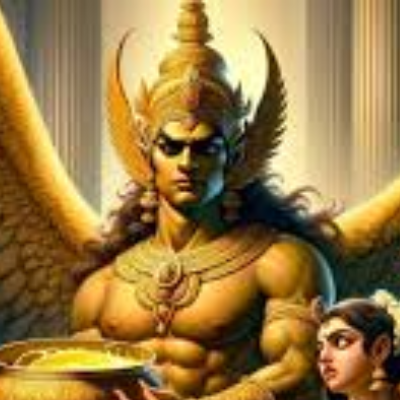
Aruni is the feminine form of Aruna, treated in certain Puranic passages as a distinct divine being who embodies the female aspect of the dawn. As with Aruna, she is understood to be a child of the sage Kashyapa and his wife Vinata, and thus belongs to the avian lineage known as the Vainateyas. The most significant independent narrative in which Aruni appears in her feminine identity is found in the Brahmanda Purana and is taken up in abbreviated form in related Puranic texts: she is said to have assumed a female body at the request or instigation of Indra, king of the gods, in order to distract the demon Sthanu or, in other versions, to participate in the celestial assembly. The profile here follows the convention established in this genealogical series of treating Aruna and Aruni as two distinct persons — the male and female expressions of the same dawn principle — while noting that most primary sources treat the female form as a temporary transformation of the male Aruna rather than as a separately born individual.
✦ The Name
Aruni is the feminine grammatical form of Aruna, carrying the same etymological root denoting the reddish-tawny colour of dawn. In Sanskrit grammatical convention, adding the feminine suffix to a noun or adjective used as a name produces the feminine counterpart; Aruni thus designates a female being who embodies the same dawn-quality as Aruna. The epithet Vainateyi is the feminine form of Vainateya, meaning "daughter of Vinata." Kashyapi is the feminine patronymic from Kashyapa, meaning "daughter or female descendant of Kashyapa."
✦ Lineage
- Father: Kashyapa — one of the seven primordial sages, a son of Marichi and grandson of Brahma; progenitor of a vast range of divine and cosmic beings across the Puranic tradition.
- Mother: Vinata — a daughter of Daksha, the progenitor-patriarch; one of Kashyapa's principal wives; sister-co-wife of Kadru, the mother of the Nagas.
- Male counterpart or elder brother (depending on textual treatment): Aruna — the charioteer of Surya the sun god, whose body radiates the crimson light of dawn; in sources that treat Aruni as a transformation of Aruna, she and Aruna are the same being in two forms; in the convention followed here, they are treated as distinct.
- Younger sibling: Garuda — the great eagle-deity and vehicle of Vishnu, born from the second of Vinata's two eggs; the most celebrated of the Vainateya lineage.
✦ The Narrative of the Female Form
The Brahmanda Purana contains the principal narrative in which a female Aruni figure plays an active role. In this account, Indra — the king of the gods — approaches Aruna and requests that he take on a female form in order to gain entry into the assembly or private domain of the great demon Sthanu, who had performed severe austerities and thereby acquired immense power. Aruna complies and assumes the form of an extraordinarily beautiful woman. In this female form, named or identified as Aruni, she dances before the assembled gods and demons and captivates those present. The narrative proceeds to describe how Indra himself, overcome by the beauty of this form, assumes the shape of a bee and drinks intoxicating honey, after which Aruni in her female form gives birth to Vali and Sugriva — the two great vanara or monkey-princes who appear in the Ramayana as pivotal figures in Rama's campaign to recover Sita from the demon-king Ravana. Vali becomes king of the vanaras at Kishkindha, and Sugriva later becomes king after being aided by Rama. This account appears in certain recensions of the Brahmanda Purana and is referenced in secondary Puranic literature.
✦ Textual Variants and Inconsistencies
The parentage of Vali and Sugriva is one of the more variable genealogical questions in Puranic and epic literature, and the account linking them to Aruni represents only one of several traditions. The Valmiki Ramayana identifies Vali as the son of Indra and Sugriva as the son of the sun god Surya, with their mother named as a female monkey or a woman named Anjana or associated with a she-monkey. The Kishkindha Kanda of the Valmiki Ramayana does not name Aruni as their mother. The Brahmanda Purana account, in which Aruna in female form becomes the mother of both Vali and Sugriva through Indra, is therefore in tension with the epic tradition. This inconsistency is not resolved across the textual corpus; it reflects the independent development of genealogical traditions in the Puranas relative to the earlier epic narratives. The convention in this series of treating Aruni as a distinct person rather than a temporary form of Aruna is an editorial device for genealogical clarity and does not correspond to a separate birth narrative found in any primary source: the primary sources consistently describe Aruni as Aruna having assumed a female body, not as a separately born individual.
✦ Theological Significance
Aruni as a feminine dawn-principle fits within a broader Puranic pattern in which solar and liminal cosmic forces — those associated with dawn, twilight, and the boundaries between states — are accorded both male and female expressions. The capacity of Aruna to shift between male and female form also places him or her within the wider tradition of divine gender-transformation, of which the most celebrated example in the Puranas is Vishnu's assumption of the form of Mohini to distribute the amrita of immortality. The Aruni episode serves a narrative function: it explains the extraordinary origin of Vali and Sugriva, giving two of the Ramayana's most important non-human allies a divine parentage rooted in the celestial order rather than in ordinary procreation.
✦ Connection to the Wider Genealogy
Aruni belongs, by the convention of this series, to the lineage of Kashyapa and Vinata, the same line that produces Garuda and Aruna. Through the Brahmanda Purana account of her union with Indra — Indra being himself a son of Kashyapa by Aditi, one of Daksha's daughters and Vinata's sister — Aruni's offspring Vali and Sugriva are doubly connected to the Kashyapa lineage on both the maternal and paternal sides. Sugriva and Vali thus become part of the wider avian-solar-divine genealogical web that the Vainateya and Aditi lines together produce. This also makes Aruni and Indra connected as half-siblings through Kashyapa, a fact the narrative does not pause to address, which is consistent with broader Puranic patterns in which the vast scope of Kashyapa's progeny makes such connections structurally unavoidable.
✦ References
- Brahmanda Purana: Primary source for the narrative of Aruna assuming female form as Aruni at Indra's request, and for the account of Vali and Sugriva being born from this female form; the specific chapters treating this episode are in the Upodghata and Anushanga sections.
- Mahabharata, Adi Parva: Background source for the birth of Aruna from Vinata's egg and for the genealogy of Kashyapa and his wives; does not treat the female form independently.
- Valmiki Ramayana, Kishkindha Kanda: Provides the principal epic account of the parentage of Vali and Sugriva, which differs from the Brahmanda Purana version and does not name Aruni as their mother; essential for establishing the textual inconsistency noted above.
- Bhagavata Purana, Skandha VI: Lists the offspring of Kashyapa's wives including Vinata, situating the Vainateya lineage within the larger Kashyapa genealogy.
- Vettam Mani, Puranic Encyclopaedia (1975): Modern reference; provides entries on both Aruna and the female form episode, drawing on Brahmanda Purana material and noting the connection to Vali and Sugriva.
- Monier-Williams Sanskrit-English Dictionary: Modern reference; confirms the grammatical relationship between Aruna and Aruni as masculine and feminine forms of the same root.