
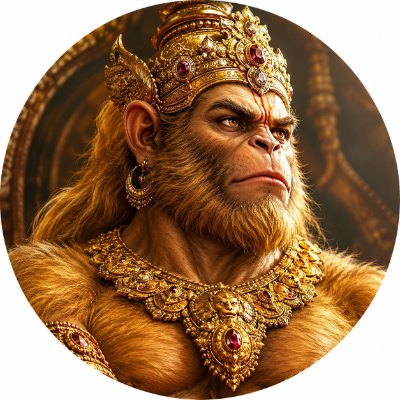
About
Vali — King of Kishkindha, Son of Indra, and the Mightiest of the Vanaras
Vali · Valin · Bali Vanara · Riksharajas-putra · Indra-putra · Sakra-nandana · Kapitishvara
Vali is the king of Kishkindha and the mightiest of all the Vanara beings in the Valmiki Ramayana, surpassed in physical power by none among his kind and matched only by the extraordinary capabilities of Hanuman, the son of the wind god Vayu. He is the son of Indra — the king of the gods, lord of Svarga, and one of the twelve Adityas born to the sage Kashyapa and his wife Aditi — and the elder brother of Sugriva, who is the son of the sun god Surya. Vali is the husband of Tara — daughter of the Vanara elder and physician Sushena, himself the son of Varuna — and the father of Angada, who becomes one of the most significant Vanara warriors and diplomats in the campaign against the demon king Ravana of Lanka. He is also the possessor of a boon of extraordinary combat power by which he received half the physical strength of any opponent who faced him directly in single combat, rendering him effectively invincible against any challenger who confronted him face to face. His life, his reign, and his death at the hands of the divine hero Rama — the seventh avatar of Vishnu and the son of the king Dasharatha of Ayodhya — constitute one of the most morally complex and narratively rich episodes of the Kishkindha Kanda of the Valmiki Ramayana. He appears in the Valmiki Ramayana, the Mahabharata, the Bhagavata Purana, the Vishnu Purana, the Brahma Purana, and in numerous regional and vernacular retellings of the Ramayana tradition across South and Southeast Asia. His killing by Rama is one of the most discussed and debated ethical episodes in the entire Hindu epic tradition, generating commentarial controversy that extends from the earliest Sanskrit glosses on the Valmiki text to modern scholarship.
✦ The Name
The name Vali — also spelled Valin in many Sanskrit manuscript traditions — derives from a Sanskrit root connected to the concept of strength, power, or the possessor of strength. The form Valin means the one possessed of strength or the powerful one, with the suffix in indicating possession of the quality named by the base. The name is thus directly expressive of Vali's defining attribute: he is the Vanara of supreme physical power, the embodiment of martial strength within the monkey world of Kishkindha. The variant spelling Bali — found in some regional traditions and not to be confused with the demon king Bali of the Vamana episode, who is a completely distinct figure — is occasionally applied to Vali in certain vernacular retellings, but the Valmiki Ramayana consistently uses the form Vali or Valin.
The patronymic Indra-putra — son of Indra — is among the most frequently used epithets for Vali in the text and reflects the centrality of his divine parentage to his identity and his power. Sakra-nandana — the delight of Sakra, Sakra being another name for Indra — carries the same reference. Riksharajas-putra appears in certain passages and refers to the Vanara king Riksharajas, who is identified in some accounts as the earthly adoptive or foster father who raised Vali and Sugriva in Kishkindha, as distinct from their respective divine biological fathers Indra and Surya. Kapitishvara means lord of the monkeys or lord of the Vanaras, a royal epithet reflecting his sovereignty over Kishkindha.
✦ Lineage
- Father (divine): Indra — king of the gods, lord of Svarga, wielder of the thunderbolt Vajra, and one of the twelve Adityas born to the sage Kashyapa and his wife Aditi, daughter of the patriarch Daksha. Indra is the supreme deity of active power in the Vedic tradition, the god of storm, rain, and battle, and the champion of the gods against demonic forces. Through Indra, Vali is the grandson of Kashyapa and Aditi and the nephew of all the other Adityas including Varuna, Mitra, Vishnu, Vivasvat, Bhaga, Pushan, Aryaman, Amsha, Parjanya, Tvashtr, and Dhata.
- Father (earthly, in certain accounts): Riksharajas — a Vanara king who appears in some textual traditions as the earthly father who raised Vali and Sugriva in Kishkindha. Some accounts describe Riksharajas as having been transformed from a human into a Vanara through a curse, and the sons born of divine intervention — Vali from Indra and Sugriva from Surya — as having been placed with him. The Riksharajas tradition is not consistently attested across all recensions of the Valmiki Ramayana and should be noted as a variant tradition rather than a universally canonical account.
- Brother: Sugriva — the younger brother of Vali; son of the sun god Surya (Vivasvat), one of the twelve Adityas; king of Kishkindha after Vali's death; Rama's principal Vanara ally in the campaign against Ravana. The relationship between Vali and Sugriva — brothers of the same earthly household but different divine fathers, caught in a destructive conflict over kingship and a wife — is one of the most dramatically significant fraternal relationships in the epic tradition.
- Wife: Tara — daughter of Sushena the Vanara elder and physician, Sushena being identified as the son of Varuna the Aditya; celebrated for her beauty, intelligence, prophetic counsel, and emotional depth; mother of Angada; included in some enumerations of the Panchakanya. After Vali's death, Tara became the wife of Sugriva.
- Son: Angada — Vanara prince of exceptional courage, eloquence, and martial power; yuvaraja of Kishkindha appointed by Rama; leader of the southern search party that located Lanka; emissary of Rama to Ravana's court in the celebrated embassy episode; one of the foremost warriors of the campaign against Ravana; grandson of Indra through Vali and grandson of Varuna through Tara's father Sushena.
- Paternal grandfather: Kashyapa — one of the seven great primordial sages; progenitor of gods, demons, Nagas, birds, and all orders of beings; son of Marichi, one of the mind-born sons of Brahma.
- Paternal grandmother: Aditi — daughter of the patriarch Daksha; wife of Kashyapa; the boundless mother of all twelve Adityas including Indra; one of the most frequently invoked divine mothers in the Rigveda.
✦ Vali's Boon and its Nature
The boon that made Vali effectively invincible in direct combat is one of the most structurally significant supernatural attributes in the Kishkindha Kanda of the Valmiki Ramayana, and its precise nature and source are worth establishing clearly. The boon stated that any opponent who faced Vali directly in single combat would have half of their own physical strength transferred to Vali at the moment of confrontation, so that Vali would possess not only his own formidable native strength but also half of his opponent's. The practical consequence was that any being who fought Vali face to face was already weakened to half capacity before the first blow was struck, while Vali was simultaneously empowered beyond his already extraordinary natural strength. No being in the three worlds — not among gods, demons, humans, or Vanaras — was capable of defeating Vali in direct single combat under these conditions.
The source of this boon varies across the textual tradition. Some passages attribute it to Brahma; others to Indra, Vali's divine father; others simply describe it as a boon obtained through Vali's own austerities. The Valmiki Ramayana does not provide an extended account of how or when the boon was granted, but it is treated throughout the Kishkindha Kanda as an established and unambiguous fact about Vali's nature. The boon applied only to direct face-to-face combat — it was precisely its condition of requiring the opponent to face Vali that created the tactical opening through which Rama was able to kill him from concealment. Had Vali faced Rama directly, the boon would have transferred half of Rama's divine strength to Vali, making any direct confrontation futile regardless of Rama's own extraordinary capacities.
The existence of this boon explains why Sugriva — who was himself a son of Surya and a being of considerable divine-born strength — was consistently unable to defeat Vali in their fraternal conflicts despite being Vali's equal in every other respect. It also explains why Rama, who was himself an avatar of Vishnu and possessed of divine weapons of immense power, was unable to confront Vali directly and was required to shoot him from behind a tree while Vali was engaged in combat with Sugriva.
✦ Vali's Early Prowess and the Conquest of Ravana
Several episodes recorded in the Valmiki Ramayana and in Puranic texts establish the extraordinary extent of Vali's power before the main narrative of the Kishkindha Kanda begins. The most celebrated of these is Vali's encounter with the demon king Ravana of Lanka — the same Ravana who is the primary antagonist of the Ramayana as a whole and who abducts Sita, prompting the entire campaign that forms the epic's central narrative.
The account records that Ravana, in his arrogance and his pursuit of conquest across the three worlds, once arrived at the shores near Kishkindha and challenged the most powerful beings he could find. He came upon Vali performing his sandhyavandana — the ritual salutation to the sun performed at the three junctions of the day, dawn, noon, and dusk — at the seashore. Ravana attempted to seize Vali from behind as he performed his worship, intending to treat the Vanara king as a minor obstacle to be brushed aside. Vali, without interrupting his ritual, simply caught Ravana under his arm — clamping the demon king against his body with one arm — and continued his devotions, carrying Ravana with him as he completed the full circuit of his sandhyavandana across all four of the cardinal directions. He flew from east to west, north to south, with the demon king of Lanka trapped under his armpit throughout, Ravana utterly unable to free himself from Vali's casual grip despite all the demon's extraordinary strength and his divine weapons.
Only after Vali had completed his worship did he set Ravana down. The two then briefly discussed terms, and Ravana — humiliated but pragmatic — entered into a treaty of friendship with Vali rather than continue a contest he could not win. This episode is one of the most striking demonstrations in the tradition of Vali's supreme power within the mortal and semi-divine world: the being who would require the full force of a divine avatar's campaign to overcome was himself treated by Vali as a minor inconvenience to be tucked under an arm during morning prayers.
The tradition also records Vali's conquest of the demon Dundubhi — a great buffalo-demon of immense strength who had been troubling the world — whom Vali killed in single combat. After killing Dundubhi, Vali is said to have thrown the carcass a great distance with a casual toss of his arm, the body landing at the hermitage of the sage Matanga where it defiled the sage's sacred grounds. Matanga, furious at this desecration, cursed Vali: he could not enter the territory around Matanga's hermitage without his head splitting open. This curse would later become strategically significant, as Sugriva took refuge in that very territory — the hill of Rishyamuka — knowing that Vali could not pursue him there.
✦ The Conflict with Sugriva — The Cave of Mayavi
The origin of the fatal enmity between Vali and Sugriva — the conflict that defines the Kishkindha Kanda's primary political situation and that provides the context for Rama's alliance with Sugriva and his killing of Vali — is traced in the Valmiki Ramayana to an episode involving the demon Mayavi, the son of the demon Dundubhi whom Vali had already killed. Mayavi, seeking revenge for his father's death, came to the gates of Kishkindha at night and challenged Vali to combat. Vali accepted the challenge and went out to fight, taking Sugriva with him as his companion.
Mayavi, apparently frightened by Vali's approach, fled and entered a deep cave in the earth. Vali pursued him into the cave and told Sugriva to wait at the entrance. The two brothers agreed that if Vali did not return within a month, Sugriva should consider him dead and return to Kishkindha. Sugriva waited at the cave's mouth. A full year passed — not the agreed month — and then blood began to flow from the cave's entrance, accompanied by the sounds of demonic laughter but no sounds of Vali. Sugriva, concluding from these signs that Vali had been killed, and fearing that the demon would now emerge and destroy him as well, sealed the cave's entrance with a great boulder and returned to Kishkindha. There, believing his brother dead, he was persuaded by the Vanara ministers to accept the kingship.
In fact, Vali had killed Mayavi after a prolonged underground combat, and the blood at the cave's entrance was Mayavi's blood, not Vali's. The laughter was the sound of Vali's own exultation at his victory. When Vali emerged from the cave and found it sealed, he understood immediately — or believed he understood — that Sugriva had deliberately blocked his exit out of desire for the throne. In this belief, Vali returned to Kishkindha, seized the kingship back from Sugriva, expelled him from the kingdom, took Sugriva's wife Ruma for himself, and refused all of Sugriva's subsequent attempts at reconciliation or explanation. The Valmiki Ramayana presents Vali's interpretation of events as a serious misreading — Sugriva's action was the result of genuine misunderstanding and fear, not treachery — but also acknowledges that from Vali's perspective the evidence as he found it was damning. The injustice of Vali's treatment of Sugriva — taking his wife, expelling him from the kingdom, repeatedly threatening his life — is established firmly in the text as the grounds for Rama's decision to side with Sugriva and eventually to kill Vali.
✦ Sugriva's Exile and the Alliance with Rama
After being expelled from Kishkindha, Sugriva took refuge on the hill of Rishyamuka — the territory cursed by Matanga, where Vali could not follow — accompanied by a small group of loyal followers including Hanuman. It was here that Sugriva encountered Rama and Lakshmana, who had come to the forest region in their search for Sita following her abduction by Ravana. The two groups entered into a formal alliance: Sugriva would help Rama find Sita by mobilising the entire Vanara army, and Rama would help Sugriva by killing Vali and restoring him to the kingship of Kishkindha. The alliance was sealed by a formal vow taken before a sacred fire.
Sugriva then challenged Vali to single combat. In the first combat, Rama watched from concealment intending to kill Vali with an arrow, but was unable to distinguish the two brothers in the heat of the fight — they were so similar in appearance that he could not risk a shot without the possibility of killing Sugriva. After Sugriva retreated wounded, Rama gave him a garland of flowers to wear as a distinguishing mark and sent him out to challenge Vali a second time. It was during this second combat that Rama shot Vali from behind a tree.
✦ Vali's Death — The Moral Crisis
Rama's arrow struck Vali while Vali was engaged in combat with Sugriva. The blow was fatal. Vali fell to the ground mortally wounded, the golden garland that Indra had given him — a divine ornament that had sustained his life and brilliance — now dimmed and broken. Tara and Angada rushed to his side, and the Kishkindha Kanda records their grief with an emotional depth that makes the death of Vali one of the most affecting passages in the Valmiki Ramayana.
Still conscious and aware of what had happened, Vali turned his gaze toward Rama and challenged him directly and sharply on the ethics of the act. His challenge was specific, articulate, and not easily dismissed. He had not wronged Rama; he had no quarrel with him; Rama had no legitimate claim to authority over the affairs of the Vanara kingdom; and the manner of the killing — from concealment, without announcement, without giving the target the opportunity to face his assailant — was contrary to every standard of righteous warfare that the tradition recognised as binding on a king and a man of dharma. A hunter who shoots an animal that is engaged elsewhere may hunt in this fashion, Vali conceded, but a warrior-king who claims to act with righteousness does not kill from hiding.
Rama's defence, delivered to the dying Vali with considerable care, rested on several arguments. He argued that Sugriva was his ally, and that as Sugriva's ally he had the right and duty to assist Sugriva in recovering what had been wrongfully taken from him — specifically the kingship and the wife Ruma whom Vali had seized. He argued that Vali's treatment of Sugriva was itself a violation of dharma: to take a younger brother's wife was an act equivalent to incest in the moral codes of the time and warranted severe punishment. He argued that kings of the Ikshvaku dynasty — the dynasty of Ayodhya to which Rama belonged and whose code of dharma extended to the governance of all beings — had the authority to punish wrongdoers in their realms by any necessary means. He further argued, in the passage that has generated the most controversy, that Vanaras as a category of being could be hunted as animals, and that the standards of face-to-face combat applied to human warfare did not necessarily govern the hunting of forest animals.
Vali listened to Rama's arguments and was ultimately pacified — not fully persuaded, in the reading of many commentators, but willing to accept the situation rather than die in continued protest. He acknowledged that what was fated could not be undone, expressed his concern for Angada's welfare under the new arrangement, and asked Tara to accept what had occurred with equanimity. He died with dignity.
The moral resolution of the episode — if it can be called a resolution — has never been universally accepted within the tradition, and the Valmiki Ramayana itself does not present Rama's justifications as so obviously correct that no question remains. Vali's challenge to Rama is given in full, with evident sympathy, and the text's presentation of Tara's grief and the pathos of Angada's loss sustain a register of moral complexity that Rama's arguments do not entirely dispel. The episode is among the most debated in the entire Sanskrit epic tradition, and different commentarial schools have taken fundamentally different positions on whether Rama's act was just, pragmatically necessary but ethically questionable, or an expression of a divine logic that transcends ordinary moral categories.
✦ Vali's Virtues and Character
The Valmiki Ramayana does not present Vali as a villain or as a being of essentially corrupt character. His treatment of Sugriva — the expulsion from the kingdom, the seizure of Ruma, the repeated refusal to hear Sugriva's explanation — is presented as a serious moral failing, but it is a failing rooted in a misunderstanding combined with an excess of pride and the arrogance of power, not in malice for its own sake. Outside of his treatment of Sugriva, Vali is consistently depicted as a king of exceptional qualities: a warrior of unmatched power who had defended his kingdom and his world against genuine threats, a ruler of intelligence and dignity, a husband of deep bond with Tara whose dying words to her are those of genuine love and care, and a father whose dying charge to Angada is the speech of a man who thinks of his son's future even in his last moments.
His response to Rama's arrows and his dying dialogue with Rama display a quality of moral seriousness and intellectual engagement that makes him one of the most fully realised secondary characters of the epic. He did not die in panic, in confusion, or in rage: he died in full awareness, with a clear articulation of his grievance, a willingness to hear the response, and a final acceptance rooted in a king's sense of what death demanded of him in terms of composure and the welfare of those he left behind.
Several Puranic and commentarial traditions offer a further theological dimension to Vali's acceptance of his death: the argument that to be slain by Vishnu's avatar — to receive the touch of Rama's arrow — was itself a form of divine grace, a liberation from the cycle of existence granted through the most intimate possible contact with the supreme deity. In this reading, Vali's death is not a punishment but a gift, and the particular manner of his dying — face to face with Rama in his final conscious moments, addressed by Rama directly, dying with Rama's name as the last sound in his ears — is an act of divine mercy concealed within what appears to be a martial injustice. This theological interpretation is most fully developed in the Vaishnava devotional tradition and is foregrounded in texts such as the Adhyatma Ramayana.
✦ Vali and the Tradition of the Previous Birth
Several later Puranic and regional traditions offer an account of Vali's previous birth to explain the karmic circumstances of his death. In one widely circulated account, Vali is identified as the same soul that had been the demon king Bali of the Vamana episode in a previous life — the noble demon whom Vishnu as Vamana had pressed down into the underworld Patala with his cosmic third stride. In this reading, Bali the demon and Vali the Vanara are the same soul across two births, and Vali's death at Rama's hands in the Ramayana is the continuation of a relationship between this soul and Vishnu's avatars that had begun in the Vamana episode. The generosity and dignity that characterise both Bali's acceptance of Vamana's act and Vali's acceptance of his death are presented as expressions of the same essentially noble soul navigating its relationship with the divine across different lives and different cosmic ages.
Another tradition, found in some regional retellings, identifies Vali as a previous birth of a soul that had some unresolved karmic connection with the being who became Rama — a connection that required resolution through the specific circumstances of Vali's death. These traditions are not consistently attested in the core Sanskrit sources and should be understood as interpretive elaborations developed by the tradition to explain what it experienced as the troubling moral surplus of the Kishkindha episode.
✦ Vali in the Mahabharata
Vali appears in the Mahabharata in the context of the Vana Parva's summary of the Ramayana delivered by the sage Markandeya to the Pandava Yudhishthira. In this summary, the principal episodes of Vali's story — his enmity with Sugriva, Rama's alliance with Sugriva, and Vali's death — are recounted in condensed form. The Mahabharata's summary does not significantly develop the moral debate over Vali's killing that the Kishkindha Kanda presents at length, but it confirms the tradition's reception of Vali as a figure of sufficient importance to be included in the Ramayana summary within the larger epic framework.
✦ Textual Variants and Inconsistencies
The Valmiki Ramayana's northern and southern recensions agree on the essential narrative of Vali's life and death but show variation in the length and detail of specific passages — particularly in the dialogue between Vali and Rama during the dying scene, which is among the most textually variable passages of the Kishkindha Kanda. The southern recension tends toward greater elaboration in the moral dialogue; the northern recension is somewhat more concise.
The account of Vali's parentage shows some variation across the tradition. The identification of Indra as Vali's divine father is consistent and universal in the Valmiki Ramayana and the major Puranic treatments. The role of Riksharajas as an earthly foster-father or earlier Vanara king in whose household Vali and Sugriva grew up is attested in certain passages and regional traditions but is not a universally canonical element of the Valmiki text.
The source of Vali's combat boon — whether given by Brahma, by Indra, or obtained through austerities — is not specified consistently across all texts, and different traditions give different accounts of its origin without any single version becoming the canonical one.
Regional vernacular retellings handle the moral complexity of Vali's killing very differently. The Tamil Kamba Ramayana, the Telugu Ranganatha Ramayana, and numerous Southeast Asian versions give the episode varying degrees of elaboration and apply different moral frameworks to its resolution. Some traditions fully vindicate Rama; others develop the moral ambiguity more openly; and some regional traditions have developed entirely new narrative elements — alternative encounters, different dialogues, additional episodes — to address what they experienced as the ethical difficulty left unresolved by the Valmiki text. The range and variety of these responses across more than two millennia of retelling itself testifies to the episode's genuine moral complexity.
✦ Theological Significance
Vali's theological significance in the tradition operates on several levels simultaneously. At the level of the Ramayana's cosmic narrative, his death is a necessary precondition for Sugriva's alliance with Rama and therefore for the entire campaign against Ravana — without Vali's removal from the Kishkindha political scene, the Vanara army that would assault Lanka could not have been assembled under Sugriva's command. In this sense, whatever moral questions attend the manner of his killing, its cosmic function is indispensable to the fulfilment of Vishnu's avatar's mission.
At the level of the tradition's meditation on power and its limits, Vali represents the principle that no being — however divinely born, however supernaturally empowered, however invincible within his own domain — is beyond the reach of divine correction when his power has been turned toward injustice. The boon that made Vali invincible in direct combat was circumvented not by a being of greater direct power but by the specific choice of a mode of action that the boon's own conditions did not cover. This structural feature of the episode encodes a broader theological message: that divine grace works through the specific circumstances that power has left unguarded, and that the invincibility of pride is always conditional.
At the level of the Vaishnava devotional tradition, Vali's death scene — in which he lies mortally wounded in Rama's presence, addresses Rama face to face, and dies with Rama's name before him — is understood as a moment of supreme spiritual intimacy. To die in the presence of Vishnu's avatar, addressed by him, seen by him, is in this tradition one of the highest possible forms of liberation, and Vali's death, however unjust it may appear in ordinary ethical terms, is in this reading the culmination of a divine design in which the mighty Vanara king was brought to precisely the condition — helpless, face to face with the divine, with all pride stripped away — in which liberation was available to him.
✦ Connection to the Wider Genealogy
As a son of Indra, Vali belongs to the first tier of divine descent within the Vanara world — his father is the king of the gods, one of the twelve Adityas born to Kashyapa and Aditi. Through Kashyapa and Aditi he is connected to the entire Aditya group, including Vivasvat, whose son Sugriva is Vali's own brother — making Vali and Sugriva divine nephews of each other's divine fathers across the same generational line. Through Vivasvat's other descendants — Vaivasvata Manu, the progenitor of the human race; Yama, the lord of the dead; and the Ikshvaku royal dynasty of Ayodhya — Vali is connected at the divine genealogical level to the lineage of Rama himself, the being who would kill him. The cosmic irony of this connection — that Indra's son is killed by the avatar of a deity who is Indra's own brother among the Adityas — is not remarked upon explicitly in the Valmiki Ramayana but is embedded in the genealogical structure that the tradition consistently maintains.
Through his wife Tara and her father Sushena, son of Varuna, Vali is connected by marriage to another Aditya lineage — Varuna being the lord of the cosmic waters and a brother of Indra within the Aditya group. Through his son Angada, he is the grandfather of Dhruva — identified in some genealogical traditions as Angada's son — and through Angada's service to Rama and the alliance with the solar human dynasty, his lineage is woven into the broader cosmic narrative of the Ramayana's resolution. Through the tradition that his soul was previously the demon king Bali of the Vamana episode, he is connected across cosmic time to the story of Vishnu's fifth avatar and to the great network of beings whose lives have been shaped by direct encounter with the supreme deity across the long succession of cosmic ages.
✦ References
- Primary Sources
- Valmiki Ramayana, Kishkindha Kanda, Sargas 1–30 (Vali's reign, the cave episode, the conflict with Sugriva, Rama's alliance with Sugriva, the first combat, and Vali's death): The primary and most authoritative source for Vali's life, character, and death; establishes his divine parentage, his boon, his conflict with Sugriva, and the full moral dialogue of his dying scene.
- Valmiki Ramayana, Kishkindha Kanda, Sargas 24–26 (Tara's counsel, Vali's response, and the second combat): Contains Tara's prophetic warning to Vali before his fatal combat and Vali's dismissal of it; establishes the tragic dimension of a death that was foreseen and not avoided.
- Valmiki Ramayana, Kishkindha Kanda, Sargas 17–23 (Vali's dialogue with Rama during the dying scene): The most morally and theologically significant passage of the Kishkindha Kanda; contains Vali's challenge to Rama and Rama's full defence of his act; the primary locus of the tradition's engagement with the ethics of Vali's killing.
- Valmiki Ramayana, Bala Kanda (divine parentage of the Vanaras): Establishes Vali as the son of Indra and Sugriva as the son of Surya, providing the divine genealogical foundations of Vali's identity and power.
- Valmiki Ramayana, Uttara Kanda: Contains post-war references to Vali's legacy, Angada's honours, and the continuing significance of the Kishkindha royal lineage; to be read with awareness of the Uttara Kanda's status as a late addition.
- Mahabharata, Vana Parva (Book III, Markandeya's Ramayana summary): Contains the condensed retelling of the Ramayana including the Vali episode; confirms the tradition's reception of Vali within the Mahabharata period.
- Bhagavata Purana, Skandha IX (genealogical and narrative references to the Ramayana and the Vanara lineages): Contains Puranic treatment of the Ramayana tradition including Vali's story and the broader Vanara genealogy.
- Vishnu Purana (Ramayana summary passages): Contains a Puranic retelling of the Ramayana episodes including the Vali narrative.
- Adhyatma Ramayana (Kishkindha Kanda): A later Sanskrit retelling within the Brahmanda Purana that interprets Vali's death within a Vaishnava devotional framework, emphasising the liberating grace of dying in Rama's presence.
- Kamba Ramayana (Tamil, Kishkindha Kanda): The celebrated Tamil retelling by Kamban that gives one of the most elaborate and emotionally nuanced treatments of the Vali episode in any regional tradition.
- Secondary Sources
- Mani, Vettam. Puranic Encyclopaedia (1975): Entries on Vali, Sugriva, Tara, Angada, Kishkindha, Indra, and the Vanara army; essential for cross-referencing textual sources and variant accounts across the full primary corpus.
- Goldman, Robert P. (general editor). The Ramayana of Valmiki: An Epic of Ancient India, Volume IV: Kishkindha (Princeton University Press, 2011): Critical edition and translation with extensive notes on the Vali episode, the moral dialogue, and the variant manuscript traditions; the most authoritative modern scholarly treatment of the Kishkindha Kanda.
- Brockington, John. The Sanskrit Epics (1998): Contains analysis of the Vali episode within the broader structure of the Ramayana and discussion of the moral and narrative dimensions of his killing.
- Lutgendorf, Philip. Hanuman's Tale: The Messages of a Divine Monkey (2007): Contains relevant discussion of the Vanara world of the Ramayana including analysis of the Kishkindha political situation and the moral complexity of Vali's death.
- O'Flaherty, Wendy Doniger. The Origins of Evil in Hindu Mythology (1976): Contains scholarly analysis of the moral ambiguities of the Vali episode and the tradition's various attempts to resolve or sustain them.
- Wisdomlib (wisdomlib.org), entries on Vali, Valin, Sugriva, Tara, Angada, Kishkindha, Riksharajas, and the ethics of Vali's killing: Aggregates verse references from digitised primary texts; useful for locating specific passages, tracking variant readings across recensions, and cross-referencing the tradition's treatment of the episode across the full primary corpus.