
About
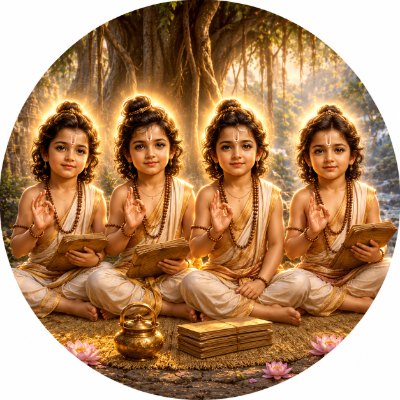
The Four Kumaras — Eternal Child-Sages, First Mind-Born Sons of Brahma
Chatursana · Catuhsana · Sanakadika Rishis · Kumaras · Brahmaputras · Manasaputras · Nivritti-dharma-preceptors
The Four Kumaras — Sanaka, Sanandana, Sanatana, and Sanatkumara — are the first mind-born sons of Brahma and the first creations of the present cosmic cycle. They are described across the Puranas as eternally appearing as five-year-old children — radiantly pure, luminous, clad in nothing but the sacred thread — who roam freely through both the material and spiritual universes without attachment or desire, solely for the purpose of teaching. They undertook lifelong vows of celibacy against Brahma's explicit wish that they assist in populating the universe — a refusal that caused Brahma's wrath to manifest as Rudra. All four studied the Vedas from their earliest existence and always travelled together. The Bhagavata Purana lists them among the twelve Mahajanas — the great devotees — alongside figures such as Narada, Bhishma, Prahlada, and Vyasa. They are the founders of the Kumara Sampradaya (also called Sanakadi Sampradaya or Nimbarka Sampradaya) — one of the four authorised Vaishnava traditions. In the Mahabharata's Shanti Parva, a broader list of seven such sages is given — adding Aniruddha, Sana, Sanatsujata, and Kapila to the four canonical Kumaras.
✦ The Names — Four Aspects of Eternal Sacred Youth
All four names share the root Sana — ancient, eternal, primordial — giving the group its collective name Chatursana (the four Sanas). Sanaka means ancient or he who is from time immemorial. Sanandana means ever-joyful or the eternally blissful one. Sanatana means eternal or the everlasting one. Sanatkumara — the most widely individually celebrated of the four — means eternal youth or the ancient one who is always young. The word kumara itself means boy or unmarried youth — reflecting their eternal appearance as children and their lifelong vow of brahmacharya. Together the four names declare a quartet of qualities: antiquity, bliss, eternity, and perpetual youth — the four dimensions of a liberated existence beyond the reach of time and desire.
✦ Lineage and Nature
- Father: Brahma — from whose mind they were directly born as the very first act of the present creation
- Origin: In one account, Brahma underwent penance for a thousand divine years before realising through Krishna's grace how to create; the first beings to emerge were the four Kumaras. In another, Vishnu rewarded Brahma's tapas by manifesting as the four child-sages
- Physical form: Eternally appearing as five-year-old children — luminous, clad only in the sacred thread, carrying kamandalu water pots
- Vow: Lifelong celibacy (brahmacharya) — undertaken against Brahma's explicit wish that they procreate
- Spiritual status: Eternally liberated souls (nitya-muktas) from birth; among the twelve Mahajanas per the Bhagavata Purana
- Disciples: Narada — to whom they transmitted the Puranic knowledge received from Brahma (who had received it from Vishnu); Narada then transmitted it to Vyasa
- Fellow Manasaputras (broader list): Marichi, Atri, Angiras, Pulastya, Pulaha, Kratu, Vasishtha, Bhrigu, Narada, Daksha
- Sampradaya founded: Kumara Sampradaya (Sanakadi Sampradaya, Nimbarka Sampradaya) — one of the four authorised Vaishnava traditions
✦ The Refusal to Create — And Brahma's Wrath
When Brahma created the four Kumaras, he instructed them to assist in the propagation of creation. They respectfully but firmly refused — asserting their prior and innate realisation of Brahman as the supreme goal, and declaring that material generation was incompatible with that realisation. They requested instead the boon of remaining perpetually five years old. Their refusal was not disobedience for its own sake — the tradition records that it was for a higher purpose, and they were therefore free from the karmic consequence of disobedience. The Bhagavata Purana records that Brahma's wrath and mortification at their refusal manifested as Rudra (Shiva) — who emerged from between Brahma's eyebrows, weeping, and asked Brahma for a name and a dwelling place. This episode makes the Kumaras' refusal one of the cosmic events that produced Shiva in his Rudra aspect.
✦ The Curse of Jaya and Vijaya — Origin of the Ramayana and Mahabharata Antagonists
One of the most celebrated episodes involving the Kumaras is their visit to Vaikuntha — the abode of Vishnu. Travelling through the seven concentric walls of Vishnu's celestial city, they arrived at the seventh and innermost gate, where the divine gatekeepers Jaya and Vijaya barred their entry. The gatekeepers, seeing only naked children, refused to let them pass — telling them that Vishnu was resting and could not be disturbed. The Kumaras, angered by this obstruction — not from ego but from the insult to the principle of universal access to the divine — cursed Jaya and Vijaya to fall from their divine status and be born three times in the material world as mortals. Vishnu, awakened by the commotion, came to the gate himself and apologised to the Kumaras. He offered Jaya and Vijaya a choice: seven births as his devotees or three births as his enemies. They chose three births as enemies — wishing to return to Vaikuntha sooner. Their three pairs of births were Hiranyaksha and Hiranyakashipu (slain by Varaha and Narasimha avatars of Vishnu), Ravana and Kumbhakarna (slain by Rama), and Shishupala and Dantavaktra (slain by Krishna). The Kumaras' curse thus set in motion the entire chain of events underlying both the Ramayana and the Mahabharata.
✦ As Devotees of Vishnu — The Transformation at Vaikuntha
The Bhagavata Purana records a pivotal moment in the Kumaras' spiritual journey within Vaikuntha itself. Though they were already eternally liberated and deeply knowledgeable, upon entering Vishnu's abode they perceived an unexpected scent of Tulasi leaves mixed with sandalwood from the body of the Lord. This fragrance triggered in them — for the first time — an overwhelming wave of devotional love. Their long practice of jnana — the path of pure knowledge and non-dual awareness — was suddenly suffused with bhakti — the direct loving devotion that even the highest knowledge cannot replicate. They fell into an ecstasy of devotion they had never previously experienced. This episode — the wise ones who knew everything suddenly discovering that they had not yet experienced the deepest form of love for the divine — is one of the Bhagavata Purana's most celebrated passages on the relationship between knowledge and devotion. Krishna himself, speaking to Uddhava in the eleventh Canto of the Bhagavata Purana, declares: I taught this yoga to my disciples, the four brothers headed by Sanaka.
✦ As Devotees of Shiva — The Teaching of Dakshinamurthy
In the Shaiva tradition, the Kumaras are depicted as profound devotees of Shiva. Seeking ultimate self-realisation, they approached Shiva, who assumed the form of Dakshinamurthy — a youthful, serene teacher seated under a banyan tree on Mount Meru, facing south. In this manifestation, Shiva imparted profound non-dual knowledge silently — using only the chinmudra gesture, in which the index finger and thumb are joined in a circle representing the union of the individual and the universal self. No words were spoken. The Kumaras received the highest teaching in silence and became enlightened. This narrative makes the Kumaras the first recipients of Dakshinamurthy's silent teaching — the bedrock of Shaiva Siddhanta and of Adi Shankara's Advaita Vedanta tradition.
✦ Individual Profiles
Sanaka — the eldest of the four, whose name means ancient. He is specifically associated with the first pada (section) of the Naradiya Purana — the first of the four sections each Kumar taught to Narada. The teachings of Sanaka and his brothers contained in the Naradiya Purana form one of the principal bodies of Puranic wisdom attributed to the Kumara lineage.
Sanandana — whose name means ever-joyful. He is the second of the four. In the Yoga Sutras tradition, he is the disciple of Hiranyagarbha — the golden embryo form of Brahma — in the transmission of yoga knowledge. He taught the second pada of the Naradiya Purana to Narada.
Sanatana — whose name means eternal. He is the third Kumar, associated with the transmission of the eternal and unchanging dimensions of dharmic knowledge. He taught the third pada of the Naradiya Purana to Narada. Some traditions replace Sanatana with Sanatsujata — who features prominently in the Udyoga Parva of the Mahabharata as the sage who taught Dhritarashtra the nature of death, Brahman, and liberation in the night before the war.
Sanatkumara — the most individually celebrated of the four. His name means eternal youth. He is the author of the Sanatkumara Samhita — part of the Shiva Purana, comprising 59 chapters. He taught Bhishma the mental and spiritual sciences as Bhishma lay on his arrow bed in the Shanti Parva. The Chandogya Upanishad (Chapter 7) records his celebrated teaching on Bhuma-Vidya — the knowledge of the infinite — imparted to the celestial sage Narada. He is linked to the Tirtha of Kanakhala near Haridwar. He taught the fourth pada of the Naradiya Purana to Narada. In the Shanti Parva of the Mahabharata he describes the greatness of Vishnu to the demon king Vritra and his guru Shukra — the discourse in which he categorises all living beings into six types by their combinations of the three gunas.
✦ Role in the Transmission of the Puranas
Brahma received the knowledge of the Puranas from Vishnu and imparted it to the four Kumaras. The Kumaras then taught the Puranas to Narada, who transmitted the knowledge to Vyasa, who composed the eighteen Maha Puranas. The Kumaras are therefore one of the primary links in the chain of transmission through which the entire Puranic corpus reached humanity. The first section of the Naradiya Purana — the Purvabhaga — is divided into four padas, each taught by one of the four Kumaras respectively to Narada.
✦ The Kumara Sampradaya
Vaishnavism recognises four authorised sampradayas (traditions) for the current Kali Yuga: the Sri Sampradaya (founded by Lakshmi, systematised by Ramanujacharya), the Brahma Sampradaya (founded by Brahma, systematised by Madhvacharya), the Rudra Sampradaya (founded by Shiva, systematised by Vishnuswami), and the Kumara Sampradaya (founded by the four Kumaras, systematised by Nimbarkacharya). The Kumara Sampradaya's philosophy is Dvaitadvaita — duality in unity. The swan avatar of Vishnu (Hamsa) first taught the philosophy to the four Kumaras, who taught it to Narada, who finally taught it to Nimbarka — the main human exponent of the tradition. The sampradaya is also called the Hamsa Sampradaya, Sanakadi Sampradaya, and Catuḥsana Sampradaya.
✦ In the Linga Purana — Kumaras Across Kalpas
The Linga Purana records that Shiva — or his aspect Vamadeva — is born as a Kumara and then multiplies into four Kumaras in each kalpa as the sons of Brahma of that kalpa. In the 29th kalpa they are named Sananda, Nandana, Vishvananda, and Upanandana of white colour; in the 30th kalpa they are Virajas, Vivahu, Visoka, and Vishvabhavana of red colour; in the 31st kalpa they are of yellow colour; and in the 32nd kalpa of black colour. This account establishes the Kumaras not as a singular set of individuals but as a recurring cosmic principle — four aspects of divine wisdom that manifest anew in each cycle of creation.
✦ References
- Mahabharata (Vyasa) — Shanti Parva (Section CCCXLI): lists seven sons of Brahma including Aniruddha, Sana, Sanatsujata, Sanaka, Sanandana, Sanatkumara, Kapila, and Sanatana; describes them as wedded to the religion of Nivritti; Shanti Parva: Sanatkumara's discourse to Vritra and Shukra on the greatness of Vishnu and the six categories of beings by guna; Shanti Parva: Sanatkumara teaching Bhishma on the arrow bed; Udyoga Parva: Sanatsujata's teaching to Dhritarashtra
- Chandogya Upanishad — Chapter 7: Sanatkumara's teaching on Bhuma-Vidya (the knowledge of the infinite) to Narada
- Bhagavata Purana — Skandha 3: birth of the four Kumaras; Brahma's wrath at their refusal producing Rudra; the visit to Vaikuntha; the curse of Jaya and Vijaya; the fragrance of Tulasi transforming the Kumaras' jnana into bhakti; Skandha 4: visit to King Prithu; Skandha 6 (3.20–21): the twelve Mahajanas including the Kumaras; Skandha 11: Krishna to Uddhava declaring he taught yoga to the four Kumaras
- Vishnu Purana — the four Kumaras as Brahma's first mind-born sons; their declaration of Narayana as ultimate refuge
- Chandogya Upanishad — Sanatkumara's teachings; Sanandana as disciple of Hiranyagarbha in yoga transmission
- Sanatkumara Samhita — part of the Shiva Purana, 59 chapters; attributed to Sanatkumara
- Naradiya Purana — four padas taught respectively by the four Kumaras to Narada
- Linga Purana — the Kumaras across successive kalpas under different names
- Wikipedia — Four Kumaras; Dharmawiki — Sanat Kumaras; Grokipedia — Four Kumaras; Kerala Mural Painting — Sanakadika Rishis: modern summaries drawing from the above primary sources