
About
Chitragupta — Divine Scribe of Yama, Seventeenth Mind-Born Son of Brahma
Chitragupta · Kayastha · Dharmaraj-sahayaka · Karma-lekhaka · Vedakshara-data · Agrasandhani-pati
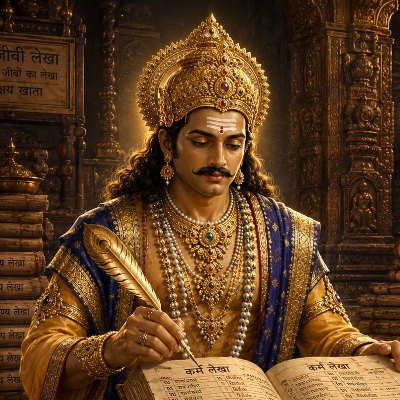
Chitragupta is the Hindu deity responsible for maintaining the complete record of every action performed by every living being across all their incarnations. He serves as the divine registrar in Yamaloka — the realm of Yama, the god of death — and upon the death of any soul, reads aloud from his record, called the Agrasandhani, so that Yama may deliver a just judgment on whether the soul proceeds to Svarga or Naraka. He is described as the seventeenth Manasaputra of Brahma — uniquely distinguished from all previous creations by being born not from any individual part of Brahma's body but from Brahma's entire body, mind, and soul together. He appeared before Brahma bearing a pen and an inkpot — the first recorded figure in the Hindu tradition created with writing as his innate nature and cosmic function. The Garuda Purana hails him as the giver of letters. The Mahabharata records his teachings in the Anushasana Parva. He is the progenitor of the twelve sub-divisions of the Chitraguptavanshi Kayastha community.
✦ The Name
The name Chitragupta is formed from chitra — picture, mind, hidden, variegated — and gupta — secret, hidden, concealed. Together: he who is hidden in the mind or rich in secrets. Brahma's own declaration of the name at the moment of Chitragupta's emergence captures the etymology precisely: as you existed in my body unseen, your name shall be Chitragupta. His other name, Kayastha, derives from kaya — body — and stha — dwelling in or sprung from: he who is sprung from the body. Brahma declared both names simultaneously: one for the community of his descendants, one for the deity himself. The Garuda Purana calls him the giver of letters — vedakshara-datre — linking him to the origin of writing and the Sanskrit script itself. The Rigveda (Book 8, Hymn 21, Stanza 18) refers to him as Chitra the king while all others are little kings — a verse interpreted across the tradition as the earliest Vedic reference to Chitragupta.
✦ Origin — Brahma's Meditation and the Emergence
The Yama Samhita — an extract from the ninth chapter of the Ahilya Kamdhenu, a work of Hindu law — records the canonical account of Chitragupta's birth. Yama came to Brahma and complained: how can I alone keep record of the deeds of beings born into 84 lakh life-forms across the three worlds? Brahma entered deep meditation to resolve the problem. He remained in meditation for eleven thousand years. When he opened his eyes, a man stood before him holding a pen and an inkpot in his hands and a sword girdled to his waist. Brahma declared: Because you are sprung from my body (kaya), you shall be called Kayastha. As you existed in my body unseen, your name shall be Chitragupta. Let your residence be always in the realm of Dharmaraja for the purpose of determining the merits and demerits of men. Brahma then directed him to dispense justice and punish those who violated dharma. The sword and the pen together established his dual nature: the learned recorder and the enforcer of cosmic law simultaneously.
The Padma Purana (Uttara Khanda) affirms that Chitragupta was placed near Yama to register the good and evil actions of all sentient beings, that he was possessed of supernatural wisdom, and became a partaker of sacrifices offered to the gods and fire — which is why the twice-born always give him oblations from their food.
✦ Distinction Among Brahma's Sons
The tradition consistently emphasises Chitragupta's unique mode of birth. Brahma's other sixteen Manasaputras — Marichi, Atri, Angiras, Pulastya, Pulaha, Kratu, Vasishtha, Daksha, Bhrigu, Narada, and the rest — were each born from individual parts of Brahma's body. Chitragupta alone was born from Brahma's entire body — his kaya, mind, and soul combined. This is given in the tradition as the reason for his dual caste status: born of the whole body rather than any single part, he holds the rights of both a Brahmin (to study and recite the Vedas, to receive oblations from sacrificial fire) and a Kshatriya (to bear arms and administer justice). The Bhavishya Purana and the Vignana Tantra both confirm this dual caste designation. The Apastamba Shakha of the Veda, as quoted in the Shabda-Kalpadrum, states that Kayasthas — Chitragupta's descendants — are Kshatriyas.
✦ Role and Function
Chitragupta maintains the Agrasandhani — the cosmic register in which the complete record of every action of every soul across every lifetime is inscribed. No deed — however small, however concealed, however forgotten by the doer — escapes his record. The Garuda Purana records him seated on an imperial throne in Yamaloka, holding court and dispensing justice alongside Yama: Dharmaraja, Chitragupta, Shravana, and others see all sins and virtues which remain concealed in the bodies of men. When a soul arrives in Yamaloka after death, Chitragupta reads from the Agrasandhani. Yama delivers the verdict — Svarga or Naraka — but the record Chitragupta provides is the basis of the judgment. He is the evidence; Yama is the judge. He is depicted in iconography holding a flowing notebook, a quill pen, and an inkpot — the original divine scribe.
✦ Lineage — Wives and Twelve Sons
- Father: Brahma — born from his entire body after eleven thousand years of meditation
- First wife: Iravati (also called Irawati or Shobhavati) — daughter of Dharma Sharma (also identified as Yama himself in some versions); Chitragupta had eight sons by her
- Second wife: Sudakshina (also called Nandini or Shobhini) — daughter of Manu, son of Surya the sun god; Chitragupta had four sons by her
- Total sons: Twelve — all invested with the sacred thread; all married to Nagakanyas (daughters of Nagaraja Vasuki) per the Padma Purana
✦ The Twelve Sons — Progenitors of the Kayastha Sub-Divisions
The twelve sons of Chitragupta became the progenitors of the twelve sub-divisions of the Chitraguptavanshi Kayastha community. Their names and associated communities are: Kulshrestha (eldest, settled in old Panchal state), Mathur, Gaur, Nigam, Asthana (settled in Brahmavart, whose capital was Sthaneshwar), Suryadwaja, Valmiki Bhatnagar, Srivastava, Ambastha (from the ancient Ambast kingdom between the Chenab and Ravi rivers), Saxena (whose ancestor Matimaan served as minister in Gandhar kingdom), Karana, and Mathur. The Padma Purana records that all twelve were invested with the sacred thread and married to Nagakanyas — the daughters of Vasuki, king of serpents.
✦ In the Mahabharata
The Mahabharata's Anushasana Parva (Chapter 130) records the teachings of Chitragupta — requiring men to perform virtuous and charitable acts and to conduct yajna, declaring that men are rewarded or punished strictly according to their good and bad deeds. This is one of the clearest statements in the epic tradition of the doctrine of karma as administered by a divine record-keeper rather than by an arbitrary divine will. Chitragupta appears not as a passive register but as a teacher who actively instructs humanity in the moral consequences of action. The Global Kayasth Family source records that Chitragupta's son Chaitrarath — light of the family, meritorious and of illustrious deeds — ruled on earth for a long time as King of Chitrakoot near Allahabad.
✦ Worship and Festival
Chitragupta Puja is celebrated primarily by the Kayastha community on the second day after Diwali — the day after Yama Dwitiya. Devotees worship their writing instruments, books, and account ledgers alongside Chitragupta's image — acknowledging the sacred dimension of their inherited profession of record-keeping and administration. The Chitragupta Temple in Kanchipuram, Tamil Nadu, is one of the most prominent temples dedicated to him. The site of Shri Chitragupta Prakatya Tirth in Ujjain — at the rear of Sandipani Ashram — is considered the sacred location where Chitragupta first manifested from Brahma's body and is glorified in both the Padma Purana and the Skanda Purana. A second Brahma temple uniquely situated on the first floor exists at this site — described as an exceptionally rare phenomenon in the entire Hindu world.
✦ References
- Rigveda — Book 8, Hymn 21, Stanza 18: interpreted as the earliest Vedic reference to Chitragupta as the greatest king
- Mahabharata (Vyasa) — Anushasana Parva, Chapter 130: Chitragupta's teaching on virtuous action, yajna, and the doctrine of karma
- Yama Samhita (extract from Ahilya Kamdhenu, Chapter 9): the canonical account of Yama's complaint to Brahma; Brahma's meditation; Chitragupta's emergence bearing pen and inkpot; the naming as Kayastha and Chitragupta; the marriage to Iravati
- Garuda Purana: description of Chitragupta's imperial throne in Yamaloka; his role dispensing justice alongside Yama; hailed as vedakshara-datre — giver of letters
- Padma Purana (Uttara Khanda and Srishti Khanda): Chitragupta placed near Yama to register all deeds; possessor of supernatural wisdom; partaker of sacrificial oblations; twelve sons by two wives married to Nagakanyas; progenitor of the twelve Kayastha sub-divisions
- Bhavishya Purana: Brahma's declaration of Chitragupta's name, duties, and dual caste status
- Vignana Tantra: confirms descendants of Chitragupta are Kshatriyas
- Brihat Brahma Khanda: Brahma's enjoinment to Chitragupta to perform all sanskars and take writing as his profession
- Vishnu Smriti (Chapter 7, Verse 3): a document attested by the king is one written by a Kayastha and stamped with the head of department's fingerprints
- Wikipedia — Chitragupta; Wikipedia — Chitraguptavanshi Kayastha; Mantra and Shlokas — Chitragupta (Kayasthas); Global Kayasth Family — Kayastha in Vedas and Puranas: modern summaries drawing from the above primary sources