
About
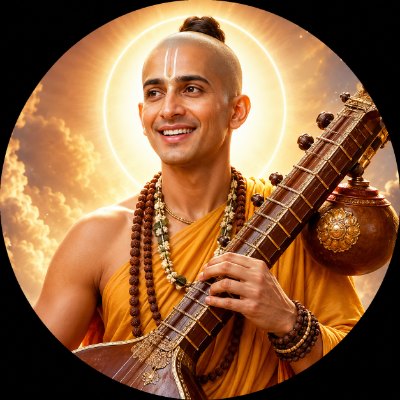
Narada — Devarishi, Cosmic Messenger, Eternal Devotee of Vishnu
Narada · Devarishi · Brahmarshi · Triloka-sanchari · Rishiraj · Kalaha-bhoja · Mahathi-vadaka · Manasaputra · Vedanara-da
Narada is the most widely appearing sage across all of Hindu sacred literature — the one figure who is present in the Rigveda, the Mahabharata, the Ramayana, and across all eighteen Maha Puranas. He is a Manasaputra of Brahma, a Devarishi (divine sage), and an eternal devotee of Vishnu — carrying the name Narayana, Narayana on his lips as he travels freely between Svarga, Bhumi, and Patala without restriction, the only being in creation granted this unlimited freedom of movement. He is depicted carrying the Mahati — his veena — and is the supreme master of that instrument. The Bhagavad Gita (10.26) records Krishna's declaration: Devarshinam cha Naradah — among divine sages, I am Narada. He is considered the first journalist of the universe — the primary source of information among the gods — and the first cosmic messenger. The Ramayana begins with his name; the Srimad Bhagavatam was composed at his instruction; and the seed of the Mahabharata was sown through his counsel to Yudhishthira. He is the guru of Prahlada, Dhruva, and Valmiki.
✦ The Name
The classical etymology of the name Narada is given in the tradition as: naram jnanam dadati iti Naradah — he who gives the water of wisdom, or the bestower of knowledge to humanity. A second derivation parses the name as nara — water or human knowledge — and da — giver. A third folk etymological account records that when Narada was born in one of his earthly incarnations, the parched land experienced miraculous rainfall at his birth — causing his Brahmin master to name him he who gives water. He is called Rishiraj — king of all sages — and Triloka-sanchari — the one who traverses the three worlds. He is also called Kalaha-bhoja — he who lives on conflict — a playful reference to his famous role as a catalyst of events, though the tradition is careful to establish that his stirring of situations always served a higher dharmic purpose.
✦ Origin and Multiple Births
The tradition records multiple accounts of Narada's origin, reflecting the understanding that he is a recurring cosmic principle who manifests in every creation cycle. The Srimad Bhagavatam (Canto 1) records the most elaborated account of his spiritual biography across lives. The Brahmavaivarta Purana states that he appeared from the throat of Brahma. The Bhagavata Purana states he first manifested from Brahma's lap — making him a Manasaputra born of Brahma's creative will.
When Brahma instructed Narada to assist in the propagation of creation, Narada — like the four Kumaras before him — refused, declaring his desire to follow the path of Vishnu's bhakti. Enraged, Brahma cursed him to be born in a lower form. As a consequence of the curse, Narada's soul passed through the form of a Gandharva named Upabarhana — an exceptionally handsome being who was enchanted by the daughters of the Gandharva Chitraratha and fell from his path. In that life he was cursed again and born on earth as the son of a maidservant — a simple, low-born child who served a group of saintly Brahmin ascetics visiting his village for the four-month Chaturmasya. The sages, pleased with the child's devotion and his mother's service, allowed him to eat their prasad. He received their blessings, heard them discourse on Vishnu, and gradually attained deep devotion. When his mother died of a snakebite while milking a cow, he roamed alone into the forest and, through intense meditation on Vishnu, attained a vision of the Lord — who promised that though he would not be visible again in that lifetime, Narada would remember him in all future lives and be reborn as his own Manasaputra. After that earthly life ended, his soul merged with Brahma at the dissolution of the Kalpa and re-emerged at the new creation as Brahma's mind-born son — the fully realised Devarishi.
✦ Lineage and Relationships
- Father: Brahma — born from his lap (Bhagavata Purana) or from his throat (Brahmavaivarta Purana)
- Brothers (fellow Manasaputras): Marichi, Atri, Angiras, Pulastya, Pulaha, Kratu, Vasishtha, Bhrigu, Daksha, and the four Kumaras
- Vishnu as avatara: The Srimad Bhagavatam records Narada as an avatara of Vishnu — the Lord incarnated as Narada to transmit the Satvata Tantra (Narada Pancharatra)
- Disciples: Prahlada (instructed even while in Hiranyakashipu's womb), Dhruva, Valmiki (to whom he narrated the Mula Ramayana), and Vyasa (to whom he instructed the Srimad Bhagavatam)
- Guru: Brahma — from whom Narada received the Vedantic knowledge he later transmitted; also instructed directly by Vishnu
- Narada Pancharatra: A body of Vaishnava doctrine attributed to him as its original teacher
- Narada Bhakti Sutra: A text on the philosophy and practice of bhakti composed by him
- Narada Smriti: A pre-6th-century juridical text attributed to him — the only Dharmashastra text dealing solely with judicial matters
✦ Attributes and Powers
The Mahabharata's Sabha Parva describes Narada's arrival at the Pandavas' court with the following attributes: conversant with the Vedas and Upanishads, acquainted with histories and Puranas, well-versed in all that occurred in ancient Kalpas, conversant with Nyaya (logic) and moral science, a perfect master in reconciling contradictory texts, eloquent, resolute, intelligent, possessed of powerful memory, and a complete master of the six Angas — pronunciation, grammar, prosody, explanation of terms, description of religious rites, and astronomy. He is described as gifted with the boon of knowledge of past, present, and future. He was cursed — as a consequence of once knowing too much and thereby obstructing divine plans — that although he would always tell the truth and warn people, they would never believe him. He is the supreme master of the Mahati veena. He carries a khartal and tambura in some depictions. He chants Narayana Narayana without cessation.
✦ As Architect of Sacred Literature
Narada's role in the origin of the two greatest Hindu epics and the supreme Purana is unique in the tradition. The very first proper noun in the Valmiki Ramayana is Narada's name — the epic begins with Valmiki asking Narada who in the world is the most virtuous man, and Narada's narration of the Mula Ramayana (the condensed story of Rama) in one hundred shlokas becomes the seed from which Valmiki composes the full epic. The first sarga of the Ramayana — called the Bala Ramayana — contains this condensed narration. It is also recorded that in one version of Valmiki's transformation from the robber Ratnakara into a sage, it was Narada who taught him the mantra.
After Vyasa had composed the Vedas, the Puranas, and the Mahabharata, he sat dejected on the banks of the Saraswati — feeling an inexplicable dissatisfaction. Narada came to him, understood the problem at once, and told him: you have described dharma and artha at length, but you have not adequately described the glory of Vishnu and the path of devotion. He instructed Vyasa to compose a text whose sole subject was bhakti — and communicated to him the essence of Vedanta as its foundation. Vyasa then composed the Srimad Bhagavatam. The Bhagavata Purana (Canto 1, Chapter 5) records this dialogue between Narada and Vyasa as the direct occasion of the Bhagavatam's composition. The chain of transmission for the entire Puranic corpus — Vishnu → Brahma → four Kumaras → Narada → Vyasa — places Narada as the critical penultimate link through whom the sacred knowledge passed to its human composer.
✦ As Catalyst of Cosmic Events — The Leela
Narada is celebrated across the tradition for his role as a catalyst — arriving at precisely the moment when a divine plan requires a spark to begin unfolding. The tradition is explicit that his interventions always serve dharma and are never motivated by malice, ego, or caprice — earning him the epithet Kalaha-bhoja (he who lives on conflict) as a gentle irony rather than a reproach. Among the most celebrated of these interventions: he revealed to Kamsa the prophecy that a child of Devaki would cause his death — not to cause cruelty but to bring out Kamsa's nature and set in motion the conditions necessary for Krishna's birth and Kamsa's destruction. He guided the five-year-old Dhruva — rejected by his father Uttanapada and his stepmother Suruchi — to perform penance on Vishnu, resulting in Dhruva's transformation into the pole star. He guided Prahlada in his mother's womb, teaching him Vishnu's glories before his birth. He advised Yudhishthira to perform the Rajasuya Yajna — which set in motion the chain of events leading to Kurukshetra. He is described as being present at Draupadi's swayamvara to ensure the right events unfolded. He revealed the Satyanarayan Katha — the story of simple devotion through the Vishnu puja — to ordinary people as the easiest path in the Kali Yuga, which is recorded in the Skanda Purana.
✦ The Maya Episode — Vishnu's Lesson in Humility
The Shiva Purana records an important episode in which Narada, having successfully resisted Kamadeva's arrows during his penance in the Himalayas — protected by Shiva's maya without knowing it — grew proud of what he believed was his own achievement. He boasted of his victory over desire before Vishnu despite Shiva and Brahma having warned him not to. Vishnu, wishing to remove this pride, created through his maya a magnificent city ruled by a king named Shilanidhi, whose daughter Shrimati was to hold a swayamvara. Narada was enchanted by Shrimati's beauty and went to Vishnu asking for Vishnu's own form so she would choose him. Vishnu gave him the face of a monkey instead. Shrimati, seeing through divine sight, chose Vishnu himself at the swayamvara. Narada, seeing his monkey-face in a stream, was furious and cursed Vishnu — declaring that since Vishnu had humiliated him for the sake of a woman, Vishnu would take human form and suffer separation from a woman, and monkeys would be his helpers. Vishnu accepted the curse with grace — since it would fulfil the Ramayana. When the maya was lifted, Narada understood, begged forgiveness, and Vishnu assured him it was all for a higher purpose and instructed him to worship Shiva at Kashi.
✦ The Maya of Vishnu — Transformation into a Woman
The Devi Bhagavata Purana records a separate episode in which Narada enquired of Vishnu about the nature and power of maya. Vishnu guided him to a lake, in which Narada bathed and was transformed into a woman. In that form he married a king named Taladhvaja and bore him many sons. After some time, Vishnu dispelled the illusion and restored Narada to his male form. Narada came to understand maya more deeply, but concluded that it remained ultimately mysterious and beyond intellectual grasp. This episode is among the tradition's most celebrated illustrations of the inscrutability of divine illusion — told through the experience of one of the wisest beings in creation.
✦ In Buddhism and Jainism
In the Jataka tales of Theravada Buddhism, Narada appears as an earlier birth of Sariputta — one of the two principal disciples of the Buddha. The name Narada also appears among medieval Buddhist scholars. In Jainism, nine Naradas exist in every cycle of Jain cosmology — named Bhima, Mahabhima, Rudra, Maharudra, Kala, Mahakala, Durmukha, Narakamukha, and Adhomukha — a structural parallel to the Hindu tradition of Narada recurring across successive creation cycles.
✦ Texts Attributed to Narada
- Narada Bhakti Sutra — foundational text on the philosophy, practice, and fruits of devotional love
- Narada Pancharatra (Satvata Tantra) — Vaishnava doctrine transmitted by him as an avatara of Vishnu; the liberation from karma through karma itself
- Narada Purana — one of the eighteen Maha Puranas, its first section structured as four padas taught respectively by the four Kumaras to Narada
- Narada Smriti — pre-6th-century juridical text; described as the most complete Dharmashastra text dealing solely with judicial matters
✦ References
- Rigveda — earliest references to Narada as a sage in the Vedic tradition
- Valmiki Ramayana — opening sarga: Narada's narration of the Mula Ramayana to Valmiki; the hundred-shloka condensed Ramayana forming the first sarga
- Mahabharata (Vyasa) — Sabha Parva (2.5–12): Narada's arrival at the Pandava court with his full attributes described; his description of the assembly halls of the gods and Yama; Udyoga Parva: Narada's counsel; Shanti Parva: Narada's appearances in Bhishma's discourses; Anushasana Parva: Narada's various teachings
- Bhagavad Gita (10.26): Krishna's declaration — Devarshinam cha Naradah — among divine sages, I am Narada
- Srimad Bhagavatam — Canto 1, Chapters 5–6: Narada's dialogue with Vyasa instructing him to compose the Bhagavatam; Narada's narration of his own spiritual biography across lifetimes; Canto 7: Narada's teaching of Prahlada in the womb; Canto 4: Narada's guidance of Dhruva
- Vishnu Purana — Narada as avatara of Vishnu; his role in the transmission of Satvata Tantra
- Shiva Purana — the maya episode: Narada's pride at overcoming Kama; Vishnu's creation of the maya city; Narada's curse of Vishnu; Vishnu's acceptance
- Devi Bhagavata Purana — Narada's transformation into a woman through Vishnu's maya; his enquiry into the nature of maya
- Brahmavaivarta Purana — Narada born from Brahma's throat; Brahma's curse causing Narada's birth as Upabarhana
- Skanda Purana — Narada requesting Vishnu for a simple path for Kali Yuga devotees; origin of the Satyanarayan Katha
- Narada Bhakti Sutra; Narada Pancharatra; Narada Purana; Narada Smriti — texts attributed to Narada
- Wikipedia — Narada; Dharmapedia — Narada; Drikpanchang — Devarishi Narada; AriseBharat — Narada Muni: modern summaries drawing from the above primary sources