
About
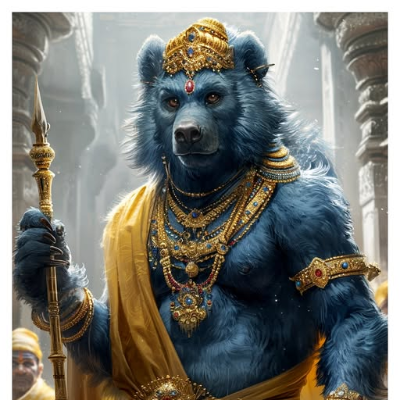
Jambavan — King of the Bears, Chiranjeevi, Witness of Three Avatars
Jambavan · Jambavanta · Jamvanta · Riksharaj · Rikshapati · Kapishreshtha · Chiranjivi
Jambavan is one of the most ancient and venerable figures in all of Hindu sacred literature — a Chiranjeevi (immortal) born at the very beginning of creation from Brahma's mouth, who lived through multiple cosmic eras and was present for the avatars of Vishnu as Vamana, Rama, and Krishna. He is the Riksharaj — king of the bears — and one of the supreme commanders of the Vanara army in the Ramayana. He is the father-in-law of Krishna through his daughter Jambavati — one of Krishna's eight principal queens. The Bhagavad Gita (10.26) tradition places him among the great immortals. He is one of only three beings — alongside Parashurama and Hanuman — known to have been present for the lives of both Rama and Krishna. At the time of the Ramayana, he was described as six Manvantaras old — a span encompassing hundreds of millions of years. He is counted among the Chiranjeevis, destined to remain on earth through the entire Kali Yuga.
✦ The Name
The name Jambavan carries two proposed etymologies in the tradition. The first derives from the Sanskrit word Jrimbhan — yawn — yielding the meaning he who is born from a yawn, reflecting his origin from Brahma's yawn at the start of creation. The second derives from Jambudvipa — the continent of the rose-apple tree, the ancient Hindu name for the Indian subcontinent — yielding the meaning he who is from Jambudvipa, or he who belongs to the primal land. His title Riksharaj means king of the Rikshas — the bears; Rikshapati means lord of bears. He is also called Kapishreshtha in some Puranic passages — foremost among monkeys — reflecting the ambiguity in early texts between bears and monkeys in the Vanara tradition.
✦ Origin
The Valmiki Ramayana records that Brahma was seated in meditation upon the lotus rising from Vishnu's navel at the beginning of creation. As he meditated, he yawned — and from that yawn Jambavan emerged. The Brahmanda Purana affirms this account, stating he manifested from Brahma's mouth during this yawn. An alternate account in the Kamba Ramayana records that he arose from Brahma's sweat during the cosmic confrontation with the demons Madhu and Kaitabha. The Dharmawiki article drawing from the Puranic Encyclopaedia records a slightly different account: Brahma created Jambavan before Rama's incarnation, at the time the gods requested Vishnu to descend and destroy Ravana — Brahma directed the chiefs of Apsaras and Gandharvas to create an army of bears and monkeys, and created Jambavan himself as one of the first and greatest of this army. A regional tradition recorded in multiple secondary sources states that in a previous cosmic life Jambavan was the king of the Himalayas, who incarnated as a bear specifically to serve Rama — and that Rama granted him the boon of a long life and the strength of ten million lions.
✦ Lineage and Family
- Father: Brahma — born from his yawn at the beginning of creation
- Form: Part-bear, part-human; depicted with a bear's head and human body, covered with black hair, wearing a golden crown and Vaishnava tilaka on his forehead
- Daughter: Jambavati — one of the eight principal queens (Ashtabharya) of Krishna; married to Krishna after the Syamantaka jewel episode
- Son: Marjara — the Brahma Purana records that all cats (marjaras) trace their origin to this son of Jambavan
- Grandchildren (through Jambavati and Krishna): Sons — Bhadra, Bhadragupta, Bhadravinda, and Saptabahu; daughters — Sambhodani and Bhadravati (per the Vayu Purana)
- Son-in-law: Krishna — who also defeated Jambavan in single combat over twenty-eight days before the marriage
✦ At the Samudra Manthana — The Churning of the Cosmic Ocean
Jambavan was present at the Samudra Manthana — the churning of the cosmic ocean by the gods and demons to obtain the nectar of immortality. Having learned from the gods about the all-curing herb Vishalyakarni during the churning, he retained that knowledge — knowledge that would prove decisive thousands of years later in the Ramayana when Lakshmana lay wounded on the battlefield and Hanuman needed to identify the correct healing herb.
✦ At the Vamana Avatar — Circumambulation of Trivikrama
When Vishnu incarnated as Vamana and, in the form of Trivikrama, measured the three worlds in three strides at the sacrifice of King Mahabali, Jambavan was present. He circled Vishnu in the Trivikrama form as an act of supreme devotion — completing the circumambulation a number of times recorded variously as seven or twenty-one across different sources. One account records that during this circumambulation, Vamana's shoulder struck and injured Jambavan — or that he bumped into Vamana in the press of activity — resulting in an injury that reduced his physical strength permanently. He later tells the assembled Vanara army at the ocean's edge: In the far old days I had walked round that Eternal Being Vishnu when he measured three steps at the sacrifice of Mahabali. Now I am very old and have not enough strength to jump over the sea. This is directly quoted in the Valmiki Ramayana (Kishkindha Kanda, Sarga 65).
✦ In the Ramayana — Minister, Strategist, and Awakener of Hanuman
Jambavan served as one of the principal ministers and strategic advisors of Sugriva during the search for Sita. The Valmiki Ramayana (Kishkindha Kanda, Sarga 41) lists him alongside Nila, Hanuman, Suhotra, Angada, and others as commanders of Sugriva's army. When the assembled Vanara and Riksha forces arrived at the southern ocean and debated who among them could cross, Jambavan alone understood the full truth of the situation: that only Hanuman had the power to cross the ocean and return, because Vayu had granted him that boon — but Hanuman had forgotten it due to a curse from his childhood. Jambavan went to Hanuman, recalled for him the full story of his divine origin and power, and encouraged him to rise to his true stature. This awakening of Hanuman to his own capability is one of the most celebrated episodes in the Ramayana tradition — Jambavan as the elder who sees in others what they cannot yet see in themselves.
In the battle of Lanka, Jambavan served primarily as a strategist and physician rather than a direct combatant — in recognition of his great age and his reduced physical strength since the Vamana episode. He nevertheless demonstrated his full power when the occasion required it: he repelled Indrajit's trident back into Indrajit's own chest when Indrajit had used it to wound Rama and Lakshmana; he kicked Ravana in the chest with such force that Ravana fell unconscious and his charioteer was forced to flee with him; and he destroyed several of Ravana's generals by crushing them under uprooted trees. When the entire Vanara army — and Rama and Lakshmana themselves — fell unconscious from Indrajit's Brahmastra, it was Jambavan who first recovered and whose voice Hanuman sought out on the battlefield. Hanuman located him by sound in the darkness, and Jambavan told him the only cure: the four healing herbs of Mount Dronagiri, including the Vishalyakarni he had learned of at the Samudra Manthana.
✦ In the Mahabharata — The Syamantaka Jewel and Krishna
The Syamantaka jewel — a radiant gem bestowed by Surya upon the Yadava king Satrajit — was said to yield eight loads of gold daily and protect its pure possessor from all calamity. When Satrajit's brother Prasena wore it while hunting, a lion killed Prasena and seized the gem. Jambavan killed the lion, took the gem, and gave it to his young son to play with inside his mountain cave. When suspicion fell on Krishna — who was falsely accused of killing Prasena for the jewel — Krishna set out to trace the truth. He followed the trail to Jambavan's cave. Jambavan, not recognising Krishna and seeing an intruder demanding the gem, attacked him. Their battle lasted twenty-eight days and nights — or eighteen days in some tellings — of extraordinary ferocity, shaking the earth. Finally, exhausted, Jambavan realised through the divine power radiating from his opponent that this was none other than Rama himself — his beloved Lord of the Treta Yuga now returned in a new form. He surrendered completely, offered the Syamantaka jewel, and gave his daughter Jambavati in marriage to Krishna. Krishna offered the gem in turn to Akrura for the welfare of all. Rama had foretold to Jambavan that when Rama defeated him again in a future birth, Jambavan would recognise him — and this prophecy was fulfilled. Jambavan thus received the unique blessing of recognising and serving two successive avatars of Vishnu across two different yugas in a single lifetime.
✦ Bear or Monkey — The Textual Ambiguity
The primary Valmiki Ramayana describes Jambavan as Rikshapungava — the foremost of bears — and depicts him as a Riksha, a bear. However, some passages in later Puranas and regional retellings — including certain Sanskrit Puranic passages — describe him as a monkey or use the word Kapishreshtha (foremost among monkeys). The Dharmawiki notes that in some Indian language versions of the Ramayana he is described as a monkey existing since before Rama's incarnation. The bear identification is the more authoritative and widely accepted reading in both the Valmiki Ramayana and the mainstream Puranic tradition.
✦ Temples and Sacred Geography
The village of Jamthun in the Ratlam district of Madhya Pradesh is traditionally called Jamvanta Nagari — the city of Jambavan — and is considered his abode. The cave where Krishna and Jambavan's battle took place is located near Ranavav in the Porbandar district of Gujarat, where a cave temple draws pilgrims. A temple dedicated to Jambavan exists at Jamkhed in the Jalna district of Maharashtra. Jambavan is also depicted in carvings at the Sri Ramasamy Temple in Kumbakonam, Tamil Nadu. His worship is particularly associated with Diwali — for his Ramayana contributions — and Janmashtami — for his Mahabharata encounter with Krishna.
✦ References
- Valmiki Ramayana — Kishkindha Kanda, Sarga 41: Jambavan listed as minister of Sugriva; Kishkindha Kanda, Sarga 65: Jambavan's own statement of his presence at the Vamana avatar and his diminished current strength; Yuddha Kanda: Jambavan's role in the battle of Lanka — directing Hanuman to the healing herbs, fighting Ravana and Indrajit, serving as strategist and physician
- Brahmanda Purana — affirms Jambavan's birth from Brahma's mouth; records his immense antiquity and divine status
- Brahma Purana — records Jambavan's son Marjara as the progenitor of all cats
- Bhagavata Purana — the Syamantaka jewel episode (Samantopakhyana): Prasena's death, Jambavan's fight with Krishna over twenty-eight days, Jambavan's recognition of Krishna as Rama, the marriage of Jambavati to Krishna
- Vayu Purana (34.241): names of Jambavati and Krishna's six children — Bhadra, Bhadragupta, Bhadravinda, Saptabahu, Sambhodani, and Bhadravati
- Puranic Encyclopaedia (Vettam Mani): Brahma's creation of Jambavan before Rama's incarnation; Marjara as Jambavan's son; Jambavan as king of the Himalayas in a previous life
- Wikipedia — Jambavan; Dharmawiki — Jambavan; Grokipedia — Jambavan; Hinduism Facts — Jambavan; AstroVed — Story of Jambavan: modern summaries drawing from the above primary sources