
About
Varuna — Aditya of Cosmic Law, the Waters, and Divine Judgment
Varuna · Varuna Aditya · Pracetas · Amburaja · Jalapati · Yadahpati · Mitra-Varuna
Varuna is one of the twelve Adityas, the solar deities born to the sage Kashyapa and his wife Aditi, daughter of the patriarch Daksha. Among all the Adityas, Varuna is the most theologically elaborate and the most prominent in the Vedic corpus, where he stands as one of the supreme sovereign deities of the entire tradition — the upolder of Rita, the cosmic order and moral truth, the keeper of divine law, the punisher of sin, and the lord of the celestial and earthly waters. His importance in the Rigveda is rivalled among Vedic deities only by Indra, and his pairing with Mitra — another Aditya and the deity of covenant and friendship — forms the most significant divine dyad in Vedic religion. In the Puranic literature, including the Vishnu Purana, the Bhagavata Purana, the Matsya Purana, and the Padma Purana, Varuna is enumerated among the twelve Adityas, assigned a presiding solar month, and also given independent standing as the lord of the waters, the god of the western direction, and a king of the Nagas and aquatic beings. He appears extensively in the Mahabharata, the Ramayana, and numerous Puranic narratives, often as a giver of divine weapons, a sovereign of the submarine world, and a figure invoked in the context of oaths, covenants, and the consequences of moral transgression.
✦ The Name
The name Varuna has been derived by scholars from a Sanskrit root connected to the concept of covering, encompassing, or binding — from the root vri, meaning to cover or to enclose. Varuna is thus understood etymologically as the one who encompasses or envelops, a meaning consonant with his role as the all-seeing deity who encloses the cosmos within his sovereign gaze and whose noose — the pasha — binds those who transgress the moral order. This etymology connects Varuna to the Avestan Ahura Mazda of the ancient Iranian tradition, and the two figures share significant functional and perhaps etymological kinship, pointing to their common origin in the Proto-Indo-Iranian religious heritage.
The epithet Pracetas, meaning the wise or the deeply knowing, is applied to Varuna in the Vedic and Puranic literature and reflects his character as the omniscient deity who perceives all deeds, spoken and unspoken, of gods and mortals alike. The epithet Amburaja means king of the waters, Jalapati means lord of water, and Yadahpati means lord of aquatic creatures — all three reflecting the Puranic consolidation of Varuna's identity as the sovereign of rivers, seas, and all bodies of water. The compound Mitra-Varuna designates the divine pair formed by Varuna and his brother Aditya Mitra, the deity of covenant and friendship.
✦ Lineage
- Father: Kashyapa — one of the seven great primordial sages, progenitor of gods, demons, humans, Nagas, birds, and all orders of living beings; son of Marichi, who was himself one of the mind-born sons of Brahma the creator.
- Mother: Aditi — daughter of the patriarch Daksha; wife of Kashyapa; the boundless mother of the gods, from whom all twelve Adityas are born; one of the most frequently invoked divine mothers in the Rigveda.
- Brothers (the Adityas): Dhata, Mitra, Aryaman, Bhaga, Indra (Shakra), Vivasvat (Surya), Pushan, Parjanya, Amsha, Tvashtr, and Vishnu — the canonical Puranic enumeration gives twelve Adityas, though Vedic lists are smaller and vary across texts.
- Spouse: Varuna's wife is named as Gauri in some Puranic references, though she is not a prominent figure in the surviving narratives. In other contexts Varuna's consort is referred to as Varunani, a name that functions more as a feminine form of his own name than as an independent figure with developed characteristics.
- Sons through Mitra (joint paternity): The Vishnu Purana, Mahabharata, and Ramayana record that Varuna and his brother Mitra jointly fathered the sages Agastya and Vasishtha through an involuntary emission caused by the sight of the Apsara Urvashi. In some versions Vasishtha is attributed specifically to Mitra and Agastya to Varuna; in others both are jointly the sons of both gods. These two sages — Agastya, the great civilising sage of the south, and Vasishtha, one of the seven eternal sages and preceptor of the solar royal dynasty — are among the most significant figures in the entire tradition.
- Son Pushkara: Some Puranic texts name Pushkara as a son of Varuna, associated with the sacred tirtha of Pushkara in Rajasthan, though this attribution is not consistent across all sources.
- Son Bala: The Bhagavata Purana records a son named Bala born to Varuna, who is identified in some contexts with the lord of a particular cosmic realm.
✦ Varuna in the Rigveda
In the Rigveda, Varuna occupies a position of extraordinary theological depth and is in many respects the most morally sophisticated deity of the entire Vedic pantheon. He is the upholder of Rita — the cosmic truth, order, and law that governs both the movements of the heavenly bodies and the moral conduct of living beings. He sees all things: his spies, called spasha, move invisibly through the world and report every act of transgression to him. He holds in his hand the pasha, a divine noose or fetter with which he binds those who violate the cosmic order, causing them to fall into disease, misfortune, or spiritual bondage. Conversely, he is also the deity to whom the penitent turns in confession of sin — several hymns of the Rigveda are moving personal appeals by the poet-seer to Varuna, asking for release from the bondage of sin and for forgiveness, expressing a degree of moral interiority and personal relationship with a deity that is unusual in ancient religious literature.
Varuna is associated in the Rigveda with the night sky, the stars regarded as his thousand-eyed gaze upon the world, and the cosmic waters above the heavenly vault. His chariot moves through the sky; he measures the earth with the sun as his instrument. He set the sun in the heavens, established the pathways of the celestial bodies, and upholds the vault of the sky. His relationship with Mitra is one of complementarity: Mitra governs the day, the sun in its benevolent aspect, and the ties of friendship and covenant; Varuna governs the night, the more awe-inspiring face of sovereignty, and the enforcement of cosmic law through detection and punishment of transgression.
✦ Varuna as Lord of the Waters
In the Puranic literature, Varuna's identity undergoes a significant transformation from the supreme sovereign deity of the Vedic corpus to the lord of the waters and the god presiding over the western direction. This shift is well attested across the major Puranas and the epics. Varuna is consistently described in Puranic texts as the ruler of the oceans, rivers, lakes, and all bodies of water; as the king of the Nagas, the divine serpent beings; and as the sovereign of aquatic creatures of all kinds. His realm is the submarine world, his palace located beneath the ocean, and he is approached by heroes and gods who need passage through water or who seek divine weapons stored in his undersea treasury.
In the Mahabharata, Varuna appears in this capacity on numerous occasions. He gives the bow Gandiva and two inexhaustible quivers to Arjuna — one of the five Pandava brothers and the greatest archer of his age — through the intermediary of Agni, the fire god, in preparation for the burning of the Khandava forest. He is also approached by sages and kings who seek boons related to water, rain, and the fertility of the earth. His palace beneath the waters, described in the Mahabharata's Sabha Parva in the account of Arjuna's journey to the celestial realms, is depicted as a magnificent structure studded with gems, populated by Nagas, Apsaras, and divine beings, and rivalling the courts of Indra and Yama in splendour.
✦ The Birth of Agastya and Vasishtha
The episode of the birth of the sages Agastya and Vasishtha from Varuna and Mitra is among the most widely attested narratives involving Varuna in the post-Vedic literature. The account is given in the Vishnu Purana, the Mahabharata, and the Valmiki Ramayana, with variations in detail.
The narrative relates that Mitra and Varuna, while engaged in a sacrificial session or while travelling through the celestial regions, encountered the Apsara Urvashi, one of the most celebrated of the celestial nymphs, renowned for her unparalleled beauty. At the sight of Urvashi, both gods experienced an involuntary emission of semen. This emission fell into a vessel — described variously as a water pot, an earthen jar, or a kumbha — and from this vessel two great sages were miraculously born. Agastya emerged from one portion and Vasishtha from the other. In the versions that assign individual paternity, Agastya is attributed to Varuna and Vasishtha to Mitra, though other versions do not make this distinction and treat both sages as jointly the offspring of both gods.
Agastya, born from this episode, became one of the most significant sages in the tradition — he is credited with the subjugation of the Vindhya mountains, which had grown so tall as to obstruct the sun's path and were persuaded by Agastya to remain low; with the destruction of the demons Vatapi and Ilvala; with the civilising of the southern regions of the subcontinent; and with a foundational role in the Tamil literary tradition. Vasishtha became one of the seven eternal sages, the preceptor of the solar dynasty of kings, and the guru of the divine hero Rama in the Ramayana.
✦ Varuna and the Sage Vishvamitra
The Mahabharata contains an episode in which the sage Vishvamitra — a king who undertook extraordinary austerities to attain the status of a brahmarshi — approaches Varuna during a time of severe famine to beg for food for himself and his family. Varuna declines to give food from his stores but does not prevent Vishvamitra from taking what he can find in an outcast settlement, displaying the complex moral universe of the epics in which divine sovereignty and human necessity come into tension. This episode is not a major narrative but illustrates Varuna's continued role in the epics as a sovereign figure approached by sages and powerful beings for boons and assistance.
✦ Varuna as One of the Twelve Solar Adityas
In the Puranic framework of the twelve Adityas as solar manifestations presiding over the twelve months of the year, Varuna is most commonly assigned the month of Bhadrapada — broadly corresponding to August and September. During this month he is understood as the solar power associated with the rainy season's later phase, the abundance of water, and the sustaining of life through moisture. The assignment varies slightly across different Puranic texts, with some placing Varuna in a different month, but the Vishnu Purana and the Mahabharata broadly agree on Bhadrapada. As with all the Adityas, his presiding month involves cosmic functions of drawing up and redistributing water, generating the warmth necessary for life, and maintaining the orderly passage of seasonal time.
✦ Textual Variants and Inconsistencies
The textual tradition surrounding Varuna contains several significant inconsistencies that deserve honest acknowledgment. The most fundamental is the shift in Varuna's nature and status between the Vedic and Puranic periods. In the Rigveda he is one of the supreme sovereign deities, a figure of cosmic and moral majesty whose importance is comparable to or surpasses that of Indra in the hymns dedicated to him. By the time of the major Puranas, this supreme sovereignty has been substantially displaced: Varuna has been recast primarily as the lord of waters and the western direction — an important deity but no longer the towering moral sovereign of the Vedic hymns. This is not a contradiction within a single text but a historical transformation across the tradition that scholars of Vedic and Puranic religion have documented in detail.
Within the Puranic literature itself, the parentage of Vasishtha is inconsistent across texts. Several Puranic passages describe Vasishtha as a mind-born son of Brahma directly, generated from the creator god's mental power without any biological parentage. Other passages give the Mitra-Varuna origin through the episode with Urvashi. The standard Puranic resolution, found in the Vishnu Purana, holds that these accounts refer to different Vasishthas belonging to different cosmic cycles or manvantaras — a device frequently employed in Puranic literature to harmonise genealogical contradictions. This resolution should be noted as a traditional interpretive strategy rather than an independent historical fact.
The individual attribution of Agastya to Varuna and Vasishtha to Mitra — as opposed to joint paternity — is also not consistent across all texts. The Valmiki Ramayana and certain Puranic passages make the individual attribution, while other versions leave both as jointly fathered. No single canonical resolution exists across the primary sources.
✦ Theological Significance
Varuna's theological significance in the Vedic period is extraordinary and in some respects unique within ancient Indian religion. His association with Rita — with cosmic truth and moral law as the ordering principle of the universe — and his function as the omniscient judge who perceives transgression and offers the possibility of forgiveness to the penitent represent a level of moral and spiritual development that has drawn comparison with the ethical monotheisms of West Asia. The Rigvedic hymns to Varuna contain some of the most personal and emotionally resonant religious poetry in the Vedic corpus: the poet addresses Varuna not merely as a power to be propitiated but as a sovereign whose justice the speaker fears and whose mercy the speaker seeks.
In Puranic theology, while the full weight of this Vedic moral sovereignty is not foregrounded, Varuna retains his identity as a deity of order and judgment. His role as lord of the waters places him within the cosmic geography of the Puranic universe as the sovereign of one of the most fundamental of all natural forces. Water in Puranic cosmology is not merely a physical substance but a cosmic principle associated with purification, fertility, the dissolution of sin, and the sustaining of all life — and Varuna as its lord carries these meanings implicitly even when the texts do not spell them out.
✦ Iconography and Worship
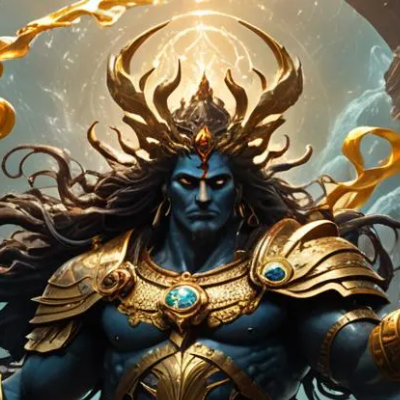
In the iconographic tradition, Varuna is depicted as a majestic figure of regal bearing, typically shown seated on a makara — the mythical sea creature that serves as his vehicle, depicted as a composite being with the body of a crocodilian or large fish and the head of an elephant or other animal. He holds the pasha, the divine noose or fetter, as his primary attribute, symbolising his power to bind those who transgress cosmic law. He is sometimes depicted holding a pot of water and a lotus. His complexion is described in some texts as white or golden. He presides over the western direction among the eight directional guardians (Ashtadikpalas), each of whom is a sovereign deity governing one of the cardinal and intermediate directions of the cosmos.
As an object of independent worship, Varuna's prominence in living practice diminished considerably after the Vedic period, consistent with the broader decline of the great Vedic sovereign deities — Mitra, Aryaman, Bhaga, and others — in the face of the rising devotional traditions centred on Vishnu, Shiva, and the goddess. Nevertheless, Varuna continues to be invoked in Vedic ritual contexts, in water-related ceremonies, and as one of the directional guardians in temple consecration rites and in the construction of sacred spaces.
✦ Connection to the Wider Genealogy
As a son of Kashyapa and Aditi, Varuna belongs to the supreme tier of the divine lineage in Puranic cosmology. Kashyapa is identified as the great progenitor of all orders of being — through Aditi he fathered the Adityas and the gods; through Diti he fathered the Daityas; through Kadru he fathered the Nagas; through Vinata he fathered Garuda and Aruna; and through other wives he generated the full diversity of living creatures. Aditi, as the mother of the Adityas, holds the status of a primordial goddess whose boundlessness is signified by her very name. Among Varuna's brothers the most cosmically significant are Indra, the king of the gods and lord of the heavens; Vivasvat (Surya), the sun god proper and progenitor of both the solar dynasty of human kings and the god of death Yama; and Vishnu, who in Puranic theology becomes the supreme deity of the Vaishnava tradition.
Through his role in the birth of Agastya and Vasishtha, Varuna stands at the origin of two of the tradition's most consequential sage lineages. Agastya — attributed to Varuna in the versions that distinguish individual paternity — is not only a figure of pan-Indian scriptural importance but the founding figure of the Tamil Sangam literary tradition and the sage whose austerities subjugated the Vindhya range. Vasishtha's lineage as one of the seven eternal sages and preceptor of the solar kings connects Varuna indirectly to the entire Ikshvaku royal dynasty, whose most celebrated member is the divine hero Rama, the subject of the Valmiki Ramayana.
✦ References
- Primary Sources
- Rigveda, Books I, II, V, VII, VIII (hymns to Varuna and to Mitra-Varuna): The foundational source for the Vedic Varuna; establishes his character as sovereign upholder of Rita, omniscient judge, holder of the pasha, and partner of Mitra; contains the penitential hymns addressed to him personally.
- Atharvaveda (various hymns): Contains additional invocations of Varuna relevant to his roles as lord of waters, punisher of sin, and cosmic sovereign; supplements the Rigvedic material.
- Vishnu Purana, Book I, Chapter 15; Book II: Enumerates Varuna among the twelve Adityas as sons of Aditi and Kashyapa; contains the account of the birth of Agastya and Vasishtha; describes Varuna's role in the monthly solar cycle.
- Bhagavata Purana, Skandha VI, Chapters 6 and 18; Skandha VIII: Lists the Adityas and their parentage; includes material on Varuna's sons and his standing as a cosmic sovereign; contains narrative episodes involving Varuna in the context of the churning of the ocean and other cosmic events.
- Mahabharata, Adi Parva (Book I); Sabha Parva (Book II); Anushasana Parva (Book XIII); Udyoga Parva (Book V): The Adi Parva contains the birth of Agastya and Vasishtha; the Sabha Parva describes Varuna's underwater palace; the Anushasana Parva lists Varuna among the twelve Adityas with his presiding month; various books record Varuna giving weapons including the bow Gandiva to Arjuna.
- Valmiki Ramayana, Bala Kanda; Yuddha Kanda: The Bala Kanda gives the birth of Vasishtha from Mitra and Varuna; the Yuddha Kanda contains invocations of Varuna in the context of Rama's campaign.
- Matsya Purana, Chapters 6 and 171: Contains genealogical and cosmological material on the Adityas including Varuna, with variant details on monthly assignments and lineage.
- Shatapatha Brahmana (various passages): Contains significant ritual and cosmological material relating to Varuna's role in Vedic sacrifice and his function as lord of waters and cosmic order.
- Secondary Sources
- Macdonell, A. A. Vedic Mythology (1897): Detailed scholarly analysis of the Vedic Varuna, his character, his hymns, and his relationship with Mitra; charts the development of his figure from the Rigveda through the Brahmanas.
- Dumezil, Georges. Mitra-Varuna (1948, French; English translation 1988): Foundational comparative study of the Mitra-Varuna pair within the Indo-European framework of sovereign deity pairs; essential for understanding Varuna's theological structure in a broader religious-historical context.
- Mani, Vettam. Puranic Encyclopaedia (1975): Entries on Varuna, the Adityas, Agastya, Vasishtha, and related figures; useful for cross-referencing textual sources and identifying variant accounts across the Puranic corpus.
- Lüders, Heinrich. Varuna (2 vols., 1951-1959): Exhaustive philological study of Varuna in Vedic and post-Vedic literature; the most comprehensive single scholarly treatment of the deity.
- Wisdomlib (wisdomlib.org), entries on Varuna, Adityas, Pracetas, and related figures: Aggregates verse references from digitised Puranic and epic texts; useful for locating variant readings and cross-textual comparisons across the primary corpus.