
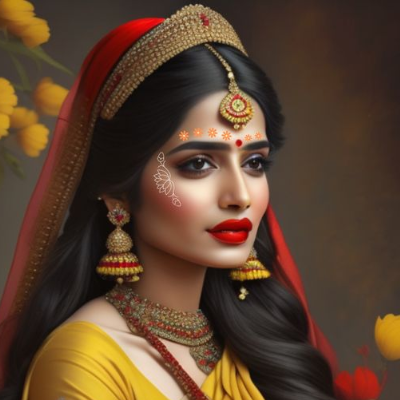
About
Jambavati — Princess of the Forests, Second Queen of Krishna, Mother of Samba
Jambavati · Jambavanti · Narendraputri · Kapindraputri · Rohini (some traditions)
Jambavati is one of the Ashtabharya — the eight principal queen-consorts of Krishna — and the only daughter of Jambavan, the immortal bear-king who served Rama in the Ramayana. She is described in the tradition as an incarnation of the goddess Lakshmi, along with the other principal wives of Krishna. She is the mother of Samba — whose story would bring about the extinction of the Yadava race. Her marriage to Krishna arose directly from the episode of the Syamantaka jewel, when Krishna defeated her father in twenty-eight days of combat and Jambavan, recognising Krishna as Rama returned, offered his daughter along with the jewel as tokens of surrender and devotion. Among the eight principal queens, she is chronologically the second to marry Krishna and ranked third in importance after Rukmini and Satyabhama. She is described across the Bhagavata Purana, Mahabharata, Harivamsa, and Vishnu Purana. The Vijayanagara emperor Krishnadevaraya composed a drama called the Jambava Kalyanam — the wedding of Jambavan's daughter — celebrating her marriage. The poet Ekaramantha composed a poem on the same subject called the Jambavati Parinayam.
✦ The Name
Jambavati is a patronymic — formed from her father's name Jambavan with the feminine suffix ti — meaning simply daughter of Jambavan. Her epithets Narendraputri (daughter of the king of men) and Kapindraputri (daughter of the lord of monkeys or bears) reflect her father's status as the supreme king of his race. The Bhagavata Purana commentator Sridhara identifies her with Krishna's wife Rohini, suggesting they are the same person by different names — a view the Harivamsa also supports. The commentator Ratnagarbha disagrees, holding them to be distinct. The matter is unresolved across the tradition.
✦ Lineage and Marriage
- Father: Jambavan — the immortal bear-king, born from Brahma's yawn at the beginning of creation, who served as one of the supreme commanders of Rama's army
- Status: Jambavan's only daughter — described as extremely dear to her father
- Husband: Krishna — who defeated Jambavan in twenty-seven or twenty-eight days of single combat (per Bhagavata Purana) or twenty-one days (per Vishnu Purana) before marrying her
- Divine identity: An incarnation of Lakshmi — along with the other Ashtabharya
- Position among the Ashtabharya: Chronologically the second to marry Krishna; third in order of prominence after Rukmini and Satyabhama
- Relationship with co-wives: Described as being close companions with Rukmini; in a state of quiet rivalry with Satyabhama — whose father Satrajit was the original owner of the Syamantaka jewel, directly linking their stories
✦ The Syamantaka Episode — How She Came to Marry Krishna
The Syamantaka jewel — a gem of extraordinary radiance given by Surya to the Yadava nobleman Satrajit — yielded eight loads of gold daily and protected its possessor from all calamity. Satrajit gave it to his brother Prasena, who wore it while hunting and was killed by a lion. The lion entered Jambavan's cave and was killed by Jambavan, who took the gem and gave it to his daughter to play with. When Prasena disappeared and the jewel went missing, false rumour spread that Krishna — who had earlier expressed admiration for the gem — had killed Prasena and stolen it. Krishna, determined to clear his name, followed the trail: to Prasena's corpse, then to the lion's corpse at the mouth of Jambavan's cave. He entered alone and saw Jambavati — described in the Vedic Story source as a little child at this time — playing with the jewel. As he approached, her nursemaid cried out, and Jambavan came to defend his home. Their battle lasted twenty-seven or twenty-eight days and nights of extraordinary ferocity. As Jambavan grew exhausted, he recognised in his opponent the divine radiance of Vishnu himself — and realised that the being before him was none other than his beloved Rama returned in a new form. He surrendered completely, returned the jewel, and offered his daughter Jambavati in marriage to Krishna. Krishna accepted both and returned to Dvaraka. He gave the Syamantaka jewel to Akrura for the welfare of the Yadava community, keeping the marriage as the true treasure of the episode.
✦ The Birth of Samba — Shiva's Boon
For a long time after her marriage, Jambavati remained childless while the other wives of Krishna bore many sons. Distressed and longing for a son as radiant and handsome as Pradyumna — Krishna's firstborn by Rukmini — she approached Krishna and asked him to seek a boon on her behalf. Krishna went to the hermitage of the sage Upamanyu in the Himalayas and, following the sage's instruction, undertook six months of severe austerities dedicated to Shiva — standing on one leg, holding a skull and rod, surviving on water alone, and in the final stage surviving only on air. Shiva appeared before him in the Ardhanarishvara form — the half-male-half-female manifestation — and granted Krishna the boon. Jambavati conceived and gave birth to Samba — named for Shiva's blessings, for Samba is one of Shiva's names. The Mahabharata and Devi Bhagavata Purana both record this account.
✦ Children
The Bhagavata Purana records that Jambavati bore Krishna ten sons. The Ashtabharya source lists them as: Samba (the eldest and most celebrated), Sumitra, Purujit, Satyajit, Sahasrajit, Vijaya, Chitraketu, Vasuman, Dravida, and Kratu. The Vayu Purana additionally records daughters — Sambhodani and Bhadravati — among her children. Krishna is described across multiple sources as being especially affectionate toward Jambavati's sons, with Samba being his particular favourite. The Bhagavata Purana records that Samba was the son for whom Krishna had performed the most arduous personal penance — which gave him a special place in Krishna's heart despite Samba's later rebellious character.
✦ Samba — Her Son and the Destruction of the Yadavas
Jambavati's wish had been for a son as beautiful and virtuous as Pradyumna. Samba was born beautiful — but grew up notorious, reckless, and the source of immense trouble for the Yadava clan. He married Lakshmana, the daughter of Duryodhana — a marriage that caused serious political tension. In his most consequential act, Samba and a group of young Yadavas dressed him in women's clothing and presented him as a pregnant woman to a group of rishis, mockingly asking what he would give birth to. The enraged sages cursed him to produce an iron pestle, which would destroy the entire Yadava race. The pestle was born as predicted, was ground to dust and cast into the sea, and the iron filings that washed ashore grew into the razor-sharp grass with which the Yadavas ultimately killed each other. Jambavati had prayed for the most beautiful son — and received the instrument of her husband's clan's destruction.
✦ Death — Sati at Krishna's Funeral
The Bhagavata Purana records that after Krishna's death — struck by a hunter's arrow tipped with iron made from the very pestle Samba had produced — the Ashtabharya, upon learning of his death, wailed in grief. Jambavati, along with Rukmini and the other principal wives, entered Krishna's funeral pyre. She is thus among the Ashtabharya who followed their husband in death.
✦ In Jainism
In the Jain tradition, Jambavati is described as the beautiful daughter of Jambavat and his wife Shivacandra — a variant not found in the Hindu Puranic accounts, which do not name Jambavan's wife.
✦ References
- Bhagavata Purana — Skandha 10: the Syamantaka episode; Jambavan's recognition of Krishna; Jambavati's marriage; her childlessness and prayer; Krishna's penance to Shiva for Samba's birth; the list of ten sons; the Ashtabharya entering Krishna's funeral pyre
- Mahabharata — Jambavan introduced as Jambavati's father; the Samba episode and the curse of the iron pestle; Samba's marriage to Lakshmana, daughter of Duryodhana; the destruction of the Yadava race
- Harivamsa — Jambavati as one of the Ashtabharya; Rohini identified as a possible alternate name; the Syamantaka story
- Vishnu Purana — the Syamantaka episode with the combat lasting twenty-one days; Samba heading the sons of Krishna and Jambavati
- Devi Bhagavata Purana — the account of Jambavati's childlessness; Krishna's penance to Shiva and Samba's birth
- Vayu Purana (34.241): names of Jambavati and Krishna's children including daughters Sambhodani and Bhadravati
- Jambava Kalyanam — drama composed by Vijayanagara emperor Krishnadevaraya celebrating Jambavati's marriage
- Jambavati Parinayam — poem on the same subject composed by Ekaramantha
- Wikipedia — Jambavati; Wisdomlib — Jambavati; Vedic Story — Jambavati Third Ashtabharya; Mytho World — Jambavati; Hindu Devotional Blog — Krishna Jambavati Marriage: modern summaries drawing from the above primary sources