
About
Samba — Son of Krishna and Jambavati, and Cause of the Destruction of the Yadava Clan
Samba · Jambavatisuta · Krishnaputra · Samba
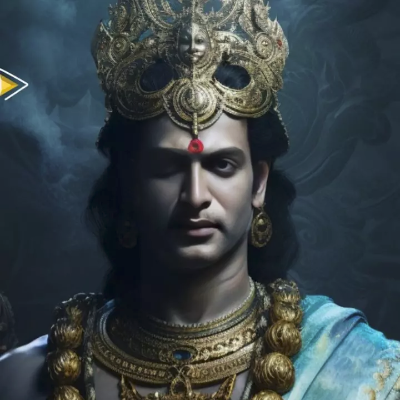
Samba is a son of Krishna — the eighth avatar of Vishnu, prince of the Yadava clan, and the central divine figure of the Mahabharata and the Bhagavata Purana — and of Jambavati, one of Krishna's principal wives and the daughter of Jambavan, the ancient bear-king who is a figure of great antiquity in the tradition, having been present at the time of the Ramayana as a devotee of Rama. Samba is among the most narratively significant of Krishna's many sons, not for any heroic deed of his own but for two interconnected episodes that carry enormous consequences: his transgression involving the wives of the Kuru elders at Kurukshetra, for which he was cursed, and the instrumental role he plays — through the fulfilment of that curse — in bringing about the total destruction of the Yadava clan at Prabhasa, an event that directly precedes Krishna's own departure from the world. Samba appears prominently in the Mahabharata, the Bhagavata Purana, the Vishnu Purana, the Harivamsa, and the Samba Purana — a minor Purana devoted specifically to him as a devotee of Surya, the sun god.
✦ The Name
The name Samba — also spelled Samba in some transliterations — is derived from the Sanskrit prefix sam, meaning together, complete, or auspicious, combined with a root associated with being or existence, yielding a sense approximating "he who is completely born" or "the fully existing one." Some commentators have connected the name to Shambhu, one of the names of Shiva, suggesting an auspicious Shaiva resonance, though this etymology is not formally elaborated in the primary texts. The patronymic Jambavatisuta identifies him as the son of Jambavati, and Krishnaputra identifies him as a son of Krishna. In the Samba Purana, his name is treated with devotional reverence in connection with his role as a devotee and propagator of the worship of Surya.
✦ Lineage
- Father: Krishna — the eighth avatar of Vishnu, son of Vasudeva and Devaki of the Yadava clan, raised in Gokula by his foster parents Nanda and Yashoda. Krishna is the supreme deity of the Bhagavata Purana's devotional theology and the divine charioteer and counsellor of Arjuna in the Mahabharata. He is the ruler of Dvaraka, the city built for the Yadavas on the western coast.
- Mother: Jambavati — a daughter of Jambavan, the ancient bear-king who appears in the Ramayana as a devotee and companion of Rama and who is described in the Puranic tradition as an immensely ancient being. Jambavati became Krishna's wife following the episode of the Syamantaka jewel — narrated in the Bhagavata Purana and the Vishnu Purana — in which Krishna tracked the jewel into Jambavan's cave, fought Jambavan for twenty-one days before Jambavan recognised Krishna as an avatar of Vishnu and submitted, and was given Jambavati in marriage as a mark of reconciliation and honour. Jambavati is counted among Krishna's eight principal wives, the Ashtabharyas.
- Paternal grandparents: Vasudeva — a prince of the Yadava clan and son of Shurasena — and Devaki — a princess of the Yadava clan and daughter of Devaka, a cousin of Ugrasena the king of Mathura. Both are figures of central importance in the Krishna narrative cycle of the Bhagavata Purana.
- Maternal grandfather: Jambavan — the ancient bear-king, said in some accounts to be the son of Brahma or to have been created by Brahma in primordial time. He is a figure of extreme longevity in the tradition, present at the events of the Ramayana as a companion of Rama and still alive at the time of Krishna's life, a span of multiple cosmic ages.
- Half-siblings: Samba has numerous half-brothers as sons of Krishna by his other wives. The Bhagavata Purana's tenth book lists ten sons born of each of Krishna's eight principal wives, giving eighty principal sons, and states that Samba is the foremost son of Jambavati. Among the sons of the other wives, Pradyumna — born of Rukmini, Krishna's foremost wife — is the most celebrated and is regarded as the avatar of Kamadeva, the god of love, within the Vaishnava theological framework. The relationship between Samba and Pradyumna is that of half-brothers; both are among the leading Yadava princes of the generation following Krishna.
✦ Samba's Character and Appearance
The Bhagavata Purana and the Mahabharata both characterise Samba as a figure of exceptional physical beauty and considerable pride in that beauty. He is repeatedly described as resembling his father Krishna in appearance — inheriting the divine radiance and physical perfection of his father — and this resemblance is treated in several passages as both a mark of his extraordinary birth and a source of his undoing, since his consciousness of his own beauty contributed to the reckless behaviour that brought about the curse. The Mahabharata's Musala Parva and the Bhagavata Purana's eleventh book are consistent in presenting Samba as handsome, spirited, and possessed of the pride natural to a prince of the Yadava royal line who was also the son of the supreme deity. He was trained in the martial arts as befitting his station, and several texts note his proficiency in warfare, though he is not given the extensive martial biography of, say, Pradyumna or Aniruddha — the other prominent grandsons of Krishna.
✦ The Transgression at Kurukshetra and Durvasa's Curse
The episode that defines Samba's place in the tradition concerns a transgression he committed that brought the curse responsible for the destruction of the Yadava clan. The Mahabharata's Musala Parva and the Bhagavata Purana's eleventh book narrate the essential facts, though they differ in certain details about the precise circumstances and agents of the curse.
According to the account in the Bhagavata Purana's eleventh book, a group of Yadava youths — with Samba as the principal figure — decided to play a prank on a group of visiting sages. Samba was dressed in women's clothing and made to appear pregnant. The youths brought him before the assembled sages — who included figures of the greatest austerity and spiritual power, among them Vishvamitra, Kanva, and Narada — and asked them mockingly what child this woman would bear. The sages, perceiving the mockery through their spiritual vision and the transgression against their dignity, pronounced a curse: that Samba would bear an iron pestle, and that this pestle would be the instrument of the destruction of the entire Yadava race, sparing none — not even Krishna and Balarama themselves would escape the consequences of this act.
The Mahabharata's Musala Parva gives a broadly consistent account of the cursing episode, though some versions of the story name the sages slightly differently or vary the framing of the transgression. In all versions, the core elements are the same: the deliberate mockery of powerful ascetics, the immediate recognition by those ascetics of the deception, and the pronouncement of a curse of total destruction upon the Yadavas. The following day, Samba did indeed give birth to an iron pestle — the mace-like weapon that emerged from his body as the curse had stipulated. The Yadava elders, alarmed, had the pestle ground to dust and the dust thrown into the ocean. But one fragment of the pestle remained and could not be ground; this was thrown into the sea separately. The dust thrown into the ocean washed ashore and grew into a crop of sharp reeds at Prabhasa on the coast. The remaining fragment was swallowed by a fish; the fish was caught, and the fragment was extracted and used by a hunter to tip an arrow.
✦ The Destruction of the Yadavas at Prabhasa
The fulfilment of the curse initiated by Samba's transgression is narrated in the Mahabharata's Musala Parva — the Book of the Clubs or Pestles — and in the Bhagavata Purana's eleventh book. Krishna, foreseeing the fulfilment of the curse and the end of the Yadava line as cosmically necessary and divinely ordained, did not prevent the events that followed. The Yadavas, already afflicted by ill omens and internal discord generated by divine will, went to Prabhasa — the sacred coastal site also associated with Chandra's penance to mitigate Daksha's curse — for a festival and pilgrimage. There, in the course of drinking and celebration, quarrels broke out among the Yadava warriors. The quarrels escalated into violence. The Yadavas, in their intoxication and fury, seized the reeds that had grown from the dust of Samba's pestle along the shore and used them as weapons against each other. These reeds, though they appeared to be ordinary grass, functioned as lethal instruments in fulfilment of the curse — for the pestle's dust had become the reeds, and the pestle's purpose was the destruction of the Yadavas. In the ensuing battle among themselves, the Yadavas killed one another almost to the last person. Krishna's brother Balarama then departed from the world by yogic means. Krishna himself, seated in meditation beneath a tree, was struck in the foot by the arrow tipped with the remaining fragment of the iron pestle, wielded by a hunter named Jara who mistook Krishna's foot for a deer. This wound was the occasion of Krishna's departure from the mortal world.
Samba himself perished in the destruction at Prabhasa along with the other Yadavas. The Musala Parva does not record his individual death separately from the general annihilation; he is subsumed into the collective fate of the clan whose destruction his transgression initiated. The tradition is consistent across the Mahabharata and the Bhagavata Purana in presenting Samba as the proximate cause — through his mockery of the sages — of the curse that destroyed the Yadavas, while simultaneously presenting the destruction as cosmically inevitable and ultimately an expression of Krishna's own divine will that his earthly manifestation and the clan associated with it should come to an end.
✦ The Episode of Duryodhana's Captivity
A separate episode involving Samba is narrated in the Mahabharata's Vana Parva and in related passages. Samba, attracted by the beauty of Lakshmana — a daughter of Duryodhana, the Kaurava prince and chief antagonist of the Pandavas — attempted to abduct her from the midst of her svayamvara, the ceremony at which she was to choose her own husband. The Kauravas — already in a state of hostility toward the Yadavas — captured Samba and imprisoned him at Hastinapura. Balarama — Krishna's elder brother and a figure of enormous physical power, regarded as an avatar of Shesha, the cosmic serpent — led a delegation to Hastinapura to demand Samba's release. When the Kauravas refused and insulted Balarama, he threatened to lift the entire city of Hastinapura with his plough and cast it into the river Ganga. This display of terrifying power compelled the Kauravas to release Samba and to give him Lakshmana in marriage as originally intended. The episode is narrated in the Bhagavata Purana as well as the Mahabharata, and it establishes Lakshmana — daughter of Duryodhana — as Samba's wife, an irony that the tradition does not comment upon directly: the son of Krishna married a daughter of Krishna's principal human antagonist.
✦ Samba as a Devotee of Surya — The Samba Purana Tradition
A dimension of Samba's biography that is elaborated primarily in the Samba Purana — a minor Upapurana devoted to Surya worship — concerns his role as a devotee and propagator of the solar cult. The Samba Purana narrates that Samba, afflicted with leprosy as a consequence of either the curse of the sages or — in some versions of the story — a curse arising from his having disturbed his father Krishna in an intimate moment with one of his wives, undertook severe austerities in devotion to Surya, the sun god. Through this devotion, Samba was cured of his leprosy by Surya's grace. In gratitude, Samba is said to have established a famous temple to Surya at Mulasthana — identified by tradition with Multan in the Punjab, a site historically known as one of the most important centres of Surya worship in the Indian subcontinent. The Samba Purana presents Samba as the human instrument through whom Maga priests — a community of solar priests of possibly Iranian or Central Asian origin — were brought to India to conduct solar worship at the temple he established.
This tradition is of considerable historical and religious interest. The association of Samba with the establishment of Surya worship and with the Maga priests represents one of the few instances in the Puranic literature where a mythological figure is explicitly connected to a specific historical religious institution and to the introduction of a priestly community with possible foreign origins. Scholars of Indian religious history have discussed the Samba Purana's account in the context of the historical spread of solar worship in the northwestern Indian subcontinent, and the figure of Samba has been used in these discussions as a legendary charter for the Maga community's presence and authority.
✦ Textual Variants and Inconsistencies
Several genuine inconsistencies and points of variation arise across the primary sources and require clear statement.
The identity of the cursing sages: The Bhagavata Purana names the sages cursed by Samba's group as including Vishvamitra, Kanva, and Narada. The Mahabharata's Musala Parva does not name the same set of sages with identical specificity in all manuscript traditions. The variation in the names of the sages across different recensions of the relevant passages is a recognised textual problem and does not affect the core narrative of the curse and its consequence.
The cause of Samba's leprosy: The Samba Purana attributes Samba's leprosy to a specific curse separate from — or elaborating — the sages' curse, sometimes connecting it to an episode in which Samba intruded upon Krishna and one of his wives. The Bhagavata Purana and Mahabharata do not narrate this specific cause for leprosy, and the Samba Purana's account of the leprosy and its cure through Surya-worship is a tradition specific to that text and not confirmed in the mainstream Mahapuranas. The two accounts — the sages' curse leading to the iron pestle, and the leprosy leading to Surya devotion — may represent parallel traditions that the Samba Purana sought to integrate, or they may reflect the Samba Purana's distinct theological agenda of promoting solar worship through Samba's biography.
Samba's wife: The Mahabharata and Bhagavata Purana name Lakshmana, daughter of Duryodhana, as Samba's wife obtained through the abduction episode resolved by Balarama. Some regional and later texts add other wives or vary the story of how Lakshmana was obtained. The Mahabharata account is the primary and most consistently attested version.
The number of Krishna's sons: The Bhagavata Purana's tenth book states that Krishna had ten sons by each of his eight principal wives, giving eighty sons in total, and adds that Samba was the foremost of Jambavati's sons. The Harivamsa gives somewhat different numbers and names for Krishna's sons across its various passages. Samba's position as the foremost or most prominent son of Jambavati is consistent across the main sources.
✦ Theological Significance
Samba's theological significance in the Bhagavata Purana and Mahabharata traditions is primarily as the instrument of cosmic necessity. The destruction of the Yadavas is presented in both texts as something that Krishna himself willed and foresaw — a necessary conclusion to his earthly manifestation. The tradition is explicit that no external force could destroy the Yadavas as long as Krishna was present and willing to protect them; their destruction required an internal cause that would operate from within the clan itself. Samba's transgression and the curse it drew provided this internal cause. In this theological reading, Samba is not simply a reckless youth but the unwitting instrument of the divine will's fulfilment — a figure through whom the necessary end of the Yadava era was accomplished without Krishna appearing to directly cause the destruction of his own clan. This interpretation does not exonerate Samba's conduct in the tradition's own moral terms — his mockery of the sages is consistently presented as a transgression — but it situates that transgression within a larger pattern of cosmic necessity governed by Krishna's own divine purpose.
In the Samba Purana's theological framework, Samba's significance is entirely different: he is a paradigmatic devotee of Surya whose suffering — the leprosy — leads him to intense solar worship and whose recovery demonstrates Surya's grace and power. This Samba Purana tradition presents him as a model for solar devotion and as the mythological founder of solar worship in northwestern India. The two theological frameworks — Samba as the instrument of the Yadavas' doom in the Vaishnava texts, and Samba as the solar devotee and temple-founder in the Saura tradition — are not reconciled with each other within the texts and reflect the different religious communities that claimed Samba as a significant figure in their respective traditions.
✦ Connection to the Wider Genealogy
Through his father Krishna, Samba descends from the Yadava royal lineage, which is itself a branch of the Lunar dynasty — the Chandravamsha. Krishna's patrilineal descent runs through Vasudeva, Shurasena, and further back through the Yadava royal line to Yadu, the son of King Yayati and the progenitor of the entire Yadava race. Yayati himself is a descendant of Pururavas and through him of Budha — the son of Chandra and Rohini — and through Chandra of the primordial creative line of Brahma. Samba is thus a descendant of the moon god Chandra at a remove of many generations. Through his mother Jambavati, Samba connects to the ancient figure of Jambavan — whose own origin is traced in different texts to Brahma's creative act — giving him a second line of primordial ancestry. His wife Lakshmana is a daughter of Duryodhana — making Samba the son-in-law of the primary antagonist of the Mahabharata — and through Duryodhana she connects to the Kaurava branch of the Chandravamsha, which descends through Kuru and the Bharata line. Samba's own sons are not given individual narrative significance in the surviving primary texts; the Yadava destruction at Prabhasa effectively closes the genealogical line of the Yadavas as an active dynastic force in the tradition.
✦ References
Primary Sources
- Mahabharata, Musala Parva (Book 16): The principal epic source for the curse of the sages, the birth of the iron pestle from Samba's body, the grinding of the pestle, and the destruction of the Yadavas at Prabhasa through the reed-weapons that grew from the pestle's dust. The foundational narrative source for Samba's most consequential role in the tradition.
- Mahabharata, Vana Parva (Book 3), sections on the Yadavas: Contains the episode of Samba's abduction of Lakshmana, his capture by the Kauravas, and Balarama's intervention to secure his release, including the threat to uproot Hastinapura.
- Bhagavata Purana, Book 10, chapters 68 and 90: Chapter 68 narrates the episode of Samba's abduction of Lakshmana and Balarama's response in the Bhagavata Purana's version. Chapter 90 lists the sons of Krishna's eight principal wives and identifies Samba as the foremost of Jambavati's sons.
- Bhagavata Purana, Book 11, chapters 1–3 and 30–31: Chapters 1–3 narrate the cursing of the Yadavas by the sages, the birth of the pestle, and the cosmic inevitability of the Yadava destruction. Chapters 30–31 narrate the destruction at Prabhasa and its immediate consequences including the deaths of Balarama and Krishna.
- Vishnu Purana, Book 5, chapters 37–38: Contains the account of the curse and the destruction of the Yadavas consistent with the Bhagavata Purana's narrative; confirms Samba's role as the central figure in the cursing episode.
- Harivamsa, chapters 79–80 and 113–116: The Harivamsa as a supplement to the Mahabharata contains additional material on Krishna's sons including Samba, the abduction of Lakshmana, and the Yadava destruction, with some variation in detail from the Mahabharata's main text.
- Samba Purana: The primary source for Samba's affliction with leprosy, his devotion to Surya, his cure, and his establishment of the Surya temple at Mulasthana; the foundational text for the Saura tradition surrounding Samba and for his role in the introduction of the Maga priests to India. A minor Upapurana devoted specifically to this dimension of Samba's biography.
- Matsya Purana, chapter 47: Contains genealogical material on Krishna's sons including Samba, consistent with the standard Puranic framework.
Modern Reference Works
- Vettam Mani, Puranic Encyclopaedia (1975): Entry on Samba; collates primary references across the Mahabharata, Bhagavata Purana, Vishnu Purana, and Harivamsa; summarises the principal episodes of the cursing, the pestle, the Lakshmana abduction, and the Yadava destruction.
- Alf Hiltebeitel, The Ritual of Battle: Krishna in the Mahabharata (1990): Contains analysis of the Musala Parva and the symbolic and theological dimensions of the Yadava destruction, relevant to understanding the structural role of Samba's transgression in the Mahabharata's narrative architecture.
- Stella Kramrisch, The Presence of Siva (1981): Touches on the Shaiva dimensions of episodes involving figures of Krishna's circle; useful contextual material for the broader religious world in which Samba's story was transmitted.
- David Pingree, "The Mesopotamian Origin of Early Indian Mathematical Astronomy" and related articles on the Maga priests: Scholarly discussion of the Maga community, their possible foreign origins, and their connection to the Samba Purana tradition of solar worship establishment, situating the Samba Purana's claims in the context of the history of Surya worship in India.
- J. A. B. van Buitenen (translator), The Mahabharata, Volume 1 and the University of Chicago complete translation project: Critical translations and notes on the relevant Mahabharata passages concerning Samba, providing textual apparatus for the Musala Parva and the Vana Parva episodes.