
About
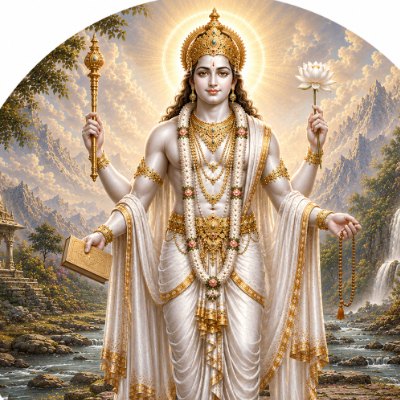
Dharma (Dharmadeva) — Personification of Cosmic Righteousness, Mind-Born Son of Brahma
Dharma · Dharmadeva · Dharmaraja · Vrishadhvaja · Dharmaraj · Vrisha · Sarvabhutahita · Yama (synonymous in the Mahabharata) · Pitrapati
Dharmadeva — the divine personification of cosmic righteousness, moral law, and virtue — is a mind-born son of Brahma who emerged from the right side of Brahma's chest. He is not the same being as Yama, the god of death, though the two share several synonyms in Sanskrit literature and are frequently confused. The Mahabharata uses the words Dharmaraja, Vrisha, and Yama interchangeably as synonyms for Dharmadeva — not because they are the same being, but because Dharma is the quality that both embody in different ways. He married the daughters of Daksha and fathered a vast progeny that comprises the entire moral and cosmic order of the universe — including the Ashtavasus, the Visvadevas, the Sadhyas, Nara-Narayana, and the devas Satyavrata and Satyasena. He is the spiritual father of Yudhishthira — the most dharmic of the Pandavas, who was physically born to Pandu through Kunti's niyoga invocation of Dharma. He is the father of Dharmavrata — the wife of Marichi who was cursed to become the sacred stone Devashila.
✦ A Critical Distinction — Dharmadeva and Yama Are Separate Beings
The Puranic Encyclopaedia (Vettam Mani) devotes a separate entry to this point — noting that there is a misunderstanding found even in some Puranas that Kala (Yama) and Dharmadeva are one and the same person. The evidence distinguishing them is conclusive. Dharmadeva's father and mother are Brahma — he emerged from Brahma's right side (or chest). Yama's father is Surya (the sun god) and his mother is Sanjna, daughter of Vishvakarma — making Yama the sixth descendant of Vishnu through the solar lineage. Dharmadeva married thirteen or more daughters of Daksha; Yama's consort is Dhumorna. Dharmadeva has sons including Yudhishthira, Vidura, Shama, Kama, and Harsha; Yama has no sons recorded in the primary texts. Their names overlap — both are called Dharmaraja, both are called Yama — but by different reasoning: Kala received the name Dharmaraja because he weighs the evil and good in human beings; Dharmadeva received it because he is the embodiment of Dharma itself. Dharmadeva received the name Yama because he possesses yama — the quality of self-control and moral restraint. The overlap in names caused the confusion, but the two remain distinct persons in the canonical tradition.
✦ The Name
The Sanskrit word Dharma derives from the root dhr — to hold, to sustain, to support. Together: that which holds the world together, that which sustains the cosmic and moral order. The Rigveda uses the word 56 times, first in the cosmological sense of the divine order that holds apart the sky and earth and sustains the stars in their courses. Later texts and the Puranas develop the meaning into the full spectrum of human duties: cosmic law, righteous action, moral virtue, social and religious duty, individual character, the truth of each being's innate nature. Dharmadeva as a deity is the personified form of this principle — not a concept but a conscious divine being who governs the moral foundation of all creation. His epithet Vrishadhvaja means he whose banner is the bull — the bull being the ancient symbol of dharmic strength and steadiness in the tradition.
✦ Origin
The Mahabharata's Adi Parva (Chapter 65) records the primary account of Dharmadeva's emergence: this deva broke the right side of Brahma's chest and came out in the form of a human being. He is therefore a Manasaputra of Brahma born from the body rather than from Brahma's breath or thought alone — emerging from the right side, which in the tradition symbolises the active, auspicious, creative, and masculine principle. Three sons were born to him immediately — Shama, Kama, and Harsha — who represent the primary qualities of inner peace, desire, and joy respectively. This is the canonical Mahabharata account. The Vishnu Purana and Bhagavata Purana also record him as sprung from Brahma's right breast, confirming the Mahabharata's account across traditions.
✦ Lineage — Father, Wives, and the Three First Sons
- Father: Brahma — emerged from his right chest
- First three sons (by unspecified mother at birth): Shama (inner peace and equanimity), Kama (desire and love — who married Rati), and Harsha (joy — who married Nanda)
- Principal wives: Thirteen daughters of Daksha per the Bhagavata Purana — Shraddha (faith), Maitri (friendship), Daya (compassion), Shanti (peace), Pushti (nourishment), Tushti (contentment), Kriya (action), Unnati (upliftment), Buddhi (intellect), Medha (wisdom), Titiksha (forbearance), Hri (modesty), and Murti (form/embodiment)
- Additional wives per the Bhagavata Purana: Ten more daughters of Daksha — Bhanu, Lamba, Kukubh, Jami, Vishva, Sadhya, Marutvati, Vasu, Muhurta, and Sankalpa — and also Sunrita
- Wives per the Mahabharata: Kirti (fame), Lakshmi (fortune), Dhriti (steadiness), Medha (wisdom), Pushti (nourishment), Shraddha (faith), Kriya (action), Buddhi (intellect), and Lajja (modesty) — nine daughters of Daksha
- Additional daughter: Dharmavrata — born of his wife Dharmavati; married to Marichi; cursed to stone; became the Devashila
✦ Children by Each Wife — The Taxonomy of Virtue
Every wife of Dharmadeva gave birth to a son who personifies the quality she embodies — making Dharma's progeny a living taxonomy of the virtues and cosmic forces that sustain the universe. From the Isvara.org and Wisdomlib accounts drawing from the Bhagavata Purana: Shraddha bore Shubha (auspiciousness); Maitri bore Prasada (grace); Daya bore Abhaya (fearlessness); Shanti bore Sukha (happiness); Tushti bore Moda (delight); Unnati bore Darpa (dignity); Buddhi bore Artha (purpose); Medha bore Sukrti (meritorious action); Titiksha bore Shama (equanimity); Hri bore Prashraya (humility). From the remaining wives: Murti — Daksha's daughter who embodies divine form — gave birth to the virtuous Nara and Narayana (the twin divine sages, earlier births of Arjuna and Krishna); Sunrita bore the devas Satyavrata and Satyasena, the latter famous for slaying cruel Yakshas and demons; Lamba bore Rishabha and Vidyotana; Kukubh bore Sankata; Jami bore Svarga (whose son was Nandi); Vishva bore the Vishvadevas (the pan-universal divinities invoked in all Shraddha rites); Sadhya bore the Sadhyas (distinct from those born of Brahma); Marutvati bore Marutvat and Jayanta; Vasu bore the eight Ashtavasus — Drona, Dhruva, Soma, Aha, Anila, Anala, Pratyusha, and Prabhasa — who represent the eight elemental forces of the natural world; Bhanu, Muhurta, and Sankalpa bore their respective cosmic offspring.
✦ Father of Yudhishthira and Vidura
Dharmadeva is the spiritual father of Yudhishthira — the eldest of the five Pandavas and the most dharmic king of his era. When King Pandu was cursed by the sage Kindama that he would die if he lay with his wives, he requested Kunti to invoke the gods to beget sons on his behalf. She invoked Dharma first — understanding that only the most righteous man in the world could beget the most dharmic son. Yudhishthira was born from this invocation. The Mahabharata consistently refers to Yudhishthira as Dharmaputra — son of Dharma — and as Dharmanandana — he who is the joy of Dharma. In Yudhishthira's famous final journey on the Mahaprasthana, when a dog followed him all the way to the gates of Svarga and Yudhishthira refused to abandon it, the dog was revealed to be Dharmadeva himself — who had followed his son to test his compassion and give him the final blessing. Dharmadeva is also the father of Vidura — through a niyoga with the maid of Ambalika, the widow of Vichitravirya — making Vidura the earthly manifestation of the god of dharma in the Kuru household.
✦ Dharma as the Dog at the Gates of Svarga
The Mahabharata's Mahaprasthana Parva and Svargarohana Parva record the final test Dharmadeva administered to his son Yudhishthira. The Pandavas, after renouncing their kingdom and crowning Parikshit, set out on the great journey to Svarga through the Himalayas. One by one — Draupadi, Sahadeva, Nakula, Arjuna, and Bhima — fell on the path, each dying of a spiritual flaw. Only Yudhishthira walked on, accompanied at the last stage only by a dog that had joined them. At the gates of Svarga, Indra arrived in his chariot to receive Yudhishthira — but declared the dog could not enter. Yudhishthira refused to abandon it, saying he would not enter a heaven that required him to abandon a devoted companion. At that moment the dog transformed and revealed himself as Dharmadeva. He declared Yudhishthira had passed the final test — that compassion without exception was the highest dharma — and welcomed him into Svarga. This episode is among the most celebrated moral parables in the entire Mahabharata tradition.
✦ The Deer of the Forest — The Second Great Test
The Mahabharata's Vana Parva records a second celebrated episode in which Dharmadeva tested Yudhishthira during the Pandavas' forest exile. The five brothers were directed by a Brahmin to find a deer that had run away carrying his fire-sticks, without which he could not perform his daily yajna. All five brothers searched exhaustedly and could not find the deer. They stopped to rest by a lake. When they tried to drink, a voice from the water demanded each brother answer questions before drinking — and killed them with a divine curse when they refused. One by one all four younger Pandavas drank without answering and fell dead. Yudhishthira arrived last, found his brothers dead, and heard the voice's questions. He sat down and answered every question with perfect correctness — a series of profound ethical and philosophical questions on the nature of dharma, the self, and right living. The voice then revealed itself as Dharmadeva and offered to restore any one brother. Yudhishthira chose Nakula — his half-brother by Madri — rather than Bhima or Arjuna, explaining that since his own mother Kunti had one son surviving, so too should his step-mother Madri have one son surviving. Dharma, moved by this supreme impartiality, restored all four brothers. This episode — the Yaksha Prashna — is one of the most celebrated passages of the entire Mahabharata.
✦ Dharmadeva's Rebirth as Vidura
The Bhagavata Purana (Canto 3 and 4) records that Dharmadeva was cursed by the sage Mandavya — also known as Animandavya — for an act of unjust punishment. The sage Mandavya had been unjustly impaled on a stake by a king, having committed no crime, and when Dharmadeva (Yama-Dharma, in the combined identity used in this passage) was asked to explain the cause, he said the sage had as a child pierced a small creature with a sharp blade, and this was the karmic fruit of that act. Mandavya declared that a child below twelve years of age could not be accountable for such an act under dharmic law, and that Dharmadeva had violated his own law by causing the punishment. He cursed Dharmadeva to be born as a Shudra on earth. Thus Dharmadeva was born as Vidura — the wisest and most dharmic man in the Kuru household, the son of Vyasa and a maidservant, who alone among the Kuru elders consistently stood for dharma throughout the Mahabharata and ultimately attained liberation on the banks of the Ganga.
✦ Dharma's Cosmic Role — Beyond the Personal
In the broader tradition, Dharmadeva is understood not merely as a named deity with a genealogy but as the principle that underlies all created existence — the force without which the universe would collapse into chaos. The Rigveda establishes this understanding from its earliest hymns. The Chandogya Upanishad declares: dharma is the foundation of the universe; on dharma everything rests. The Mahabharata's Shanti Parva declares: the foundation of the world is dharma. In this cosmic sense, Dharmadeva is less a personal being and more the living face of the principle that holds creation together — the divine authority behind every act of justice, every fulfilment of duty, every expression of compassion, and every restraint of selfish desire. The Bhagavad Gita's famous declaration — whenever dharma declines and adharma rises, I manifest myself — describes the recurring necessity of Vishnu's avatars as a response to the weakening of the principle Dharmadeva embodies.
✦ Note on Available Information
The tradition does not record a distinct biography for Dharmadeva in the same way it does for figures like Narada, Kashyapa, or Brahma. Beyond his origin, his wives and children, his daughter Dharmavrata, his fathering of Yudhishthira and Vidura, and his appearances as the dog and the Yaksha in the Mahabharata's great tests, he functions primarily as a divine principle embodied — present in every dharmic act and every moment of cosmic order, rather than as a figure who undertakes his own independent narrative arc.
✦ References
- Mahabharata (Vyasa) — Adi Parva, Chapter 65: Dharmadeva's emergence from Brahma's right chest; his three first sons Shama, Kama, and Harsha; Adi Parva: Kunti's invocation of Dharma; birth of Yudhishthira; Vana Parva: the Yaksha Prashna — Dharmadeva as the voice at the lake; the test of Yudhishthira's answers; the restoration of the brothers; Udyoga Parva: the Vidura-niti — Dharmadeva as Vidura's counsel to Dhritarashtra; Svargarohana Parva: Dharmadeva as the dog at the gates of Svarga; the final test of compassion; Mahaprasthana Parva: the great journey
- Bhagavata Purana — Canto 3 and 4: Dharmadeva's marriages to thirteen daughters of Daksha; the complete list of sons born to each wife including the Ashtavasus and Nara-Narayana; Canto 3–4: the curse of Mandavya and Dharmadeva's birth as Vidura
- Vishnu Purana — records Dharmadeva's marriages to Daksha's daughters; his emergence from Brahma's right side; his sons by each wife
- Agni Purana — Chapter 114: records the episode of Dharmavrata's curse by Marichi and the creation of the Devashila; Dharmadeva as her father
- Vayu Purana — records Dharmavrata's mother as Vishvarupa, wife of Dharma
- Puranic Encyclopaedia (Vettam Mani) — the critical entry distinguishing Dharmadeva from Yama/Kala; separate origins, separate wives, separate children; the shared synonyms explained; full genealogy
- Wikipedia — Yama (Hinduism): the Wikipedia article on Yama explicitly notes that Yama is the son of Surya and Sanjna, while Dharmadeva is born from Brahma's chest — recording both as distinct beings
- Isvara.org — Yamaraja (drawing from Puranic Encyclopaedia): the critical passage on the distinction between Kala and Dharmadeva; the full list of Dharmadeva's wives and sons
- Wisdomlib — Story of Dharma: the complete account of Dharmadeva's emergence, his wives, and all sons born to each wife per the Bhagavata Purana and Mahabharata