
About
Mainda — Vanara Hero of Kishkindha, Son of Nasatya
Mainda · Mainda Vanara · Nasatya-putra · Ashvini-putra
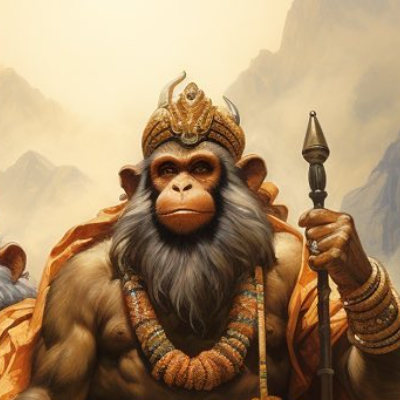
Mainda is a Vanara hero of Kishkindha who appears in the Valmiki Ramayana as one of the significant warriors of the Vanara army assembled by Sugriva for the campaign against the demon king Ravana of Lanka. He is the son of Nasatya — one of the two Ashvini Kumaras, the divine twin physicians of the gods — and is almost always named in close conjunction with his companion and fellow Vanara Dvivida, the son of Dasra, the other Ashvini Kumara twin. Mainda and Dvivida are treated throughout the Valmiki Ramayana and in subsequent Puranic literature as an inseparable pair — twin-born in the divine sense that their fathers are themselves twins — and the two together constitute one of the most consistently paired warrior dyads among the Vanara heroes of the epic. Mainda appears in the Valmiki Ramayana, the Mahabharata's summary of the Ramayana, the Bhagavata Purana, and in the Harivamsa, where he and Dvivida appear in a narrative involving the god Krishna that is one of the most significant post-Ramayana episodes in which either figure plays a role. He is a figure of secondary narrative prominence — not among the foremost Vanara heroes in terms of the length of his individual episodes — but his consistent presence in the battle narrative and his striking appearance in the Harivamsa give him a defined place in the tradition.
✦ The Name
The name Mainda does not yield a straightforward Sanskrit etymology of the kind that most divine and heroic names in the tradition carry. Some commentators have connected it to forms meaning powerful or vigorous, consistent with his character as a warrior of great strength. The name does not carry the obvious semantic transparency of names like Angada, Dhruva, or Pushan, and the primary sources do not provide an explicit gloss or derivation for it. It is possible that Mainda, like several other Vanara names in the Ramayana, belongs to a stratum of nomenclature that reflects older linguistic or regional traditions rather than straightforward classical Sanskrit etymology. The name consistently appears paired with Dvivida — his companion born of the other Ashvini Kumara twin — and the two names are treated in the tradition as belonging together, a pairing that reflects their inseparable character throughout the narrative.
✦ Lineage
- Father: Nasatya — one of the two Ashvini Kumaras, the divine twin physicians of the gods. The Ashvini Kumaras are among the most ancient deities of the Vedic tradition, celebrated in the Rigveda for their medical skill, their swiftness, their golden appearance, and their role as helpers of those in distress. Nasatya is the name applied to one of the twins; in the Vedic texts the two twins are often addressed together as the Ashvins or Ashvini Kumaras without always specifying which name belongs to which twin, and some texts give Nasatya as a name applicable to both. In the tradition that distinguishes them individually, Nasatya is the father of Mainda and Dasra is the father of Dvivida.
- Divine grandfather: The parentage of the Ashvini Kumaras themselves varies across the primary sources. In the most widely attested Puranic account they are the sons of Vivasvat — the sun god Surya, one of the twelve Adityas born to Kashyapa and Aditi — born from his wife Saranyu in the form of a mare. In this account Mainda is the great-grandson of the sage Kashyapa and of Aditi, daughter of the patriarch Daksha, and a nephew of Indra, Varuna, Vishnu, and the other Adityas through the divine lineage of Vivasvat. Alternative accounts of the Ashvini Kumaras' parentage exist — some texts give them different divine parents — but the Vivasvat-Saranyu derivation is the most consistently attested in the major Puranas.
- Companion and paired figure: Dvivida — son of Dasra, the other Ashvini Kumara twin; Mainda's inseparable companion throughout the Ramayana narrative and in subsequent Puranic appearances. The two are treated as a unit across virtually every passage in which they appear.
✦ The Ashvini Kumaras and Mainda's Divine Inheritance
To understand Mainda's divine inheritance it is necessary to establish the character of his father Nasatya and the Ashvini Kumaras as a pair. The Ashvini Kumaras — also called the Ashvins, the Nashatayas, and the Dasras — are among the most frequently invoked deities in the Rigveda, where they receive more hymns than any deity except Indra, Agni, and Soma. They are the divine physicians, the healers, the helpers of those in distress, the rescuers of the drowning and the lost, the restorers of youth and vigour. They travel across the sky in a golden chariot at the boundary between night and day — they are the deities of the twilight, the liminal luminosity between darkness and full day — and their swiftness is legendary. They are also depicted as young, handsome, and horse-headed in some iconographic traditions, their association with horses being fundamental to their identity.
The medical expertise of the Ashvini Kumaras — their capacity to heal, to restore, to revive — is the quality most consistently attributed to them in the Vedic corpus, and it is this quality that gives Mainda and Dvivida their particular character within the Vanara world of the Ramayana. The sons of the divine physicians are, in the tradition's logic of divine inheritance, expected to carry something of their fathers' character — a combination of physical power with a quality of vitality, resilience, and the capacity to endure and recover. The Valmiki Ramayana does not make this connection explicit in extended narrative form, but the consistent pairing of Mainda and Dvivida throughout the text reflects their identity as a divine twin pair whose nature mirrors their fathers' paired identity.
✦ Mainda in the Valmiki Ramayana
Mainda is introduced in the Kishkindha Kanda of the Valmiki Ramayana in the passage that enumerates the divine origins of the principal Vanara warriors, where he is identified as the son of Nasatya. He is among the Vanara leaders present at the assembly in which Sugriva organises the search for Sita, and he is among those assigned to assist in the campaign against Ravana. The Valmiki Ramayana consistently names Mainda and Dvivida together whenever either appears, treating them as a pair rather than as individual figures with separately developed narrative roles.
In the Yuddha Kanda, Mainda participates in the great battle of Lanka as one of the significant Vanara warriors. He is described fighting in the general engagements of the battle and is specifically mentioned in passages that record the advance of the Vanara army and the organisation of its forces around the walls of Lanka. The Valmiki Ramayana assigns him combat against demon warriors of Ravana's army, though the specific individual combats attributed to him are not developed at the length reserved for the foremost warriors such as Hanuman, Angada, Sugriva, and Nila. His presence in the battle narrative is consistent rather than episodic — he is among the warriors who sustain the Vanara army's fighting capacity across the full course of the war rather than among those who are given singular decisive moments.
One passage in the Yuddha Kanda that gives Mainda and Dvivida a jointly significant role involves their participation in a particularly fierce phase of the fighting in which the demon forces were temporarily gaining the upper hand. The two are described as rallying the Vanara forces together, fighting side by side with a coordination and mutual reinforcement that the text associates with their paired identity as sons of the twin gods. Their joint action is presented as having a quality different from that of solo warriors — the twin sons of twins fighting together carry a doubling of purpose and of power that the narrative marks as distinctive.
✦ Mainda's Boon of Amrita
One of the most theologically significant details associated with Mainda — and with Dvivida alongside him — is recorded in certain Puranic passages and in commentarial traditions on the Ramayana: the two Vanaras are said to have received from the Ashvini Kumaras, their divine fathers, a boon of Amrita — the nectar of immortality. According to this tradition, the Ashvini Kumaras gave their sons a share of the Amrita that had been obtained from the churning of the cosmic ocean, granting them extraordinary resilience, the capacity to recover from wounds that would be fatal to ordinary beings, and a vitality that transcended normal physical limits. This boon is consistent with the Ashvini Kumaras' role as the divine physicians who restore life and vigour, and it explains the exceptional durability of Mainda and Dvivida as warriors — they are not merely strong but sustained by a divine life force beyond what their natural capacities alone would provide.
This detail of the Amrita boon is not consistently attested across all manuscript traditions of the Valmiki Ramayana but appears in several Puranic treatments of the Vanara genealogies and in commentaries on the relevant passages. It should be noted as a tradition associated with Mainda and Dvivida rather than as universally canonical, while recognising that its theological coherence — sons of the divine physicians receiving the supreme life-sustaining substance — gives it a plausibility within the internal logic of the tradition.
✦ Mainda and Dvivida in the Harivamsa
The most narratively significant post-Ramayana appearance of Mainda — again always in company with Dvivida — occurs in the Harivamsa, the supplement to the Mahabharata that deals extensively with the life and exploits of Krishna. The relevant episode involves Dvivida primarily, but Mainda is named as present and associated with the events, and the episode therefore belongs to both their histories.
The Harivamsa records that Dvivida, acting under the influence of the demon Narakasura's friendship or out of misguided fury, had been causing devastation in the region of Saubhara — uprooting trees, destroying villages, blocking rivers, and generally causing havoc in the lands around the Raivataka mountain. This episode is presented as a case of a great warrior whose power, unchecked by appropriate purpose, had become destructive rather than protective. The detailed narrative of Dvivida's depredations and his eventual defeat by Krishna is given more fully in Dvivida's own profile. Mainda's association with this episode is as Dvivida's companion and paired figure; the tradition does not record Mainda as participating in the destructive acts attributed to Dvivida, but his presence in the narrative context of this episode establishes that both sons of the Ashvini Kumaras remained active as figures in the world during the period of Krishna's earthly life — a period considerably later than the Ramayana events in which they had originally appeared as warriors under Sugriva's command.
The survival of Mainda and Dvivida into the Krishna period — given the vast span of cosmic time that separates the Ramayana from the Mahabharata in the traditional chronology — is itself remarkable and is explained in the tradition by the Amrita boon discussed above. Only beings of extraordinary longevity or actual immortality could span the gap between the two great epics, and Mainda and Dvivida are among the very small number of Vanara figures from the Ramayana who appear as living figures in the Mahabharata-period narrative.
✦ Textual Variants and Inconsistencies
The primary textual inconsistency relevant to Mainda concerns the naming of the individual Ashvini Kumara twins and the assignment of Nasatya specifically to Mainda and Dasra to Dvivida. In the Vedic texts, the Ashvini Kumaras are most often addressed together without consistent differentiation of which name belongs to which twin. In some passages Nasatya appears as a name applicable to both twins collectively rather than to one alone. The assignment of Nasatya as Mainda's father specifically and Dasra as Dvivida's father appears in certain genealogical passages of the Puranic and Ramayana tradition but is not universal across all texts, and some sources simply describe both Mainda and Dvivida as sons of the Ashvini Kumaras without distinguishing which Ashvini Kumara fathered which Vanara.
The Amrita boon tradition is not attested in all manuscript traditions of the Valmiki Ramayana and appears more consistently in Puranic commentary and later retellings than in the core Valmiki text. Its status as a canonical element of the tradition rather than a later elaboration is therefore not fully established, and it should be treated as a well-attested traditional attribution rather than as a universally confirmed primary source fact.
✦ Theological Significance
Mainda's theological significance is primarily as the Vanara embodiment of the Ashvini Kumara principle — the divine twin healers' power of vitality, resilience, and the capacity to endure and recover — translated into the martial world of the Vanara army. As one of the two sons of the twin divine physicians, he participates in the structure of twinned divine power that pervades both the Ashvini Kumara mythology and the paired Vanara world of the Ramayana. The Vanara army as a whole is understood in the tradition as a manifestation of divine power assembled specifically for the campaign against Ravana, and each warrior's divine parentage contributes a specific quality to the collective force. Mainda's contribution — and Dvivida's — is the resilience and vital force of the Ashvini Kumaras, the divine quality of sustaining power that complements the storm force of Indra's son Vali, the solar brilliance of Surya's son Sugriva, the wind's speed of Vayu's son Hanuman, and the other qualities represented in the army's divine composition.
✦ Connection to the Wider Genealogy
Through his father Nasatya and the Ashvini Kumara lineage, Mainda is connected — in the most widely attested Puranic genealogy of the Ashvins — to Vivasvat, the sun god and one of the twelve Adityas born to Kashyapa and Aditi. If this genealogy is accepted, Mainda is the great-grandson of Kashyapa and Aditi, and a nephew — at the divine generational level — of Indra, Varuna, Vishnu, Mitra, Bhaga, Pushan, Aryaman, Amsha, Parjanya, Dhata, and Tvashtr. Through Vivasvat's other sons, Mainda is a divine cousin of Vaivasvata Manu — the progenitor of the current human race — and of Yama, the lord of the dead; and through the Ikshvaku dynasty descended from Manu, he is a divine cousin of the entire solar royal lineage including Rama himself. Through Dvivida, his inseparable companion and the son of his father's twin, Mainda is part of a paired divine structure that has no close equivalent elsewhere in the Vanara world of the Ramayana.
✦ References
- Primary Sources
- Rigveda (numerous hymns to the Ashvini Kumaras across Books I–X): The foundational Vedic source for the character and domains of the Ashvini Kumaras — Mainda's divine father Nasatya and his companion Dvivida's father Dasra; establishes their identity as divine physicians, twin gods, helpers of the distressed, and figures of dawn and twilight.
- Valmiki Ramayana, Bala Kanda (divine parentage of the Vanaras); Kishkindha Kanda (assembly of Vanara forces); Yuddha Kanda (battle of Lanka): The primary narrative source for Mainda's identity as a son of Nasatya, his membership of Sugriva's Vanara army, and his participation in the battle of Lanka alongside Dvivida.
- Harivamsa (relevant chapters on Dvivida's episode with Krishna): Contains the post-Ramayana episode in which Mainda and Dvivida appear as still-living figures in the Krishna period; the primary source for their survival into the Dvapara Yuga and for the events associated with Dvivida during that period.
- Bhagavata Purana, Skandha X (Krishna's encounter with Dvivida): Contains a version of the Dvivida episode that names Mainda in association with his companion; provides the Puranic treatment of the Ashvini Kumara sons' continued existence in the later age.
- Vishnu Purana (genealogical passages on the Ashvini Kumaras and their lineage): Contains the genealogy establishing the Ashvini Kumaras as sons of Vivasvat, providing Mainda's divine lineage through his father.
- Matsya Purana and Brahma Purana (passages on the Ashvini Kumaras and Vanara genealogies): Additional Puranic sources for the genealogical position of the Ashvini Kumaras and their sons within the larger divine lineage structure.
- Secondary Sources
- Mani, Vettam. Puranic Encyclopaedia (1975): Entries on Mainda, Dvivida, the Ashvini Kumaras, Nasatya, Dasra, and the Vanara army; essential for cross-referencing appearances across the primary corpus and for identifying the tradition of the Amrita boon.
- Macdonell, A. A. Vedic Mythology (1897): Detailed analysis of the Ashvini Kumaras in the Vedic tradition; establishes the character of Mainda's divine father and the theological significance of the Ashvins' domains of medicine, vitality, and twin divine power.
- Goldman, Robert P. (general editor). The Ramayana of Valmiki: An Epic of Ancient India (Princeton University Press): Critical edition with notes relevant to the divine parentage passages and the battle narrative in which Mainda appears.
- Wisdomlib (wisdomlib.org), entries on Mainda, Dvivida, the Ashvini Kumaras, and the Vanara army: Aggregates verse references from digitised primary texts; useful for locating specific passages and comparing variant readings.