
About
Dvivida — Vanara Hero of Kishkindha, Son of Dasra, and Antagonist of Krishna
Dvivida · Dvivida Vanara · Dasra-putra · Ashvini-putra
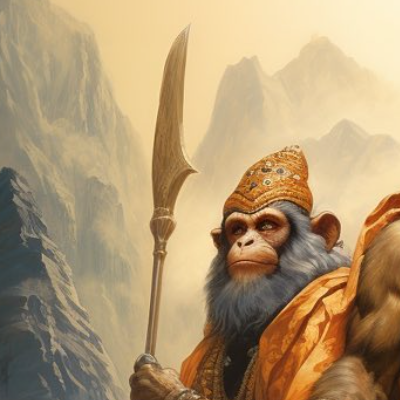
Dvivida is a Vanara hero of Kishkindha who appears first in the Valmiki Ramayana as one of the significant warriors of the Vanara army assembled by Sugriva for the campaign against Ravana, and later — in a narrative of considerable dramatic weight — in the Harivamsa and the Bhagavata Purana as a figure who becomes the antagonist of the god Krishna during the Dvapara Yuga, long after the events of the Ramayana. He is the son of Dasra — one of the two Ashvini Kumara twins, the divine physicians of the gods — and he is the constant companion and paired figure of Mainda, the son of the other Ashvini Kumara twin Nasatya. The two together form one of the most consistently paired warrior dyads of the Vanara world, appearing in virtually every passage of the tradition as a unit rather than as independently developed individual figures. Dvivida, however, achieves a degree of individual narrative prominence that Mainda does not, principally through the Harivamsa episode in which he alone — not Mainda — becomes the primary antagonist of Krishna and meets his death at the hands of the god. This episode, in which a Vanara hero of the Ramayana period who had fought on the side of righteousness in Rama's campaign subsequently causes widespread destruction and is killed by Vishnu's avatar in a later age, is one of the tradition's most striking examples of a figure who spans the boundary between the two great epics and whose long life ends in circumstances radically different from those of his origin.
✦ The Name
The name Dvivida is a Sanskrit compound derived from dvi, meaning two or twice, and vida, derived from the root vid meaning to know or to find. Dvivida therefore means the one who knows twice or the twice-knowing one — a name that suggests double knowledge, double perception, or a quality of knowing that exceeds the ordinary. Some commentators have interpreted the name as carrying the sense of knowing both worlds, or knowing both the upper and lower realms — an interpretation consistent with his character as a being of extraordinary longevity who lives across two cosmic ages. The dvi prefix also connects the name to his identity as one of a pair — the son of one of two divine twins, the companion of another Vanara whose father is the other twin — and the concept of doubleness or twinness runs through his identity at multiple levels.
✦ Lineage
- Father: Dasra — one of the two Ashvini Kumara twins, the divine physicians of the gods. In the Vedic tradition the Ashvini Kumaras are the most celebrated divine healers, invoked in the Rigveda in more hymns than any deity except Indra, Agni, and Soma. Dasra is the name applied to one of the twins in the tradition that distinguishes the two individually; in many Vedic and Puranic passages the twins are addressed collectively without individual differentiation.
- Divine grandfather: In the most widely attested Puranic account, the Ashvini Kumaras are the sons of Vivasvat — the sun god Surya, one of the twelve Adityas born to the sage Kashyapa and his wife Aditi — born from his wife Saranyu in the form of a mare while Vivasvat had taken the form of a horse. In this genealogy, Dvivida is the great-grandson of Kashyapa and Aditi, and a nephew at the divine generational level of all the other Adityas including Indra, Varuna, and Vishnu.
- Companion and paired figure: Mainda — son of Nasatya, the other Ashvini Kumara twin; Dvivida's inseparable companion throughout the Ramayana narrative and in subsequent Puranic appearances; the two are treated as a unit across virtually every passage in which either appears.
- Association with Narakasura: The Harivamsa and Bhagavata Purana record that Dvivida had been a friend of Narakasura — the demon king of Pragjyotisha whom Krishna killed in a celebrated episode — and that it was out of this friendship and the desire to avenge Narakasura's death that Dvivida undertook the destructive acts that led to his own confrontation with Krishna. This association with Narakasura does not constitute a genealogical relationship but is the motivational link that connects Dvivida's post-Ramayana episode to the narrative world of the Bhagavata Purana's Krishna cycle.
✦ The Ashvini Kumaras and Dvivida's Divine Inheritance
The Ashvini Kumaras — Dvivida's father Dasra and his companion Mainda's father Nasatya — are among the most ancient and most frequently invoked deities of the Rigveda. They are the divine physicians of the gods, the healers of the sick and the injured, the rescuers of those in danger, and the restorers of youth and vigour. They travel across the sky in a golden chariot at the twilight hours — the boundary between darkness and light — and their swiftness and beauty are constantly celebrated in the Vedic hymns. Their medical power is their defining characteristic: they restored the sage Chyavana to youth, rescued the quail from the jaws of the wolf, drew the sage Vandana from the pit in which he lay buried, and performed numerous other acts of healing and rescue that the Rigvedic hymns enumerate with evident delight in the variety and ingenuity of the divine physicians' interventions.
Dvivida as the son of Dasra inherits from his divine father a combination of extraordinary vitality, physical resilience, and the potential for both the healing and the harmful dimensions of great power. The Ashvini Kumaras' own character in the Vedic texts is not uniformly beneficent — they are powerful beings whose interventions could be dramatic and not always predictable — and Dvivida's eventual career as a destructive force in the Harivamsa episode may be understood, within the tradition's logic of divine inheritance, as the shadow side of the Ashvini Kumara vitality manifesting without the guidance of righteous purpose.
✦ Dvivida in the Valmiki Ramayana
Dvivida appears in the Valmiki Ramayana in the same passages and contexts as his companion Mainda: in the Bala Kanda's enumeration of the divine origins of the Vanara warriors, in the Kishkindha Kanda's organisation of the search parties and the assembly of forces, and throughout the Yuddha Kanda's battle narrative. He is always named alongside Mainda, and the two fight together as a unit in the engagements of the battle of Lanka. Like Mainda, Dvivida is a significant warrior of the Vanara army but not among the foremost individual heroes in terms of extended personal narrative — his Ramayana role is as part of the collective force of the army, contributing to the general campaign rather than performing a single decisive act that becomes his defining moment in the text.
The same tradition of the Amrita boon that applies to Mainda applies equally to Dvivida: both sons of the Ashvini Kumara twins are said in certain Puranic and commentarial traditions to have received from their divine fathers a portion of the Amrita, the nectar of immortality obtained from the churning of the cosmic ocean, which granted them extraordinary longevity and resilience. This boon is the theological explanation for their survival across the vast span of cosmic time between the Ramayana and the Mahabharata periods.
✦ Dvivida's Depredations — The Harivamsa Episode
The narrative episode that gives Dvivida his most significant individual presence in the tradition is contained in the Harivamsa — the supplement to the Mahabharata — and is repeated with some variation in the Bhagavata Purana's tenth book. The episode is set in the Dvapara Yuga, the cosmic age of the Mahabharata period, long after the Ramayana events of the Treta Yuga. Dvivida had been a friend of the demon king Narakasura, who had ruled the kingdom of Pragjyotisha and whose power had extended across the three worlds until Krishna killed him in the celebrated episode that is one of the major events of the Bhagavata Purana's tenth book. Narakasura's death at Krishna's hands had left Dvivida without his ally and, according to the Harivamsa account, filled him with a grief and rage that he was unable to contain or direct constructively.
Dvivida began to cause widespread destruction in the regions surrounding the Raivataka mountain — a sacred mountain associated with the Yadava clan of Krishna's people. He uprooted forests and threw the trees into the sea, blocking coastal channels and disrupting the fishing communities that depended on them. He demolished villages and towns with his immense physical strength, throwing boulders, redirecting rivers, and in general applying the enormous power of his divine-born Vanara body to the destruction of whatever lay in his path. He also, in the version given by the Bhagavata Purana, disrupted the sacrificial fires of sages performing austerities in the forest, scattered their ritual implements, and defiled their hermitages — acts that constituted a direct assault on the sacred order as well as on the physical world.
The Harivamsa adds a further dimension to Dvivida's misconduct: it records that he used his power to torment human beings in their settlements, abducting women, destroying crops, and rendering large areas uninhabitable. The specific nature of his offences against women is described in terms that the text presents as among the gravest of his transgressions, and it is these offences that most urgently required a divine response.
The tradition does not present Dvivida's destructive turn as inexplicable or as a simple descent into evil. The Harivamsa frames his motivation as grief and loyalty — the rage of a being who had lost a companion to what he experienced as unjust divine violence — and the resulting behaviour as the misdirection of a great power that had lost its moral compass without losing its physical force. This framing gives the episode a degree of psychological coherence: Dvivida is not a demon by nature or origin, and his destructive period is a departure from his earlier character as one of the righteous warriors of Rama's campaign rather than an expression of an essential nature.
✦ The Confrontation with Balarama
The decisive confrontation that ended Dvivida's depredations was not with Krishna directly but with Balarama — Krishna's elder brother and the eighth avatar of Vishnu in some enumerations, identified in the Vaishnava tradition as a partial manifestation of Shesha, the cosmic serpent on whom Vishnu reclines. The Harivamsa and the Bhagavata Purana both give this account with considerable narrative detail.
Balarama had gone to the Raivataka mountain for a period of relaxation and pleasure, accompanied by the women of the Yadava clan. Dvivida, who had been operating in the region of Raivataka, became aware of Balarama's presence and came to disturb him. The specific form of his initial provocation varies between the Harivamsa and the Bhagavata Purana: in the Harivamsa he comes before Balarama and performs various acts of disrespect and mockery; in the Bhagavata Purana the account is more detailed, describing Dvivida making obscene gestures toward the women with Balarama, throwing dust and debris at them, breaking down the trees of the pleasure grove, and laughing contemptuously at Balarama himself. The Bhagavata Purana specifies that Dvivida was in a state of intoxication — having consumed wine — and that his behaviour in this state was without restraint or consideration.
Balarama, roused to fury by the insults to himself and especially by the harassment of the women under his protection, seized his characteristic weapon — the plough — and his club and confronted Dvivida directly. The battle between the two was fierce and extensive. Dvivida was a being of extraordinary physical strength, possessed of the Amrita boon and the divine inheritance of the Ashvini Kumaras, and he had been exercising his destructive power across a wide region for an extended period. He hurled mountains at Balarama, assaulted him with uprooted trees, and deployed the full range of his Vanara fighting techniques — the tree-throwing, rock-hurling, and direct physical assault that characterised the combat style of the great Vanara warriors in the Ramayana battle as well.
Balarama met every assault. He smashed the mountains hurled at him with his club, shattered the trees thrown at him, and gradually wore down Dvivida's offensive capacity through the superior divine force that he embodied as Shesha's manifestation. The final act of the combat, as described in the Bhagavata Purana, involved Balarama striking Dvivida on the head with his club with a force that was decisive and irresistible. Dvivida fell, and as he fell the text describes his body crashing to the earth like a mountain struck by lightning, his great form breaking forests and splitting the ground with the force of his descent. He died from Balarama's blow.
The Bhagavata Purana records that at the moment of Dvivida's death, a shower of flowers fell from the sky — a celestial acknowledgment that accompanies the deaths of great beings in the Puranic narrative convention — and that the assembled gods and sages praised Balarama for the act. The tradition's presentation of Dvivida's death as accompanied by celestial recognition suggests that even in his destructive period he retained a quality of greatness that made his end an event of cosmic significance rather than merely the elimination of a pest.
✦ Theological Significance of the Harivamsa Episode
The Dvivida episode in the Harivamsa and Bhagavata Purana carries several layers of theological significance. At the most immediate level it is a demonstration of Balarama's power as a manifestation of cosmic divine force — the elder of the two brothers who together constitute the full manifestation of Vishnu's presence in the Dvapara Yuga, here acting to protect the innocent and restore order when a great warrior has become a source of destruction rather than protection.
At a deeper level, the episode raises the question of what happens to great power — even power that has been used righteously in a previous age — when the moral context that gave it purpose has dissolved. Dvivida was not an evil being in his origin: he was the son of a divine physician, a participant in the campaign of righteousness against Ravana, a warrior who had served the cause of dharma under Rama's command. His destructive turn in the Dvapara Yuga is presented not as the revelation of a nature that was always evil but as the consequences of unguided, unmoored power — strength that was great enough to reshape the physical world but that had lost the righteous purpose that had previously given it direction. The theological implication is that even great power derived from divine lineage requires the ongoing guidance of dharma and devotion to remain constructive; without that guidance, the same power that had defended the righteous becomes the force that destroys them.
The specific motivation of Dvivida's destructive period — friendship with Narakasura and rage at Narakasura's death — also carries a message about the dangers of attachment to those who are themselves enemies of dharma. Narakasura was a demon king whose depredations had caused suffering across the three worlds, and his death at Krishna's hands was an act of cosmic restoration. Dvivida's grief for Narakasura, and the destructive rage it generated, illustrates the principle that misplaced loyalty — devotion to the wrong cause or the wrong being — is as dangerous as outright wickedness, and that the consequences of such misplaced loyalty ultimately require the same divine correction as deliberate evil.
✦ Textual Variants and Inconsistencies
The Harivamsa and the Bhagavata Purana give broadly consistent accounts of the Dvivida episode but differ in certain details. The Bhagavata Purana's version is more elaborate in its description of Dvivida's specific offences, his intoxicated state at the time of the confrontation with Balarama, and the physical details of the combat. The Harivamsa's version is somewhat more concise in some of these specifics while giving more attention to the motivation of friendship with Narakasura. The two texts agree on the essential narrative: Dvivida's destructive behaviour in the Raivataka region, his confrontation with Balarama, and his death from Balarama's club strike.
As with Mainda, the individual attribution of Dasra specifically as Dvivida's father — as opposed to treating both Vanaras simply as sons of the Ashvini Kumaras collectively — is not universally attested across all passages of the Valmiki Ramayana, and some passages describe Mainda and Dvivida together as Ashvini-putras without distinguishing which twin fathered which son. The specific Dasra-Dvivida and Nasatya-Mainda pairing appears in the genealogical traditions that seek to establish individual paternity for each Vanara, consistent with the tradition's broader project of assigning each significant Vanara a specific divine father.
The question of whether Mainda participated in or was present during Dvivida's destructive period and his death is not consistently addressed across the texts. The Harivamsa and Bhagavata Purana focus on Dvivida in the relevant episode without elaborating on Mainda's whereabouts or actions. Some later traditions have speculated that the two companions were separated before or during this period, which would explain why Mainda — who had always been Dvivida's constant companion — is not present at Dvivida's death, but this is an inference from silence in the primary sources rather than a statement they make themselves.
✦ Connection to the Wider Genealogy
Through his father Dasra and the Ashvini Kumara lineage, Dvivida is connected — in the most widely attested Puranic genealogy — to Vivasvat, the sun god and one of the twelve Adityas born to Kashyapa and Aditi. In this genealogy Dvivida is the great-grandson of Kashyapa and Aditi, and a nephew at the divine generational level of all the other Adityas including Indra, Varuna, and Vishnu. Through Vivasvat's other offspring, Dvivida is a divine cousin of Vaivasvata Manu — the progenitor of the current human race — and of Yama, the lord of the dead; and through Manu's descendants he is a divine cousin of the Ikshvaku royal dynasty including Rama, under whose command he had fought in the Ramayana.
The connection to Balarama — the being who killed him — is also genealogically significant within the framework of the tradition. Balarama as a manifestation of Shesha is an expression of Vishnu, who is himself one of the Adityas and therefore Dvivida's divine uncle through the Kashyapa-Aditi lineage. The cosmic irony of Dvivida — himself a figure of divine lineage who had once fought for Vishnu's avatar Rama — being killed by another manifestation of the same supreme deity in a later age encapsulates the tradition's understanding of the relationship between individual history and cosmic necessity: the same divine power that had empowered him in one age corrects and ends him in another, not because the power has changed but because his alignment with it has.
✦ References
- Primary Sources
- Rigveda (numerous hymns to the Ashvini Kumaras across Books I–X): The foundational Vedic source for the character and domains of the Ashvini Kumaras — Dvivida's divine father Dasra and his companion Mainda's father Nasatya; establishes their identity as divine physicians, twin helpers, and figures of dawn and twilight whose power is both healing and formidable.
- Valmiki Ramayana, Bala Kanda (divine parentage of the Vanaras); Kishkindha Kanda; Yuddha Kanda: The primary narrative source for Dvivida's identity as a son of Dasra, his membership of the Vanara army, and his participation alongside Mainda in the battle of Lanka under Rama's campaign.
- Harivamsa (Vishnu Parva, chapters on Dvivida's depredations and his combat with Balarama): The primary source for the post-Ramayana episode that constitutes Dvivida's most significant individual narrative; contains the account of his destructive behaviour in the Raivataka region, his friendship with Narakasura as the motivating grievance, and the combat with Balarama that ends in his death.
- Bhagavata Purana, Skandha X, Chapter 67 (the Dvivida episode): The most elaborated Puranic version of the confrontation between Dvivida and Balarama; gives detailed descriptions of Dvivida's offences, his intoxicated state, the combat, and Balarama's killing blow; the most important single Puranic source for the episode.
- Vishnu Purana (genealogical passages on the Ashvini Kumaras): Contains the genealogy of the Ashvini Kumaras as sons of Vivasvat, establishing Dvivida's divine lineage through his father Dasra.
- Matsya Purana and Brahma Purana (passages on the Ashvini Kumaras and Vanara genealogies): Additional Puranic sources for the genealogical placement of the Ashvini Kumaras and their Vanara sons.
- Secondary Sources
- Mani, Vettam. Puranic Encyclopaedia (1975): Entries on Dvivida, Mainda, the Ashvini Kumaras, Dasra, Narakasura, and Balarama; essential for cross-referencing the primary sources and for identifying the full scope of Dvivida's appearances across the corpus.
- Macdonell, A. A. Vedic Mythology (1897): Detailed analysis of the Ashvini Kumaras in the Vedic tradition; provides the theological foundation for understanding Dvivida's divine inheritance through his father Dasra.
- Goldman, Robert P. (general editor). The Ramayana of Valmiki: An Epic of Ancient India (Princeton University Press): Critical edition with notes relevant to the divine parentage passages and battle narrative in which Dvivida appears alongside Mainda.
- Bryant, Edwin F. Krishna: A Sourcebook (2007): Contains scholarly discussion of the Krishna cycle narratives in the Bhagavata Purana and Harivamsa, including the episode of Dvivida's defeat by Balarama and its place within the theological structure of the tenth book.
- Wisdomlib (wisdomlib.org), entries on Dvivida, Mainda, the Ashvini Kumaras, Balarama, Narakasura, and the Raivataka episode: Aggregates verse references from digitised primary texts; useful for locating specific passages, tracking variant readings across recensions, and cross-referencing the episode across the Harivamsa and Bhagavata Purana traditions.