
About
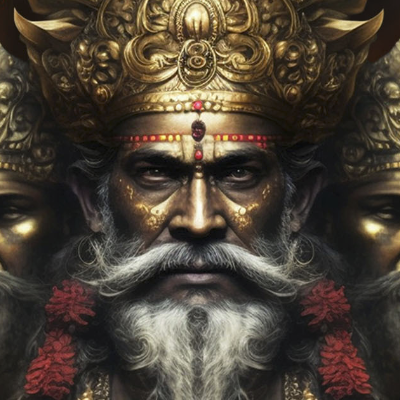
Jambha — Danava King, Grandfather of Prahlada, Slain by Indra
Jambha · Jambhasura · Danava-raja · Kayadhu-pita · Indra-vadhya · Jambhabhedi-hetu
Jambha is a Danava king — a son of Kashyapa and Danu — and the father of Kayadhu, who became the wife of Hiranyakashipu and the mother of Prahlada. He is thus the maternal grandfather of the supreme devotee of Vishnu. His name appears consistently in the Rigveda and in the Puranas as one of the canonical great enemies of Indra — alongside Vritra, Namuchi, Shambara, and Viprachitti — and his death at Indra's hands gave rise to one of Indra's permanent epithets: Jambhabhedi or Jambhabheti — the cleaver of Jambha. He appears in two distinct narrative contexts across the tradition: as the leader of the Asuras who seized the pot of amrita from Dhanvantari during the Samudra Manthana, and as the Asura king who obtained a boon from Brahma allowing him to cause enemies to yawn and grow drowsy in battle — using it to conquer Svarga before Indra eventually slew him with the Vajra. A significant textual note applies to this profile: the Quora source and multiple commentators note the tradition contains several figures named Jambha — killed in different episodes by Indra, Vishnu, Krishna, and Arjuna respectively — and the genealogical Jambha (father of Kayadhu) may or may not be identical with all of these episodic figures.
✦ The Name
The Sanskrit word jambha has two primary meanings: a yawn or gaping mouth — directly relevant to his battle-boon of inducing drowsiness — and also the citron fruit (Citrus medica, sometimes called jambhira). In the Rigveda his name is invoked in the context of Indra's conquests — among the list of demons thrown down from mountain strongholds, defeated in river-battles, or slain in the cosmic wars of the Vedic age. The epithet Jambhabhedi — literally he who splits or cleaves Jambha — is listed among Indra's formal epithets in both the Puranic Encyclopaedia of Vettam Mani (Wisdomlib Indra entry) and in the Amarakosha, the classical Sanskrit lexicon. The epithet confirms his death at Indra's Vajra as a fixed feature of the tradition across multiple textual layers.
✦ Lineage
- Father: Kashyapa — the great Prajapati, son of Marichi; universal progenitor of all living beings
- Mother: Danu — daughter of Daksha; one of Kashyapa's wives; mother of the Danava race; her hundred sons collectively called the Danavas
- Brothers (co-Danavas): Vritra (the great serpentine obstructor of the waters), Viprachitti (king of the Danavas, husband of Simhika), Namuchi, Shambara, Sushna, Pipru, and numerous others — the hundred sons of Kashyapa and Danu
- Daughter: Kayadhu — who married Hiranyakashipu the Daitya king and became the mother of Prahlada; the Bhagavata Purana (6.18.12) identifies her explicitly as daughter of Jambha and a descendant of Danu
- Grandson (through Kayadhu): Prahlada — one of the twelve Mahajanas, supreme devotee of Vishnu, king of the Asuras
- Great-grandson: Virochana — son of Prahlada
- Great-great-grandson: Mahabali — son of Virochana, the magnanimous Asura king
✦ Among the Great Danavas of the Rigveda
The Manastaramgini source — drawing on the most ancient layers of Vedic and Puranic tradition — records Jambha in a list of the major Danavas known in the Rigveda whose deaths at Indra's hands are among the oldest mythological acts in the Hindu canon. The list includes Vritra, Vala, Namuchi, Shambara, Sushna, Pipru, Kuyava, Aurnavabha — and then, added by the epics: Naraka and Jambha, slain by Indra probably assisted by Vishnu. The Mahabharata's Drona Parva (7.77.17) records — as cited in the Wisdomlib Purana Bulletin entry: in the struggle of gods and asuras of old, Indra slew Jambha. This confirms Jambha's death as a fixed point in the epic tradition. His inclusion in the Rigveda-era lists of Indra's opponents — alongside Vritra and Vala — establishes him as one of the oldest named adversaries in the Hindu tradition, pre-dating the full elaboration of the Puranic narrative cycles.
✦ The Boon — Inducing Drowsiness in Battle
The Trinitygods Blogspot source — drawing from the Devi Bhagavata Purana — records Jambha's battle-boon: he performed tapasya to Brahma and received the power that any enemy who faced him in battle would begin to yawn and grow drowsy and could be overcome easily. Armed with this boon he defeated all the Devas and became king of Indraloka — the celestial realm — driving Indra from his throne. Indra went to Narada for counsel. Narada advised him to seek Dattatreya's help. Dattatreya invited Jambha to battle at his ashrama, where his single divine glance weakened all the Daityas who entered it. With their power diminished, Indra engaged Jambha directly and killed him with his Vajra. The Select Puranas source (Kamakoti) lists Jambha among the worst of the Danavas — alongside Shambhara, Maya, Tarakasura, Naraka, and Pralamba — describing them as beings with great passion for destroying yajnas, shraddhas, children, and cows.
✦ The Amrita Episode — Seizing the Nectar
The Harivamsa — the supplement to the Mahabharata — records a separate episode in which Jambha appears as the leader of the Asuras who seized the pot of amrita from Dhanvantari when it emerged from the Samudra Manthana. The Hindu Blog source summarises: as Dhanvantari rose from the cosmic ocean bearing the pot of nectar, Jambha seized it on behalf of the Asuras. The Asuras were overjoyed. But Vishnu took the form of Mohini — the enchanting woman — and beguiled the Asuras into letting Mohini distribute the nectar equitably. Mohini gave it only to the Devas. When the Asuras realised the deception, Jambha led them into a furious battle against the Devas. Indra confronted Jambha directly and struck him with the Vajra, killing him. Whether this Harivamsa episode of Jambha seizing the amrita at the Samudra Manthana is the same Jambha as the Devi Bhagavata's Jambha who obtained the yawning-boon is not explicitly reconciled in the primary texts — the two may be the same figure described in different episodes, or two figures of the same name collapsed in the tradition.
✦ The Multiplicity Problem — Several Figures Named Jambha
The Quora source raises a genuine textual difficulty: across the Puranas and epics there appear to be multiple Asura figures named Jambha. The Mahabharata records Jambha slain by Indra. The Harivamsa records Jambha as the Asura leader who seized the amrita. The Bhagavata Purana identifies Jambha as the father of Kayadhu. The Mahabharata also records Krishna and Arjuna each killing Asuras named Jambha in separate episodes. Whether all of these are the same figure — one great Danava whose single story has been fragmented across texts — or different beings who share the name, is a question the primary sources do not resolve. The most genealogically certain identification is the Bhagavata Purana's: Kayadhu, wife of Hiranyakashipu, was the daughter of the Danava Jambha who was killed by Indra. This is confirmed by the Manastaramgini scholarly source which cites Bhagavata Purana 4.18.12 in this context.
✦ Jambha in the Mahabharata — A Reference Figure for Heroic Combat
The Wisdomlib Wisdomlib concept entry on Jambha confirms that the name appears repeatedly in the Mahabharata and the Puranas as a standard reference for an Asura defeated in glorious combat. The celestials praised Indra when he triumphed over this Asura — a phrase that mirrors the praise directed toward Krishna for his own victories. In the Drona Parva, Jambha is referenced as a measure of combat ferocity: an enemy who is violently slain on a hillock, against whom Ekalavya in his final stand is compared. This function — as the canonical type of the great fallen Asura — means Jambha's name continued to be invoked throughout the epic tradition long after his own narrative episode was fixed.
✦ Significance in the Lineage
Jambha occupies a quietly paradoxical position in the genealogy of this lineage. He is one of the ancient canonical enemies of Indra — listed in the Rigveda's oldest conquest-lists, his death one of the defining acts of the Vedic god. And yet through his daughter Kayadhu, he is the maternal grandfather of Prahlada — the supreme devotee of Vishnu, the being whose life became the tradition's central statement that divine grace transcends lineage entirely. The Danava king slain by Indra became the ancestor of the Asura whom Indra himself tried to kill in Kayadhu's womb — and failed, because Narada intervened. The family of the Vedic demon produced the greatest devotee in all of Puranic literature. This genealogical irony is embedded in the Bhagavata Purana's precise wording of the verse that names Kayadhu: she is Jambha's daughter, a Danavi — her lineage from the ancient enemy of the gods recorded with full clarity at the very moment the tradition introduces her as the vessel through whom the world's greatest lover of God was born.
✦ References
- Rigveda — among the earliest textual layers: Jambha listed alongside Vritra, Shambara, Namuchi, and others as one of the great Danavas conquered by Indra in the Vedic cosmic wars; his name in Indra's conquest-lists establishes him as one of the oldest named adversaries in the Hindu tradition
- Bhagavata Purana (6.18.12) — the primary genealogical locus: Kayadhu was the daughter of Jambha and a descendant of Danu; confirming Jambha as a Danava and as the father of Hiranyakashipu's wife
- Mahabharata — Drona Parva (7.77.17): in the struggle of gods and asuras of old, Indra slew Jambha; the Mahabharata's earliest and most direct confirmation of his death at Indra's hands; additional references across the Drona Parva and Shanti Parva using Jambha as a type-figure for Asura combat
- Harivamsa (supplement to the Mahabharata) — Jambha as leader of the Asuras who seized the amrita from Dhanvantari at the Samudra Manthana; his battle with Indra; death by the Vajra; Indra's title Jambhabhedi established through this victory
- Devi Bhagavata Purana — Jambha's boon from Brahma granting him the power to induce yawning and drowsiness in enemies; conquest of Svarga; Indra's appeal to Narada and Dattatreya; defeat and death by Indra's Vajra at Dattatreya's ashrama
- Puranic Encyclopaedia (Vettam Mani) — Jambhabhedi listed as a formal epithet of Indra, derived from his slaying of Jambha; confirming the death as a fixed canonical event across the tradition
- Amarakosha (classical Sanskrit lexicon) — Jambhabhedi and Jambhabheti listed among Indra's epithets
- Manastaramgini (scholarly blog, July 2013) — the most rigorous scholarly treatment: Bhagavata Purana 4.18.12 cited for Kayadhu as Jambha's daughter; Jambha listed among the great Danava enemies of Indra in both Vedic and epic tradition; identified as slain by Indra probably assisted by Vishnu
- Wisdomlib — Jambha (concept); Wisdomlib — Asura Jambha (concept); Hindu Blog — Story of Demon Jambha; Mahapurana.com — Jambha; Trinitygods Blogspot — Jambhasura; Quora — Who was Jambhasura: modern summaries drawing from the above primary sources