
About
Kesari — Son of Brihaspati, King of Sumeru, Husband of Anjana, and Earthly Father of Hanuman
Kesari · Kesarin · Brihaspatinandana · Anjanapati · Hanumat-pita · Kesarinandana-pitri · Shambasadana-nihatri · Sumereadhipati
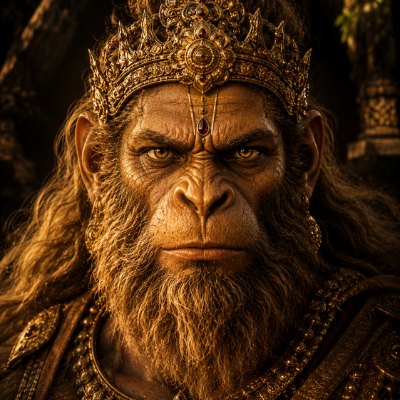
Kesari is a vanara king — a mighty warrior chief of the vanara race — identified in the Valmiki Ramayana's Yuddha Kanda as the son of Brihaspati, the divine preceptor of the gods and the deity identified with Jupiter in the Navagraha system. He is the husband of Anjana — the Apsara Punjikastala reborn in vanara form under a curse — and the earthly father of Hanuman, the great vanara devotee of Rama and the hero of the Sundara Kanda. Kesari is described in the Valmiki Ramayana's Kishkindha Kanda as one of the foremost among the vanara chiefs assembled to serve Sugriva and Rama — a figure of wisdom, illustrious standing, and radiant physical appearance described as possessing a lotus-filament hue and a countenance as radiant as the rising sun. He and Anjana together performed intense austerities directed toward Shiva in order to obtain a child, and from the divine intervention of Vayu the wind god — carrying the power of Shiva into Anjana's womb — Hanuman was born as their son. Before Hanuman's birth, Kesari performed the celebrated act of killing the demon Shambasadana at a sacred shrine near Gokarna mountain by the seashore — a deed accomplished at the behest of the gods and sages who were being persecuted by that demon, and one that established Kesari's reputation as a warrior of exceptional power and dharmic commitment. He participated in the Ramayana's Lanka war as part of Rama's vanara army, arriving at Kishkindha as one of the senior chieftains responding to Sugriva's summons. Through Hanuman — who takes the epithet Kesarinandan, the son of Kesari — his name is permanently embedded in the devotional tradition of Hanuman worship across the entire tradition. Kesari appears in the Valmiki Ramayana's Kishkindha Kanda and Yuddha Kanda, and in Puranic and secondary sources dealing with Hanuman's genealogy.
✦ The Name
The name Kesari derives from the Sanskrit kesara or kesarin — meaning "the maned one," "he who has a mane," or more specifically "lion," since the lion is the most prominent maned creature in the tradition's iconographic world. The word kesara also means a filament — the stamens of a flower — and the Valmiki Ramayana's physical description of Kesari specifically uses the lotus-filament comparison for his bodily gleam, suggesting that the name resonates with both the lion-mane and the flower-filament meanings simultaneously. As a name for a vanara king, Kesari most naturally carries the lion-connotation — a maned, powerful, commanding figure — while the physical description in the text plays on the lotus-filament meaning. The patronymic Brihaspatinandana means "son of Brihaspati." Anjanapati means "husband of Anjana." Hanumat-pita means "father of Hanuman." Shambasadana-nihatri means "the killer of Shambasadana." Sumereadhipati means "lord of Sumeru."
✦ Lineage
- Father: Brihaspati — the divine preceptor of the gods, son of Angiras, lord of sacred speech and wisdom, and the deity identified with Jupiter in the Navagraha system. The identification of Kesari as Brihaspati's son is given in the Valmiki Ramayana's Yuddha Kanda and confirmed in secondary sources citing this passage. This identification places Kesari in the Angirasa divine lineage — making him a half-brother of Bharadvaja and connected to the same tradition that produced Drona and Ashvatthama in the Mahabharata. Brihaspati's biography is given separately in this series.
- Wife: Anjana — the Apsara Punjikastala who was cursed to be born on earth in vanara form and who was liberated from that curse at the moment of Hanuman's birth. She was the daughter of the vanara chief Kunjara in her earthly existence. Her biography is given separately in this series.
- Son: Hanuman — born of Anjana through the divine power of Vayu, carrying the cosmic energy of Shiva as transmitted through the wind god, and accepted by Kesari as his earthly son. Hanuman is the great vanara devotee of Rama, the Chiranjivi who is present wherever the Ramayana is recited, and the figure who takes the epithet Kesarinandan — son of Kesari — alongside his maternal epithet Anjaneya and his divine epithet Vayuputra. From Hanuman's compound identity — Kesari's earthly son, Anjana's womb-born child, Vayu's divine offspring — Kesari's name enters the devotional tradition as one of the three paternal dimensions of Hanuman's celebrated identity.
✦ Kesari's Other Sons — The Five Brothers of Hanuman
The Brahmanda Purana records that Kesari fathered five additional sons beyond Hanuman — making Hanuman the eldest of six brothers in total. The five younger brothers are named as Matiman, Shrutiman, Ketuman, Gatiman, and Dhritiman — with some accounts giving the fifth as Dyutiman rather than Dhritiman, reflecting a variant transmission of the name across different sources. All five are described in the tradition as having lived full lives with wives and children, continuing the Kesari dynasty into subsequent generations. The primary source does not give any of the five brothers an independent narrative episode in the surviving accessible passages — no individual deed, battle, or philosophical act is attributed to any one of them separately. Their significance in the tradition is genealogical: they establish that the Kesari lineage had continuity and breadth beyond the singular figure of Hanuman, and that Hanuman's earthly family was a dynasty rather than a single extraordinary individual standing alone.
The names of the five brothers each carry a distinctive Sanskrit meaning that the tradition reads as encoding the quality of the brother designated. Matiman means "the wise one" or "he of good mind," from mati (intelligence, wisdom, understanding). Shrutiman means "the learned one" or "he of excellent hearing," from shruti (what has been heard, the Vedic canon) — a name that associates the second brother with sacred learning and the Vedic tradition. Ketuman means "the radiant one" or "he of the banner," from ketu (brightness, a flag or banner, a comet) — a name of luminous distinction. Gatiman means "the swift one" or "he of excellent movement," from gati (movement, gait, course) — a name that associates the fourth brother with speed and directness of action. Dhritiman means "the steadfast one" or "he of firm resolve," from dhriti (steadfastness, fortitude, resolution) — a name encoding the quality of endurance and commitment. The tradition notes that these five qualities — wisdom, learning, radiance, swiftness, and steadfastness — are themselves appropriate qualities for the brothers of a being in whom all these qualities were present in their supreme form.
It should be noted that the Brahmanda Purana passages recording the five brothers have not been independently verified with a specific chapter and verse reference in any of the scholarly secondary sources consulted for this research series. The attribution to the Brahmanda Purana is consistent across multiple independent popular and devotional sources and is treated as a legitimate Puranic tradition on the basis of that convergent attestation. The question of the mother of the five brothers is not resolved in the primary sources accessed — the Brahmanda Purana passages as cited in secondary sources do not name a mother separately from Anjana for the five younger sons, and the detail of a second wife has not been confirmed in any primary Puranic text consulted for this profile.
✦ The Killing of Shambasadana
The primary deed attributed to Kesari in the tradition — beyond his role as Anjana's husband and Hanuman's earthly father — is the killing of the demon Shambasadana at a sacred shrine near Gokarna mountain by the seashore. The Puranic and secondary sources recording this episode describe the demon Shambasadana as a being of great destructive power who was persecuting the sages and holy men who resided in and around the Gokarna shrine — a sacred site associated with Shiva in the tradition's pilgrimage geography. The gods and sages, unable to protect themselves from the demon's violence, appealed for a warrior capable of defeating Shambasadana. Kesari responded to this appeal and engaged the demon in combat at the sacred site. The fight was fierce but Kesari's exceptional martial power prevailed and Shambasadana was killed.
This episode establishes several things about Kesari's character and standing simultaneously. It demonstrates his martial power — he was capable of defeating a demon that the gods and sages could not handle. It demonstrates his dharmic commitment — he fought not for personal gain or glory but in response to an appeal on behalf of innocent ascetics being persecuted. And it connects him to the Shaiva sacred geography of the Gokarna shrine — the same sacred landscape associated with Shiva at whose feet Kesari and Anjana later performed their austerities for a son, and who granted them the boon of Hanuman's birth. The killing of Shambasadana at Gokarna and the austerities at Gokarna for Hanuman's birth are thus part of the same sacred geography in Kesari's biography, giving that landscape a double significance in his life.
✦ The Austerities for Hanuman and the Marriage to Anjana
The tradition records that Kesari and Anjana lived together for a period without children. The Puranic accounts state that Kesari used to wander to different holy places before Hanuman's birth — a devotional practice of visiting sacred tirthas — and that wherever he found a place of scenic and spiritual beauty he would sit in long meditation. This portrait of Kesari as a wandering ascetic-warrior — combining the martial standing of a vanara king with the devotional practice of pilgrimage and meditation — is consistent with his lineage as Brihaspati's son: the divine preceptor's offspring who carried into the vanara world the combination of sacred learning and martial power that characterised his father's tradition.
Kesari and Anjana together performed austerities directed toward Shiva, seeking the boon of a son. Shiva was pleased with their combined devotion and granted the boon — directing the fulfilment of the boon through Vayu the wind god, who would carry the divine power into Anjana's womb. This joint performance of austerities — husband and wife together in sustained devotional practice — gives Kesari and Anjana's relationship a dimension of shared spiritual purpose that the tradition presents as the appropriate foundation for the birth of an extraordinary being. Hanuman was not born of chance or of merely physical union but of the concentrated devotional energy of two beings — one a warrior of divine lineage, the other an Apsara of divine origin born in earthly form — who turned their combined will toward the divine.
✦ Physical Description in the Valmiki Ramayana
The Valmiki Ramayana's Kishkindha Kanda describes Kesari's physical appearance with specific and distinctive imagery when he arrives among the vanara chiefs at the assembly convened by Sugriva to serve Rama. He is described as wise and illustrious — foregrounding his qualities of mind and standing before his physical description. He is described as possessing a bodily gleam resembling lotus fibrils — the thin golden-cream filaments of the lotus flower — a comparison that gives his complexion a quality of luminous warmth. His countenance is described as radiant like the early morning sun — the specific quality of dawn light, which is warm, auspicious, and life-giving rather than the harsh brightness of midday. He arrives accompanied by thousands of monkeys, indicating the scale of his command and the authority he carries within the vanara social world.
This description places Kesari among the most visually distinguished of the vanara chiefs in the assembly — the lotus-filament gleam and the dawn-sun countenance are among the most positively valenced physical comparisons available in the Sanskrit poetic vocabulary. The description functions both as a literal physical portrait and as a marker of his moral and spiritual standing — in the tradition's consistent visual vocabulary, luminosity and warmth of appearance signal inner virtue.
✦ Kesari's Participation in the Lanka War
The Valmiki Ramayana confirms that Kesari fought on Rama's side in the Yuddha Kanda — the war against Ravana. He is among the vanara chiefs who responded to Sugriva's summons when Sugriva organised the vanara armies to serve Rama's mission. He also participated in the southern search party — the Kishkindha Kanda records that Hanuman was joined by Angad, Nala, Kesari, and Jambavan among others as they headed south toward the ocean. Kesari's presence alongside his son Hanuman in the southern search party — the very search that led to Hanuman's discovery of Sita in Lanka — gives him a direct connection to the Ramayana's most decisive episode, even though it is Hanuman alone who makes the great leap across the ocean. Kesari's role in the war's battles is not narrated in individual episode form in the primary texts — he is among the senior commanders of the assembled vanara forces rather than the subject of an independent battle narrative.
✦ Kesari's Connection to Brihaspati and the Angirasa Lineage
The identification of Kesari as Brihaspati's son — confirmed by the Valmiki Ramayana's Yuddha Kanda — is one of the most theologically significant genealogical facts in his biography. Brihaspati is the lord of sacred speech, the divine preceptor of the gods, and the son of Angiras who is one of the primordial mind-born sons of Brahma. By placing Kesari within the Angirasa divine lineage — the same lineage that produced the Rigvedic hymn tradition, the sages Utathya and Dirghatamas, and through Brihaspati's son Bharadvaja the teacher Drona and his son Ashvatthama — the tradition establishes that the vanara world of Kishkindha is not entirely separate from the brahminical divine world of the Vedic tradition but is connected to it through genealogical bonds.
The further theological implication is that Hanuman — already the son of Vayu and the cosmic embodiment of Shiva's power — carries through Kesari's paternity the sacred learning tradition of Brihaspati and Angiras into the vanara world. The greatest of all devotees thus inherits from his earthly father the lineage of the greatest of all divine teachers, giving his devotional intelligence a genealogical grounding in the divine intellectual tradition as well as in the cosmic power traditions of Shiva and Vayu through which he came to exist.
✦ Kesarinandan — the Name That Perpetuates Kesari in the Devotional Tradition
The epithet Kesarinandan — "the son of Kesari" — is one of the most frequently used names of Hanuman in the devotional tradition, appearing in hymns, the Hanuman Chalisa, and devotional invocations across the entire tradition. During Hanuman Jayanti celebrations the name Kesarinandan is specifically invoked, and the recitation of the Hanuman Chalisa uses this epithet to invoke blessings for strength and devotion. This perpetual invocation of Kesari's name through the most personal epithet of the greatest devotee ensures that Kesari's identity is present wherever Hanuman is worshipped — which is to say, across virtually the entire breadth of the Hindu tradition's devotional geography. Kesari thus achieves through his son a kind of presence in the tradition that far exceeds what his own biographical narrative would suggest — the father who is forever named in the name of the most universally beloved of all Rama's devotees.
✦ Textual Variants and Inconsistencies
The Kanda in which Kesari's Brihaspati-son identity is given: The primary source identification of Kesari as Brihaspati's son is given in the Yuddha Kanda of the Valmiki Ramayana rather than in the Kishkindha Kanda where Kesari first appears physically. Some regional and vernacular retellings of the Ramayana do not emphasise this genealogical identification and treat Kesari simply as a vanara king without specifying his divine parentage. The Valmiki text's own statement in the Yuddha Kanda is the canonical primary source.
Kesari as king of Sumeru: Some accounts identify Kesari specifically as the king of the Sumeru mountain — a designation that gives him a specific territorial authority within the vanara world corresponding to the sacred mountain that is the axis of the cosmos in the tradition's geographical imagination. Other accounts are less specific about his territorial identity. The Sumeru association is found in secondary sources and regional traditions rather than in the most specific language of the Valmiki Ramayana's passages about him.
The mechanism of Hanuman's conception in the Valmiki Ramayana's Kishkindha Kanda sarga 66: The Valmiki Ramayana's Kishkindha Kanda gives an account of Anjana and Vayu's encounter that differs from the more elaborated Puranic accounts — specifically, the Kishkindha Kanda passage describes Vayu lifting Anjana's garments as she walked on a mountaintop and beholding her form, and the seed of Vayu thus entering her. This is a different and more physically immediate account of the conception than the accounts in the Shiva Purana or in Eknath's Bhavartha Ramayana. Kesari's role in all these accounts is as the earthly father who accepted the divinely conceived child as his own — this dimension of his paternity is consistent across all versions.
✦ Theological and Narrative Significance
Kesari's theological significance operates through two complementary dimensions. The first is genealogical and cosmological — as the earthly father of Hanuman and as Brihaspati's son, he provides the human-scale vanara lineage through which the cosmic being Hanuman was anchored in the earthly world of Kishkindha, its social structures, its warrior traditions, and its political relationships with Sugriva and Rama's mission. Without an earthly father, Hanuman would be purely a divine being descending into the world rather than a being born of it; Kesari's paternity gives Hanuman roots in the vanara earth alongside his roots in the divine sky of Vayu and Shiva.
The second dimension is devotional — through the epithet Kesarinandan, Kesari's name is perpetually invoked in Hanuman's devotional worship across the entire tradition. In this devotional dimension Kesari functions not merely as a genealogical fact but as a permanent component of Hanuman's identity that devotees invoke when they seek from Hanuman the qualities of earthly courage, parental protection, and the strength of the warrior king — qualities that Kesari embodied in his killing of Shambasadana, his austerities for a son, and his participation in Rama's war against Ravana.
✦ Connection to the Wider Genealogy
Through his father Brihaspati and grandfather Angiras, Kesari descends from the primordial creative line of Brahma through the Angirasa lineage — one of the most ancient and prolific of the Vedic sage traditions. Through his wife Anjana — daughter of the vanara chief Kunjara — he is embedded in the vanara social world of the Kishkindha tradition. Through his son Hanuman — the Chiranjivi who is present wherever the Ramayana is recited — Kesari's paternal identity extends across all times and all places where Hanuman's devotion is active. Through Vayu's divine paternity of Hanuman, Kesari shares the paternal relationship with the wind god who is elsewhere the father of Bhima the Pandava — making Hanuman and Bhima both Vayu's sons through different human mothers, and thus making Kesari and Kunti the earthly parents through whom the same divine father produced his two most celebrated earthly offspring in the tradition's two great epics. The connection between Kesari's household in the Ramayana and Kunti's household in the Mahabharata through their shared divine son-father relationship with Vayu is one of the tradition's quiet structural symmetries across its two great epics.
✦ References
Primary Sources
- Valmiki Ramayana, Kishkindha Kanda, sarga 39: Kesari's arrival among the vanara chiefs assembled at Kishkindha to serve Sugriva and Rama — describes his physical appearance as possessing a lotus-filament bodily gleam and a countenance radiant like the rising sun, his wisdom and illustrious standing, and his command of thousands of vanara followers.
- Valmiki Ramayana, Kishkindha Kanda, sarga 66: Jambavan's narration of Hanuman's birth — identifies Anjana as Kesari's wife Punjikastala reborn in vanara form, and confirms Hanuman as "Kesari's son through his wife" alongside being the lineal son of the wind god.
- Valmiki Ramayana, Yuddha Kanda: The passage that identifies Kesari explicitly as the son of Brihaspati — the most authoritative primary source for his divine parentage; confirms his participation in the Lanka war on Rama's side.
- Valmiki Ramayana, Kishkindha Kanda, sarga 44–45 (southern search party): Confirms Kesari's participation in the southern search party alongside Hanuman, Angad, Nala, and Jambavan — placing him in the same company during the search that culminated in Hanuman's discovery of Sita.
- Skanda Purana and related Puranic accounts of the Shambasadana episode: The primary sources for the narrative of Kesari's killing of the demon Shambasadana at the Gokarna sacred shrine at the behest of the gods and sages; establishes his martial credentials and dharmic commitment independent of his paternal role.
Modern Reference Works
- Vettam Mani, Puranic Encyclopaedia (1975): Entry on Kesari; identifies his position as Brihaspati's son, his marriage to Anjana, and his role as Hanuman's earthly father; notes the Shambasadana episode and his participation in the Lanka war.
- Robert P. Goldman and Sally J. Sutherland Goldman (translators), The Ramayana of Valmiki — Kishkindha Kanda (1994): Critical translation with scholarly notes on the vanara assembly passages and the Hanuman origin narrative in sarga 66; the most authoritative English-language treatment of the primary source passages in which Kesari appears.
- Philip Lutgendorf, Hanuman's Tale: The Messages of a Divine Monkey (2007): The most comprehensive modern scholarly study of the Hanuman tradition; contains discussion of Kesari's role in the birth narrative, the significance of the triple paternity, and the devotional invocation of Kesarinandan across the tradition's hymnic and ritual literature.