
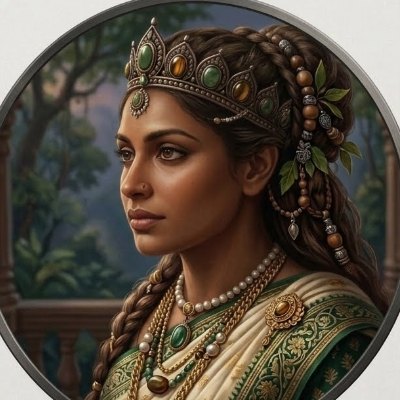
About
Ruma — Wife of Sugriva and Queen of Kishkindha
Ruma · Ruma Vanari · Sugriva-patni
Ruma is the principal wife of Sugriva — the king of Kishkindha, son of the sun god Surya and younger brother of Vali — and one of the senior queens of the Vanara royal household. She appears in the Valmiki Ramayana as a named but narratively undeveloped figure whose significance in the text is primarily structural and moral: her seizure by Vali when he expelled Sugriva from Kishkindha is cited by Rama as one of the specific injustices that justify his killing of Vali, and her restoration to Sugriva is among the explicit terms of the alliance between Rama and Sugriva that drives the entire second half of the epic's action. Beyond this structural role, Ruma receives no independent narrative episodes, no extended speeches, and no characterisation of her individual qualities in the Valmiki Ramayana or in any of the principal Puranic texts that engage with the Ramayana tradition. She is named, her relationship to Sugriva is established, the injustice of her seizure by Vali is recorded, and her restoration is implied by the resolution of the Kishkindha episode — but the primary sources do not develop her as an individual beyond these facts. This profile records what is attested with complete transparency about the limits of the evidence, without supplementing the absence of narrative with inference or invention.
✦ The Name
The name Ruma is of uncertain etymology within the Sanskrit tradition, and the primary sources do not provide an explicit derivation or gloss for it. Some commentators have connected it to forms meaning bright, pure, or radiant — qualities consistent with the tradition's general association of noble Vanara women with beauty and luminosity — but these derivations are not established with certainty in the primary sources. The name Ruma appears across the major manuscript traditions of the Valmiki Ramayana without significant variant spelling, suggesting that it is a settled name within the tradition rather than a variant or corruption of another form. It is a relatively uncommon name in the Sanskrit literary tradition outside of the Ramayana context, and its primary identification in the tradition is entirely with Sugriva's wife.
✦ Lineage
- Husband: Sugriva — king of Kishkindha; son of the sun god Surya (Vivasvat), one of the twelve Adityas born to the sage Kashyapa and his wife Aditi; younger brother of Vali; Rama's principal Vanara ally in the campaign against Ravana; restored to his kingdom and to Ruma through Rama's killing of Vali.
- Father (not recorded): The primary sources do not name Ruma's father or provide any information about her parentage or the family into which she was born. This information is entirely absent from the Valmiki Ramayana and from the principal Puranic treatments of the Ramayana tradition.
- Brother-in-law (by Sugriva's fraternal relationship): Vali — the elder brother of Sugriva and the previous king of Kishkindha; son of Indra the king of the gods; the being who seized Ruma when he expelled Sugriva from Kishkindha, keeping her in his household during the years of Sugriva's exile on Rishyamuka. Vali's seizure of Ruma is presented in the Valmiki Ramayana as one of the specific moral offences that Rama invokes to justify his killing of Vali — the taking of a younger brother's wife being classified in the text's moral framework as an act equivalent to a grave form of transgression against the familial and social order.
- Co-wife: Tara — daughter of Sushena the Vanara elder and physician; widow of Vali; married to Sugriva after Vali's death. Ruma and Tara are co-wives in the Kishkindha royal household after the Ramayana's Kishkindha Kanda events are resolved, though the primary sources do not describe any interaction between them or develop the dynamics of this domestic arrangement.
✦ Ruma's Structural Role in the Narrative
Although Ruma is not given individual narrative development in the Valmiki Ramayana, her situation occupies a structurally significant position in the moral argument that underlies the alliance between Rama and Sugriva and, through that alliance, the entire campaign against Ravana. Understanding this structural role requires understanding how the tradition of the text deploys the injustice done to Ruma within its ethical framework.
When Vali expelled Sugriva from Kishkindha following the misunderstanding over the cave of Mayavi, he did not merely take the kingdom from his brother. He also took Ruma — Sugriva's wife — into his own household, keeping her there through the entire period of Sugriva's exile. This act is treated by the Valmiki Ramayana's moral discourse as a specific and grave offence: in the tradition's articulation of social and familial order, a man's wife is inviolable to his brothers, and the appropriation of a younger brother's wife by an elder brother is a transgression of the dharmic order governing family relationships. Rama, when Sugriva presented his case against Vali, cited this seizure of Ruma alongside Sugriva's expulsion from the kingdom as the specific injustices that made Vali a worthy target of royal correction.
There is a structural irony in the Kishkindha Kanda that the tradition acknowledges without fully resolving: the same moral argument that Rama used to justify killing Vali for taking Sugriva's wife Ruma — the inviolability of a brother's wife — would by the same logic apply to Sugriva's subsequent marriage to Tara, the widow of Vali. Sugriva married Tara after Vali's death, and Tara had been Vali's wife, making her — in the framework of the tradition's familial prohibitions — a figure whose appropriation by Sugriva could be viewed in the same moral category as Vali's appropriation of Ruma. Several commentarial traditions have noted this symmetry, and the Valmiki Ramayana does not address it with the same moral weight it gives to the Ruma case, treating Sugriva's marriage to Tara as an established fact without the extended moral discussion that accompanies the Ruma injustice. The asymmetry in the text's treatment of the two situations has been a subject of commentarial attention across the tradition's history.
The restoration of Ruma to Sugriva is implied by the resolution of the Kishkindha episode — once Vali was dead and Sugriva was restored to the kingdom, the conditions that had separated them were removed — but the Valmiki Ramayana does not narrate a specific scene of reunion between Sugriva and Ruma comparable to the reunion of Rama and Sita after Lanka's fall. Ruma's return to her position as Sugriva's queen is treated as a structural resolution rather than a narrative event with its own emotional development.
✦ Ruma's Condition During the Years of Vali's Possession
The Valmiki Ramayana does not describe Ruma's experience, emotional state, or conduct during the years she spent in Vali's household while Sugriva was in exile. Her perspective on her situation — whether she was there under coercion or under conditions of some accommodation, whether she sought contact with Sugriva, whether she was treated well or poorly within Vali's court — is entirely absent from the text. The primary sources are silent on every aspect of Ruma's interior life during this period.
What the text does record is the fact of her situation — that she was in Vali's possession — and the moral weight it attaches to that fact through Rama's invocation of it as a justification for Vali's killing. Ruma is present in the moral argument as the wronged party without being present as a speaking subject with her own voice in the narrative. Her situation is narrated from the outside — from the perspective of what was done to her and of the obligation that wrong created — not from the inside.
This characteristic of Ruma's narrative position — being morally central to the argument while being personally absent from the narrative — reflects a broader pattern in the Valmiki Ramayana's treatment of several female figures whose situations are invoked as the grounds for male characters' actions without those female figures being given independent voice or developed interiority. Ruma belongs to this category more completely than almost any other named figure in the text — even Sita, whose abduction is the entire premise of the epic, is given extensive narrative development and individual voice that Ruma is not given.
✦ Ruma in Later Traditions
In the regional and vernacular retellings of the Ramayana across South and Southeast Asia, Ruma's treatment varies considerably. In some regional traditions, she is given slightly more narrative presence — a brief scene of reunion with Sugriva, a line or two of expressed feeling during the events of the Kishkindha Kanda — but she nowhere receives the extended individual development that Tara receives in the same tradition. Her role as Sugriva's first wife and the wronged party of the Vali episode is acknowledged across virtually every retelling that treats the Kishkindha episodes with any fullness, but the development of her character beyond that acknowledgment remains minimal.
The Tamil Kamba Ramayana, one of the most celebrated of all regional retellings and one that gives considerable attention to several female figures not fully developed in the Valmiki text, does not significantly expand Ruma's role beyond what the Valmiki Ramayana establishes. The Adhyatma Ramayana, which frames the entire narrative within a Vaishnava devotional theology, similarly does not develop Ruma as an individual figure. This consistency of relative underdevelopment across both the Sanskrit and regional vernacular traditions suggests that the tradition as a whole found Ruma's narrative role complete as it stood — a moral marker rather than a narrative protagonist.
✦ Textual Variants and Inconsistencies
The name Ruma is consistent across the major manuscript traditions of the Valmiki Ramayana without significant variant. The northern and southern recensions agree on her identity as Sugriva's wife, the fact of her seizure by Vali, and its role in the moral argument for Vali's killing. There are no major textual inconsistencies concerning Ruma across the primary sources — the consistency of her minimal narrative presence is itself a textual fact rather than an area of manuscript variation.
The question of Ruma's parentage — not addressed in the Valmiki Ramayana — is equally absent from the Puranic treatments of the Ramayana tradition. Neither the Bhagavata Purana, the Vishnu Purana, nor the Brahma Purana provides information about Ruma's family of origin. The Puranic encyclopaedic tradition represented by texts such as Vettam Mani's Puranic Encyclopaedia records Ruma as Sugriva's wife without adding genealogical information beyond what the Valmiki text itself provides.
✦ Connection to the Wider Genealogy
Through her husband Sugriva, son of the sun god Surya — one of the twelve Adityas born to the sage Kashyapa and his wife Aditi — Ruma is connected by marriage to the full Aditya lineage and to the divine solar order that underlies the Vanara world of the Ramayana. She is the wife of a son of Surya and therefore the daughter-in-law, in the structure of divine kinship, of one of the twelve Adityas. Through Surya's other sons — Yama the lord of the dead, Vaivasvata Manu the progenitor of the current human race, and the Ashvini Kumara twins — she is connected by this marriage to the full width of Surya's genealogical reach across the cosmic and human orders.
Through Sugriva's brother Vali — the son of Indra — Ruma is connected by the fraternal relationship to another primary line of Aditya descent: Indra being Surya's brother within the Aditya group and therefore Ruma's husband's divine uncle. Through Sugriva's second wife Tara — daughter of Sushena the son of Varuna — Ruma is connected as a co-wife to yet another Aditya lineage, Varuna being another of the twelve Adityas and Sushena's divine father. The convergence of these several Aditya-descended lineages within the Kishkindha royal household, of which Ruma is the senior queen, gives her marital position a genealogical depth that her own undocumented personal lineage does not independently provide.
Through the alliance between Sugriva and Rama — the event that restored Ruma to her husband — she is connected to the wider divine genealogy of the Ramayana: Rama being the son of Dasharatha, a king of the Ikshvaku solar dynasty descended from Vivasvat Manu, and therefore a descendant of Surya who is Ruma's husband's own divine father. The meeting of Rama and Sugriva on Rishyamuka was in this sense a meeting of two lines descended from the same solar Aditya, and Ruma's restoration was among the outcomes of that reunion of solar-descended beings.
✦ References
- Primary Sources
- Valmiki Ramayana, Kishkindha Kanda (Sargas 7–12 and related passages on Sugriva's complaint against Vali and Rama's justification for killing Vali): The primary source for Ruma's identity as Sugriva's wife and the primary locus of the moral argument that invokes her seizure by Vali as a justification for Rama's action; establishes the structural and moral significance of her situation without developing her as an individual figure.
- Valmiki Ramayana, Kishkindha Kanda (restoration passages following Vali's death): The section in which Sugriva's restoration to the kingship of Kishkindha and to his wife is resolved; Ruma's return to her position is implied by the resolution of the episode without being explicitly narrated as an individual scene.
- Valmiki Ramayana, Bala Kanda (divine parentage of the Vanaras): Establishes Sugriva as the son of Surya, providing the divine genealogical context within which Ruma's marital position in the Kishkindha royal household is situated.
- Mahabharata, Vana Parva (Book III, Markandeya's Ramayana summary): Contains the condensed retelling of the Ramayana including the Sugriva narrative; Ruma is referenced in the context of Vali's wrongful seizure of Sugriva's wife.
- Adhyatma Ramayana (Kishkindha Kanda): A later Sanskrit retelling within the Brahmanda Purana that includes the Kishkindha episodes; treats Ruma's situation within its Vaishnava devotional framing without expanding her individual narrative presence beyond the Valmiki text.
- Kamba Ramayana (Tamil, Kishkindha Kanda): The celebrated Tamil retelling by Kamban; includes Ruma's situation in the Kishkindha narrative without substantially expanding her individual characterisation beyond the Valmiki framework.
- Secondary Sources
- Mani, Vettam. Puranic Encyclopaedia (1975): Entry on Ruma; confirms the limits of the primary source record and provides cross-references to the Sugriva narrative within which her significance is established.
- Goldman, Robert P. (general editor). The Ramayana of Valmiki: An Epic of Ancient India, Volume IV: Kishkindha (Princeton University Press, 2011): Critical edition and translation with notes; provides the scholarly context for the moral arguments surrounding Ruma's seizure by Vali and their role in the justification of Vali's killing.
- Leslie, Julia. The Perfect Wife: The Orthodox Hindu Woman According to the Stridharmapaddhati of Tryambakayajvan (1989): Contains relevant discussion of the status and dharmic expectations of wives in the tradition within which Ruma's situation is narratively positioned; useful for contextualising the moral weight attached to her seizure by Vali in the text's argument.
- Wisdomlib (wisdomlib.org), entries on Ruma, Sugriva, Vali, and the Kishkindha royal household: Aggregates verse references from digitised primary texts; confirms the minimal scope of Ruma's individual narrative presence across the tradition and provides cross-references to the passages in which she is named.