
About
Ruchi (Ruci) — Prajapati, Husband of Akuti, Father of Yajna and Dakshina
Ruchi · Ruci · Ruchi Prajapati · Brahma-manasaputra · Akuti-pati · Yajna-pita · Dakshina-pita
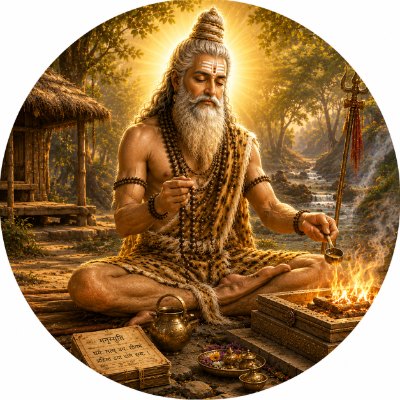
Ruchi — also spelled Ruci — is one of the mind-born sons of Brahma, the Creator; a Prajapati tasked with the work of cosmic creation and propagation; the husband of Akuti, eldest daughter of Svayambhuva Manu (the first Manu, the primordial progenitor of humanity) and his wife Shatarupa; and the father of the twin divine children Yajna and Dakshina. He is described across the Bhagavata Purana, Garuda Purana, and related texts as a Prajapati endowed with immense spiritual brilliance — a being of Brahmatej, the luminous power of Brahmic knowledge — and as a figure deeply devoted to the Lord. His principal significance in the tradition is genealogical and cosmological: through his union with Akuti he fathered Yajna — an avatar of Vishnu himself, who served as the Indra of the Svayambhuva Manvantara — and Dakshina — a partial manifestation of Lakshmi, the goddess of fortune. His personal canonical record is relatively brief; his importance lies almost entirely in the two divine beings he brought into the world and in the unusual marriage arrangement through which Akuti was given to him.
✦ The Name
The Sanskrit name Ruchi — written Ruci — derives from the root ruc — to shine, to be bright, to be pleasing, to taste — and means light, brightness, lustre, taste, inclination, desire. As a name it carries the sense of one who shines with inner spiritual light — a name wholly appropriate for a Prajapati described as being full of the spiritual glory of Brahman. The Bhagavata Purana (Skandha 4) uses the precise formulation that Ruchi was full of Brahmatej — the luminous spiritual force associated with mastery of Brahmic knowledge — when he received Akuti in marriage. The name in its sense of taste or inclination also carries a subtle meaning: Ruchi is the Prajapati whose inclination and devotion toward the Lord was of a quality sufficient to produce Vishnu's own avatar as his son.
✦ Lineage
- Origin: one of the mind-born sons (Manasaputras) of Brahma, the Creator; born directly from Brahma's will and creative consciousness rather than from a womb; a Prajapati — one of the progenitors tasked with populating the cosmos; listed among the Prajapatis in the Garuda Purana alongside Dharma, Rudra, Manu, the Kumaras, Bhrigu, Marichi, Atri, Angiras, Pulastya, Pulaha, Kratu, Narada, and others; some texts include him among the ten primary Prajapatis and others among the supplementary creators
- Father: Brahma — the Creator; the self-born grandfather of all beings; who created Ruchi from his own consciousness as a generative agent
- Wife: Akuti — eldest of the three daughters of Svayambhuva Manu and Shatarupa; given to Ruchi in marriage under the Putrikadharma convention; described as beautiful, virtuous, and endowed with noble qualities
- Son: Yajna — a twin; the male child born simultaneously with Dakshina; an avatar of Vishnu himself; who served as the Indra of the Svayambhuva Manvantara; the personification of the Vedic ritual of sacrifice; taken by Svayambhuva Manu as his adopted son under the Putrikadharma agreement; later married his twin sister Dakshina
- Daughter: Dakshina — the female twin born simultaneously with Yajna; a partial incarnation of Lakshmi, the goddess of fortune; retained in Ruchi's household after Yajna was taken by Manu; later given in marriage to Yajna himself; mother of Ruchi's twelve grandsons
- Grandsons (through Yajna and Dakshina): twelve divine beings collectively known as the Yama Devatas or Tushitas — Tosha, Pratosha, Santosh, Bhadra, Shanti, Idaspati (or Indrapati), Idhma, Kavi, Vibhu, Svahna (or Svahana), Sudeva, and Rochan — who served as the dominant deities of the Svayambhuva Manvantara; described across the sources as highly powerful divine beings who maintained the cosmic order of that age
✦ The Putrikadharma Marriage — Its Meaning and Significance
The marriage of Akuti to Ruchi was conducted under the specific convention known as Putrikadharma — a marriage arrangement in which the bride's father stipulates that the first male child born to the daughter shall be adopted back by the maternal grandfather and reckoned as the grandfather's son, securing the continuity of the grandfather's line. The Bhagavata Purana (Skandha 4, Chapter 1) records this arrangement explicitly: Svayambhuva Manu gave his eldest daughter Akuti to Ruchi under the Putrikadharma condition. The commentator Padaratnavalī explains that although Manu had sons — Priyavrata and Uttanapada — he nonetheless imposed this condition because he knew in advance, through divine knowledge, that Vishnu himself would be born as Akuti's son; Manu wished to secure the extraordinary spiritual grace of having Vishnu as his adopted son. Ruchi, bound by the marriage agreement, fulfilled the condition: when the twin children Yajna and Dakshina were born, Yajna — the male child — was taken by Svayambhuva Manu to his home and raised as his own son, while Dakshina was retained in Ruchi's household. Ruchi then gave Dakshina in marriage to Yajna — though the two were twins, this marriage was not considered improper in the tradition because both Yajna and Dakshina were divine manifestations (Vishnu and Lakshmi respectively) rather than ordinary human beings, and the brother-sister designation applied only to their human birth-forms.
✦ Yajna — The Divine Son
Yajna — the son of Ruchi and Akuti — is listed in the Bhagavata Purana, Devi Bhagavata Purana, and Garuda Purana as an avatar of Vishnu, and is classified in the tradition as one of the fourteen Manvantara-avatars — the specific incarnation of Vishnu corresponding to each Manvantara who supports the Indra and other gods of that age in maintaining the principles of cosmic order. The Drikpanchang source confirms Yajna's status as the seventh incarnation of Vishnu in the Srimad Bhagavatam's listing, and as a Kalpa-avatar. During the Svayambhuva Manvantara — the era governed by Svayambhuva Manu, Ruchi's father-in-law — there was initially no qualified Indra to serve as the king of Svarga and govern the devas. Vishnu, incarnating as Yajna through Ruchi and Akuti, assumed the post of Indra and reigned over Svarga throughout the Svayambhuva Manvantara. Under his governance, the twelve sons he and Dakshina produced — the Yama Devatas or Tushitas — served as the dominant gods of that age, maintaining cosmic order collectively. Yajna is depicted wearing yellow garments, adorned with golden ornaments and a crown, and is sometimes shown ascending from a Yajna Kunda (sacrificial fire pit) — an iconographic statement that he is the ritual of sacrifice itself made divine. His name is the Sanskrit word for the fire sacrifice — making him the embodiment of the central act of Vedic religion, the sacrifice through which the divine and human worlds communicate.
✦ Dakshina — The Divine Daughter
Dakshina — the daughter of Ruchi and Akuti, and twin of Yajna — is described across the sources as bearing the essence of Lakshmi, the goddess of fortune. The JKYog source describes her as Lakshmi's partial incarnation; the Hindu Temple Talk source confirms she bore the essence of Lakshmi; the Bhagavata Purana commentator notes that Dakshina was an amsha (partial manifestation) of Lakshmi who manifested herself to others as an avirbhava — an appearance in the world. The Sanskrit word dakshina means the gift or honorarium given to a priest or teacher at the conclusion of a sacred ritual — the offering that completes and seals the sacrifice. As the twin of Yajna — who is the sacrifice itself — Dakshina is the gift that accompanies the sacrifice; the two are inseparable, which is why their subsequent marriage is the tradition's statement that every act of sacred giving is a union of the ritual (Yajna) and its completion (Dakshina). Through her marriage to Yajna she bore the twelve Yama Devatas — the Tushita gods — who governed the Svayambhuva Manvantara.
✦ Ruchi's Position Among the Prajapatis
The Garuda Purana lists Ruchi explicitly alongside the ten primary Prajapatis and their associated functions in the work of creation: Dharma, Rudra, Manu, Sanaka, Sanatana, Bhrigu, Sanatkumara, Ruchi, Shuddha, Marichi, Atri, Angiras, Pulastya, Pulaha, Kratu, Narada, and the Varhisada Pitrs. The Bhagavata Purana (Skandha 4, Chapter 1) explicitly names Ruchi as a Prajapati and describes him as full of the spiritual glory of Brahman — a Brahmatej-endowed being whose spiritual attainment was precisely the quality that made him a suitable vehicle for Vishnu's Yajna avatar. The Drikpanchang source confirms: Ruchi Prajapati was the father of Lord Yajna. Unlike many Prajapatis whose contributions to creation are enumerated in terms of the species or divine classes they fathered, Ruchi's contribution is of a different order: he provided the human parentage through which the supreme deity himself took birth. His function in the tradition's creation narrative is less that of a proliferating progenitor than of a sanctified vessel — the Prajapati whose spiritual purity was of the quality required to house the divine.
✦ References
- Bhagavata Purana (Skandha 4, Chapter 1) — the foundational canonical account of Ruchi: named as a Prajapati full of the spiritual glory of Brahman; the Putrikadharma marriage to Akuti described; the twin birth of Yajna (Vishnu's avatar) and Dakshina (Lakshmi's partial manifestation); Yajna taken by Manu as his adopted son; Dakshina retained with Ruchi; the marriage of Yajna and Dakshina; the twelve Yama Devatas born; Yajna serving as Indra of the Svayambhuva Manvantara; the Tushitas as the gods of that era
- Garuda Purana (Chapter 5, the Creation of the Prajapatis) — Ruchi listed among the mind-born sons of Brahma tasked with creation; to Ruchi were born Yajna and Dakshina; Yajna fathered the twelve Yamas on Dakshina
- Devi Bhagavata Purana — Yajna listed as an avatar of Vishnu born to Ruchi and Akuti; the Svayambhuva Manvantara context
- Vishnu Purana (Book 1) — Ruchi as husband of Akuti; the Putrikadharma convention; Yajna and Dakshina as their children; the twelve Yama Devatas
- Markandeya Purana — Yajna as the Vishnu incarnation who appeared in the Svayambhuva Manvantara to protect Manu and the cosmic order; born to Prajapati Ruci and Akuti
- Wikipedia — Yajna (avatar); Drikpanchang — Lord Yajna Yajna Avatara Yajna Purusha; Hindu Temple Talk — Yajna A Significant Avatar of Lord Vishnu; JKYog — Description of the Lineage of Manu's Daughters; Dharamam WordPress — Description of the Clans of Manu's Daughters (Bhagavata Purana Chapter 4); Wisdomlib — The Bhagavata Purana Skandha 4 Chapter 1 The Progeny of Svayambhuva Manu's Daughters; Bhagavata Keshavaswami — Genealogy of Manu's Daughters: modern summaries drawing from the above primary sources