
About
Yajna (Yajneshvara) — Avatar of Vishnu, Indra of the Svayambhuva Manvantara, Son of Ruchi and Akuti
Yajna · Yajña · Yajneshvara · Yajnapati · Makha · Yajna Purusha · Svayambhuva-Manvantara-Indra · Ruchi-putra · Akuti-suta · Saptama-avatara · Manvantara-avatara · Kalpa-avatara
Yajna — also known as Yajneshvara, the lord of sacrifice — is an avatar of Vishnu, the Preserver; the son of the Prajapati Ruchi and Akuti, the eldest daughter of Svayambhuva Manu; the twin brother and eventual husband of Dakshina; the Indra of the Svayambhuva Manvantara — the first of the fourteen cosmic ages of the present creation cycle; and the father of the twelve divine sons known as the Yama Devatas or Tushitas, who served as the gods of that era. He is classified in the Bhagavata Purana as the seventh avatar of Vishnu in the sequence of Vishnu's major incarnations, and simultaneously as one of the fourteen Manvantara-avatars — the specific incarnation of Vishnu corresponding to each Manvantara, whose function is to support the Indra and the other gods of that age in maintaining cosmic order. He is also classified as a Kalpa-avatar — an avatar corresponding to an entire aeon, or Kalpa. His name is the Sanskrit word for the Vedic fire sacrifice — the most sacred ritual of the tradition — making him the living embodiment of the rite through which the human and divine worlds communicate. The Yajurveda contains an account of his glory. He is described as superior to Indra, Agni, Varuna, Surya, Chandra, and all other deities.
✦ The Name
The Sanskrit name Yajna — written Yajña — derives from the root yaj — to worship, to offer, to sacrifice — and means worship, offering, sacrifice, the sacred rite. It is the most fundamental word in the Vedic ritual vocabulary: the yajna is the act through which human beings communicate with the divine, through which the cosmic order is maintained, through which the gods receive their sustenance and the world its blessings. As a personal name it means he who is the sacrifice itself — the divine being who is not merely the recipient of the ritual but its living substance. His epithet Yajneshvara means lord of the sacrifice; Yajnapati means master of the sacrifice; Makha is another ancient name for the sacred rite, used especially in the Yajurveda. The Drikpanchang source notes that after the incarnation of Yajna Purusha, the sacrificial rituals of Yajna and Homa came into being and were practised by the gods — establishing his birth as the origin-event of the entire Vedic sacrificial tradition.
✦ Lineage
- Father: Ruchi (Ruci) — one of Brahma's mind-born sons; a Prajapati; described in the Bhagavata Purana as full of the spiritual glory of Brahman; deeply devoted to the Lord; who gave up his first-born male child to his father-in-law Manu under the Putrikadharma convention
- Mother: Akuti — eldest daughter of Svayambhuva Manu (the first Manu, primordial progenitor of humanity) and his wife Shatarupa (the first woman); married to Ruchi under the Putrikadharma condition
- Maternal grandfather (adoptive father after birth): Svayambhuva Manu — who took Yajna as his adopted son under the Putrikadharma arrangement; who raised him in his household; who knew in advance through divine foreknowledge that Vishnu would incarnate as Akuti's son and organised the entire marriage arrangement to bring this about
- Twin sister and wife: Dakshina — born simultaneously from Akuti's womb; a partial incarnation of Lakshmi, the goddess of fortune; retained by Ruchi in his household; later given in marriage to Yajna; their union though of twins was not considered objectionable in the tradition because both were divine manifestations — Vishnu and Lakshmi — rather than ordinary human siblings
- Sons (through Dakshina): twelve divine beings collectively known as the Yama Devatas or Tushitas — Tosha, Pratosha, Santosh, Bhadra, Shanti, Idaspati (Indrapati), Idhma, Kavi, Vibhu, Svahna, Sudeva, and Rochan — who served as the dominant gods of the Svayambhuva Manvantara, maintaining the cosmic order of that age collectively; these twelve are also referred to in the Bhagavata Purana as the Yamas who assisted Yajna during his tenure as Indra
- His divine identity: the seventh avatar of Vishnu in the Bhagavata Purana's listing of Vishnu's twenty-four avatars; one of the fourteen Manvantara-avatars; a Kalpa-avatar; embodiment of the sacred fire sacrifice; listed in the Bhagavad Gita's famous declaration in which Krishna states that among yajnas he is the japa yajna
✦ The Svayambhuva Manvantara — His Cosmic Role
During the Svayambhuva Manvantara — the first of the fourteen cosmic ages governed by Svayambhuva Manu — there was no suitable being qualified to serve as the Indra of Svarga and govern the gods. Indra is not merely a personal deity but a cosmic post — a position that must always be filled for the governance of the three worlds to function. When the post was vacant, the gods were left without a ruler and the cosmic order was threatened. Vishnu therefore incarnated as Yajna specifically to fill this role. He killed the Rakshasas and demons who threatened Svayambhuva Manu and his Manvantara. When the gods, grateful and reassured, requested him to accept the throne of Svarga, he accepted after they entreated him repeatedly. He served as the Indra of the Svayambhuva Manvantara through its entire duration, assisted by his twelve sons the Yama Devatas. The Bhagavata Purana (Skandha 1, Chapter 3, Verse 12) records this role explicitly: the seventh incarnation was Yajna, the son of Prajapati Ruci and his wife Akuti; he controlled the period during the reign of Svayambhuva Manu and was assisted by demigods such as his son Yama.
✦ Iconography
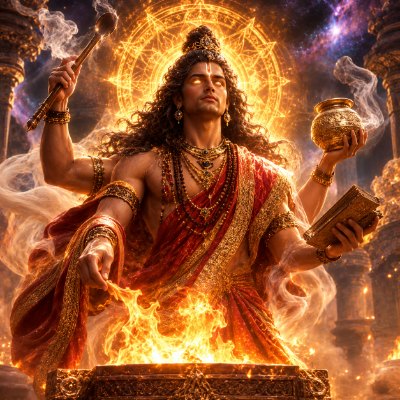
Yajna is depicted wearing Pitambari — yellow garments — adorned with golden ornaments and a crown, carrying the attributes of Vishnu. He is sometimes depicted ascending from a Yajna Kunda (sacrificial fire pit) — an iconographic statement that he is the fire sacrifice itself made divine. His form combines the majesty of Vishnu with the ritual context of the Vedic fire ceremony, representing the inseparability of divine worship and divine being: the god is the rite, and the rite is the god.
✦ References
- Bhagavata Purana (Skandha 1, Chapter 3, Verse 12) — Yajna as the seventh avatar of Vishnu; son of Prajapati Ruci and Akuti; governed the Svayambhuva Manvantara; assisted by his sons the Yamas
- Bhagavata Purana (Skandha 4, Chapter 1) — the birth of Yajna from Akuti's womb; the Putrikadharma adoption by Svayambhuva Manu; the marriage to Dakshina; the twelve Yama Devata sons; his role as Indra of the Svayambhuva Manvantara
- Bhagavata Purana (Skandha 8, Chapter 1) — the list of fourteen Manvantara-avatars including Yajna as the avatar of the Svayambhuva Manvantara
- Devi Bhagavata Purana — Yajna listed as an avatar of Vishnu born to Ruchi and Akuti
- Garuda Purana — Yajna as son of Ruchi and Akuti; the twelve sons born to Yajna and Dakshina
- Markandeya Purana — Vishnu incarnating as Yajna to protect Svayambhuva Manu and the cosmic order of his Manvantara
- Yajurveda — account of the glory of Yajna as a prominent deity
- Wikipedia — Yajna (avatar); Drikpanchang — Lord Yajna Yajna Avatara Yajna Purusha; Hindu Temple Talk — Yajna A Significant Avatar of Lord Vishnu; JKYog — Description of the Lineage of Manu's Daughters; Wisdomlib — Bhagavata Purana Skandha 4 Chapter 1; CCDAS — Genealogical Table of the Daughters of Manu: modern summaries drawing from the above primary sources