
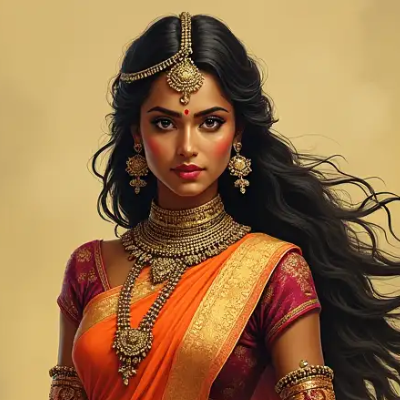
About
Murti — Daughter of Daksha, Wife of Dharma, Mother of Nara and Narayana
Murti · Daksha-putri · Dakshayani · Dharma-patni · Nara-Narayana-mata
Murti is a daughter of Daksha — the great Prajapati and progenitor — named in the Vishnu Purana, the Bhagavata Purana, and related Puranic sources as one of the daughters of Daksha given in marriage to Dharma — the divine personification of cosmic righteousness, moral order, and righteous law, who in the Puranic system is not merely an abstraction but a divine being who takes wives and fathers children of cosmic significance. Through her union with Dharma, Murti becomes the mother of Nara and Narayana — the twin sages of Badrinath celebrated across the Mahabharata and the Bhagavata Purana as ancient and immensely powerful ascetics who have performed austerities since the beginning of the current cosmic age. Nara and Narayana are identified in the Vaishnava tradition as partial avataras of Vishnu — Narayana being an aspect of Vishnu himself and Nara being identified with Arjuna, the great archer and hero of the Mahabharata, in their human manifestations of a later age. This identification makes Murti one of the most theologically significant of all Daksha's daughters, and her profile is correspondingly the most substantial of this group.
✦ The Name
The name Murti is Sanskrit, derived from the root mur or related forms, meaning to take form, to become solid, to crystallise into shape. Murti means form, embodiment, manifestation, image, or the concrete physical or visible expression of something that might otherwise remain abstract or invisible. In the Hindu devotional tradition, murti denotes the sacred image or icon of a deity — the form through which the formless divine makes itself accessible to the worshipper. The name for a daughter of Daksha thus encodes the principle of embodiment and manifestation — the giving of form to what is without form. This meaning is profoundly appropriate for a figure through whom Vishnu himself takes partial form in the world — her sons Nara and Narayana are avataric manifestations, and Murti as their mother is literally the embodiment through which the divine descends into visible, worshippable form. The name carries both a cosmological and a devotional resonance that makes it one of the most theologically fitting names among Daksha's daughters.
✦ Lineage
- Father: Daksha, one of the foremost Prajapatis of the Puranic tradition, a mind-born son of Brahma and the great progenitor whose daughters populate the world with gods, demons, and countless other categories of being.
- Husband: Dharma, the divine personification of cosmic order, righteousness, moral law, and the principle of right conduct that sustains the world. In the Puranic system Dharma is a divine being — a son of Brahma in certain accounts — who is given multiple wives from Daksha's daughters, each wife representing a virtue or principle that sustains the dharmic order of creation. Dharma's wives include not only Murti but several other daughters of Daksha representing different aspects of the moral and cosmic order. The personalisation of Dharma as a divine husband of Daksha's daughters is one of the characteristic features of Puranic genealogical thinking, in which abstract cosmic principles are given personal form, placed in genealogical relationships, and made to father offspring who embody specific dimensions of those principles.
- Co-wives of Dharma: Several other daughters of Daksha are named in the Vishnu Purana and Bhagavata Purana as wives of Dharma alongside Murti — including figures whose names encode virtues such as Kirti, Lakshmi, Dhriti, Tushti, Pushti, Medha, Kriya, Buddhi, Lajja, Vapu, Shanti, Siddhi, and Kiriti in various combinations across different Puranic lists. The lists vary somewhat between the Vishnu Purana and the Bhagavata Purana, but Murti's presence among them and her specific identification as the mother of Nara and Narayana is consistent across the major sources.
- Son Nara: One of the twin sages born of Murti and Dharma, described across the Mahabharata and the Bhagavata Purana as a being who has performed austerities at the sacred site of Badrikashrama — Badrinath in the Himalayas — since the beginning of the current cosmic age. Nara is identified in the Vaishnava tradition as a partial avatara of Vishnu and in certain passages as the eternal companion of Narayana. In the Mahabharata's theological framework, Nara is identified with Arjuna — the great archer and hero, the friend and disciple of Krishna — while Narayana is identified with Krishna himself, so that the divine friendship between the twin sages finds its human expression in the relationship between Arjuna and Krishna.
- Son Narayana: The second of the twin sages born of Murti and Dharma, described as an aspect of Vishnu himself who has taken the form of a human sage to perform austerities at Badrikashrama. Narayana's name is one of the primary names of Vishnu in the Vaishnava tradition — meaning one who moves upon the waters or one who is the refuge of all beings — and his identity as both a sage and an aspect of the supreme deity gives him a unique position in the Puranic devotional hierarchy. The Mahabharata's Shanti Parva and Narayaniya section contain extended philosophical and theological accounts of Nara and Narayana that constitute one of the earliest systematic expressions of Vaishnava theology in the epic literature.
✦ Nara and Narayana — The Significance of Murti's Sons
The theological importance of Nara and Narayana in the Hindu tradition cannot be overstated, and their importance reflects directly on the significance of Murti as their mother. The twin sages are among the most ancient and consistently celebrated figures in the Vaishnava tradition. The Mahabharata references them extensively — they appear in the Vana Parva, the Shanti Parva, the Anushasana Parva, and the Narayaniya — and they are presented as beings whose austerities at Badrikashrama have been continuous since the beginning of the current cosmic age, their tapas sustaining the dharmic order of the world. The Bhagavata Purana identifies Narayana as a direct avatara of Vishnu and situates the twin sages within the broader framework of Vishnu's descents into the world for the protection of dharma.
The identification of Nara with Arjuna and Narayana with Krishna — present in the Mahabharata itself — gives the ancient sage-pair a direct connection to the central narrative of the epic. When Krishna and Arjuna are described in the Mahabharata as the ancient sages Nara and Narayana reborn in human form, their friendship and their roles in the Kurukshetra war are presented as the continuation of a divine relationship that has existed since the beginning of time. Through Murti, therefore, the entire theological framework of Nara-Narayana — and by extension the Krishna-Arjuna relationship that is the vehicle of the Bhagavad Gita — has a genealogical origin: the union of Dharma and a daughter of Daksha.
✦ The Episode of Urvashi and the Apsaras
The Bhagavata Purana narrates an episode associated with the austerities of Nara and Narayana at Badrikashrama that is relevant to understanding the power of Murti's sons and the devotional tradition surrounding them. When Indra, the king of the gods, became concerned that the twin sages' austerities were accumulating such power that they might threaten his sovereignty over the celestial realm — a fear that Indra harbours throughout the Puranic tradition toward any being of extraordinary ascetic attainment — he sent the celestial apsaras to disturb their meditation through their beauty and dance. Narayana, unperturbed, struck his thigh and produced from it a woman of beauty so surpassing that of all the apsaras combined that Indra's entire retinue was made to appear ordinary. This woman was Urvashi — one of the most celebrated of all the apsaras — who was then given to Indra as a gift, demonstrating the complete superiority of Narayana's yogic creative power over Indra's attempts at disturbance. This episode is one of the most frequently cited in discussions of the power of the Nara-Narayana pair and of the futility of attempting to disturb their tapas.
✦ Theological and Philosophical Significance
Murti's theological significance is inseparable from the identity of her sons. As the mother of Nara and Narayana — and through them the mother of two aspects of Vishnu in human sage form — she occupies a position in the Puranic genealogical system analogous in certain respects to that of Khyati, the mother of Lakshmi. Both are daughters of Daksha through whom the divine enters the world in form: Khyati through the goddess of auspiciousness, Murti through the twin sage-avataras of the supreme deity. The union of Murti with Dharma — the divine personification of cosmic order — to produce Narayana, who is himself an aspect of Vishnu the sustainer of that same order, creates a profound theological coherence: the offspring of righteousness is the sustainer of righteousness in divine form. Her name, meaning embodiment or form, similarly encodes this dynamic: she is the form through which the formless divine principle of Narayana takes its first human shape in the world.
✦ References
Primary Sources
- Vishnu Purana, Book 1, sections on Daksha's daughters and Dharma's wives: Names Murti as a daughter of Daksha given to Dharma and identifies Nara and Narayana as her sons; the principal genealogical source for her placement and her children.
- Bhagavata Purana, Skandha 6, sections on Daksha's progeny and Dharma's wives: Includes Murti among Daksha's daughters given to Dharma and identifies Nara and Narayana as avataric beings born of this union.
- Bhagavata Purana, Skandha 11, Narayaniya and avatara sections: Identifies Narayana as an avatara of Vishnu and elaborates the theological significance of the Nara-Narayana pair; provides the devotional context for understanding Murti's sons.
- Mahabharata, Shanti Parva, Narayaniya section: The most extensive treatment of the Nara-Narayana pair in the epic literature; addresses their identity, their austerities at Badrikashrama, their relationship to Krishna and Arjuna, and their theological significance in the developing Vaishnava tradition.
- Mahabharata, Vana Parva: Contains the episode of Indra's attempt to disturb the austerities of Nara and Narayana and the creation of Urvashi from Narayana's thigh; the principal narrative episode associated with the twin sages.
Modern Reference Works
- Vettam Mani, Puranic Encyclopaedia (Motilal Banarsidass, 1975), entries on Murti, Nara, and Narayana: Synthesises the Puranic and epic material on Murti's genealogy and the identity and significance of her sons.
- Alf Hiltebeitel, The Ritual of Battle: Krishna in the Mahabharata (Cornell University Press, 1976): Addresses the Nara-Narayana identification with Arjuna and Krishna and the theological framework of the twin-sage pair in the Mahabharata tradition.
- F. E. Pargiter, Ancient Indian Historical Tradition (Oxford University Press, 1922): Analyses the Puranic genealogical lists for Daksha's daughters and Dharma's wives comparatively across the major Puranas.
- Ganesh Vasudeo Tagare (trans.), Bhagavata Purana (Motilal Banarsidass, various volumes): Critical translation of the relevant skandhas; the notes address the avatara identification of Nara and Narayana and the genealogical placement of Murti.