
About
Nara — Divine Sage of Badrikashrama, Son of Dharma and Murti, Partial Avatara of Vishnu
Nara · Nara-rishi · Dharma-putra · Murti-putra · Narayana-sahaja · Arjuna-purva
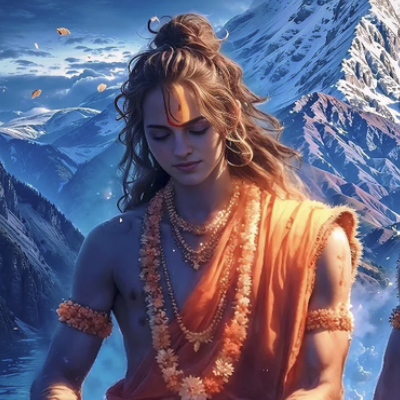
Nara is one of the twin divine sages of Badrikashrama — the sacred site in the Himalayas known in modern times as Badrinath — born of the union of Dharma, the divine personification of cosmic righteousness, and Murti, a daughter of the Prajapati Daksha. He is the inseparable companion of his twin Narayana, and the two sages are consistently presented as a pair throughout the Mahabharata, the Bhagavata Purana, the Vishnu Purana, and other Mahapuranas — beings who have performed austerities at Badrikashrama together since the beginning of the current cosmic age. Nara is identified in the Vaishnava tradition as a partial avatara of Vishnu and in the Mahabharata's own theological framework as the eternal human companion of the divine Narayana, the two together representing the relationship between the individual soul and the supreme self. Most significantly, the Mahabharata explicitly identifies Nara with Arjuna — the great archer, third of the Pandava brothers, and the central human hero of the Kurukshetra war — presenting the friendship between Arjuna and Krishna as the human manifestation in the Dvapara Yuga of the eternal relationship between the divine sages Nara and Narayana. He appears in narrative episodes in the Vana Parva, the Shanti Parva, the Anushasana Parva, and the Narayaniya section of the Mahabharata, as well as in the Bhagavata Purana and the Vishnu Purana.
✦ The Name
The name Nara is one of the most ancient and fundamental words in Sanskrit, meaning man, human being, or the masculine principle — from the root nr, denoting the essential quality of human or masculine being. In its cosmological usage, nara denotes the individual soul, the embodied conscious being, the human as distinct from the divine — while narayana denotes the supreme soul, the ground of all individual souls, the divine source from which nara arises and toward which it returns. The pairing of Nara and Narayana in the tradition thus encodes a fundamental philosophical distinction: the individual self and the universal self, the human and the divine, the devotee and the deity. That these two principles are presented as twin brothers born of the same mother — inseparable, equal in their ascetic power, eternally co-present — conveys the Vaishnava theological teaching that the individual soul and the supreme soul, though distinct, are in a relationship of irreducible intimacy and mutual dependence. The name Nara in its simplest sense — human being, man — also signals the accessibility and humanity of this figure: he is the divine made approachable through the human form.
✦ Lineage
- Father: Dharma, the divine personification of cosmic righteousness, moral order, and the principle of right conduct that sustains the created world. In the Puranic system Dharma is a divine being — described in certain accounts as a son of Brahma — who takes multiple wives from among Daksha's daughters, each representing a virtue or principle that sustains the dharmic order. His union with Murti, whose name means embodiment or form, to produce Narayana — who is an aspect of Vishnu the sustainer of that same order — is one of the most theologically coherent genealogical constructions in the Puranic system.
- Mother: Murti, a daughter of Daksha — the great Prajapati and progenitor — whose name meaning form or embodiment encodes the principle of giving visible shape to the divine. Through her union with Dharma, Murti becomes the earthly vessel through which Vishnu's twin avataric forms enter the world as Nara and Narayana.
- Twin brother: Narayana, the second of the twin sages born of Murti and Dharma, identified in the Vaishnava tradition as an aspect or partial avatara of Vishnu himself — the supreme deity who has taken the form of a human sage to perform austerities at Badrikashrama since the beginning of the current cosmic age. Narayana and Nara are eternally inseparable — the tradition presents them as never apart, always performing their austerities in each other's company, and always acting in concert in the episodes narrated about them.
- Human manifestation: Arjuna, the third of the five Pandava brothers, son of Kunti and the god Indra, the greatest archer of his age and the central human hero of the Mahabharata's Kurukshetra war narrative — identified in the Mahabharata itself as Nara reborn in human form in the Dvapara Yuga, the divine sage taking human birth to participate in the great war that restores the dharmic order of the world.
✦ The Austerities at Badrikashrama
The Mahabharata and the Bhagavata Purana both describe Nara and Narayana as having performed austerities at Badrikashrama — the sacred confluence of mountains at the source of the Ganga in the Himalayas, identified with the modern pilgrimage site of Badrinath in Uttarakhand — since the very beginning of the current cosmic age, the Krita or Satya Yuga. Their austerities are described as continuous and of immense intensity, and the tapas they accumulate is presented as one of the forces that sustains the dharmic order of the universe across the successive ages. The site of Badrikashrama is described in the tradition as the hermitage of Nara-Narayana, and it retains this association in the living pilgrimage tradition of Hinduism — the Badrinath temple and its sacred landscape are understood as the place where these twin divine sages continue to be present.
The austerities of Nara and Narayana are described as oriented toward the supreme deity — toward Vishnu — in the Vaishnava devotional framework, which creates the theological paradox that Narayana, being himself an aspect of Vishnu, performs austerities directed toward the very deity of whom he is a manifestation. The tradition resolves this through the understanding that the sage Narayana demonstrates the path of devotion for the benefit of all other beings — his austerities are not for his own benefit but as a teaching, a model of the devotional path made visible in the life of a divine being who has voluntarily taken human form.
✦ The Defence Against Indra and the Creation of Urvashi
The Mahabharata's Vana Parva narrates one of the most celebrated episodes associated with Nara and Narayana. Indra, the king of the gods, perceiving that the twin sages' austerities were accumulating power that might eventually challenge his authority over the heavens — a concern Indra harbours throughout the Puranic tradition toward any being of great ascetic attainment — dispatched the celestial apsaras to Badrikashrama with instruction to disturb the meditation of the sages through their beauty, their music, and their dance. Nara was present during this episode. Narayana, completely undisturbed by the apsaras' efforts, struck his own thigh and produced from it a woman of beauty so utterly surpassing that of the entire divine retinue sent by Indra that the apsaras themselves were rendered ordinary by comparison. This woman was Urvashi — one of the most celebrated and beautiful of all the celestial apsaras. Narayana then gave Urvashi to Indra as a gift, making explicit the total superiority of the sages' yogic creative power over Indra's most powerful means of worldly disturbance. The episode demonstrates through narrative that the power of tapas — ascetic heat — cultivated by Nara and Narayana is far beyond the reach of any force in the created world to disturb.
✦ Nara and Narayana in Conflict with Shiva
The Mahabharata also preserves an account of a conflict between the twin sages and the god Shiva. In this episode, a battle breaks out between Nara and Shiva, in which Nara — armed with his divine bow — demonstrates power sufficient to challenge even the great destroyer. The episode ends with a reconciliation and mutual recognition of each other's greatness, and it functions within the Mahabharata's theological architecture as an assertion that the power of the Nara-Narayana pair is comparable to that of the supreme gods themselves. The episode is one of several in the tradition that navigate the relationship between the Vaishnava and Shaiva theological frameworks, and it is treated differently in different recensions and interpretive traditions.
✦ The Identification with Arjuna
The Mahabharata's identification of Nara with Arjuna is one of the most theologically significant statements in the entire epic. It is made explicitly in the Adi Parva, restated in the Shanti Parva and the Narayaniya, and carried as a structuring assumption through much of the epic's devotional and philosophical content. The identification means that Arjuna is not merely a great human warrior but the divine sage Nara — eternal companion of Narayana — who has taken birth in human form in the Dvapara Yuga to participate in the Kurukshetra war as the human instrument through whom the dharmic order is restored. Krishna — who is the human manifestation of Narayana in this same theological framework — is therefore not merely Arjuna's charioteer and friend but the eternal divine companion of his own other half, the supreme self reunited in human form with the individual self it has always accompanied.
This identification gives the Bhagavad Gita — the dialogue between Krishna and Arjuna on the battlefield of Kurukshetra — a dimension beyond the merely situational. When Narayana-as-Krishna instructs Nara-as-Arjuna in the nature of the self, the proper performance of duty, and the path of devotion, the supreme soul is speaking to the individual soul — and the instruction given is not a new teaching imparted to an ignorant student but a reminder delivered by the eternal teacher to his eternal companion, who has temporarily forgotten his own divine nature through his immersion in human birth. The entire philosophical content of the Gita is thus grounded, in the Mahabharata's own theological framework, in the primordial relationship between Nara and Narayana that has its genealogical origin in the union of Dharma and Murti.
✦ Theological and Philosophical Significance
Nara's theological significance operates on multiple levels simultaneously. At the cosmological level he is a being of the primordial creation, born of Dharma and Murti, whose continuous austerities sustain the dharmic order across the cosmic ages. At the avataric level he is an aspect of Vishnu who has taken the form of a human sage to demonstrate the path of devotion and asceticism. At the epic level he is Arjuna — the human hero whose struggles, doubts, and eventual illumination on the battlefield of Kurukshetra are the narrative occasion for the Bhagavad Gita, one of the most celebrated philosophical and devotional texts in the entire world's religious literature. At the philosophical level he represents the individual soul — the jiva or nara — in its eternal relationship with the supreme soul Narayana, a relationship that is simultaneously one of distinction and of intimate union. The Vaishnava philosophical tradition has returned repeatedly to the Nara-Narayana pair as an expression of the relationship between the individual self and the divine — the two are not identical, as in absolute non-dualism, but neither are they simply separate, as in pure dualism; they are eternally related, eternally companions, eternally inseparable while remaining distinct.
✦ Connection to the Wider Genealogy
Through his mother Murti, Nara is connected to the lineage of Daksha and through Daksha to the primordial Prajapati order that descends from Brahma. Through his father Dharma he is connected to the cosmic ordering principle that sustains creation. Through his twin Narayana he is connected to Vishnu — the supreme deity of the Vaishnava tradition. Through his human manifestation as Arjuna he is connected to the Lunar dynasty — the Chandravamsha — through the Pandava lineage, and to the entire narrative world of the Mahabharata. His position at the intersection of the primordial sage lineage, the avataric theology of Vishnu, and the human heroic tradition of the Mahabharata makes him one of the most genealogically and theologically connected figures in this entire series.
✦ References
Primary Sources
- Mahabharata, Adi Parva, sections on the origin of the Pandavas: Contains the identification of Nara with Arjuna and establishes the theological framework of Nara-Narayana as the divine predecessors of the Arjuna-Krishna pair.
- Mahabharata, Vana Parva: Narrates the episode of Indra's attempt to disturb the austerities of Nara and Narayana and the creation of Urvashi from Narayana's thigh; also contains other references to the twin sages in the context of pilgrimage and sacred geography.
- Mahabharata, Shanti Parva, Narayaniya section: The most extensive theological treatment of the Nara-Narayana pair in the epic; addresses their identity, their austerities, their relationship to Vishnu, and the significance of their human manifestations as Arjuna and Krishna.
- Bhagavata Purana, Skandha 6, sections on Dharma's wives and children: Names Nara as a son of Dharma and Murti and identifies him as a partial avatara of Vishnu.
- Bhagavata Purana, Skandha 11, avatara and theological sections: Situates Nara within the broader framework of Vishnu's descents and addresses the philosophical significance of the Nara-Narayana pair.
- Vishnu Purana, Book 1, sections on Dharma's progeny: Names Nara and Narayana as sons of Dharma and Murti and places them within the cosmological genealogical framework.
Modern Reference Works
- Vettam Mani, Puranic Encyclopaedia (Motilal Banarsidass, 1975), entries on Nara and Nara-Narayana: Synthesises the Puranic and epic material on Nara's identity, austerities, narrative episodes, and identification with Arjuna.
- Alf Hiltebeitel, The Ritual of Battle: Krishna in the Mahabharata (Cornell University Press, 1976): The most sustained modern scholarly treatment of the Nara-Narayana identification with Arjuna and Krishna and its implications for the theological architecture of the Mahabharata.
- J. A. B. van Buitenen (trans.), The Mahabharata, multiple volumes (University of Chicago Press, 1973–1978): Critical translation with annotation of the relevant parvas; the notes address the Nara-Narayana identification and its structural role in the epic.
- Georg Feuerstein, The Yoga Tradition (Hohm Press, 1998): Addresses the ascetic and yogic dimensions of the Nara-Narayana pair and their significance in the broader Hindu contemplative tradition.