
About
Narayana — Divine Sage of Badrikashrama, Son of Dharma and Murti, Avatara of Vishnu
Narayana · Narayana-rishi · Dharma-putra · Murti-putra · Nara-sahaja · Krishna-purva · Hari
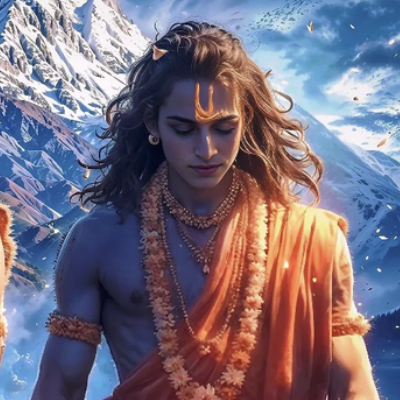
Narayana is one of the twin divine sages of Badrikashrama, born of the union of Dharma — the divine personification of cosmic righteousness — and Murti, a daughter of the Prajapati Daksha. He is the inseparable companion of his twin Nara, and together the pair have performed austerities at the sacred Himalayan site of Badrikashrama since the beginning of the current cosmic age. Narayana is identified in the Vaishnava tradition as a partial or full avatara of Vishnu — the supreme deity of the Vaishnava theological system — who has taken the form of a human sage in order to demonstrate the path of devotion and asceticism for the benefit of all beings. He is named in the Mahabharata, the Bhagavata Purana, the Vishnu Purana, and other Mahapuranas, and his identification with Vishnu pervades these texts at every level of their narrative and theological content. The most significant aspect of this profile — and its most complex textual challenge — is the relationship between Narayana as a specific sage born of Murti and Dharma, and Narayana as one of the most ancient and primary names of Vishnu himself as the supreme uncreated being. The tradition does not always maintain a clean boundary between these two registers, and this profile addresses the relationship between them with full transparency. In the Mahabharata's theological framework, this Narayana is identified with Krishna — the eighth avatara of Vishnu and the divine charioteer and teacher of Arjuna in the Kurukshetra war — as his previous manifestation in the form of a divine sage, just as Nara is identified with Arjuna.
✦ The Name — The Sage and the Supreme Deity
The name Narayana is one of the most ancient, most sacred, and most theologically layered names in the entire Hindu tradition. Its etymology has been given in multiple forms across the primary sources, and no single derivation commands universal agreement among the texts themselves. The most widely cited etymological account in the Puranic and commentarial tradition derives the name from nara meaning water or the primordial waters, and ayana meaning abode, refuge, or the place of movement — giving the sense of one whose abode is the primordial waters, one who moves upon the waters, or one who is the refuge of all. This connects the name to the cosmological image of Vishnu reclining on the cosmic serpent Shesha upon the primordial ocean between cosmic cycles — the ananta-shayana, the eternal repose — from which he awakens to initiate each new creation. An alternative derivation connects nara to the individual souls — the nara beings — and ayana to their refuge or goal, giving the sense of the refuge of all individual souls or the destination toward which all beings move. Both derivations are present in primary sources and both are theologically significant.
The critical point for this profile is that the name Narayana appears in the Rigveda's Purusha Sukta in its later extensions, in the Narayaniya section of the Mahabharata, in the Upanishads — particularly the Narayana Upanishad and sections of the Taittiriya Aranyaka — and throughout the Puranic literature as a name for the supreme uncreated deity Vishnu, predating and entirely independent of the specific sage born of Murti and Dharma. The sage Narayana of the Puranic genealogical system is therefore a being who shares his name with — and is in the Vaishnava theological framework identified with — the supreme cosmic deity. The Bhagavata Purana handles this identification not as a problem but as its central theological point: the sage Narayana is Vishnu himself who has voluntarily taken the form of a human ascetic, and therefore the name of the sage and the name of the supreme deity are rightly the same.
✦ Lineage
- Father: Dharma, the divine personification of cosmic righteousness and moral order, described in certain Puranic accounts as a son of Brahma, who takes multiple wives from among Daksha's daughters. His union with Murti to produce Narayana creates one of the most coherent genealogical constructions in the Puranic system — the offspring of righteousness is the sustainer of righteousness in divine form.
- Mother: Murti, a daughter of Daksha whose name meaning embodiment or form encodes the principle of giving visible shape to the divine. Through her union with Dharma, Murti becomes the human vessel through whom Vishnu's avataric twin forms enter the world as Nara and Narayana.
- Twin brother: Nara, the companion sage of Badrikashrama, identified as a partial avatara of Vishnu representing the individual soul in its eternal relationship with the supreme soul that Narayana embodies. Nara and Narayana are never apart — the tradition consistently presents them as inseparable, performing their austerities together, acting together in every narrative episode associated with them, and sharing a single sacred identity as the Nara-Narayana pair.
- Divine identity: Vishnu, the supreme deity of the Vaishnava tradition — the preserver of the cosmic order, the lord of Vaikuntha, the master of Lakshmi, and the supreme self of all individual souls — of whom Narayana the sage is understood to be a manifestation or partial descent in the Vaishnava theological framework developed most fully in the Bhagavata Purana.
- Human manifestation: Krishna, the eighth avatara of Vishnu, son of Vasudeva and Devaki of the Yadava clan, the divine charioteer of Arjuna in the Kurukshetra war, the teacher of the Bhagavad Gita, and the most celebrated figure in the Vaishnava devotional tradition — identified in the Mahabharata's own theological framework as the human manifestation in the Dvapara Yuga of the divine sage Narayana, just as Arjuna is the human manifestation of Nara.
✦ The Austerities at Badrikashrama
The Mahabharata and the Bhagavata Purana describe Narayana as performing continuous austerities at Badrikashrama alongside Nara since the beginning of the current cosmic age. These austerities are of a quality and intensity that surpasses the ascetic power of every other being in the created world — their tapas is described as the sustaining force that maintains the dharmic order across the successive cosmic ages and that renders all attempts at disturbance futile. The site of Badrikashrama is sacred specifically as the place where these twin divine sages are permanently present, and the pilgrimage tradition that makes Badrinath one of the four dhamas — the four supreme pilgrimage sites of the Hindu tradition — is grounded in this understanding of the continuous divine presence of Nara and Narayana at that location.
In the Bhagavata Purana's theological framing, Narayana's performance of austerities at Badrikashrama is understood not as a means by which he accumulates power he does not already possess — since he is Vishnu and possesses all power eternally — but as a demonstration, a teaching offered to the world by a divine being who has taken human form. By appearing to perform austerities as a sage, Narayana models the path of devotional and ascetic discipline for all human beings who aspire to liberation. This understanding is characteristic of the Bhagavata Purana's treatment of avataras generally: the divine being does not descend because he needs to do anything for himself, but because his descent and the actions he performs while embodied are themselves the most powerful possible instruction for those who observe them.
✦ The Creation of Urvashi
The most extensively narrated episode specifically associated with Narayana as a sage — as distinct from the wider body of narratives about Vishnu under this name — is the episode of the creation of Urvashi, narrated in the Mahabharata's Vana Parva. When Indra, fearing the power accumulated by the twin sages' austerities, sent the celestial apsaras to disturb their meditation, Narayana was entirely undisturbed. To demonstrate the completeness of his mastery over the creative powers that the apsaras' beauty was meant to invoke, he struck his own thigh and produced from it a woman whose beauty so utterly exceeded that of the entire divine retinue that the apsaras themselves appeared ordinary by comparison. This woman — Urvashi, one of the most celebrated of the celestial apsaras — was then presented by Narayana to Indra as a gift, simultaneously demonstrating the futility of Indra's stratagem and the unlimited creative power of the sage's yogic mastery. Urvashi subsequently plays significant roles in several other Puranic and epic narratives — including her relationship with the king Pururava in the Lunar dynasty, narrated in the Vishnu Purana — but her origin from Narayana's thigh in this episode remains her defining moment of creation.
✦ The Identification with Krishna and the Bhagavad Gita
The Mahabharata's identification of the sage Narayana with Krishna is the most theologically consequential fact in this profile and the one that connects it to the broadest range of the Hindu tradition's devotional and philosophical life. The identification is made explicitly in the Adi Parva's account of the origins of the main characters, restated in the Shanti Parva's Narayaniya, and carried as a structuring theological assumption through much of the epic's devotional content. When Krishna reveals his cosmic form to Arjuna in the eleventh chapter of the Bhagavad Gita, when he describes himself as the supreme self of all beings, when he declares that he has taught this yoga to the sun-god at the beginning of creation and that it has passed through successive teachers to the present moment — all of this is the sage Narayana speaking in his human form as Krishna, making explicit what the epic's theological framework has already established as his identity.
The Bhagavata Purana deepens this identification further. In its eleventh skandha, the Uddhava Gita — the discourse Krishna delivers to his devotee Uddhava shortly before his departure from the world — is presented as substantially identical in content to the Bhagavad Gita, given by the same divine teacher who has been giving this teaching since the beginning of time as the sage Narayana. The continuity of the teaching across the cosmic ages — from Narayana at Badrikashrama through the transmission to various teachers and ultimately to Krishna on the battlefield of Kurukshetra — is one of the Bhagavata Purana's central theological propositions.
✦ Narayana as a Name of Vishnu — The Wider Theological Context
As noted in the opening of this profile, the name Narayana is independently one of the most primary and ancient names of Vishnu as the supreme deity, predating the specific genealogical figure born of Murti and Dharma. The Narayana Upanishad, the Mahanarayana Upanishad embedded in the Taittiriya Aranyaka, and the Narayaniya section of the Mahabharata's Shanti Parva all use Narayana as the name of the supreme uncreated being — the lord of all, the source of all creation, the ground of all individual souls — in contexts that are not primarily genealogical but cosmological and theological. The Vishnu Sahasranama — the thousand names of Vishnu recited in the Anushasana Parva of the Mahabharata — includes Narayana prominently as one of the supreme names.
The Vaishnava tradition does not treat the coexistence of these two registers — Narayana as a specific genealogical sage and Narayana as the name of the supreme deity — as a contradiction but as the natural consequence of the sage being an avatara of the deity. Since the sage Narayana is Vishnu in human form, it is entirely appropriate that he bears the same name as the supreme being of whom he is a manifestation. The genealogical framework — born of Murti and Dharma, twin of Nara — is the tradition's way of situating the eternal divine in the created world of time and relationship, giving the supreme being a mother, a father, and a brother through whom he is accessible to the genealogical imagination.
✦ Theological and Philosophical Significance
Narayana's theological significance in the Hindu tradition is of the highest possible order. As a sage he demonstrates that the supreme divine can be present in the world in the form of a human ascetic — accessible, observable, embodied, performing the same practices he recommends to others. As an avatara of Vishnu he is one of the most ancient of the divine descents, predating even the ten principal avataras listed in the Bhagavata Purana's standard enumeration, and he establishes the precedent for all subsequent avataric descents. As the companion of Nara he embodies the eternal relationship between the supreme self and the individual soul — the inseparability of Narayana and Nara being the Vaishnava tradition's most vivid expression of the doctrine that the devotee and the deity, while genuinely distinct, are bound in a relationship of eternal intimacy. As the predecessor of Krishna he gives the entire Mahabharata narrative — and the Bhagavad Gita in particular — a cosmic depth that extends the teaching far beyond its immediate historical occasion into the beginningless past.
✦ Connection to the Wider Genealogy
Through his mother Murti, Narayana is connected to the lineage of Daksha and through Daksha to the primordial Prajapati order descending from Brahma. Through his father Dharma he is connected to the cosmic ordering principle. Through his twin Nara he is connected to the line that eventually manifests as Arjuna of the Pandava Lunar dynasty. Through his human manifestation as Krishna he is connected to the Yadava clan, to the city of Mathura and Dvaraka, to the Kurukshetra war and its vast cast of characters, and to the entire devotional tradition of Vaishnavism that flows from the Bhagavad Gita and the Bhagavata Purana. Through the episode of Urvashi's creation he is connected to the Lunar dynasty narrative through Urvashi's subsequent relationship with Pururava. No other figure in this genealogical series — with the possible exception of Vishnu himself — generates connections of comparable breadth across every dimension of the Hindu canonical tradition.
✦ References
Primary Sources
- Mahabharata, Adi Parva, sections on divine origins: Contains the identification of Narayana with Krishna and Nara with Arjuna; establishes the theological framework of the twin-sage pair as the divine predecessors of the epic's central relationship.
- Mahabharata, Vana Parva: Narrates the episode of the creation of Urvashi from Narayana's thigh in response to Indra's attempt to disturb the sages' austerities; the principal narrative episode specifically associated with Narayana as a sage.
- Mahabharata, Shanti Parva, Narayaniya section: The most extensive theological treatment of Narayana in the epic; addresses his identity as Vishnu, the nature of his austerities, the significance of Badrikashrama, and the relationship between the sage Narayana and the supreme deity of the same name.
- Bhagavad Gita, all eighteen chapters: The discourse of Narayana-as-Krishna to Nara-as-Arjuna on the battlefield of Kurukshetra; the most celebrated primary text in which the identification of Narayana with Krishna is enacted rather than merely stated.
- Bhagavata Purana, Skandha 6, sections on Dharma's wives and children: Names Narayana as a son of Dharma and Murti and identifies him as an avatara of Vishnu.
- Bhagavata Purana, Skandha 11, Uddhava Gita sections: Presents the teaching of Narayana-as-Krishna to Uddhava as the continuation of the eternal teaching delivered by the sage Narayana; establishes the continuity of the divine teaching across the cosmic ages.
- Vishnu Purana, Book 1, sections on Dharma's progeny: Names Narayana and Nara as sons of Dharma and Murti and places them within the cosmological genealogical framework.
- Narayana Upanishad and Mahanarayana Upanishad (embedded in the Taittiriya Aranyaka): Use Narayana as the name of the supreme uncreated being; provide the theological and Vedic background for the name independent of its genealogical usage.
Modern Reference Works
- Vettam Mani, Puranic Encyclopaedia (Motilal Banarsidass, 1975), entries on Narayana and Nara-Narayana: Synthesises the Puranic and epic material on Narayana's identity, austerities, narrative episodes, and identification with Vishnu and Krishna.
- Alf Hiltebeitel, The Ritual of Battle: Krishna in the Mahabharata (Cornell University Press, 1976): The most sustained modern scholarly treatment of the Nara-Narayana identification with Arjuna and Krishna and its structural role in the Mahabharata's theological architecture.
- J. A. B. van Buitenen (trans.), The Mahabharata, multiple volumes (University of Chicago Press, 1973–1978): Critical translation with annotation of the relevant parvas including the Narayaniya; the notes address the Narayana identification and its theological implications.
- S. Radhakrishnan (trans.), The Bhagavadgita (George Allen and Unwin, 1948): Translation and philosophical commentary on the Bhagavad Gita; addresses the theological identity of Krishna as Narayana and the significance of the Arjuna-Krishna relationship as the human expression of the Nara-Narayana pair.
- Jan Gonda, Aspects of Early Visnuism (Motilal Banarsidass, 1969): Addresses the early development of the name and concept of Narayana in the Vedic and epic literature and its relationship to the developing Vaishnava theological tradition.