
About
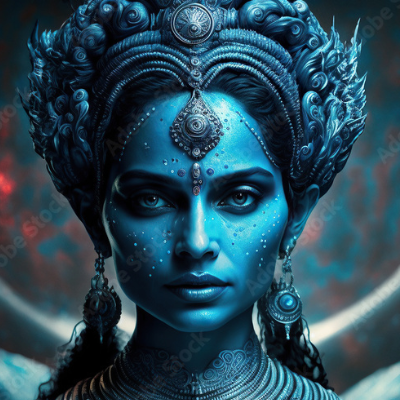
Krodhavasha — Mother of Rakshasas, Pisachas, and Beings of Wrath
Krodhavasha · Krodha · Dakshakanya · Kashyapapatni
Krodhavasha is a daughter of Daksha, the primordial progenitor lord and one of the Prajapatis appointed by Brahma, and one of the wives of the sage Kashyapa — grandson of Brahma through the seer Marichi and the universal progenitor of all races of beings. Krodhavasha is identified in the genealogical lists of the Vishnu Purana as the mother of a group of beings associated with wrath, violence, and the darker categories of supernatural existence — including Rakshasas, Pisachas, and related malevolent classes. Her name is a compound that makes her identity explicit at the level of language. She appears only in genealogical enumerations in the surviving primary texts and is not the subject of any independent narrative episode. This profile is proportionate to that limited attestation.
✦ The Name
The name Krodhavasha is a Sanskrit compound formed from krodha (wrath, anger, fury) and vasha (in the power of, subject to, under the control of). The full compound thus means "she who is subject to wrath" or "she who is in the power of anger" — a name that encodes the nature of her progeny directly into her own designation. This is consistent with the naming practice visible across the wives of Kashyapa in the Vishnu Purana, where several names function as indices of the character or nature of the beings to whom the named figure gives birth. The shortened form Krodha — simply "wrath" — is used for this figure in some texts in place of the full compound.
✦ Lineage
- Father: Daksha — a Prajapati and primordial progenitor, son of Brahma, who distributed his daughters as wives to the great sages to generate the full range of beings across the cosmos.
- Mother: Varies across sources as with all of Daksha's daughters — Panchajani in some Puranic passages, Prasuti in the Bhagavata Purana, Virani in certain Mahabharata references.
- Siblings: Krodhavasha is one of the group of Daksha's daughters given to Kashyapa. Her sisters as co-wives include Aditi (mother of the Adityas), Diti (mother of the Daityas), Danu (mother of the Danavas), Kadru (mother of the Nagas), Vinata (mother of Garuda and Aruna), Surasa (mother of a group of Nagas), Arishta (mother of the Gandharvas), Muni (mother of the Apsaras), Tamra, Ira, Surabhi, and Timi, among others.
- Spouse: Kashyapa — the primordial sage and universal progenitor.
- Children: The Vishnu Purana names Krodhavasha as the mother of the Rakshasas, the Pisachas, and related classes of malevolent supernatural beings. Rakshasas are a broad category of demonic beings in the tradition — they range from the cosmic demon Ravana, king of Lanka and the primary antagonist of the Ramayana, to the forest-dwelling flesh-eating beings who harass sages and humans throughout the Puranas and epics. Pisachas are a class of ghoul-like or ghost-like beings associated with death, disease, and the consumption of flesh, considered lower in the supernatural hierarchy than Rakshasas. The texts do not enumerate named individual Rakshasa or Pisacha offspring of Krodhavasha specifically, and several other origin accounts for Rakshasas exist alongside the Krodhavasha attribution, as noted below.
✦ Textual Variants and Inconsistencies
The origin of the Rakshasas is one of the most multiply-attested and inconsistently narrated topics in the Puranic and epic tradition. The Vishnu Purana's assignment of them to Krodhavasha as their mother is one of several competing accounts. The Valmiki Ramayana's Uttara Kanda gives a different account, in which the Rakshasas arise from beings created by Brahma to guard the primordial waters, some of whom declared they would devour the waters while others declared they would protect them — those who declared protection becoming Yakshas and those who declared devouring becoming Rakshasas. The Mahabharata contains yet another account in which Rakshasas arise from Brahma's anger or from other creative acts not involving Krodhavasha. The Bhagavata Purana presents Rakshasas as emerging from Brahma's belly or from other aspects of his primordial body during the initial creation of beings. These multiple accounts are not reconciled within the texts. The Vishnu Purana's genealogical attribution to Krodhavasha represents the version that integrates the Rakshasas into the Kashyapa household framework; the other accounts stand independently.
Similarly, the Pisachas have multiple origin accounts across the tradition, and their assignment to Krodhavasha in the Vishnu Purana is not universally echoed. Some texts associate Pisachas with the anger of specific sages or with Brahma's sneeze rather than with the Kashyapa genealogical line.
✦ Theological Significance
Within the Puranic genealogical scheme, Krodhavasha serves the function of providing a parental origin for the beings of wrath and malevolence within the same universal household of Kashyapa from which the gods, demons, and all other races also descend. The name encodes a theological proposition: wrath-born beings arise from a mother who is herself subject to wrath. This is consistent with the broader Puranic pattern in which the character of the progeny is understood as deriving in some essential way from the state, disposition, or circumstance of the parent at the time of conception or generation — a principle seen also in the Daityas arising from an inauspicious hour of conception, and in Aruna's incompleteness arising from premature birth.
✦ Connection to the Wider Genealogy
Through Daksha and Kashyapa, Krodhavasha is embedded in the same primordial household as all of Kashyapa's wives. If the Vishnu Purana's attribution is followed, her Rakshasa progeny include the ancestors of Ravana — the most prominent Rakshasa in the entire tradition, the king of Lanka and the abductor of Sita whose defeat by Rama forms the central action of the Valmiki Ramayana. However, Ravana's own genealogy in the Ramayana and the Puranas traces him through his father Vishrava and grandfather Pulastya — one of the seven primordial sages and a son of Brahma — rather than through Krodhavasha's line as such, making his connection to Krodhavasha indirect at best within the framework of the primary texts.
✦ References
Primary Sources
- Vishnu Purana, Book 1, chapter 21: The primary source naming Krodhavasha as a wife of Kashyapa and as the mother of the Rakshasas and Pisachas; the foundational text for this genealogical attribution.
- Bhagavata Purana, Book 6, chapter 6: Lists Krodhavasha among the daughters of Daksha given to Kashyapa without elaborating her progeny in comparable detail.
- Mahabharata, Adi Parva, sections 65–66: Includes Krodhavasha in the genealogical list of Kashyapa's wives within the cosmological genealogy.
- Valmiki Ramayana, Uttara Kanda: Provides the alternative account of Rakshasa origins from the primordial guardians of the cosmic waters, relevant for establishing the variant tradition against which the Krodhavasha attribution must be placed.
- Matsya Purana, chapter 6: Names Krodhavasha among Daksha's daughters and Kashyapa's wives.
Modern Reference Works
- Vettam Mani, Puranic Encyclopaedia (1975): Entry on Krodhavasha; notes her genealogical position and the multiple textual traditions for the origin of the Rakshasas.
- Sukumari Bhattacharji, The Indian Theogony (1970): Examines the multiple origin accounts for Rakshasas and Pisachas across the Puranic and epic tradition, relevant to evaluating the Krodhavasha attribution in context.