
About
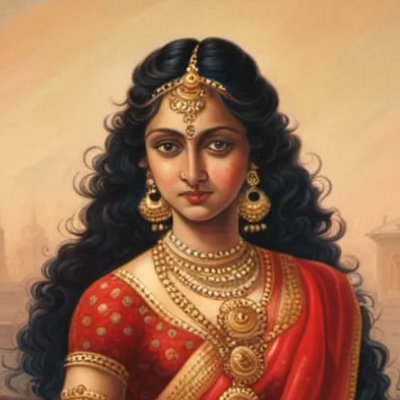
Ira — Mother of Plants, Trees, and Creeping Vegetation
Ira · Ilamata · Vanaspatimata · Dakshakanya · Kashyapapatni
Ira is a daughter of Daksha, the primordial progenitor lord and one of the Prajapatis, and one of the wives of the sage Kashyapa, the universal progenitor of all races of beings. She is identified in the Vishnu Purana as the mother of the plants, trees, creepers, and the broader domain of vegetation — the entire living world of flora that covers the earth. Ira thus holds a distinctive position among Kashyapa's wives in that her progeny are not divine, demonic, or animal beings but the plant world itself, making her the progenitress of an entire kingdom of life in the Puranic cosmological taxonomy. Her textual presence is confined to genealogical enumerations and she is not the subject of any independent narrative episode. This profile is proportionate to that limited attestation.
✦ The Name
The name Ira has multiple resonances in Sanskrit. The word ira or ila carries the meanings of refreshment, nourishment, the earth, and speech — in the Rigveda, Ila or Ida is a goddess of nourishment and the sacred food-offering, invoked in ritual as the embodiment of the earth's sustenance. The connection between a figure named Ira and the plant kingdom is thus etymologically coherent: the name's associations with nourishment, the earth, and refreshing moisture align naturally with the generative and sustaining functions of vegetation. The primary texts do not supply an explicit internal etymology for this figure's name in the genealogical passages where she appears, but the semantic field of the name supports the role assigned to her. The epithet Vanaspatimata means "mother of trees" — vanaspati being the Sanskrit term for forest trees or large trees.
✦ Lineage
- Father: Daksha — a Prajapati and primordial progenitor, son of Brahma.
- Mother: Varies across sources as with all of Daksha's daughters — Panchajani, Prasuti, or Virani depending on the text.
- Siblings: Ira is one of the group of Daksha's daughters given to Kashyapa, alongside Aditi, Diti, Danu, Kadru, Vinata, Surasa, Arishta, Muni, Krodhavasha, Tamra, Surabhi, Timi, and others.
- Spouse: Kashyapa — the primordial sage and universal progenitor.
- Children: The Vishnu Purana names Ira as the mother of trees, plants, creeping vines, and all forms of vegetation. This assignment covers the entire plant kingdom — from great forest trees to herbaceous plants and climbing creepers — making Ira the progenitress of the vegetable world in the Puranic cosmological taxonomy. The texts do not enumerate named individual plant species as Ira's children in the manner that individual Nagas are named as Kadru's sons; the attribution is categorical rather than individual.
✦ Ira and the Vedic Ida
It is necessary to distinguish the Puranic Ira — a wife of Kashyapa and mother of vegetation — from two other figures sharing similar names in the broader tradition. The Rigvedic goddess Ida (also spelled Ila) is a deity of nourishment, ritual food, and the sacred cow, invoked in Vedic ritual as a personification of the earth's abundance and the sacred butter offering. She is a distinct figure from the Puranic Ira in both function and narrative context. Separately, the Puranas and the Mahabharata also contain a figure named Ila (or Ida) who is a descendant of Vaivasvata Manu — himself the son of the solar deity Vivasvat — and who undergoes a celebrated gender transformation, becoming alternately male and female under a curse, and whose male form Sudyumna and female form Ila generate the lineages of important kings. This figure is entirely distinct from the Ira who is Daksha's daughter and Kashyapa's wife. The primary texts do not connect these figures, and the similarity of names across different strata of the tradition reflects the multiple uses of this phonological root rather than a shared identity.
✦ Textual Variants and Inconsistencies
The Bhagavata Purana lists Ira among Daksha's daughters given to Kashyapa but does not elaborate her progeny in the same terms as the Vishnu Purana. Several Puranic cosmogonic passages attribute the creation of plants and vegetation to Brahma's initial creative act — specifically to his hair or to aspects of his body — rather than to Ira as their mother. As with several other wives of Kashyapa, the genealogical attribution in the Vishnu Purana framework coexists with alternative cosmogonic accounts in other texts, and the primary sources do not explicitly reconcile these divergent traditions.
✦ Theological Significance
Ira's assignment as the mother of vegetation within the Puranic genealogical scheme completes the coverage of the living world by Kashyapa's wives: the gods, demons, serpents, birds, celestial nymphs, and musicians are accounted for through other wives, and Ira supplies the plant kingdom. This reflects the Puranic tradition's ambition to derive every significant category of existence from the single household of the universal progenitor Kashyapa. The inclusion of the plant world within this scheme — assigning it a personal mother rather than treating it as an inanimate domain — reflects the tradition's broadly animistic or vitalistic understanding of the natural world, in which plants are living beings with their own genealogical descent rather than an inert background to the drama of divine and human existence.
✦ Connection to the Wider Genealogy
Through Daksha and Kashyapa, Ira is embedded in the same primordial cosmological genealogy as all of Kashyapa's wives. Her plant progeny, while not participants in the narrative dramas of gods and demons, are cosmologically essential in the Puranic worldview as the foundational layer of life that sustains the entire system of beings above them. Specific plants — particularly the sacred Soma plant, the tulasi, and various trees revered in the tradition — occupy positions of religious significance in both the Vedic and Puranic frameworks, and Ira as their progenitress is implicitly the ancestress of these sacred plants as well.
✦ References
Primary Sources
- Vishnu Purana, Book 1, chapter 21: The primary source naming Ira as a wife of Kashyapa and as the mother of trees, plants, and creeping vegetation; the foundational text for this genealogical attribution.
- Bhagavata Purana, Book 6, chapter 6: Lists Ira among the daughters of Daksha given to Kashyapa without elaborating her vegetative progeny.
- Mahabharata, Adi Parva, sections 65–66: Names Ira in the genealogical list of Kashyapa's wives.
- Matsya Purana, chapter 6: Names Ira among Daksha's daughters and Kashyapa's wives.
Modern Reference Works
- Vettam Mani, Puranic Encyclopaedia (1975): Entry on Ira; notes her genealogical position and her attribution as mother of the plant world.
- A. A. Macdonell and A. B. Keith, Vedic Index of Names and Subjects (1912): Entry on Ida and Ila in the Vedic tradition; useful for distinguishing the Vedic nourishment-goddess from the Puranic Ira wife of Kashyapa.