
About
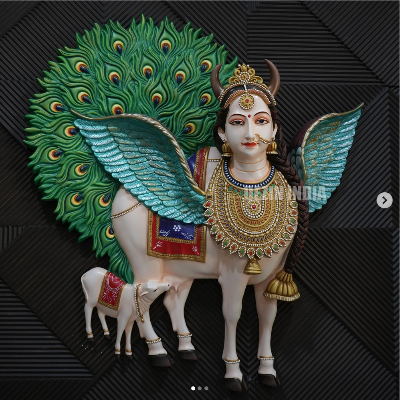
Surabhi — Mother of Cattle and the Cosmic Wish-Fulfilling Cow
Surabhi · Kamadenu · Gomata · Dakshakanya · Kashyapapatni
Surabhi is a daughter of Daksha, the primordial progenitor lord and one of the Prajapatis, and one of the wives of the sage Kashyapa, the universal progenitor of all races of beings. She is identified in the Vishnu Purana as the mother of cattle and of the divine wish-fulfilling cow — and in some texts she is herself identified with or functionally equivalent to Kamadenu, the celestial cow who grants all desires. Surabhi is among the most theologically significant of the secondary wives of Kashyapa, because cattle hold a position of supreme sacred importance in the Vedic and Puranic religious world, and the divine cow Kamadenu is one of the most celebrated figures in the tradition. Surabhi appears in the Vishnu Purana, the Bhagavata Purana, the Mahabharata, and the Ramayana, and her identity involves important questions of whether she is the same being as Kamadenu or a distinct progenitress of that class of divine cows.
✦ The Name
The name Surabhi derives from the Sanskrit su (good, pleasant, excellent) and rabhi or the root rabh, yielding the combined sense of "the fragrant one," "the pleasant one," or "the excellent-smelling one." The name is specifically associated with sweetness of fragrance and pleasantness of quality, both of which are associated in the tradition with the divine cow whose milk is the substance of abundance and nourishment. The name Kamadenu — used in many texts for the divine wish-fulfilling cow — is a compound of kama (desire, wish) and denu (a milch cow), meaning "the cow who fulfils desires." Whether Surabhi and Kamadenu are names for the same individual divine being or whether Surabhi is the mother of a class of beings that includes Kamadenu is a question on which different texts take different positions.
✦ Lineage
- Father: Daksha — a Prajapati and primordial progenitor, son of Brahma.
- Mother: Varies across sources as with all of Daksha's daughters — Panchajani, Prasuti, or Virani depending on the text.
- Siblings: Surabhi is one of the group of Daksha's daughters given to Kashyapa, alongside Aditi, Diti, Danu, Kadru, Vinata, Surasa, Arishta, Muni, Krodhavasha, Tamra, Ira, Timi, and others.
- Spouse: Kashyapa — the primordial sage and universal progenitor.
- Children: The Vishnu Purana names Surabhi as the mother of cattle — specifically of the divine cows and of the eleven Rudras in one variant account. The Bhagavata Purana presents an alternative in which Surabhi is one of the beings that emerges from the Samudra Manthan, the churning of the cosmic ocean, rather than a daughter of Daksha in this specific context — though the Bhagavata Purana also includes her in the Daksha's daughters list in Book 6. This duality in the Bhagavata Purana's treatment of Surabhi is a genuine textual complexity addressed below.
✦ Surabhi as Kamadenu
The tradition of the divine wish-fulfilling cow — called Kamadenu, Kamadhenu, or Surabhi interchangeably in many texts — is ancient and pervasive. In the Mahabharata, Kamadenu is the divine cow possessed by the sage Vasishtha whose extraordinary powers caused the king Vishvamitra to attempt to seize her by force, precipitating a long conflict between the two. In this episode the cow is called both Surabhi and Kamadenu in different portions of the narrative. The Ramayana's Bala Kanda retells a version of this same conflict between Vasishtha and Vishvamitra over the divine cow, again using both names. In the Harivamsa, Surabhi appears in the heavenly realms weeping, and Krishna asks her the cause of her grief — she laments the suffering of cattle on earth — an episode that connects the divine bovine mother to the concerns of her earthly cattle children.
Several texts present Surabhi not as an individual divine cow but as the progenitress of a class of divine cows, of which Kamadenu or Nandini (Vasishtha's specific cow) is the most prominent individual. The Vishnu Purana's genealogical framework assigns to Surabhi the role of mother of cattle as a class, which is consistent with this reading. Other texts use Surabhi as the personal name of the specific divine wish-fulfilling cow herself. The tradition does not consistently resolve whether the name designates an individual being or the progenitress of a class, and both usages coexist in the primary literature without explicit harmonisation.
✦ Surabhi and the Samudra Manthan
The Bhagavata Purana's account of the Samudra Manthan — the churning of the cosmic ocean by the gods and demons using Mount Mandara as the churning rod and Vasuki as the churning rope — lists Surabhi among the beings and objects that emerge from the ocean's depths as a result of the churning, alongside Lakshmi, Ucchaishravas, the Kaustubha gem, the amrita, and other celestial treasures. This presentation places Surabhi as a product of the cosmic churning rather than as a daughter of Daksha. The same Bhagavata Purana, however, also lists Surabhi among Daksha's daughters in Book 6. These two accounts within a single text represent a genuine internal inconsistency that the Bhagavata Purana does not explicitly resolve. Other Puranic texts that narrate the Samudra Manthan — including the Vishnu Purana and the Mahabharata's Adi Parva — also include Surabhi among the churning's products in their accounts of that episode, suggesting that the churning-origin for Surabhi was a widespread and early tradition that later genealogical systematisation sought to integrate into the Daksha's-daughters framework without fully displacing the earlier account.
✦ Textual Variants and Inconsistencies
The central inconsistency regarding Surabhi is between her presentation as a daughter of Daksha and wife of Kashyapa in the genealogical lists, and her presentation as a being who emerges from the churning of the ocean in the Samudra Manthan narratives. Both presentations appear in the Vishnu Purana and the Bhagavata Purana — sometimes within the same text. Additionally, the question of whether Surabhi is herself the wish-fulfilling cow or the mother of such cows is not uniformly resolved across sources. Some texts use Surabhi as the name of Vasishtha's specific divine cow; others give Vasishtha's cow as Nandini and describe her as a daughter of Surabhi. The Mahabharata uses Surabhi and Kamadenu in a way that suggests they may be the same being in some passages and different beings — mother and daughter — in others.
✦ Theological Significance
Surabhi is among the most theologically weighted of all the secondary wives of Kashyapa, because cattle in the Vedic and Puranic tradition are not merely economically important animals but sacred beings whose milk sustains both human life and the ritual oblations that nourish the gods. The divine cow who grants all desires is a symbol of inexhaustible abundance, of the earth's generosity, and of the ideal of a sustaining cosmic power that gives freely without depletion. Surabhi's position as the mother of cattle in the Puranic genealogical system places this cosmic abundance within the household of Kashyapa — making her the bovine counterpart, in a sense, of Aditi's solar abundance — and connects the origin of sacred cattle to the same primordial creative act that generated the gods and all other beings.
✦ Connection to the Wider Genealogy
Through Daksha and Kashyapa, Surabhi is embedded in the primordial cosmological genealogy. Her daughter Nandini — if the tradition that Nandini is Surabhi's daughter is followed — is the specific divine cow in the possession of the sage Vasishtha, whose attempted seizure by King Vishvamitra generates one of the most consequential episodes of the Mahabharata and Ramayana, with Vishvamitra's subsequent transformation from king to brahmarshi (a Brahmin sage of supreme attainment) serving as a moral and spiritual exemplum in both texts. Surabhi's progeny thus have indirect narrative consequences of the first order, even though Surabhi herself does not appear as an active narrative protagonist in any extended episode.
✦ References
Primary Sources
- Vishnu Purana, Book 1, chapters 21 and 22; Book 4: Names Surabhi as a wife of Kashyapa and mother of cattle; also lists her among the beings produced at the Samudra Manthan. The primary Puranic source for both of Surabhi's origin contexts.
- Bhagavata Purana, Book 6, chapter 6; Book 8, chapter 8: Book 6 lists Surabhi among Daksha's daughters given to Kashyapa; Book 8 narrates the Samudra Manthan and includes Surabhi among its products, creating the internal dual-origin situation discussed above.
- Mahabharata, Adi Parva, sections 65–66 and the Vasishtha-Vishvamitra episodes: Names Surabhi in the genealogical list and provides the narrative context of the divine cow in Vasishtha's possession and Vishvamitra's attempt to seize her.
- Valmiki Ramayana, Bala Kanda, chapters 51–56: Retells the episode of Vasishtha's divine cow — called both Surabhi and Kamadenu in different passages — and Vishvamitra's conflict with Vasishtha over her.
- Harivamsa, chapter 58: Contains the episode of Surabhi weeping before Krishna and lamenting the suffering of cattle, providing narrative characterisation for Surabhi beyond the genealogical lists.
- Matsya Purana, chapter 6: Names Surabhi among Daksha's daughters and Kashyapa's wives.
Modern Reference Works
- Vettam Mani, Puranic Encyclopaedia (1975): Entry on Surabhi; collates primary references across texts, notes the dual origin tradition, and discusses the relationship between Surabhi and Kamadenu.
- Wendy Doniger O'Flaherty, Hindu Myths (1975): Contains translations and discussion of the Samudra Manthan and the beings produced from the churning, relevant to Surabhi's origin in that tradition.