
About
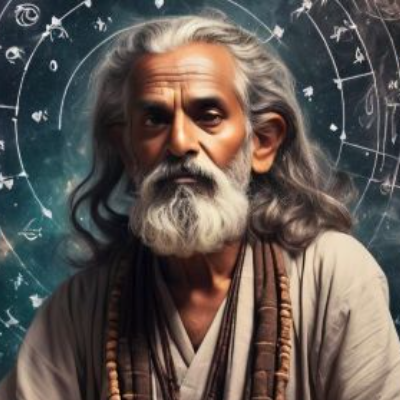
Utathya — Son of Angiras, Elder Brother of Brihaspati, and Sage of the Angirasa Line
Utathya · Angirasakumara · Brihaspatibhrata · Mamatapati · Dirghatamaspita · Angirasakula
Utathya is a sage of the Angirasa lineage — a son of Angiras, the primordial sage and one of the mind-born sons of Brahma, and an elder brother of Brihaspati, the divine preceptor of the gods. He is the husband of Mamata — a woman of great beauty whose name means "mine" or "possessiveness" — and the father of Dirghatamas, one of the most extraordinary and philosophically significant figures in the Mahabharata and Puranic traditions, a sage born blind whose lineage connects directly to several of the major dynastic lines of the epics. Utathya is most prominently featured in the Mahabharata's Adi Parva in the narrative of Dirghatamas's birth, and in a celebrated episode narrated in the Shanti Parva in which he demonstrated to the king Mandhata the sovereignty of dharma over the king's claims to the waters of the ocean. He appears also in the Vishnu Purana and Bhagavata Purana in genealogical contexts. His profile in the primary sources is substantial enough to record these narrative episodes and his genealogical significance but does not extend to the length of the tradition's treatment of the great figures of the epics.
✦ The Name
The name Utathya is of uncertain internal etymology in the primary texts, which do not provide an elaborated derivation. Some commentators have connected it to the Sanskrit uta — meaning "and," "also," or "indeed" — combined with a root suggesting being or standing, giving a sense of the one who also stands or exists — that is, one who occupies his own distinct position in the tradition. This derivation is speculative rather than confirmed in any primary source. The name functions as a proper name within the tradition without systematic etymological commentary. The patronymic Angirasakumara means "son of Angiras." Brihaspatibhrata means "brother of Brihaspati." Mamatapati means "husband of Mamata."
✦ Lineage
- Father: Angiras — one of the most ancient and significant of the primordial sages, a mind-born son of Brahma and one of the seven Saptarishis in certain configurations. Angiras is the progenitor of the Angirasa lineage, one of the most important sage lineages in the Vedic tradition and the ancestral line from which several major figures descend. He is also identified with the fire — Agni — in certain Vedic passages and is associated with the Atharvaveda. The Rigveda contains hymns attributed to Angirasa poets, and the lineage is one of the most prolific and influential in the Vedic hymn tradition.
- Brother: Brihaspati — the divine preceptor of the gods, the teacher of the Adityas and of Indra, the lord of sacred wisdom and ritual knowledge, and the divine being identified with the planet Jupiter in the Navagraha system. Brihaspati is the primary rival of Shukracharya — the preceptor of the demons — and is one of the most important divine figures in the tradition. The relationship between Utathya and Brihaspati is crucial for understanding the circumstances of Dirghatamas's birth, as the narrative involves Brihaspati's desire for Mamata — Utathya's wife — as discussed below. The Mahabharata identifies Utathya consistently as the elder brother and Brihaspati as the younger.
- Wife: Mamata — whose name means "mine" or "possessiveness," a name that the tradition connects to her role in the episode of Dirghatamas's birth. The Mahabharata's account of Mamata is discussed in the principal narrative below. She is not given an elaborate independent biography beyond her role in these events.
- Son: Dirghatamas — born blind, one of the most philosophically extraordinary figures in the Mahabharata tradition, whose biography is given in full in the Dirghatamas profile in this series. Dirghatamas is also the father, through his union with Sudeshna the wife of King Bali of Anga, of five sons who became the founders of major kingdoms — including Anga, Vanga, Kalinga, Pundra, and Suhma.
✦ The Birth of Dirghatamas — the Episode of Mamata and Brihaspati
The Mahabharata's Adi Parva narrates the circumstances of Dirghatamas's unusual conception in a passage that involves Utathya, his wife Mamata, and his younger brother Brihaspati. Mamata was pregnant with Utathya's child when Brihaspati — the divine preceptor of the gods, Utathya's own younger brother — came to her and expressed his desire for her. The Mahabharata is explicit that Brihaspati made this approach despite knowing that Mamata was his elder brother's wife — a transgression of the most fundamental obligations of the brother-brother relationship. Mamata resisted, telling Brihaspati that she was already pregnant with Utathya's child and that conception with Brihaspati would be inappropriate.
Brihaspati, not deterred, proceeded nonetheless. The child already in the womb — the embryo of Utathya's son — perceived the intrusion and protested, crying out from within the womb that there was no room for another being and that the seed should not be planted where another already grew. Brihaspati, in anger at this protest from an unborn child, cursed the child in the womb: that he would be born into prolonged darkness — that he would be blind. The child born was Dirghatamas — whose name means "long darkness," a name that encodes directly the curse of blindness that he received from Brihaspati before birth. Mamata, distressed at the situation, is said in some accounts to have subsequently abandoned the newborn Dirghatamas on the banks of the river, though the Mahabharata's account of this detail and its consequences belongs primarily to Dirghatamas's own biography.
This episode has several layers of moral and narrative significance. Brihaspati — the teacher of dharma to the gods — is here the agent of a profound violation of dharma: desire for his elder brother's wife, disregard for her refusal, and the cursing of an unborn child who was simply defending the space that was rightfully his. The tradition does not soften these facts. The episode adds to the portrait of Brihaspati as a figure of great learning but not invariably of great conduct — elsewhere in the tradition Brihaspati is also associated with the Tarakamaya war in the episode of Tara's abduction — and it provides the causal explanation for Dirghatamas's blindness, one of the most defining features of that sage's life and spiritual practice.
✦ Utathya and the Ocean — the Episode with Mandhata
The Mahabharata's Shanti Parva contains a celebrated episode in which Utathya demonstrated the sovereignty of dharma over the claims of even the greatest kings through a remarkable act of spiritual power involving the ocean. The narrative concerns the great Solar dynasty king Mandhata — a figure of supreme conquest who had performed the digvijaya, the four-direction conquest, and who considered the entire earth and all its waters his sovereign domain. Mandhata demanded that Varuna — the lord of the waters — render tribute to him or acknowledge his sovereignty over the ocean. Varuna refused, asserting that the ocean belonged to no earthly king's dominion.
Utathya, in whose presence this dispute arose or to whom it was referred in certain versions of the account, demonstrated the brahminical power that exceeds royal sovereignty through a direct act: he drank the ocean dry. The Shanti Parva narrates that Utathya, through the concentrated power of his ascetic tapas and his spiritual authority, consumed the ocean's waters, leaving the ocean bed exposed and dry. This demonstration of the brahmin sage's accumulated spiritual power — which could do what even the greatest Kshatriya king could not compel — was the proof that the dharmic order of sacred learning and austerity exceeded the political and military order of royal sovereignty. The ocean was restored after Utathya's demonstration had made its point. The episode is cited in the Shanti Parva in the context of the broader discussion of the relationship between brahminical and royal authority — the perennial tension between the two highest varnas of the tradition — and Utathya's act serves as the exemplum of the principle that the brahmin's spiritual power, when properly exercised, is the supreme force in the cosmos.
✦ Textual Variants and Inconsistencies
The circumstances of the Mamata-Brihaspati encounter: The Mahabharata's Adi Parva is the primary source for this episode. Different passages of the same text and different Puranic versions give slightly varying accounts of whether Mamata was told beforehand what Brihaspati intended, of the exact nature of her protest, and of the precise form of Brihaspati's subsequent seed and the child produced from it. The core facts — Brihaspati's transgression, the embryo's protest, the curse of blindness — are consistent across the major manuscript traditions.
The ocean episode: The Shanti Parva's account of Utathya drinking the ocean is the primary source for this episode. Some Puranic texts and regional traditions vary the details of the narrative — the identity of the king involved, the specific provocation, and the outcome — but the essential demonstration of brahminical power through the act of drinking the ocean is consistent as an episode associated with Utathya's name.
✦ Theological and Narrative Significance
Utathya's theological significance in the tradition operates through two distinct registers. In the birth narrative of Dirghatamas he is the wronged elder brother — the figure whose household was violated by the very person — his own younger brother Brihaspati — who ought to have been the most reliable guardian of domestic sanctity. His son's blindness, cursed by Brihaspati before birth, is the consequence of a wrong done to Utathya's family; and the extraordinary life that the blind Dirghatamas subsequently lived — a life of philosophical depth, of harsh experiences, and of immense generative power — flows entirely from the wrong done to Utathya's household. In the ocean episode he is the supreme demonstrator of brahminical power — the sage whose accumulated spiritual force could empty the cosmic ocean, placing his authority beyond the reach of even the greatest royal challenger.
✦ Connection to the Wider Genealogy
Through his father Angiras — one of the primordial mind-born sons of Brahma — Utathya connects to the most ancient creative genealogy of the tradition. Through his younger brother Brihaspati — the divine preceptor of the gods and the deity identified with Jupiter in the Navagraha system — he is the elder sibling of one of the most significant divine figures in the tradition. Through his son Dirghatamas and Dirghatamas's five sons by Queen Sudeshna — Anga, Vanga, Kalinga, Pundra, and Suhma — Utathya is the remote patriarch of the five eastern kingdoms that bear his grandsons' names, dynasties of considerable importance in the Mahabharata's political geography. Through Dirghatamas's son Kakshivat — born of another union — the Angirasa poetic lineage was continued in the Rigvedic tradition.
✦ References
Primary Sources
- Mahabharata, Adi Parva, sections 98–104 (birth of Dirghatamas): The primary narrative source for the episode of Mamata, Brihaspati's transgression, the embryo's protest, the curse of blindness, and the birth of Dirghatamas — establishing Utathya's central narrative role as the wronged husband and father.
- Mahabharata, Shanti Parva, sections 340–344 (Utathya and the ocean): The account of Utathya's demonstration of brahminical power through drinking the ocean dry in the context of the dispute with King Mandhata and Varuna.
- Vishnu Purana, Book 3, chapters 6–7: Genealogical material on the Angirasa lineage confirming Utathya's position as Angiras's son and Brihaspati's elder brother.
- Bhagavata Purana, Book 9, chapter 20: Genealogical references relevant to the Angirasa lineage and the births of figures descended from it.
Modern Reference Works
- Vettam Mani, Puranic Encyclopaedia (1975): Entry on Utathya; collates primary references and summarises the principal episodes of his biography and his genealogical connections.
- A. A. Macdonell and A. B. Keith, Vedic Index of Names and Subjects (1912): Entry on Utathya; establishes the Vedic background of the figure and his position in the Angirasa lineage.
- J. A. B. van Buitenen (translator), The Mahabharata, Volume 1 (1973): Critical translation of the Adi Parva with scholarly notes on the birth of Dirghatamas narrative in which Utathya's role is central.