
About
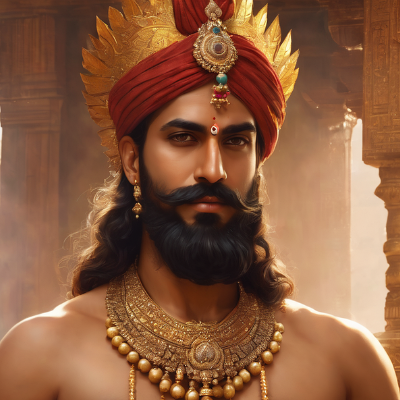
Vikukshi — Son of Ikshvaku, Second King of Ayodhya, and Continuer of the Solar Dynasty
Vikukshi · Shashada · Ikshvakuputra · Suryavamshiya · Okkaka
Vikukshi is the eldest son of Ikshvaku — the founder of the Solar dynasty and the first king of Ayodhya, himself the eldest son of Vaivasvata Manu the progenitor of the present human race — and is the second king of the Solar dynasty, the Suryavamsha, whose seat of power is the sacred city of Ayodhya on the Sarayu river. Vikukshi is best known in the tradition under his epithet Shashada — the hare-eater — acquired through an episode of ritual impurity during his father's reign that resulted in his banishment from the kingdom. He returned to Ayodhya and assumed the throne after Ikshvaku's death, and from him the Solar dynasty's main Ayodhya lineage continues through many generations to Mandhata, Harishchandra, Sagara, Bhagiratha, Dilipa, Raghu, Aja, Dasharatha, and ultimately Rama — the seventh avatar of Vishnu and the hero of the Valmiki Ramayana. Vikukshi appears in the Vishnu Purana, the Bhagavata Purana, the Harivamsa, and the Valmiki Ramayana's genealogical passages. His own reign receives minimal narrative elaboration in the primary sources beyond the episode that earned him his epithet and the record of his succession; his primary significance is genealogical as the link between Ikshvaku and the long Solar dynasty line that follows.
✦ The Names
The name Vikukshi is of uncertain internal etymology in the primary texts, which do not provide an explicit derivation or explanation of its meaning. Some secondary commentators have connected it to the Sanskrit root vi — indicating separation or distinction — and kukshi — belly or interior — yielding a sense of "one with a distinguished or unusual interior," but this derivation is not confirmed in any primary source. The name may simply function as a proper name within the genealogical tradition without a transparent Sanskrit etymology. The epithet Shashada is entirely clear: it is a compound of shasha — hare — and ada — eater — meaning "the hare-eater," a name directly derived from the episode in which Vikukshi ate a hare from the collection of sacrificial meat intended for his father's Shraddha ceremony. The Pali Buddhist form of his name is Okkaka — a phonological rendering of Ikshvaku applied in Buddhist genealogical tradition to the Solar line's continuation, though in some Buddhist accounts Okkaka is identified with Ikshvaku himself rather than with Vikukshi specifically.
✦ Lineage
- Father: Ikshvaku — the eldest son of Vaivasvata Manu and the founder and first king of the Solar dynasty with Ayodhya as its seat. Ikshvaku established the paradigm of dharmic solar kingship that all subsequent kings of the Suryavamsha are measured against. He is the figure who gave his name to the entire dynasty — the Ikshvaku vamsha — used interchangeably with Suryavamsha in many texts.
- Paternal grandfather: Vaivasvata Manu — the seventh and current Manu, progenitor of the present human race, son of Vivasvat the solar deity and the goddess Saranyu. Survivor of the great flood narrated in the Shatapatha Brahmana, the Mahabharata, and the Bhagavata Purana.
- Paternal great-grandfather: Vivasvat — the solar deity, one of the twelve Adityas, son of Aditi and the sage Kashyapa, and the divine source from whose line the entire Solar dynasty flows.
- Siblings: Vikukshi's brothers as sons of Ikshvaku include Nimi — who founded the separate royal line of Videha after a conflict with the sage Vasistha — and Danda — who founded his own kingdom and whose line ended in devastation through his own transgression. The Vishnu Purana and Bhagavata Purana state that Ikshvaku had many sons, of whom Vikukshi, Nimi, and Danda are the most narratively significant.
- Son: Kakutstha — also known by the epithet Puranjaya in connection with the specific episode in which he was offered the position of Indra's vehicle during a battle against the demons. Kakutstha is the third king of the Solar dynasty and the figure through whom the Ayodhya line continues. He is discussed further below.
✦ The Episode of the Hare and the Banishment
The episode through which Vikukshi acquired the epithet Shashada is narrated in the Vishnu Purana's fourth book and the Bhagavata Purana's ninth book with broad consistency. During Ikshvaku's reign, the king decided to perform a Shraddha — the solemn ancestral rite in which food offerings are made to the departed ancestors to sustain them in their post-mortem existence. The Shraddha required ritually pure meat obtained by hunting, and Ikshvaku commissioned his eldest son Vikukshi to go to the forest, hunt the appropriate animals, and return with the pure game for use in the ceremony.
Vikukshi hunted as directed and collected the required game. However, on his return journey he became hungry — the Vishnu Purana simply states that he was overcome by hunger without elaborating the circumstances — and ate a hare from the collected animals. He then returned to Ayodhya and presented the remaining collection to Ikshvaku for use in the Shraddha. Ikshvaku, before using the meat in the ceremony, presented it to the sage Vasistha — the family preceptor of the Solar dynasty — for ritual examination and verification of purity, as was the proper procedure. Vasistha, employing his spiritual insight, immediately perceived that a portion of the collection had been consumed by Vikukshi before being presented and that the entire collection was therefore rendered ritually impure through this contamination. He declared the meat unfit for the sacred ancestral rite and informed Ikshvaku of what his son had done.
Ikshvaku, bound by the same dharmic severity that characterised his own governance, pronounced Vikukshi's act an unacceptable violation of the ritual standards required for the ancestral ceremony and banished his eldest son from the kingdom. Vikukshi departed and lived in exile. The Vishnu Purana and Bhagavata Purana do not detail what Vikukshi did during his period of exile or how long the exile lasted. After Ikshvaku's death, Vikukshi returned to Ayodhya and assumed the kingship as Ikshvaku's legitimate eldest heir. He was thereafter known by the epithet Shashada — the hare-eater — which the tradition preserved as a permanent memorial of the act that caused his banishment, attached to his name in all subsequent genealogical enumerations.
✦ Vikukshi's Son Kakutstha and the Episode of Puranjaya
Although Vikukshi's own reign receives no further narrative elaboration in the primary texts beyond his accession, his son Kakutstha — the third king of the Solar dynasty — is associated with a celebrated episode that gives the Solar dynasty one of its most distinctive epithets. The Vishnu Purana and Bhagavata Purana narrate that in the era of Kakutstha's reign, the gods and the demons were engaged in a great conflict in which the gods were being worsted. Indra — the lord of the gods — and the divine assembly, seeking an extraordinary warrior to lead the gods to victory, asked the great king Kakutstha to fight on their behalf. Kakutstha agreed on one condition: that Indra himself serve as his vehicle during the battle. Indra, in his form as a great bull, offered his hump — the kakud, the raised shoulder hump of the bull — as the seat on which Kakutstha rode into battle. Seated on Indra's hump, Kakutstha led the gods to victory over the demons. From this episode Kakutstha acquired the name Puranjaya — "the conqueror of cities" or "the conqueror of the enemy's strongholds" — and the entire Solar dynasty acquired the dynastic epithet Kakutstha from him, used interchangeably with Ikshvaku and Raghu as a dynastic name in the Ramayana and other texts. When the Ramayana refers to Rama as Kakutstha, it invokes this specific dynastic name derived from Vikukshi's son.
✦ Textual Variants and Inconsistencies
The name Vikukshi and Shashada in different texts: The Vishnu Purana and Bhagavata Purana consistently give both names — Vikukshi as the proper name and Shashada as the epithet acquired through the hare episode. The Valmiki Ramayana's genealogical passage in the Bala Kanda names the second Solar king differently in some recensions, and not all versions of the Ramayana's genealogy use both names with equal clarity. The Harivamsa follows the Puranic convention of using both names. The Pali Buddhist tradition's Okkaka may refer to Ikshvaku, to Vikukshi, or to the dynasty generically depending on the specific Buddhist text consulted, and the identification is contested in the scholarly literature on Buddhist genealogy.
The Solar dynasty genealogy between Vikukshi and Rama: As noted in the Ikshvaku profile, the genealogical lists of the Solar dynasty between Vikukshi and Rama differ between the Valmiki Ramayana's Bala Kanda account, the Vishnu Purana's list, the Bhagavata Purana's list, and the Harivamsa's version. Some kings appear in one text but not in another, and the number of generations between Vikukshi and Rama varies. These are recognised discrepancies in the Puranic genealogical tradition and are characteristic of the compositional and transmission histories of the individual texts rather than of fundamental disagreements about the dynasty's nature or direction.
✦ Theological Significance
Vikukshi's theological significance within the tradition is modest in itself but structurally essential. The episode of the hare and the banishment — like the parallel episode of Ikshvaku's banishment of Vikukshi in the broader Solar dynasty narrative — demonstrates the tradition's consistent emphasis on the principle that even the heir to the Solar throne cannot be exempted from the consequences of ritual transgression. Ikshvaku's willingness to banish his own eldest son for contaminating the Shraddha offerings is presented as an act of dharmic integrity, and Vikukshi's eventual return and accession as legitimate heir demonstrates that the consequence was proportionate — exile rather than permanent disqualification. The preservation of the epithet Shashada as a permanent part of Vikukshi's identity in all subsequent genealogical texts reflects the tradition's practice of encoding the moral history of the royal line into its very names, so that the Solar dynasty's genealogy serves simultaneously as a record of royal deeds and as a moral narrative.
✦ Connection to the Wider Genealogy
Through his father Ikshvaku and grandfather Vaivasvata Manu, Vikukshi is embedded in the solar cosmic lineage descending from Vivasvat through the Adityas to the creative household of Aditi and Kashyapa and ultimately to Brahma. Through his son Kakutstha — whose epithet Puranjaya and the dynastic name Kakutstha-vamsha derived from him become standard designations for the Solar dynasty in the Ramayana — Vikukshi stands at the genealogical root of the long line of Ayodhya kings whose careers are recorded across the Puranas and whose line culminates in Rama. Every king of Ayodhya from the third generation onward — Kakutstha, Anenas, Prithu, Vishvarandhi, Chandra, Yuvanashva, Shravasta, Brihadashva, Kuvalashva, and through them to Mandhata, Trasadasyu, Purukutsa, Trishanku, Harishchandra, Rohita, Harita, Chunchu, Vijaya, Ruruka, Vrika, Bahu, Sagara, Asamanjas, Anshumant, Dilipa, Bhagiratha, Kakutstha (a later king of the same name), Raghu, Pravridha, Shankhana, Sudarshana, Agnivarna, Shighra, Maru, Prashushruka, Ambarisha, Nahusha, Yayati, Nabhaga, Aja, Dasharatha, and Rama — descends from Vikukshi through Kakutstha. The dynastic epithet Kakutstha applied to Rama in the Ramayana traces directly back to Vikukshi's son, making Vikukshi the grandfather of the figure whose name becomes one of Rama's most celebrated dynastic titles.
✦ References
Primary Sources
- Vishnu Purana, Book 4, chapters 2–3: The primary Mahapuranic source for the episode of Vikukshi's collection of the Shraddha meat, the consumption of the hare, Vasistha's disclosure, Ikshvaku's banishment, and Vikukshi's subsequent accession; also gives the Solar dynasty genealogy from Vikukshi through Kakutstha and beyond.
- Bhagavata Purana, Book 9, chapters 6–7: The Bhagavata Purana's account of Vikukshi and the hare episode, consistent in its broad outline with the Vishnu Purana; also narrates the Kakutstha-Puranjaya episode in which Vikukshi's son rides Indra as a bull to victory over the demons.
- Valmiki Ramayana, Bala Kanda, chapters 70–71: The Solar dynasty genealogy as given by Vishvamitra to Rama; names Vikukshi in the line of succession and lists subsequent kings through Kakutstha to Dasharatha and Rama.
- Harivamsa, chapters 10–12: Contains the Solar dynasty genealogy from Ikshvaku through Vikukshi and Kakutstha with some additional detail relative to the main Puranic accounts.
- Matsya Purana, chapters 11–12: Contains the Solar dynasty genealogy from Ikshvaku through Vikukshi within the broader post-diluvian royal genealogical framework.
- Vayu Purana, chapters 86–88: The Solar dynasty genealogy from Ikshvaku through Vikukshi and Kakutstha with the Vayu Purana's own enumeration of subsequent kings.
Modern Reference Works
- Vettam Mani, Puranic Encyclopaedia (1975): Entries on Vikukshi and Kakutstha; collates primary references across texts and notes the derivation of the dynastic epithet Kakutstha from Vikukshi's son.
- F. E. Pargiter, Ancient Indian Historical Tradition (1922): Critical analysis of the Solar dynasty genealogical lists across multiple Puranic sources; discusses the discrepancies between versions and attempts a reconstruction of the main Ayodhya line from Ikshvaku through Vikukshi and beyond.
- Robert P. Goldman (general editor), The Ramayana of Valmiki — Bala Kanda (1984): Critical edition and translation with scholarly notes on the Solar dynasty genealogy including the position of Vikukshi and the derivation of the Kakutstha dynastic name.