
About
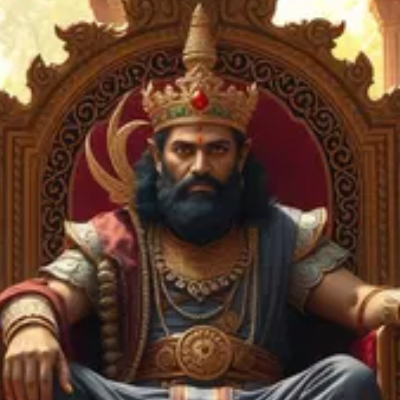
Nimi — Son of Ikshvaku, Founder of the Videha Dynasty, and Origin of the Bodiless Existence
Nimi · Nemi · Videhajanaka · Ikshvakuputra · Vaideharaja · Videha
Nimi is a son of Ikshvaku — the founder of the Solar dynasty and the first king of Ayodhya, himself the eldest son of Vaivasvata Manu — and the founder of the separate royal line of Videha, whose seat of power is in the eastern region of the subcontinent. Nimi is the occasion of one of the most narratively elaborate episodes in the Solar dynasty's history: his conflict with the sage Vasistha — the family preceptor of the Ikshvaku line — which resulted in mutual curses, his own death, his refusal to accept a new body, his existence as a bodiless being in the eyes of all living creatures, and the extraordinary birth of his son Janaka from the churning of his preserved body. From this Janaka — the first of the Videha kings, also called Mithi — the celebrated line of Videha kings descends through many generations to the king Siradhvaja Janaka who is the father of Sita, the wife of Rama. Nimi thus stands at the root of a royal line that intersects the main Solar dynasty at the most significant genealogical junction in the Ramayana tradition. Nimi appears in the Vishnu Purana, the Bhagavata Purana, the Mahabharata, the Harivamsa, and several other texts.
✦ The Names
The name Nimi — also rendered as Nemi in some texts — is derived from the Sanskrit nemi, meaning the rim or felloe of a wheel, the circular outer edge of a chariot wheel. This is a name of uncertain symbolic application in the context of this king's biography, and the primary texts do not supply an internal explanation for its choice. The alternative form Nemi simply reflects a variant spelling within the manuscript tradition. The designation Videha — used both as a personal epithet and as the name of the kingdom and dynasty he founded — derives from vi (without) and deha (body), meaning "the bodiless one." This name is the most theologically significant of his designations and arises directly from the episode of his refusal to accept a new body after his death, through which he chose to exist without corporeal form in the eyes of living beings. The patronymic Ikshvakuputra identifies him as Ikshvaku's son, and Vaideharaja means "king of Videha."
✦ Lineage
- Father: Ikshvaku — the eldest son of Vaivasvata Manu and the founder and first king of the Solar dynasty with its seat at Ayodhya. Ikshvaku established the tradition of dharmic solar kingship and gave his name to the Ikshvaku vamsha.
- Paternal grandfather: Vaivasvata Manu — the seventh Manu, progenitor of the present human race, son of Vivasvat the solar deity and Saranyu.
- Siblings: Nimi's brothers include Vikukshi — who became the second king of Ayodhya and whose line continued the main Solar dynasty — and Danda — whose kingdom ended in desolation. Other sons of Ikshvaku are named in the Puranas without their lines being elaborated.
- Son: Janaka — also called Mithi — born not through conventional biological generation but from the churning of Nimi's preserved body by the sages, as described in the principal narrative below. This Janaka-Mithi is the first king of Videha and the founder of the Janaka lineage from which the later Siradhvaja Janaka — the father of Sita — descends. The name Mithi is derived from manthana — churning — reflecting the unusual circumstances of his birth. From Mithi the city of Mithila takes its name, Mithila being the capital of the Videha kingdom and the city associated with the later Janaka kings including Siradhvaja Janaka of the Ramayana.
✦ The Sacrifice, the Conflict with Vasistha, and the Mutual Curses
The Vishnu Purana and the Bhagavata Purana both narrate the central episode of Nimi's biography with considerable care, and the two accounts are broadly consistent with each other while differing in some details of framing and emphasis. Nimi, wishing to perform a great sacrifice of the highest order, approached the sage Vasistha — who served as the hereditary family preceptor of the Solar dynasty — and requested him to serve as the chief officiant at the ceremony. Vasistha was willing but was already committed to officiating at a sacrifice being performed by Indra, the lord of the gods. He asked Nimi to wait until he had fulfilled his prior obligation to Indra, after which he would come and preside at Nimi's sacrifice.
Nimi agreed, or at least gave no immediate objection. However — whether because the auspicious moment for the sacrifice was time-sensitive, because Nimi felt that Vasistha's absence constituted a failure to honour his commitment, or simply because Nimi was unwilling to wait — he engaged other sages to officiate at his sacrifice in Vasistha's absence and proceeded without him. The Bhagavata Purana is more explicit than the Vishnu Purana in noting that Nimi chose not to wait, without clearly assigning blame for this decision beyond stating that he proceeded with other officiants.
When Vasistha returned and discovered that the sacrifice had been conducted without him — that Nimi had not waited as requested and had replaced him with other priests — he was deeply offended. In the tradition's understanding, the relationship between a king and his family's hereditary preceptor was one of sacred obligation on both sides: the king was bound to honour the preceptor's precedence, and the preceptor was bound to serve the king's ritual needs. Nimi's proceeding without Vasistha constituted, in Vasistha's view, a breach of this sacred bond and an act of disrespect to his authority as preceptor. Vasistha pronounced a curse upon Nimi: that his body would fall — that is, that he would die.
Nimi — who was himself a king of great ascetic power and sacred standing, not a figure who could be cursed without consequence — pronounced a counter-curse in return: that Vasistha too would lose his body, since Vasistha had cursed an innocent man who had committed no wrong beyond choosing not to wait. Whether Nimi's conduct was in fact a transgression or a legitimate exercise of a king's right to conduct his own sacrifice is left somewhat open in the texts, and the counter-curse suggests that Nimi himself regarded Vasistha's action as unjust. Both curses took effect: Nimi died, and Vasistha also lost his body.
✦ Nimi's Bodiless Existence and the Blinking of Eyes
After Nimi's death, the sages who had officiated at his sacrifice preserved his body in fragrant oils and unguents so that it would not decay, while his sacrifice continued to its completion. When the sacrifice was finished, the assembled gods came to receive the offerings and, observing the unusual situation of the dead king's preserved body, offered Nimi a boon: they would restore him to life in any form he chose. Nimi refused embodied existence. The Vishnu Purana and Bhagavata Purana both record his response: he declared that he had no desire to return to a body, which was subject to suffering, impermanence, and the loss of consciousness through sleep — a state that he likened to a form of death in itself. He asked instead to be allowed to dwell in the eyes of all living beings.
The gods granted this extraordinary boon. Nimi — whose name and dynastic title Videha, meaning the bodiless one, encodes this choice — took up residence in the eyes of all living creatures. The tradition offers this episode as the mythological explanation for the phenomenon of eye-blinking and the involuntary flickering of eyelids: the consciousness of Nimi, inhabiting all eyes, causes them to flutter and blink. This aetiological function — the derivation of a universal physical phenomenon from a mythological narrative — is characteristic of the Puranic mode of cosmological explanation and parallels similar episodes elsewhere in the tradition in which a divine or royal being's unusual fate is encoded into a permanent feature of the natural world.
✦ The Birth of Janaka-Mithi from the Churning of Nimi's Body
The second extraordinary feature of Nimi's narrative concerns the birth of his son and heir. Since Nimi had refused to resume his body and had chosen a bodiless existence, the question of succession and the continuation of his royal line required an unusual solution. The sages who had officiated at his sacrifice, and who had preserved his body, undertook the procedure of manthana — churning or generating by friction — applied to Nimi's preserved body. Through this churning of the royal body, a son was produced directly from the physical substance of the father without the participation of a mother. This son was Janaka — called Janaka from the root jan, to be born or to generate, and Mithi from the manthana process of his generation. He is also sometimes called Vaideha — the son of the Videha or the bodiless one.
Janaka-Mithi became the first king of the Videha line and established his capital at Mithila — a city that takes its name from him and that becomes one of the most important royal cities in the tradition. The Vishnu Purana records a lineage of Videha kings descending from Janaka-Mithi through many generations, ending with Siradhvaja Janaka — the king who found the infant Sita while ploughing the earth for a sacrifice, adopted her as his daughter, and gave her in marriage to Rama at the great bow-contest. The connection between the first Janaka of Nimi's line and the later Siradhvaja Janaka of the Ramayana is established through this unbroken royal succession of the Videha kings.
✦ Vasistha's Rebirth
The Vishnu Purana records that Vasistha, having lost his body through Nimi's counter-curse, was subsequently reborn. The account given is that Vasistha was reborn as the son of the twin deities Mitra and Varuna through the celestial nymph Urvashi — conceived when Mitra and Varuna shed their seed upon seeing Urvashi and it fell into a pot. This birth gives Vasistha the alternate patronymic Maitravaruni — son of Mitra and Varuna — by which he is also known in the tradition. This is one of several variant accounts of Vasistha's origin in the texts: the Rigveda identifies him as one of the seven primordial sages of the earliest creative period without specifying parents, while the Puranic tradition attempts to account for multiple births of Vasistha across different cosmic periods. The episode is noted here because it is directly connected to the narrative of Nimi's curse and forms part of the same passage in the Vishnu Purana.
✦ Textual Variants and Inconsistencies
The reason for Nimi's proceeding without Vasistha: The Vishnu Purana and Bhagavata Purana differ slightly in how they characterise Nimi's decision to proceed without Vasistha. The Bhagavata Purana is somewhat more explicit in stating that Nimi chose not to wait — that the decision was active rather than a misunderstanding — while the Vishnu Purana is more neutral. The Mahabharata's account of this episode is compressed and does not resolve the moral question of whose conduct was more at fault with the same degree of detail as the Puranic accounts.
The identity of the first Janaka and his relationship to Siradhvaja Janaka: The Vishnu Purana is explicit that the Janaka born of Nimi's body-churning — called Mithi — is the first in a line of Videha kings and that Siradhvaja Janaka, the father of Sita, is a later king of this line. The Bhagavata Purana's account of the Videha lineage is somewhat less elaborated in its enumeration of the intermediate kings. Some later devotional and regional texts conflate or elide the distinction between the first Janaka and Siradhvaja Janaka, treating them as the same figure. The primary Mahapuranic texts do not support this conflation; they clearly present the two Janakas as separated by many generations of Videha royal succession.
Vasistha's rebirth account: As noted above, the account of Vasistha's rebirth through Mitra, Varuna, and Urvashi given in connection with the Nimi episode is one of several variant accounts of Vasistha's parentage and origins across the tradition. The Rigveda, the Vishnu Purana in other passages, and the Mahabharata give different frameworks for Vasistha's existence across cosmic periods, and these are not fully reconciled within the texts.
✦ Theological and Philosophical Significance
Nimi's theological significance operates at several distinct levels. At the narrative level, his conflict with Vasistha presents one of the tradition's most sustained explorations of the tension between a king's prerogative in conducting his own sacred duties and a preceptor's authority over the form and timing of those duties — a tension that the texts do not resolve simply by assigning blame to one side. The mutual curses and their mutual consequences suggest a tradition that regarded both Nimi and Vasistha as having legitimate grievances and as having acted within the scope of their respective powers, even if the outcome was destructive for both.
At the philosophical level, Nimi's refusal to accept a new body is a remarkable episode that positions him as a figure who has, through the experience of death and the perspective it affords, arrived at a genuine dispassion toward embodied existence — a state that the Upanishadic and Vedantic philosophical traditions regard as the mark of liberation or near-liberation. His dwelling in the eyes of all beings is an unusual form of omnipresent existence that functions neither as the embodied life of a king nor as the post-mortem state of an ordinary soul, but as something between and beyond both. The name Videha — the bodiless one — encodes this philosophical position permanently into his identity and into the name of the dynasty and kingdom he founded, making the Videha tradition one whose very name gestures toward the Vedantic ideal of transcendence beyond bodily identification.
This philosophical resonance is not incidental to the Videha tradition: the later Janaka kings of Mithila — particularly Siradhvaja Janaka — are celebrated in the Upanishadic and epic traditions precisely as philosopher-kings, rulers who combined the exercise of royal power with the deepest insight into the nature of the self and liberation. The Brihadaranyaka Upanishad presents Janaka as a pupil and interlocutor of the sage Yajnavalkya in some of the most important philosophical dialogues in the Upanishadic corpus. This tradition of philosophical kingship in the Videha line may be understood as a legacy of the founder Nimi's own radical philosophical gesture in choosing bodiless existence over the continuity of embodied royal life.
✦ Connection to the Wider Genealogy
Through his father Ikshvaku and grandfather Vaivasvata Manu, Nimi is embedded in the solar cosmic lineage ascending to Vivasvat, Aditi, Kashyapa, and Brahma. His brother Vikukshi continued the main Ayodhya Solar dynasty through Kakutstha and the long line of Ayodhya kings to Rama. Through his own son Janaka-Mithi, Nimi founded the separate Videha royal line of Mithila, which after many generations produced Siradhvaja Janaka — the father of Sita. Since Sita married Rama — a descendant of Vikukshi through the Ayodhya Solar line — the marriage of Rama and Sita is simultaneously the union of two lineages both descending from Ikshvaku through different sons: Vikukshi's line through the Ayodhya kings, and Nimi's line through the Videha kings. Nimi is thus the common ancestor — two generations removed — of both Rama's dynasty and Sita's dynasty, making him the shared Solar dynasty patriarch of the Ramayana's central relationship. The Brihadaranyaka Upanishad's later Janaka — who engages the sage Yajnavalkya in philosophical dialogue — is a descendant of Nimi's Janaka-Mithi and participates in the Vedantic tradition of philosophical inquiry that the Videha line's very name — the bodiless dynasty — prefigures.
✦ References
Primary Sources
- Vishnu Purana, Book 4, chapters 2 and 5: The primary Mahapuranic source for the full Nimi narrative — the sacrifice, the conflict with Vasistha, the mutual curses, the death of both, Nimi's refusal of a new body, his dwelling in eyes, the churning of his body, and the birth of Janaka-Mithi; also provides the enumeration of the Videha king lineage descending from Janaka-Mithi to Siradhvaja Janaka.
- Bhagavata Purana, Book 9, chapters 6 and 13: Chapter 6 gives the Bhagavata Purana's version of the Nimi-Vasistha conflict and the birth of Janaka-Mithi. Chapter 13 provides the Bhagavata Purana's account of the Videha king lineage from Janaka-Mithi through the subsequent kings to the later Janaka of the Ramayana.
- Mahabharata, Shanti Parva, sections 59–60: Contains a compressed account of the Nimi-Vasistha episode, providing the epic's version for comparison with the Puranic accounts.
- Harivamsa, chapters 10–12: Contains the Solar dynasty genealogy including Nimi's position and the founding of the Videha line through Janaka-Mithi.
- Valmiki Ramayana, Bala Kanda, chapters 70–73: Gives the Solar dynasty genealogy from Ikshvaku through Vikukshi's main line to Rama; and separately in chapters 71–73 describes the Videha-Mithila royal tradition in connection with the bow of Shiva and the context of Sita's svayamvara, affirming the Janaka kingship of Mithila.
- Brihadaranyaka Upanishad, chapters 3 and 4: Contains the philosophical dialogues of Janaka — a later Videha king — with the sage Yajnavalkya; establishes the Videha tradition of philosopher-kingship that flows from Nimi's founding gesture.
- Matsya Purana, chapters 12–13: The Solar dynasty genealogy including the Nimi episode and the Videha line's foundation.
Modern Reference Works
- Vettam Mani, Puranic Encyclopaedia (1975): Entries on Nimi, Janaka, and Videha; comprehensive collation of primary references and summary of the principal episodes with notes on variant accounts.
- F. E. Pargiter, Ancient Indian Historical Tradition (1922): Critical analysis of the Videha dynastic genealogy as reconstructed from the Puranic lists; discusses the relationship between the first Janaka-Mithi and the later Siradhvaja Janaka.
- Patrick Olivelle (translator), The Early Upanishads (1998): Critical translation of the Brihadaranyaka Upanishad with scholarly notes; provides context for the Janaka of the Upanishadic dialogues as a descendant of Nimi's Videha line.
- Wendy Doniger O'Flaherty, The Origins of Evil in Hindu Mythology (1976): Contains analysis of the mutual curse episode between Nimi and Vasistha as an example of the tradition's handling of conflicts between royal and priestly authority.