
About
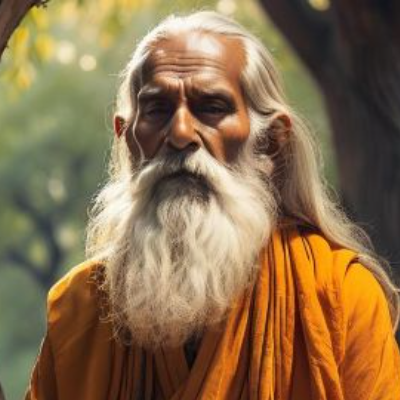
Dirghatamas — Blind Sage of the Angirasa Line, Philosopher of the Rigveda, and Progenitor of Eastern Kingdoms
Dirghatamas · Mamateyah · Aucathya · Andha-muni · Prachetasa · Kakshivat-pita · Anga-Vanga-Kalinga-janaka
Dirghatamas is one of the most extraordinary and philosophically rich figures in the Vedic and Puranic tradition — a sage born blind under a curse pronounced upon him in the womb by Brihaspati, the divine preceptor of the gods, who composed hymns of remarkable philosophical depth in the Rigveda, who lived through a series of severe hardships including abandonment by his own sons and an existence adrift on the river, and who eventually fathered a line of kings whose names became the designations of major eastern kingdoms of the subcontinent. He is the son of the sage Utathya — a son of the primordial Angiras — and of Mamata, Utathya's wife. His name itself is the record of his curse: Dirghatamas means "long darkness" — from dirgha (long, extended) and tamas (darkness) — a name that encodes the blindness with which he entered and traversed his life. Despite this darkness, or perhaps because of it, Dirghatamas is associated in the Rigveda with some of the most philosophically penetrating hymns in the entire corpus — passages of profound cosmogonic speculation, riddle-poetry, and solar mysticism that have attracted the sustained attention of Vedic scholars. He appears in the Mahabharata's Adi Parva, the Rigveda, the Vishnu Purana, the Bhagavata Purana, and several other texts.
✦ The Names
The name Dirghatamas is, as noted above, a compound meaning "long darkness" — a direct reference to the blindness he bore from birth through to extreme old age, and in some accounts through the entirety of his natural life. The name is unusual in the tradition for the directness of its encoding of the figure's defining characteristic — it is not a name of honour or aspiration but a factual designation of his condition, suggesting either that he was named with unsparing directness by his parents or, in the tradition of names that encode their recipient's story, that the name was understood as the appropriate designation for one whose life was defined by this particular darkness. The patronymic Mamateyah means "son of Mamata." Aucathya means "descendant of Utathya." Andha-muni means "the blind sage." Prachetasa is a name found in some Rigvedic attributions — it means "the discerning one" or "the one of intelligence," from prachetana, understanding — and is used in some passages as an alternative name or epithet for Dirghatamas, suggesting that the tradition recognised his blindness as being complemented by a corresponding acuteness of inner vision. Kakshivat-pita means "father of Kakshivat."
✦ Lineage
- Father: Utathya — a sage of the Angirasa lineage, son of Angiras, and elder brother of Brihaspati. His profile is given separately in this series.
- Mother: Mamata — the wife of Utathya, whose name means "mine" or "possessiveness." The Mahabharata records that after Dirghatamas was born blind — cursed in the womb by Brihaspati — Mamata, distressed at having a blind son, abandoned him on the banks of the Ganga. The blind infant was found by people of the Kuru lineage and raised. This abandonment is narrated in the Mahabharata without extended moral commentary on Mamata's act; the focus is on the origin of the blindness and on Dirghatamas's subsequent life rather than on Mamata's decision.
- Wives: The Mahabharata and Puranic accounts mention a wife of Dirghatamas named Pradveshi. The Mahabharata's narrative of Dirghatamas's abandonment by his sons involves this wife and is discussed below.
- Sons by Pradveshi — who abandoned him: The Mahabharata names sons of Dirghatamas by his wife Pradveshi, including Gautama — born of this marriage and not to be confused with the great sage Gautama Maharishi — and others. These sons, at their mother Pradveshi's instigation, decided that their blind old father was a burden and resolved to abandon him. They placed the aged blind sage on a raft and set him adrift on the Ganga, intending to be rid of him.
- Son by a slave woman — Kakshivat: Some accounts of Dirghatamas's life record that he had a son named Kakshivat born of a union with a slave woman before his abandonment — Kakshivat being a significant figure in the Rigvedic hymn tradition whose hymns are attributed to the Kakshivat Dirghatamasa lineage.
- Sons by Queen Sudeshna — the five royal founders: The most genealogically consequential of Dirghatamas's progeny are five sons born of his union with Sudeshna, the wife of King Bali of Anga, in an extraordinary episode narrated in the Mahabharata's Adi Parva. These five sons — Anga, Vanga, Kalinga, Pundra, and Suhma — became the founders and eponyms of five eastern kingdoms whose names correspond to major regions of eastern India: the Anga territory around modern Bhagalpur in Bihar; the Vanga territory corresponding to Bengal; the Kalinga territory corresponding to Odisha; the Pundra territory in northern Bengal; and the Suhma territory in the western delta region. These five kingdoms are significant in the Mahabharata's political geography and their rulers and peoples appear across the epic's narratives of war, alliance, and conquest.
✦ The Birth and Early Life — Cursed in the Womb
The circumstances of Dirghatamas's birth — narrated in the Mahabharata's Adi Parva as part of his father Utathya's story — are given in full in the Utathya profile above. Brihaspati's curse, pronounced in anger at the embryonic Dirghatamas's protest from within the womb, condemned him to be born blind. The Mahabharata describes this as a curse of long darkness — dirgha-tamas — and the name Dirghatamas is thus the permanent record of the prenatal curse that defined the physical conditions of his entire earthly existence.
After his birth, Mamata abandoned him on the riverbank. The Mahabharata records that the infant was found by people of the Kuru tradition — the lineage of the great northern kingdom — and raised. The tradition of being abandoned and found, which is a recurring narrative pattern in Sanskrit heroic biography, gives Dirghatamas from the very beginning of his life the mark of an unusual destiny — a being whom ordinary social arrangements cannot contain and who must find his way through circumstances of repeated extremity.
✦ Dirghatamas's Abandonment on the River
The second major episode of abandonment in Dirghatamas's life is narrated in the Mahabharata's Adi Parva. Dirghatamas, old and blind, lived with his wife Pradveshi and their sons. His wife and sons came to regard his blindness and age as a burden — he could not work, could not provide materially for the family, and required care and support. Pradveshi persuaded or directed the sons to remove their aged father from the household permanently. The sons placed Dirghatamas on a raft and set him adrift on the current of the Ganga, abandoning him to the river.
This act of filial abandonment — one of the most serious violations of the tradition's obligations of care for parents — is presented in the Mahabharata as a great wrong done to a great man. The tradition's judgment on the sons who abandoned their blind father to drown in the river is implicit in the subsequent narrative: their father, far from drowning, was rescued and went on to produce a line of kings, while the sons who abandoned him are not given any further narrative presence or significance. The raft adrift on the Ganga became the occasion of Dirghatamas's rescue and of the extraordinary union that produced the five royal founders.
✦ The Rescue by King Bali and the Union with Sudeshna
King Bali — the king of Anga, not to be confused with the great Daitya king Bali of the Vamana episode — encountered the blind sage drifting on the raft on the Ganga and rescued him. Bali welcomed Dirghatamas with honour and, recognising his extraordinary spiritual power, asked him to father sons upon his wife Sudeshna, who had not yet produced heirs. The tradition of niyoga — the levirate or proxy fatherhood — in which a sage or suitable man fathers children on behalf of a childless couple was an accepted convention in the tradition's understanding of dynastic necessity, and Bali's request to Dirghatamas was made within this convention.
Sudeshna, however, was unwilling to receive the blind old sage personally. She sent her maidservant instead, in a manner parallel to the episode of Ambika substituting a maidservant for herself during Vyasa's second visit in the Kuru lineage's birth narrative. From the maidservant's union with Dirghatamas, a son was born named Kakshivat — the Rigvedic poet whose hymns form a significant portion of the first Mandala's composition. Bali, discovering that the maidservant had been substituted, pressed Sudeshna to receive Dirghatamas herself. From this union five sons were born: Anga, Vanga, Kalinga, Pundra, and Suhma — who became the kings and eponyms of the five eastern territories that bear their names. The Mahabharata records that Bali recognised and honoured all five as his own sons in the dynastic convention, and that they grew to become great kings whose kingdoms formed the eastern part of the subcontinent.
✦ Dirghatamas in the Rigveda
Dirghatamas's most extraordinary contribution to the tradition is his authorship of several hymns in the Rigveda's first Mandala, attributed to him by the Vedic anukramanis — the traditional indices of hymn authorship. The hymns attributed to Dirghatamas — particularly the celebrated Asya Vamasya hymn — are among the most philosophically and linguistically complex in the entire Rigvedic corpus. The Asya Vamasya hymn is a riddle-poem of cosmogonic speculation — a text that uses the forms of ritual riddle and enigmatic verse to probe questions about the origin of the universe, the nature of the divine, the structure of cosmic time, and the relationship between the seen and the unseen. It contains passages of extraordinary philosophical density — including verses that have been interpreted as anticipating the cosmogonic scepticism of the Nasadiya Sukta and as exploring the limits of sacrificial and verbal knowledge — that have attracted sustained scholarly attention as among the most intellectually ambitious passages in the Rigveda.
The attribution of these philosophically sophisticated hymns to a blind sage is itself theologically suggestive within the tradition: the one who cannot see outward forms is the one most capable of perceiving the invisible structures of cosmic reality. The blind sage as a figure of inner vision — whose physical darkness is the condition of a compensating depth of spiritual perception — is a pattern that appears across multiple traditions, and Dirghatamas's blindness and his hymns' philosophical depth are connected in the tradition's understanding as two aspects of the same extraordinary nature.
✦ The Philosophy of the Asya Vamasya Hymn
The Asya Vamasya hymn — Rigveda 1.164 — is attributed to Dirghatamas Aucathya and is one of the most discussed hymns in Vedic scholarship. It takes the form of a series of enigmatic questions and riddles about cosmic reality — questions about the wheel of time with twelve spokes and three hundred and sixty nails, about the cow of Aditi who speaks without a voice, about the two birds on the same tree (one eating and one watching without eating), about the seven-wheeled chariot with seven horses, and many others. These riddles have been interpreted by the Vedic tradition itself in terms of the sacrificial cosmology — the year, the directions, the seasons, the ritual apparatus — and by modern scholars in terms of early cosmological speculation about the structure of time, consciousness, and reality.
The image of the two birds on the same tree — one eating the fruits and the other simply watching — became one of the most cited images in the Upanishadic and Vedantic traditions, where it was understood as an allegory of the individual soul (jiva) engaged with the world and the witnessing consciousness (Atman or Brahman) that observes without engagement. This image appears in the Mundaka Upanishad and the Shvetashvatara Upanishad, explicitly cited from the Rigvedic original attributed to Dirghatamas, and its use in the Upanishadic tradition gives Dirghatamas's blind sage a direct line of influence into the most central concepts of the Vedantic philosophical inheritance.
✦ Textual Variants and Inconsistencies
The mother of Kakshivat: The Mahabharata's account identifies Kakshivat as the son born of Dirghatamas's union with the maidservant substituted by Sudeshna. Some Vedic anukramani traditions identify Kakshivat's mother differently — as a woman named Usij or as another figure — and the Rigvedic hymns attributed to Kakshivat Dirghatamasa are sometimes given slightly different genealogical contexts in different parts of the Vedic cataloguing tradition. The Mahabharata's account is the most elaborated narrative version.
The identity of King Bali: The Mahabharata's account names Bali as the king of Anga who rescued Dirghatamas from the river and requested the niyoga. This Bali of Anga is a figure distinct from the great Daitya king Bali — the grandson of Prahlada and the subject of the Vamana episode — and the two should not be conflated. The Mahabharata is clear that the Bali in this episode is a human king of an eastern territory.
The nature and extent of the blindness: Some traditions describe Dirghatamas as having been born blind and remaining blind throughout his life. Others suggest that through his spiritual power he was able to perceive reality directly through other means — a form of compensating inner vision that his outer blindness enabled. The primary texts describe him as physically blind from birth through his life without giving an account of any restoration of physical sight.
✦ Theological and Philosophical Significance
Dirghatamas's theological significance is extraordinary and operates simultaneously in the genealogical, the philosophical, and the Vedantic registers. Genealogically, through his five royal sons by Sudeshna he is the remote patriarch of the five eastern kingdoms that bear his grandsons' names and whose peoples appear across the Mahabharata's world. Through Kakshivat he continued the Angirasa hymn tradition into the next generation of the Vedic poetic canon. Philosophically, through the Asya Vamasya hymn and the other Rigvedic compositions attributed to him, he contributed some of the most seminal images and ideas of the early Vedic cosmological speculation — including the two-birds image that became foundational for the Upanishadic non-dual tradition. The figure of the blind sage who sees most clearly is one of the tradition's most consistent archetypes of inner vision and transcendent perception, and Dirghatamas is its most fully biographical embodiment in the Vedic and Puranic canon.
His life narrative also functions as a sustained meditation on the pattern of abandonment and resilience — abandoned first by his mother at birth, abandoned again by his sons in old age, and surviving both to produce philosophical hymns of lasting significance and a royal line of five kingdoms. This pattern of repeated rejection and endurance gives Dirghatamas a biographical shape that the tradition reads as the appropriate container for his extraordinary spiritual perception: the outer life of darkness and repeated abandonment was the condition under which the inner life of profound cosmological vision was cultivated.
✦ Connection to the Wider Genealogy
Through his father Utathya and grandfather Angiras, Dirghatamas ascends to the primordial creative line of Brahma through the Angirasa lineage. Through his great-uncle Brihaspati — whose curse created his blindness — he is connected to the divine preceptor of the gods and to the world of the Adityas and the divine order. Through his sons by Sudeshna — Anga, Vanga, Kalinga, Pundra, and Suhma — he is the progenitor of the five eastern kingdoms whose peoples are significant participants in the Mahabharata's political world: the Angas, Vangas, Kalingas, Pundras, and Suhmas appear in the epic's battle catalogues, in the Karna narrative — Karna becoming the king of Anga under Duryodhana's patronage — and in the accounts of the digvijaya conquests by the Pandava brothers. Through Kakshivat and his Rigvedic hymn tradition, Dirghatamas continues the Angirasa lineage of sacred poetic composition into the next generation of the Vedic canon. Through the Asya Vamasya hymn's two-birds image and its reception in the Upanishads, Dirghatamas has an invisible but profound line of influence on the central philosophical inheritance of the non-dual Vedantic tradition.
✦ References
Primary Sources
- Rigveda, Mandala 1, hymn 164 (Asya Vamasya — the Long Darkness hymn): The primary Vedic source for Dirghatamas as a hymn-composer; the most philosophically rich and widely discussed of the hymns attributed to him; contains the two-birds image and the cosmological riddle-poetry that became foundational for subsequent philosophical traditions.
- Rigveda, Mandala 1, hymns 140–164 (Dirghatamas Aucathya hymns): The collection of Rigvedic hymns attributed to Dirghatamas in the anukramani tradition; establishes his identity as a major Rigvedic poet within the Angirasa family tradition.
- Mahabharata, Adi Parva, sections 98–104: The primary narrative source for Dirghatamas's biography — the birth under Brihaspati's curse, Mamata's abandonment, the marriage to Pradveshi, the abandonment by his sons on the raft, the rescue by King Bali, the niyoga with Sudeshna and the maidservant, the birth of Kakshivat and the five royal founders. The foundational epic text for Dirghatamas's biography.
- Mundaka Upanishad, 3.1.1; Shvetashvatara Upanishad, 4.6: The Upanishadic passages that cite and elaborate the two-birds image from the Asya Vamasya hymn attributed to Dirghatamas; essential for understanding the philosophical legacy of his Rigvedic composition.
- Vishnu Purana, Book 4, chapters 18–19: Genealogical material on the Angirasa lineage and the eastern kingdoms founded by Dirghatamas's sons by Sudeshna.
- Bhagavata Purana, Book 9, chapter 23: The genealogical account of the five eastern kingdoms — Anga, Vanga, Kalinga, Pundra, Suhma — and their founding through Dirghatamas's sons by Sudeshna.
Modern Reference Works
- Vettam Mani, Puranic Encyclopaedia (1975): Entry on Dirghatamas; comprehensive collation of all primary references across the Mahabharata, the Puranas, and the Rigvedic tradition; notes the key episodes and genealogical connections.
- A. A. Macdonell, Vedic Mythology (1897): Analysis of the Asya Vamasya hymn and the Dirghatamas Aucathya tradition in the Rigveda; establishes the Vedic scholarly context for the hymns attributed to Dirghatamas.
- A. A. Macdonell and A. B. Keith, Vedic Index of Names and Subjects (1912): Entry on Dirghatamas; establishes the Vedic background of the figure and his position in the Angirasa hymn tradition.
- Wendy Doniger O'Flaherty (translator), The Rig Veda: An Anthology (1981): Contains translation and scholarly notes on the Asya Vamasya hymn; the most accessible English-language treatment of the primary Vedic text attributed to Dirghatamas, with discussion of its philosophical content and its reception in the Upanishadic tradition.
- J. A. B. van Buitenen (translator), The Mahabharata, Volume 1 (1973): Critical translation of the Adi Parva with scholarly notes on the Dirghatamas narrative including the birth episode and the union with Sudeshna.
- Frits Staal, Agni: The Vedic Ritual of the Fire Altar (1983): Contains analysis of the Angirasa ritual and poetic traditions relevant to situating Dirghatamas's hymns within the broader framework of the Angirasa lineage's contribution to the Vedic canon.