
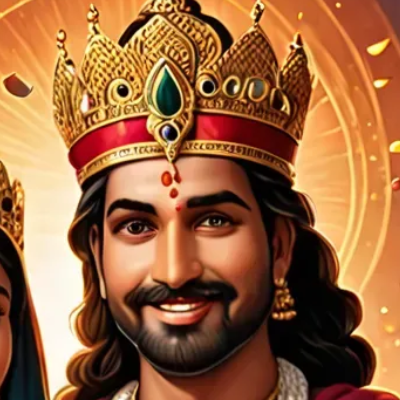
About
Uparichara Vasu — King of Chedi, Devotee of Vishnu, and Biological Father of Satyavati
Uparichara Vasu · Vasu · Chediraj · Girikakanta · Indrasakha · Vasumat
Uparichara Vasu is a king of the Chedi dynasty, celebrated in the Mahabharata as a great devotee of Vishnu, a righteous and powerful monarch, and a figure of unusual divine favour who received from Indra a celestial crystal chariot capable of moving through the sky — hence the epithet Uparichara, meaning one who moves above or one who travels in the sky. He is significant in the Puranic and epic genealogical tradition principally as the biological father of Satyavati — the woman who became the queen of Hastinapura, wife of the king Shantanu, and the mother of the sage Vyasa and the kings Chitrangada and Vichitravirya — and thereby as a remote biological ancestor of the entire Kuru-Pandava-Kaurava lineage of the Mahabharata. He is also a figure of some importance in the tradition of Vishnu devotion and of Vedic sacrifice, and his story includes a celebrated passage in which he adjudicated a cosmic theological dispute between the gods and the sages regarding the interpretation of a sacrificial injunction. Uparichara Vasu appears most extensively in the Mahabharata's Adi Parva and Shanti Parva, with references in the Vishnu Purana, the Bhagavata Purana, and the Harivamsa.
✦ The Names
The name Uparichara is a compound of upari — above, overhead — and chara — one who moves, a wanderer — yielding the sense of "one who moves above" or "the sky-traveller." This name directly encodes his most distinctive attribute: the celestial crystal chariot given to him by Indra, with which he travelled through the air, becoming the first mortal king to traverse the sky in this manner. The name Vasu is a Sanskrit term meaning "excellent," "good," "wealthy," or "a being of light." It is also the name of the class of eight divine beings — the Vasus — who feature prominently in the Mahabharata's Bhishma narrative, though Uparichara Vasu is a distinct figure from those celestial Vasus and shares only the name. Chediraj means "king of Chedi." Girikakanta means "beloved of the mountain" or "he whose beloved is the mountain" — a reference connected to his wife Girika, whose name derives from giri, mountain. Indrasakha means "friend of Indra," reflecting the special relationship of divine favour described in the Mahabharata.
✦ Lineage
- Dynasty: Uparichara Vasu is a king of the Chedi dynasty — the Chedis are a royal line of the Chandravamsha settled in the region of Chedi, identified with parts of central India in the vicinity of the Yamuna and Betwa rivers. The Chedi dynasty is one of the significant royal lines mentioned across the Mahabharata and Puranas. The Mahabharata does not specify Uparichara Vasu's exact position in the Chedi genealogy with the same precision that it gives for the Kuru or Ikshvaku lines, and the primary texts do not name his father or provide a detailed ancestral chain for him within the Chedi line.
- Wife: Girika — a woman of great beauty whose name connects her to the mountain. The Mahabharata describes her as Uparichara Vasu's deeply beloved wife and narrates the episode of her summons during his hunting expedition that led to the circumstances of Satyavati's conception. She is the mother of Uparichara Vasu's sons through the conventional conjugal relationship. The primary texts do not provide details of Girika's own parentage beyond her name.
- Sons by Girika: The Mahabharata names five sons of Uparichara Vasu and Girika. The Adi Parva gives their names as Brihadratha — who became the great king of Magadha and founder of the Brihadratha dynasty, of which the celebrated Jarasandha is a later descendant — Kushamba, Matsya, Pratyagra, and Chedipa. These sons became kings of different regions and founded dynasties of their own. Brihadratha's significance as the ancestor of Jarasandha — the powerful king of Magadha who was the principal ally of Kamsa and the persistent antagonist of Krishna in the Bhagavata Purana and the Mahabharata — makes this branch of Uparichara Vasu's lineage of considerable narrative importance.
- Daughter — biological, by Adrika the Apsara: Satyavati — born from the fish-form of the Apsara Adrika who had swallowed Uparichara Vasu's seed from the river. Satyavati was given to the fisherman king Dasharaja who raised her as his daughter. She subsequently became the wife of the Kuru king Shantanu and the mother of Vyasa, Chitrangada, and Vichitravirya, making her the matriarch from whom the entire Kuru-Pandava-Kaurava world biologically descends. Through Satyavati, Uparichara Vasu is the remote biological great-grandfather of Dhritarashtra, Pandu, and Vidura — and through them of the Kauravas and Pandavas.
- Son — biological, by Adrika the Apsara: The same birth that produced Satyavati from the fish also produced a boy. The Mahabharata narrates that when the fish was cut open, both a boy and a girl were found. The boy was taken by Uparichara Vasu and became a king; the girl became Satyavati. The name of this son is not consistently given across all versions of the narrative.
✦ Indra's Gift of the Crystal Chariot
The Mahabharata's Adi Parva narrates that Uparichara Vasu was a great king who was also a devoted practitioner of religious austerities. At the urging and entreaty of Indra — the lord of the gods, who was concerned that Uparichara Vasu's austerities were generating a spiritual power that might eventually challenge the divine order — Indra came to Vasu and persuaded him to abandon his ascetic retirement and return to the active governance of his kingdom, assuring him that righteous kingship was itself a valid form of dharmic practice and was no less worthy than forest austerity. Indra gave Uparichara Vasu a bamboo pole — which Vasu planted and consecrated as a standard in honour of Indra, establishing the festival of Indra's standard that is described as continuing in the Chedi kingdom — and the remarkable crystal chariot with which Vasu could travel through the sky. Uparichara Vasu thus became the only mortal king to travel in a celestial vehicle of this kind during the period described in the tradition, and his sky-travels gave him the name by which he is principally known.
The Mahabharata also describes Uparichara Vasu as wearing a garland of undying lotuses given to him by Indra — a mark of divine favour comparable to the crystal chariot. His relationship with Indra is presented as one of exceptional closeness and mutual respect, with Indra treating Uparichara Vasu as a friend and ally rather than merely as a mortal devotee. This relationship of divine friendship between a mortal king and the king of the gods is a mark of Uparichara Vasu's extraordinary standing in the tradition.
✦ The Conception of Satyavati — the Seed in the River
The Mahabharata's Adi Parva narrates the circumstances of Satyavati's biological conception in detail. Uparichara Vasu, while on a hunting expedition in the forest, was overcome by desire for his wife Girika, who was at that time in her purified state following her menstrual period — the time considered most auspicious for conception in the tradition. Girika herself, desiring union, sent a message to Vasu through a bird. Uparichara Vasu, his seed stimulated by desire, discharged it onto a leaf and, wishing to preserve it for Girika rather than let it be wasted, entrusted it to a hawk to carry to his wife. The hawk, flying through the sky, was attacked by another hawk who mistook the leaf for food; in the struggle, the leaf with Vasu's seed fell into the Yamuna river.
In the Yamuna river lived the Apsara Adrika, who had been cursed to inhabit the form of a fish. Adrika swallowed the seed. Ten months later — the standard period of gestation — a fisherman named Dasharaja caught Adrika-in-fish-form in his net. When the fish was cut open, two human children were found inside: a boy and a girl. Dasharaja, astonished, took the children to Uparichara Vasu and reported what had happened. Uparichara Vasu took the boy, who became a king. The girl — who still carried the fishy odour of her origin from a fish — was left with Dasharaja to raise as his daughter. This girl was Satyavati — called Matsyagandha, the fish-scented one, in her early years before the sage Parashara transformed her odour into a sweet fragrance. When Adrika gave birth to the two children, the curse that had confined her to fish-form was lifted and she resumed her Apsara identity.
✦ The Theological Dispute and Uparichara Vasu's Fall
The Mahabharata's Shanti Parva contains a celebrated episode in which Uparichara Vasu plays a central role in a dispute between the gods and the sages regarding the correct interpretation of a Vedic injunction. The dispute concerned whether the word aja in a sacrificial context referred to a goat — and thus that a goat was required as the sacrificial animal — or to grain that had not yet sprouted — the word aja being interpretable as either "the unborn" or "goat" — in which case only grain rather than an animal was required. The gods supported the interpretation that required an animal sacrifice; the sages supported the interpretation that required grain. Both sides appealed to Uparichara Vasu to adjudicate, since he was regarded as the most righteous and learned of mortal kings.
Uparichara Vasu, after consideration, gave his judgment in favour of the gods — declaring that aja meant goat and that animal sacrifice was what the text intended. The sages, convinced that the correct interpretation was otherwise and that Uparichara Vasu had ruled incorrectly under the influence of his friendship with Indra rather than from pure impartial judgment, cursed him for his unjust decision. The curse caused Uparichara Vasu to fall from his celestial crystal chariot and to sink beneath the earth into a subterranean existence. He remained underground for a long period as a consequence of the sages' curse.
The Mahabharata's Shanti Parva narrates that Uparichara Vasu, confined below the earth, meditated upon Vishnu and ultimately obtained liberation through his devotion. The episode of the theological dispute and its consequences is used in the Shanti Parva in the context of a broader discussion of the proper principles of sacrifice — specifically the question of whether Vedic sacrifice requires animal offerings or can be conducted with vegetable substitutes. The passage is cited in later tradition as one of the foundational texts for the view that the sages' interpretation — favouring grain over animals — was correct, and that Uparichara Vasu's misjudgment was a failure of independent reason overcome by the influence of divine friendship.
✦ Uparichara Vasu as a Devotee of Vishnu
The Mahabharata presents Uparichara Vasu as a great devotee of Vishnu — a Vaishnava king whose religious allegiance was primarily to the supreme deity in his Vishnu form. His final liberation through devotion to Vishnu, as narrated in the Shanti Parva, follows the standard Vaishnava soteriological pattern in which single-minded devotion to Vishnu overcomes even the most severe karmic obstacles. The Vishnu Purana and Bhagavata Purana reference Uparichara Vasu in contexts that confirm his Vaishnava identity and his extraordinary royal standing, though neither elaborates his biography with the same narrative richness as the Mahabharata.
✦ Brihadratha and the Magadha Connection
Among Uparichara Vasu's five sons by Girika, Brihadratha is the most genealogically consequential. Brihadratha became the king of Magadha — the great kingdom of the eastern Ganga plain — and is the founder of the Brihadratha dynasty, the earliest major royal line of Magadha recorded in the Puranic tradition. The Brihadratha dynasty is one of the long lists of royal dynasties enumerated in the Puranas. Its most celebrated later member is Jarasandha — the powerful king of Magadha who was the father-in-law of Kamsa, the persistent enemy of Krishna, and the antagonist who imprisoned eighty-six kings in a mountain fortress until killed by Bhima at Krishna's instigation in the Mahabharata's Sabha Parva. Jarasandha's genealogical descent from Brihadratha and thus from Uparichara Vasu makes Uparichara Vasu a remote ancestor of the Mahabharata's most powerful secondary antagonist in addition to being the biological ancestor of its central heroic lineage through Satyavati.
✦ Textual Variants and Inconsistencies
The mechanism of the seed's transmission: The Mahabharata's account of the seed being placed on a leaf and carried by a hawk is the standard version of this episode. Some regional and later retellings vary the mechanism of transmission — in some versions the seed falls directly into the river rather than through the hawk's misadventure — but the core elements of the episode — Uparichara Vasu's seed, the river, Adrika's swallowing, and the birth of Satyavati and her brother — are consistent across all versions.
The identity of the son born alongside Satyavati: The Mahabharata states that two children — a boy and a girl — were born from Adrika. The boy was taken by Uparichara Vasu and became a king. However, the name of this son is not given consistently across all passages and manuscripts of the Mahabharata, and some passages do not name him at all. The Harivamsa and some Puranic passages give different names in different contexts. This son's identity is therefore one of the textual loose ends of the episode that the primary sources do not resolve uniformly.
The theological dispute in the Shanti Parva: The Shanti Parva's account of the theological dispute and Uparichara Vasu's fall is presented in the context of the broader Shanti Parva discourse on dharma and sacrifice. The episode is used to support specific positions in the tradition's ongoing debate about animal versus vegetable sacrifice, and its inclusion in the Shanti Parva reflects the editors' interest in using Uparichara Vasu's story as a cautionary example. The Adi Parva does not contain this episode, and the two different portrayals of Uparichara Vasu — as the blessed and favoured king in the Adi Parva, and as the fallen and cursed figure in the Shanti Parva — represent different narrative contexts for the same figure rather than contradictory accounts of the same episode.
✦ Theological Significance
Uparichara Vasu's theological profile is layered across two distinct narrative registers. In the Adi Parva register he is a figure of exceptional divine favour — a mortal king who received celestial gifts from Indra, who travelled through the sky, and who governed with perfect righteousness. In the Shanti Parva register he is a figure of judicial misjudgment — a king whose friendship with Indra compromised his impartiality in a theological dispute, resulting in a fall from grace that the tradition reads as a lesson in the dangers of allowing personal allegiance to distort the application of dharmic principle. His ultimate liberation through Vishnu-devotion redeems the fall without erasing the lesson it teaches. The combination of these two registers creates a complex theological portrait: a supremely blessed king who nonetheless fell through a single failure of judgment, and who recovered through the devotional practice that had always been his deepest commitment.
✦ Connection to the Wider Genealogy
Through his sons by Girika, Uparichara Vasu is the progenitor of the Magadha royal line through Brihadratha and — several generations later — of Jarasandha, one of the Mahabharata's most powerful antagonists. Through his biological daughter Satyavati — born of the Apsara Adrika — he is the remote biological ancestor of the entire Kuru-Pandava-Kaurava world: Satyavati's son Vyasa fathered Dhritarashtra, Pandu, and Vidura on the widows of Vichitravirya; Dhritarashtra fathered the hundred Kauravas; Pandu's wives bore the five Pandavas by divine fathers. All of these figures — the protagonists of the Mahabharata on both sides — are biological descendants of Uparichara Vasu through Satyavati and Vyasa. Uparichara Vasu is thus one of the few figures in the tradition who is an ancestor of both the primary antagonists — the Kauravas through Dhritarashtra — and the primary protagonists — the Pandavas through Pandu — of the Mahabharata's central conflict, as well as of the Magadha royal power through Brihadratha and Jarasandha.
✦ References
Primary Sources
- Mahabharata, Adi Parva, sections 57 and 63: The primary source for Uparichara Vasu's biography as king of Chedi — his austerities, Indra's gifts of the crystal chariot and the garland, the consecration of Indra's standard, and the episode of the seed, the hawk, the river, and the birth of Satyavati and her brother from Adrika the Apsara-fish. The foundational narrative source for this profile.
- Mahabharata, Shanti Parva, sections 336–337: The account of the theological dispute between the gods and sages, Uparichara Vasu's adjudication in favour of animal sacrifice, the sages' curse, his fall from the crystal chariot, his subterranean existence, and his ultimate liberation through Vishnu-devotion.
- Vishnu Purana, Book 4, chapter 19: References to Uparichara Vasu and the Chedi dynasty within the broader dynastic genealogy; confirms his position as a Chandravamsha king and the founder of the Chedi royal line.
- Bhagavata Purana, Book 9, chapter 22: The Chandravamsha genealogy including the Chedi royal line; confirms Uparichara Vasu's position and the Magadha connection through Brihadratha.
- Mahabharata, Sabha Parva, sections 14–21: The narrative of Jarasandha — Uparichara Vasu's descendant through Brihadratha — and his imprisonment of eighty-six kings; provides the narrative context for the significance of the Magadha lineage that Uparichara Vasu founded through Brihadratha.
- Harivamsa, chapters 30–32: Contains genealogical material on Uparichara Vasu and the Chedi dynasty, with additional details on the birth of Satyavati.
Modern Reference Works
- Vettam Mani, Puranic Encyclopaedia (1975): Entry on Uparichara Vasu; comprehensive collation of primary references across the Mahabharata, Puranas, and Harivamsa; summarises the principal episodes of his biography and notes his genealogical connections to both Satyavati and the Magadha line.
- J. A. B. van Buitenen (translator), The Mahabharata, Volume 1 (1973): Critical translation of the Adi Parva with scholarly notes on the Uparichara Vasu episode and the birth of Satyavati.
- J. A. B. van Buitenen (translator), The Mahabharata, Volume 2 (1975): Critical translation of the Sabha Parva including the Jarasandha narrative, providing the genealogical context for the Magadha line descending from Uparichara Vasu through Brihadratha.
- F. E. Pargiter, Ancient Indian Historical Tradition (1922): Analysis of the Chedi dynasty and the Magadha royal line's descent from Brihadratha; critical reconstruction of these genealogies from multiple Puranic sources.
- Patrick Olivelle, "The Semantic History of Dharma" in The Concept of Duty in South Asia (1978): Contains discussion relevant to the theological dispute in the Shanti Parva in which Uparichara Vasu adjudicated the question of animal sacrifice, situating the episode within the tradition's debates about sacrificial dharma.