
About
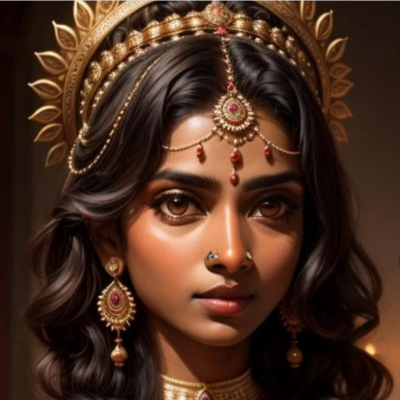
Girika — Queen of Uparichara Vasu, Born of Mountain and River
Girika · Girika · Daughter of Kolahala and Suktimati · Queen of Chedi
Girika was the wife of Uparichara Vasu, the righteous Paurava king of Chedi, and the mother of his five sons. She was born, according to the Mahabharata's Adi Parva, from the union of the mountain Kolahala and the river Suktimati — the sacred river that flowed through Uparichara Vasu's capital city. Her origins are thus of a wholly non-human character in the textual tradition, making her one of the several figures in the epic whose parentage involves the personified forces of the natural world. Girika is attested by name in the Mahabharata at Adi Parva I.63 and at Harivamsa 1805, where she is identified as the wife of Uparichara Vasu. She does not appear as an independent narrative agent but is central to two pivotal episodes in the Adi Parva: the episode of her husband's involuntary emission in the forest, which leads to the birth of Matsya and Satyavati, and the prior episode of her own extraordinary birth, which directly occasions her marriage to the king.
✦ The Name
The name Girika is derived from the Sanskrit root giri, meaning "mountain." The Monier-Williams Sanskrit dictionary glosses Girika in one of its senses as "making hills" and in a lexicographical sense as a common noun for a mouse or small creature that burrows in earth; however, as a proper name in the Mahabharata and Harivamsa, Girika denotes exclusively the queen of Uparichara Vasu. The name reflects her parentage: she is literally the daughter of Kolahala, the mountain, and Suktimati, the river. The AncientVoice commentary on the Mahabharata notes that girika in common speech also carries the sense of "one who belongs to the mountains," which further suits her identity as a child born of a mountain's union with a river. The Cologne Digital Sanskrit Dictionary confirms her identification at Mahabharata I.2371 and Harivamsa 1805.
✦ Lineage
- Father: Kolahala — a sentient mountain in the domain of Uparichara Vasu's Chedi kingdom; described in the Mahabharata as a life-endued mountain that was maddened by lust and forcibly seized the river Suktimati.
- Mother: Suktimati — the sacred river flowing through Uparichara Vasu's capital city, also called Shuktimati; she sought the king's protection when Kolahala blocked her course, and upon being freed, presented her two children to the king as a gift of gratitude.
- Twin brother: Unnamed in the primary sources; he was given by Suktimati along with Girika to Uparichara Vasu, who appointed him commander-in-chief of his army. His personal name is not recorded in the Mahabharata.
- Husband: Uparichara Vasu — the Paurava king of Chedi, descendant of Kuru, favoured by Indra with a crystal flying chariot and a vaijayanti garland; renowned in the epic tradition as a righteous and generous sovereign.
- Sons: Five sons, each of whom was installed by Uparichara Vasu as governor of a separate province and went on to found his own kingdom and dynasty — Brihadratha, Pratyagraha, Kushamba (also called Manivahana), Mavella, and Yadu.
✦ The Birth of Girika
The Mahabharata's Adi Parva narrates the circumstances of Girika's birth as follows. The river Suktimati flowed through the capital city of Uparichara Vasu's kingdom. The nearby mountain Kolahala, overcome by desire, seized the river and blocked her course. Suktimati, unable to free herself, sought the protection of the king. Uparichara Vasu came to the river's aid and struck the mountain with his foot, creating an opening through which the river escaped. However, from the union of Kolahala and Suktimati that had already occurred, two children were born as twins — a son and a daughter. The river Suktimati, grateful for her liberation, presented both children to the king. Uparichara Vasu raised the son and appointed him the generalissimo of his armies. The daughter was raised and, when she reached marriageable age, was wedded by Uparichara Vasu himself. The Mahabharata gives her name as Girika.
✦ The Episode of the Hawk and the Seed
Girika is at the centre of the episode that leads, through a chain of unforeseen events, to the birth of Matsya and Satyavati. The Mahabharata narrates that on the day Girika had completed her menstrual period, purified herself by bathing, and informed her husband that the time was auspicious for conception, Uparichara Vasu was simultaneously visited by his ancestral manes — the Pitrs — who requested that he hunt deer for their monthly commemorative rite. Bound by the obligation of filial duty, the king set out for the forest. His thoughts remained fixed on Girika throughout. In the forest, inflamed by the fragrance of spring blossoms and the beauty of the season, his desire for her overcame him and his seed fell involuntarily. Unwilling to waste it during so auspicious a period of his wife's fertility, the king collected the seed on a leaf and entrusted it to a hawk, asking the bird to carry it to Girika at the palace. A second hawk, mistaking the leaf's contents for a piece of meat, attacked the first hawk in the sky. In the struggle the seed fell into the waters of the Yamuna below, where it was swallowed by the apsara Adrika, who had been condemned by a sage's curse to live in the form of a fish. The seed thus intended for Girika never reached her. Ten months later, fishermen of the king's domain caught the fish and found two human children in its belly — a boy and a girl. These children were brought to Uparichara Vasu. The king retained the boy, who was named Matsya and later founded the Matsya kingdom. He gave the girl to the fisherman Dasharaj, who named her Satyavati. Upon delivering the two children, the apsara Adrika was released from her curse and returned to the heavens.
✦ The Sons of Girika
The Mahabharata's Adi Parva (chapters 63–64) names five sons born to Uparichara Vasu by Girika. The Vishnu Purana (Book IV, chapter 19), the Bhagavata Purana (Canto IX, chapter 22), and the Harivamsa all corroborate the same five sons, though minor name variants exist across manuscripts. These five sons, each described as possessed of great energy and immeasurable prowess, were installed by their father as governors over separate provinces of his empire and went on to found kingdoms and towns named after themselves, establishing dynasties of long duration.
- Brihadratha — the eldest, also known as Maharatha; installed at Magadha, where he founded the Brihadratha dynasty, the earliest ruling line of that kingdom. He was the direct father of Jarasandha, the powerful king of Magadha who became an antagonist of Krishna in the Mahabharata's Sabha Parva.
- Pratyagraha — installed in the Chedi kingdom, his father's principal domain; identified in the Mahabharata as the ancestor from whose line descended Shishupala, the Chedi king who was slain by Krishna at the Rajasuya sacrifice of Yudhishthira. The intervening generations between Pratyagraha and Shishupala are not enumerated in the primary texts.
- Kushamba — also called Manivahana; founded his own kingdom and dynasty. The primary texts offer no further details of his reign or descendants. He must not be confused with the Ramayana-era Kushamba, son of Kusha and grandson of Brahma, who is a wholly different figure of a different lineage and era.
- Mavella — founded his own kingdom and dynasty. No narrative episodes or descendants are recorded in any primary source.
- Yadu — the fifth son, described in the Mahabharata as "of great prowess and invincible in battle"; founded his own kingdom and dynasty. He is distinct from the much earlier Yadu, son of Yayati, who was the eponymous ancestor of the Yadava clan and from whose line Krishna descended many generations later. The two share a name but belong to different generations and different lineages.
It should be noted explicitly that Matsya — the son of Uparichara Vasu who founded the Matsya kingdom — was born not of Girika but of the apsara Adrika. As the narrative above shows, the seed intended for Girika never reached her; it was carried by the hawk, fell into the Yamuna, and was swallowed by Adrika. Matsya is accordingly Girika's stepson by the circumstances of the story, not her own child. The primary sources make this distinction clearly.
✦ Theological and Narrative Significance
Girika's role in the Mahabharata is primarily structural rather than active. Her auspicious bathing and her communication of her fertile state to the king sets the entire chain of events in motion that produces Matsya and Satyavati. It is the king's desire for Girika — present with him throughout his hunt in the forest — that causes his involuntary emission, which in turn falls into the Yamuna, impregnates Adrika, and yields the two children who become, respectively, the founder of the Matsya royal line and the great ancestress of the Pandavas and Kauravas. In this sense, Girika's role, though largely passive, is the narrative pivot on which the entire genealogical chain of the Mahabharata depends. The tradition of her birth — from the union of a mountain and a river — places her within the category of beings in the epic world who are born of natural forces personified, a category that includes several other figures whose origins bridge the human and the elemental.
✦ Connection to the Wider Genealogy
Through her five sons, Girika is the maternal ancestor of two of the most consequential royal dynasties of the Mahabharata world. Through Brihadratha and his son Jarasandha, her line connects to the Magadhan royal house whose political ambitions shape the Sabha Parva's narrative of the Rajasuya sacrifice. Through Pratyagraha and his descendant Shishupala, her line connects to the Chedi kingdom whose king became the most outspoken opponent of Krishna at Yudhishthira's court and was ultimately slain by him. Through her husband's son Matsya by the apsara Adrika — not her own child — the Matsya kingdom was founded, whose later king Virata sheltered the Pandavas during their incognito exile, and whose daughter Uttara married Abhimanyu, producing Parikshit, the heir to the Hastinapura throne after the Kurukshetra war. Through her husband's daughter Satyavati — likewise born of Adrika, not of Girika — the Kuru royal line continued through the sage Vyasa and produced the Pandavas and Kauravas themselves.
✦ References
Primary Sources
- Mahabharata, Adi Parva, chapter 63 (verses I.63.36 and surrounding) — The principal source for Girika's birth from Kolahala and Suktimati, her marriage to Uparichara Vasu, the five sons she bore him, and the episode of the hawk, the seed, and the birth of Matsya and Satyavati.
- Mahabharata, Adi Parva, chapter 64 — Names all five sons of Girika and records that each founded kingdoms and dynasties after his own name.
- Harivamsa, verse 1805 — Corroborates Girika's identification as the wife of Uparichara Vasu and the mother of his sons.
- Vishnu Purana, Book IV, chapter 19 — Lists the five sons of Uparichara Vasu by Girika in the Paurava dynastic genealogy; distinguishes them from Matsya and Satyavati who were born of Adrika.
- Bhagavata Purana, Canto IX, chapter 22 — Corroborates the account of Uparichara Vasu's family in the lunar dynasty genealogy.
Secondary and Reference Works
- Wisdomlib, "Girika" entry — Provides the Cologne Digital Sanskrit Dictionary and Monier-Williams references for Girika, citing Mahabharata I.2371 and Harivamsa 1805; confirms the Puranic gloss of her name and parentage.
- Vyasa Mahabharata (vyasaonline.com), "Girika" entry — Summarises her identity as daughter of the river Suktimati and wife of Uparichara Vasu, consistent with the Adi Parva account.
- Wikipedia, "Suktimati" — Documents the river's role in Girika's birth narrative and the broader geography of the Chedi capital.
- Indica Today, "Apsara Adrika and the Chronicler of Mahabharata" — Narrates the hawk episode in full and clarifies the distinct maternal origins of Girika's five sons versus Matsya and Satyavati born of Adrika.
- Puranic Encyclopaedia (Vettam Mani) — Provides a consolidated account of the sons of Uparichara Vasu by Girika, naming the five correctly as Brihadratha, Pratyagraha, Kushamba (Manivahana), Mavella, and Yadu.