
About
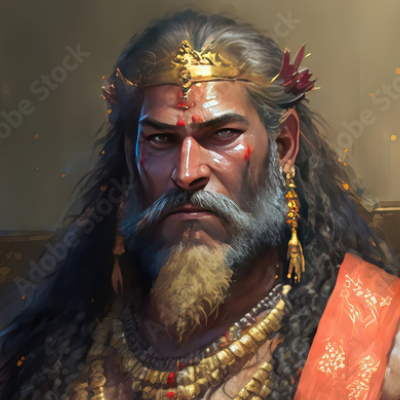
Brihadratha — Founder of the Magadha Dynasty and Father of Jarasandha
Vrihadratha · Maharatha · Brhadratha · Son of Uparichara Vasu · King of Magadha
Brihadratha was the eldest son of Uparichara Vasu, a righteous king of the Paurava lineage who ruled the kingdom of Chedi, and his queen Girika, daughter of the mountain Kolahala and the river Suktimati. He is primarily known as the founder of the earliest ruling dynasty of Magadha and as the father of Jarasandha, the formidable antagonist of the Mahabharata. Brihadratha appears in the Mahabharata across the Adi Parva and Sabha Parva, and is mentioned in the genealogical sections of the Vishnu Purana, the Bhagavata Purana, the Matsya Purana, the Vayu Purana, the Harivamsa, and the Agni Purana. His name also appears twice in the Rigveda, though it cannot be established that those references denote the same figure.
✦ The Name
The name Brihadratha is a Sanskrit compound meaning "he of the great chariot" or "he of many chariots," from brihat (great, vast) and ratha (chariot). The Mahabharata also refers to him by the epithet Maharatha, meaning "great chariot-warrior," which reinforces the same martial sense. The Rigveda contains the name at I.36.18 and X.49.6, though the commentarial tradition does not confirm that these Vedic occurrences refer to the Magadhan king.
✦ Lineage
- Father: Uparichara Vasu — a Paurava king of Chedi, famous for riding a crystal flying chariot gifted by Indra, and regarded in the epics as a paragon of dharmic kingship.
- Mother: Girika — daughter of the mountain Kolahala and the river Suktimati, who was given in marriage to Uparichara Vasu after he freed the river from the mountain's forcible embrace.
- Brothers: Pratyagraha — who inherited Chedi; Kushamba, also called Manivahana; Mavella; and Yadu — all sons of Girika, each of whom founded his own kingdom and dynasty.
- Half-brother: Matsya — son of Uparichara Vasu by the apsara Adrika, who had been cursed to live as a fish; Matsya was raised in Vasu's household and later founded the Matsya kingdom.
- Wives: The twin daughters of the king of Kashi — two queens whom Brihadratha married and promised to treat with perfect equality.
- Son: Jarasandha — the most celebrated king of Magadha, born under extraordinary supernatural circumstances; father of Sahadeva, who succeeded to the Magadhan throne after Jarasandha's death.
- Daughter (per Wikipedia / Brihadratha article): Shashirekha — said in one account to have become the second wife of Dhrishtadyumna, the Pandava general; this detail is not found in the principal Puranic genealogies and must be treated with caution.
✦ Installation at Magadha
The Mahabharata records that Uparichara Vasu, having governed Chedi as an imperial overlord, installed each of his five sons by Girika as governors over separate provinces. Brihadratha, as the eldest, was installed over Magadha, where he established what became known as the Brihadratha dynasty. The Puranas consistently identify this as the first ruling dynasty of Magadha. Brihadratha established his capital at Girivraja, the city surrounded by five hills, identified by scholars with modern Rajgir in Bihar. The Vishnu Purana states that the dynasty produced a succession of twenty-four kings; the Matsya Purana gives twenty-two. Both accounts agree that the line concluded with Ripunjaya, who is said to have been killed by his own minister.
✦ The Birth of Jarasandha
The Mahabharata narrates that Brihadratha, despite his two queens — the twin daughters of the king of Kashi — remained without a son for many years. Grieved by this, he eventually sought the forest and served the sage Chandakaushika. The sage, pleased with his devotion, granted him a fruit charged with a mantra and instructed that it be given to one wife only, so that a single son might be born. Brihadratha, unwilling to show partiality between his two equally beloved queens, divided the fruit and gave half to each. Each queen became pregnant but delivered not a whole child but a lifeless half of a body. The two halves were grotesque in appearance and the king, troubled, had them cast outside the city walls. A female demon named Jara — the same name meaning decay or old age — came upon the two halves. She picked them up, one in each hand, and when she pressed her palms together to carry them, the two halves joined and became a living, crying child of extraordinary strength. Alarmed by the infant's cries, Jara brought the child to the king and explained what had occurred. Brihadratha received the child with great joy and named him Jarasandha — "the one joined by Jara" — in honour of the being who had made him whole. The sage Chandakaushika subsequently visited Magadha and blessed the boy with remarkable prophecies of his future glory and invincibility.
✦ Retirement and Succession
After installing Jarasandha on the throne of Magadha, Brihadratha and his two queens withdrew from royal life to perform austerities in the forest. The texts do not record any further narrative episodes involving Brihadratha after this retirement.
✦ Textual Variants and Inconsistencies
The principal inconsistency concerns the genealogical position of Jarasandha in the Magadhan dynastic list. The Mahabharata and most Puranas — including the Vishnu Purana and the Bhagavata Purana — describe Jarasandha as the direct son of Brihadratha. However, the Agni Purana places several generations between Brihadratha and Jarasandha, naming Satyahita, Urjja, and Sambhava as intervening kings before Jarasandha. The Matsya Purana gives yet another intervening sequence: Satyadhrita, Dhanusha, Sarva, and Sambhava before Jarasandha. Most scholars treat the Mahabharata's account of Jarasandha as the son of Brihadratha as the primary narrative, while acknowledging that the Puranic dynastic lists reflect a longer and more complex tradition. The Vayu Purana names Satyahita as the father of Jarasandha, diverging from the Mahabharata's account entirely.
A secondary inconsistency concerns the list of Brihadratha's brothers. The Mahabharata (Adi Parva 1.63–64) names them as Pratyagraha, Kusamva (Manivahana), Mavella, and Yadu. The Puranic Encyclopaedia (citing the Mahabharata) gives the fifth son as Rajanya instead of Yadu. The name Yadu also designates the eponymous ancestor of the Yadava clan — a figure many generations earlier than Uparichara Vasu — which has led to confusion in secondary literature; the Yadu named as Brihadratha's brother is a distinct individual sharing the same name.
✦ Connection to the Wider Genealogy
Brihadratha belongs to the Paurava branch of the lunar dynasty. His father Uparichara Vasu was a descendant of Kuru, the eponymous ancestor of the Kuru lineage and the holy district of Kurukshetra. Through his son Jarasandha, Brihadratha is the grandfather of Sahadeva of Magadha (not to be confused with the Pandava of the same name), who became an ally of the Pandavas after Jarasandha's death and participated in the Kurukshetra war. Through his half-sister Satyavati — the daughter of Uparichara Vasu by the apsara Adrika, raised by the fisherman Dasharaj — Brihadratha is connected indirectly to the principal Kuru lineage of the Mahabharata: Satyavati married King Shantanu of Hastinapura and became the grandmother of Dhritarashtra, Pandu, and Vidura, and through the sage Vyasa whom she bore to Parashara, the remote ancestress of both the Pandavas and the Kauravas.
✦ References
Primary Sources
- Mahabharata, Adi Parva, chapters 63–64 — The canonical source for the five sons of Uparichara Vasu by Girika; names Brihadratha as eldest, installed at Magadha, also called Maharatha.
- Mahabharata, Sabha Parva, sections 14–22 — Narrates the episode of Jarasandha, describing his birth from two joined halves, his power and enmity with Krishna, and his death at Bhima's hands; establishes Brihadratha as his father.
- Vishnu Purana, Book IV, chapter 19 — Gives the genealogy of Uparichara Vasu and names Brihadratha as founder of the Magadhan line, with Jarasandha as a descendant; notes the dynasty ran to twenty-four kings ending with Ripunjaya.
- Bhagavata Purana, Canto IX, chapter 22 — Refers to the Brihadratha dynasty's origins and the miraculous conception of Jarasandha.
- Matsya Purana, chapter 50 and related sections — Provides a genealogical list giving twenty-two Brihadratha kings; offers an intervening sequence between Brihadratha and Jarasandha that differs from both the Mahabharata and the Vishnu Purana.
- Vayu Purana, genealogical sections — Names Satyahita rather than Brihadratha as the direct father of Jarasandha, representing a significant divergence from the Mahabharata narrative.
- Agni Purana, genealogical sections — Places Satyahita, Urjja, and Sambhava between Brihadratha and Jarasandha; diverges from the Mahabharata account of direct sonship.
- Harivamsa, genealogical sections — Corroborates the account of Uparichara Vasu's sons and the Magadhan line.
- Rigveda, I.36.18 and X.49.6 — Contains the name Brihadratha; whether this refers to the Magadhan king cannot be established from context.
Secondary and Reference Works
- Puranic Encyclopaedia (Vettam Mani) — Provides a consolidated account of Brihadratha's parentage, the birth of Jarasandha, and the sons of Vasu; notes the variant name Rajanya for one of the five brothers.
- Vishnu Purana (H.H. Wilson translation, Book IV, chapter 19, with notes) — Wilson's footnotes at pp. 455–456 carefully document the divergences between the Agni, Matsya, Vayu, and Bhagavata Puranas on the genealogical position of Jarasandha.
- Wikipedia, "Brihadratha" — Provides a summary of the dynastic list and notes the reference to Shashirekha as his daughter; treated with caution as it cites no Puranic verse for this detail.
- Wikipedia, "Brihadratha dynasty" — Summarises the Puranic king-lists and scholarly debate on the dynasty's historicity and relationship to the archaeological record at Rajgir.