
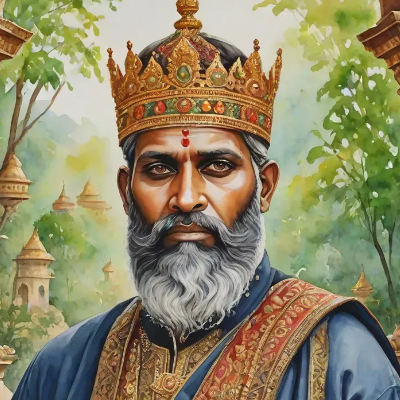
About
Kushamba — Son of Uparichara Vasu, Also Known as Manivahana
Kusamva · Kusambu · Kusamba · Manivahana · Son of Uparichara Vasu
Kushamba was one of the five sons born to Uparichara Vasu, the righteous Paurava king of Chedi, and his queen Girika, daughter of the mountain Kolahala and the river Suktimati. He is consistently distinguished in the primary sources by his second name or epithet Manivahana, which appears alongside his personal name as a paired identification in the Mahabharata and the Puranas. Among the five sons of Uparichara Vasu by Girika, Kushamba is the one most frequently singled out for this dual naming. The primary sources do not record any individual narrative episodes, exploits, or descendants for Kushamba, but confirm that he, like his brothers, founded a kingdom and a dynasty bearing his own name.
✦ The Name
The name Kushamba (also found as Kusamva, Kusambu, or Kusamba in various manuscript traditions) is formed from the Sanskrit root kus or kush, associated with grass or prosperity, and the suffix -amba. No ancient source provides an explicit etymology for this bearer of the name. His second name, Manivahana, is more transparent: mani means "jewel" and vahana means "vehicle" or "bearer," giving the combined sense of "jewel-bearer" or "he whose vehicle is adorned with jewels." This epithet suggests a characterisation relating to wealth, royal splendour, or possibly a specific chariot or mount.
It should be noted that the name Kushamba also appears in the Ramayana and in Puranic genealogies in a wholly separate context — as one of the four sons of Kusha, who was himself a son of Brahma, and as the founder of the city of Kaushambi. That Kushamba is a figure of an entirely different lineage and era; the two bearers of the name are distinct, and no primary source conflates them.
✦ Lineage
- Father: Uparichara Vasu — a Paurava king of Chedi, descendant of Kuru, renowned for his friendship with Indra and for riding a crystal flying chariot; honoured in the epics as a righteous and generous sovereign.
- Mother: Girika — daughter of the mountain Kolahala and the river Suktimati, married to Uparichara Vasu after he liberated the river from Kolahala's forceful embrace.
- Brothers: Brihadratha, also known as Maharatha — the eldest, installed at Magadha, father of Jarasandha; Pratyagraha — installed at Chedi, ancestor of Shishupala; Mavella; and Yadu — all founders of separate kingdoms.
- Half-brother: Matsya — son of Uparichara Vasu by the apsara Adrika, who had been cursed to live in the form of a fish; raised in Vasu's household and later founder of the Matsya kingdom.
✦ Role in the Narrative
The Mahabharata's Adi Parva records that Uparichara Vasu installed each of his five sons by Girika as governors over distinct provinces of his empire, and that each son founded kingdoms and towns after his own name, establishing dynasties that lasted for long ages. Kushamba is named as one of these five sons. Beyond this foundational statement, no individual deeds, campaigns, marriages, or children of Kushamba are recorded in the Mahabharata, the Vishnu Purana, the Bhagavata Purana, or the Harivamsa. The texts that mention him do so exclusively in the context of enumerating the sons of Uparichara Vasu. The brevity of the record for Kushamba is consistent with the brevity of the records for Mavella and Yadu among the same sibling group; it does not represent an omission in this profile but an honest reflection of what the primary sources contain.
✦ Textual Variants
The name appears in several orthographic forms across manuscripts and printed editions: Kusamva in some versions of the Mahabharata, Kusambu in certain Puranic lists, Kusamba in secondary compilations, and Kushamba in modern reference works. The Mahabharata at Adi Parva 1.63 employs the form Kusamva. The Vishnu Purana at Book IV, chapter 19 uses Kusamva with the gloss "also called Manivahana." All these forms refer to the same individual. No source gives a different parentage, maternal line, or dynastic assignment for any of these variant forms.
✦ Connection to the Wider Genealogy
Kushamba belongs to the Paurava branch of the lunar dynasty. His father Uparichara Vasu was a descendant of Kuru, the eponymous ancestor of the Kuru lineage. Through his brother Brihadratha, Kushamba is the paternal uncle of Jarasandha, the powerful king of Magadha who became one of the principal antagonists of the Mahabharata. Through his brother Pratyagraha, he is an ancestor's brother of Shishupala, the Chedi king who was slain by Krishna at the Rajasuya sacrifice. Through his father's son by the apsara Adrika — the boy named Matsya, who founded the Matsya kingdom — Kushamba is connected to the lineage that eventually produced Virata, the king of Matsya in whose court the Pandavas spent their year of incognito exile. Through his father's daughter Satyavati, who married King Shantanu of Hastinapura, he is a collateral kinsman of the Kuru line that produced the Pandavas and Kauravas.
✦ References
Primary Sources
- Mahabharata, Adi Parva, chapters 63–64 — Names Kusamva (Kushamba) as one of the five sons of Uparichara Vasu by Girika, with the paired epithet Manivahana; states that all five founded kingdoms and dynasties after their own names.
- Vishnu Purana, Book IV, chapter 19 — Lists Kusamva (also called Manivahana) among the sons of Uparichara Vasu in the Paurava dynastic genealogy.
- Bhagavata Purana, Canto IX, chapter 22 — Corroborates the list of Uparichara Vasu's sons in the lunar dynasty account.
- Harivamsa, genealogical sections — Corroborates the enumeration of Vasu's sons including Kushamba.
Secondary and Reference Works
- Puranic Encyclopaedia (Vettam Mani) — Provides a consolidated note on the sons of Uparichara Vasu, naming Kusamba (Manivahana) and distinguishing him from the Ramayana-era Kushamba of the Brahma lineage.
- Wisdomlib, "Uparicara" entry — Provides the cross-Puranic index references confirming Kushamba's place in the sibling list.
- Sacred Texts Archive, Mahabharata Book I, chapter 64 — Reproduces the Ganguli translation of the Adi Parva passage naming Kusamva and Manivahana together.