
About
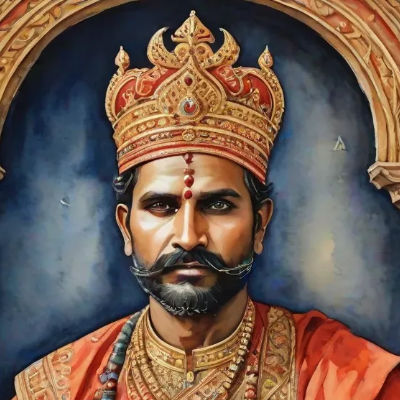
King of Kashi — Father of Amba, Ambika, and Ambalika
Kashya · Kashiraja
The King of Kashi is a ruler of the kingdom of Kashi recorded in the Adi Parva of the Mahabharata, identified in the tradition by the patronymic Kashya, meaning simply "of Kashi" or "descendant of Kashi," rather than by a personal name. He is the father of three princesses central to the founding generation of the Kuru dynasty: Amba, Ambika, and Ambalika. His daughters' swayamvara, at which Bhishma abducted all three to secure brides for his half-brother Vichitravirya, sets in motion a chain of consequences extending through the birth of Dhritarashtra and Pandu and ultimately to the events of the Kurukshetra War. The king himself does not act as an independent figure beyond hosting this swayamvara; his significance in the tradition lies entirely in his paternity of the three princesses.
✦ The Name
Kashya is a Sanskrit patronymic derived from Kashi, the name of the kingdom and city he ruled, with the suffix -ya indicating descent or association. The name therefore functions as a title rather than a personal name, identifying him as "the one of Kashi" or "the Kashi king," in the same manner that many Mahabharata rulers are identified by their kingdom rather than by an individual name when the text's narrative interest lies primarily in their royal office and their daughters or descendants rather than in their own person.
✦ Lineage
- Wife: Kausalya, named in some secondary sources as the mother of his three daughters.
- Daughter: Amba, the eldest of the three princesses, who was in love with Salva, king of the Saubha kingdom, and was released by Bhishma to go to him after the abduction; she later sought Bhishma's destruction and was reborn as Shikhandi, child of King Drupada.
- Daughter: Ambika, the second daughter, who married Vichitravirya, king of Hastinapura, and became the mother of Dhritarashtra through the practice of niyoga with the sage Vyasa after Vichitravirya's death.
- Daughter: Ambalika, the youngest daughter, who likewise married Vichitravirya and became the mother of Pandu through niyoga with Vyasa.
✦ The Swayamvara and Bhishma's Abduction of the Princesses
The Mahabharata recounts that the King of Kashi held a swayamvara for his three daughters, to which kings and princes from across the land were invited so that the princesses might choose their own husbands. Bhishma, the Kuru regent and half-brother of the childless king Vichitravirya, learned of the ceremony and travelled to Kashi with the intention of securing brides for Vichitravirya rather than for himself. Upon his arrival, the assembled suitors mocked him, questioning why a man who had renounced marriage through his own vow of celibacy had come to a bridal gathering. Provoked by this taunt to the honour of his clan, Bhishma declared his intention to take the three princesses by force, challenged the assembled kings to stop him, and carried all three onto his chariot. The kings pursued him and showered him with arrows; Bhishma turned and defeated them in battle, including Salva, the king who held Amba's affection, whom Bhishma overpowered but spared. Bhishma then brought the three princesses to Hastinapura and presented them to his stepmother Satyavati for marriage to Vichitravirya.
✦ Connection to the Wider Genealogy
Through his daughters Ambika and Ambalika, the King of Kashi becomes the maternal grandfather of Dhritarashtra and Pandu, the two patriarchs whose sons, the Kauravas and the Pandavas, fight the Kurukshetra War at the centre of the Mahabharata's narrative. Through his eldest daughter Amba, he is connected by the logic of rebirth to Shikhandi, child of King Drupada of the Panchalas, who in a later life plays a direct role in Bhishma's death on the battlefield. The kingdom of Kashi itself, ruled by this king, lies along the Ganga and is associated in the tradition with the sacred city of Varanasi.
✦ Textual Note
Several secondary sources list a son, Senabindu, as a sibling of Amba, Ambika, and Ambalika. This appears to confuse the King of Kashi's family with a separate and unrelated Mahabharata warrior-king also called Senabindu or Senavindu, described elsewhere in the epic as the rebirth of the asura Tuhunda and as a ruler twice defeated by Arjuna during his campaign of conquest. No primary source has been found establishing this Senabindu as a son of the King of Kashi or a brother of the three princesses, and the claim is accordingly omitted here.
✦ References
- Mahabharata, Adi Parva, Sambhava Parva, Chapter 100 (approx.): the primary attestation of the swayamvara of the three princesses of Kashi and their abduction by Bhishma.
- Wikipedia, entries on Amba (Mahabharata), Ambika (Mahabharata), and Ambalika: secondary summaries confirming the king's patronymic Kashya, his wife Kausalya, and the identities and subsequent fates of his three daughters.
- Vyasa Mahabharata Encyclopaedia, entries on Amba, Ambika, and Ambalika: secondary summaries corroborating the swayamvara narrative and the daughters' marriages and offspring.