
About
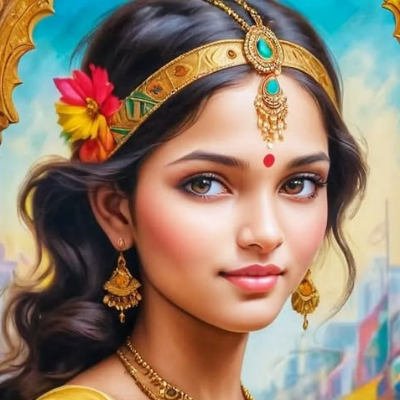
Amba — Princess of Kashi, Victim of Bhishma's Abduction, and Reborn Destroyer of the Grandsire
Amba · Kashirajatanaya · Shikhandi-purvajanma · Shikhandini · Bhishmashapini
Amba is the eldest of the three daughters of the king of Kashi — the sacred city on the Ganga, also called Varanasi — who were abducted from their svayamvara by Bhishma, the son of Shantanu and the goddess Ganga and the incomparable guardian of the Kuru throne, to be given as wives to Vichitravirya, the young king of Hastinapura. Of the three sisters, Amba alone was not married to Vichitravirya — having already given her heart at the svayamvara to King Shalva of Saubha, she told Bhishma of her prior commitment and was released to seek Shalva. Shalva refused her, regarding her as having been another man's captive; she was rejected by her father's household as well. Amba was thus rendered unmarriageable by the act of abduction — an act for which she held Bhishma entirely and permanently responsible. Her sustained campaign to destroy Bhishma — through appeals to kings, through Parashurama's intervention, through her own austerities, and through her eventual rebirth as Shikhandi — is one of the most dramatically extended and morally searching narratives in the entire Mahabharata. It is also the narrative that explains the single fact on which the entire Kurukshetra war's turning point depended: that Bhishma fell on the tenth day because he would not raise his bow against Shikhandi, who stood before Arjuna. Amba appears primarily in the Udyoga Parva and is referenced across the Adi Parva, the Bhishma Parva, and several Puranic texts.
✦ The Names
The name Amba is an ancient Sanskrit word meaning mother, a respectful term of address for an elder woman, or simply a name of affection. In its most basic sense it carries the warmth of the maternal principle — an irony given that Amba's biography contains no motherhood and is defined entirely by deprivation, injustice, and an implacable drive toward vengeance. The patronymic Kashirajatanaya means "daughter of the king of Kashi." The designation Shikhandi-purvajanma means "the previous birth of Shikhandi" — identifying her by her rebirth rather than by her present life. Bhishmashapini means "she who cursed Bhishma" — though technically Amba did not curse Bhishma directly but rather obtained a divine boon specifically oriented toward his destruction. In the tradition's popular understanding she is the one whose sustained will brought about Bhishma's fall, and the designation reflects this association.
✦ Lineage
- Father: The king of Kashi — referred to in most Mahabharata passages simply as Kashiraj, the king of Kashi, without a personal name in the primary narrative of the Amba episode. He is the ruler of the kingdom of Kashi, whose capital is the sacred city of Varanasi on the Ganga. He arranged the svayamvara at which his three daughters were to choose their husbands.
- Sisters: Ambika and Ambalika — the younger sisters who were married to Vichitravirya and who subsequently became the mothers of Dhritarashtra and Pandu through the levirate arrangement with Vyasa. Both are profiled separately in this series.
- The man she chose: Shalva — the king of Saubha, who had come to the svayamvara intending to win Amba. Before Bhishma's arrival and abduction, Amba had chosen Shalva in her heart as her intended husband. Shalva subsequently fought Bhishma on the road to prevent the abduction and was defeated. When Amba was released by Bhishma and went to Shalva, he refused to accept her, saying that a woman taken by force by another great warrior could not be taken back in honour — and in some versions of the text, citing his own defeat by Bhishma as a humiliation he had not forgiven. Shalva's rejection is the first and most proximate cause of Amba's ruined life.
- Rebirth: Shikhandi — the son of King Drupada of Panchala, born female as Shikhandini and subsequently transformed to male through an exchange with a Yaksha. Shikhandi is identified in the Mahabharata as the rebirth of Amba, who had obtained from Shiva the boon that she would be born as Bhishma's destroyer. Shikhandi stood before Arjuna's chariot on the tenth day of the Kurukshetra war, and Bhishma — recognising in Shikhandi the woman from a previous birth — lowered his bow, allowing Arjuna's arrows to bring him down.
✦ The Svayamvara, the Abduction, and the Release
The Mahabharata's Udyoga Parva narrates the full Amba story in the sub-narrative known as the Amba-Upakhyana, told by Bhishma himself to Duryodhana before the war. The king of Kashi held a svayamvara for his three daughters — Amba, Ambika, and Ambalika. The assembled kings and princes had come to be considered. Bhishma, acting as regent and protector of the young Vichitravirya, came uninvited and publicly announced that he was taking all three women for his brother. He challenged the kings to stop him, stating his name so they would understand what they faced. He then fought and defeated every king who attempted to prevent him and drove away with all three women.
On the road back to Hastinapura, Amba told Bhishma the truth: that she had already given her heart to Shalva and regarded herself as already bound to him in intention if not in formal rite. Bhishma, acknowledging the force of this declaration, released her and sent her to seek Shalva, keeping only Ambika and Ambalika for Vichitravirya. This release was an act of recognition on Bhishma's part — he acknowledged Amba's prior commitment and its moral weight. But it did not undo the harm already done: Amba had been abducted, carried away publicly, and the fact of her abduction was now a part of her history that Shalva would not overlook.
✦ Rejection by Shalva and the Demand That Bhishma Marry Her
Amba went to Shalva and told him what had happened — that she had been abducted, that she had not consented, and that she had been released by Bhishma specifically because of her prior commitment to Shalva. She asked Shalva to accept her as his wife as had been the original intention. Shalva refused. The Mahabharata records several dimensions of his refusal: his wounded pride at having been defeated by Bhishma in front of the assembled kings; his view that a woman who had been in another man's power — however involuntarily — could not be received back without dishonour; and perhaps a simpler unwillingness to take what he saw as a compromised bride. Whatever the precise balance of his motivations, the refusal was absolute and unalterable.
Amba then returned to her father's kingdom and sought to be taken back. Her father — the king of Kashi — would not receive her either, on the grounds that she had already been taken to another man's household and the circumstances of her situation were too complex and dishonoured for her reception back into the family to be possible without stigma. Amba was thus rejected on all sides: by Shalva, by her father, and by the prospect of a conventional life. She returned to the one man who was, in her view, the cause of all this — Bhishma — and demanded that he marry her. He refused absolutely, citing his vow of lifelong celibacy, which he had made irrevocably before the gods and which no force or circumstance could break. He offered alternative arrangements — he would find her another husband, or he would return her to her father with an escort — but he would not marry her himself.
The Mahabharata presents Bhishma's refusal as genuine and his vow as genuinely inviolable. It does not present him as callous toward Amba's suffering — the text shows him as aware of the injustice of her situation and troubled by it. But the vow is the vow, and the vow cannot be broken. This collision between two genuinely held and mutually incompatible positions — Amba's legitimate claim arising from the harm done to her, and Bhishma's legitimate inability to remedy it in the way she demanded — is the moral core of the episode and one of the Mahabharata's finest explorations of how suffering and injustice can arise not from wickedness but from the collision of rigid commitments.
✦ The Appeal to the Kings and Parashurama's Intervention
Amba, having been refused by Bhishma, sought other means of redress. She went to various kings and warriors requesting that they champion her cause and compel Bhishma to either marry her or be killed. None was willing to take on Bhishma — the greatest warrior of the age, the man who had fought the gods themselves to a standstill. She then turned to Parashurama — the sixth avatar of Vishnu, the brahmin-warrior of supreme martial skill, and most significantly, Bhishma's own teacher. Parashurama was sympathetic to Amba's cause. He summoned Bhishma and commanded him to marry Amba. Bhishma refused even this command from his revered guru.
Parashurama, furious, challenged Bhishma to combat. The battle that followed — narrated in the Udyoga Parva at considerable length — lasted many days and was one of the most extraordinary combats in the tradition, fought between teacher and student of effectively equal cosmic stature. Neither could defeat the other. Eventually the ancestral spirits of Bhishma's line intervened from the sky, calling on him to cease — not because he was losing, but out of respect for the teacher's dignity. Other divine beings also intervened. Parashurama, faced with the honest acknowledgement that he could not force Bhishma to break a righteous vow, told Amba directly: he had done what he could and it was not enough. She must seek her revenge by other means.
✦ Amba's Austerities and Shiva's Boon
Amba, told by Parashurama that she must find her own path to revenge, undertook severe austerities in the forest. The Mahabharata narrates that she performed penances of extraordinary intensity — standing on one foot, living on minimal sustenance, enduring extreme heat and cold — for an extended period, with her entire mental and spiritual energy concentrated on a single objective: the destruction of Bhishma. She received in the course of these austerities the attention of various divine beings. The god Kartikeya — the divine commander of the gods' armies and a figure associated with martial valour — appeared to her and gave her a garland of undying lotuses, telling her that whoever wore this garland would become Bhishma's destroyer. Amba took the garland and went to various kings seeking one who would wear it and champion her cause. None would accept it — the garland was associated with the task of destroying Bhishma, and no king was willing to take on that fate. Amba eventually hung the garland on the gate of Drupada's palace in Panchala, where it remained.
Amba continued her austerities. She undertook the most extreme forms of ascetic practice — including the standing on one foot beside a fire in the blazing sun — and eventually attained the direct vision of Shiva. She told Shiva of her purpose and asked for the power to destroy Bhishma. Shiva granted her the boon: she would be reborn as Bhishma's destroyer. Amba asked whether she herself — in her current body — would remember her purpose and retain the power in the next birth. Shiva confirmed that she would remember. She then ended her mortal life — the Mahabharata's Udyoga Parva states that she built a funeral pyre and immolated herself, or in some accounts drowned herself in the river — with the words that she was dying for Bhishma's destruction on her lips.
✦ The Rebirth as Shikhandi and the Destruction of Bhishma
Amba was reborn as the child of King Drupada of Panchala — the same king at whose palace gate the lotus garland had been left. The Mahabharata's Adi Parva narrates that Drupada, having been told by an oracle that his next child would be a son who would kill Bhishma, received instead a daughter. He raised the child as a boy — naming the child Shikhandi and concealing the female birth. Shikhandi grew up trained as a male warrior. In young adulthood, Shikhandi — needing to consummate a marriage and unable to do so as a woman — went into the forest in distress and encountered a Yaksha named Sthunakarna, with whom Shikhandi exchanged gender temporarily, becoming male. This male form became permanent through the grace of Kubera — lord of the Yakshas — when Sthunakarna was cursed to remain female for having given away his maleness. Shikhandi thus became permanently male, a warrior trained by Drupada and subsequently trained further at the academy of Drona, and found the lotus garland still hanging at Drupada's gate and wore it.
Bhishma, who knew the full story of Amba and her vow, recognised Shikhandi as her rebirth. He had stated before the war that he would not fight Shikhandi — perceiving in this figure the woman from a previous birth — because he held a lifelong commitment never to fight a woman or one who had been a woman. On the tenth day of the Kurukshetra war, Shikhandi was placed in the lead of Arjuna's chariot by Krishna. When Bhishma saw Shikhandi, he lowered his bow. Arjuna fired from behind Shikhandi with a relentless precision, covering Bhishma's body with arrows until he fell from his chariot onto a bed of arrows. Amba's purpose, sustained through an entire mortal lifetime and an entire rebirth, was fulfilled.
✦ Textual Variants and Inconsistencies
The manner of Amba's death: The Mahabharata's Udyoga Parva gives immolation as the manner of Amba's death at the end of her austerities. Some recensions of the text and some later retellings give drowning rather than immolation. The critical edition of the Mahabharata supports the immolation account more strongly across manuscript traditions.
The gender of Shikhandi's birth and the Yaksha exchange: The Mahabharata's Adi Parva and Udyoga Parva together give the account of Shikhandi's birth as female, upbringing as male, and gender exchange with the Yaksha Sthunakarna. Different Puranic and regional texts handle the Shikhandi narrative with some variation in detail — the number of Yakshas involved, the mechanism of the exchange, the terms of Kubera's intervention — but the core narrative is consistent: Shikhandi was born female, lived as male, and the gender exchange made the male form permanent.
Bhishma's own account: The full Amba narrative in the Udyoga Parva is told by Bhishma himself to Duryodhana before the war, when Duryodhana questions why Bhishma will not fight Shikhandi. This framing means the primary source for Amba's story is presented through Bhishma's perspective — the perspective of the figure she wanted to destroy. The Mahabharata does not elsewhere give Amba's own voice as a narrator.
✦ Theological and Narrative Significance
Amba is one of the Mahabharata's most searching portraits of a person wronged by a system — and specifically by the collision between the rights of kings to act in certain ways and the rights of individuals not to be destroyed by the consequences of those acts. Bhishma's abduction was a recognised form of marriage by force; he acted within the conventions of his world. The consequences for Amba were not his intention. His vow prevented the remedy she demanded. The tradition presents all of this without simple resolution: Bhishma is not condemned as a villain, Amba is not dismissed as unreasonable, and the system that produced the collision is not defended as just. The narrative simply follows the consequences of a single act of force through a human lifetime and a rebirth until the act's destruction of Bhishma is complete — a moral trajectory spanning two lives that the tradition presents as cosmically appropriate even if it cannot be called simply just.
The theological implication of Shiva's boon — that the god of transformation and destruction granted the specific power of Bhishma's destruction to a woman who had performed austerities of singular intensity in pursuit of a single purpose — reflects the tradition's understanding that the accumulated power of righteous purpose, directed through ascetic practice, can achieve what no warrior's sword can accomplish. Amba could not defeat Bhishma in arms; she defeated him through the power generated by the absolute consistency of her purpose across two lifetimes.
✦ Connection to the Wider Genealogy
Through her sisters Ambika and Ambalika, Amba is the elder sister of the mothers of Dhritarashtra and Pandu — the patriarchs of the Kauravas and Pandavas. She herself generates no dynastic line. Her significance to the genealogy of the Mahabharata is indirect but causally fundamental: without Amba's abduction, there would have been no campaign of vengeance; without the campaign, no Shikhandi; without Shikhandi, no fall of Bhishma on the tenth day; without the fall of Bhishma, the entire course and outcome of the Kurukshetra war would have been different. The woman who was denied a place in the dynastic succession of the tradition — who had no husband, no children, no kingdom — is the figure whose single-minded purpose shaped the outcome of the Mahabharata's central event.
✦ References
Primary Sources
- Mahabharata, Adi Parva, sections 96, 102: The abduction from the svayamvara; Amba's declaration of her prior commitment to Shalva; Bhishma's release of her.
- Mahabharata, Adi Parva, sections 166–170 (Shikhandi's birth and gender transformation): The account of Amba's rebirth as Shikhandi, Drupada's upbringing of the female child as a male, the Yaksha exchange, Kubera's intervention, and Shikhandi's permanent male identity.
- Mahabharata, Udyoga Parva, sections 170–197 (the Amba-Upakhyana): The complete Amba narrative told by Bhishma to Duryodhana — Amba's rejection by Shalva, her father, and Bhishma; her appeals to the kings; Parashurama's intervention and his battle with Bhishma; Amba's austerities; Shiva's boon; her death and announced rebirth. The primary and most extensive source for Amba's biography.
- Mahabharata, Bhishma Parva, sections 45–50: The tenth day of battle; Shikhandi placed before Arjuna's chariot; Bhishma's lowering of his bow on seeing Shikhandi; Arjuna's arrows bringing Bhishma down. The culmination of Amba's two-life purpose.
- Vishnu Purana, Book 4, chapter 20: Brief genealogical reference to the Kashi princesses in the context of the Kuru dynastic line.
Modern Reference Works
- Vettam Mani, Puranic Encyclopaedia (1975): Entry on Amba; collates primary references and summarises the principal episodes of her biography and her rebirth as Shikhandi.
- J. A. B. van Buitenen (translator), The Mahabharata, Volume 3 (1978): Critical translation of the Udyoga Parva containing the Amba-Upakhyana with scholarly notes; the most authoritative English-language translation of the primary source narrative.
- Wendy Doniger O'Flaherty, Women, Androgynes, and Other Mythical Beasts (1980): Contains extended analysis of the Amba narrative and the Shikhandi gender transformation as paradigms of vengeance, transformation, and the limits of institutional dharma in the treatment of women.
- Bimal Krishna Matilal (editor), Moral Dilemmas in the Mahabharata (1989): Contains scholarly analysis of the moral collision between Bhishma's inviolable vow and Amba's legitimate grievance as one of the Mahabharata's most complex ethical situations.
- Irawati Karve, Yuganta: The End of an Epoch (1969): Contains analysis of Amba's story as a portrait of a woman destroyed by the conventions of her world and of Bhishma's specific form of moral rigidity.