
About
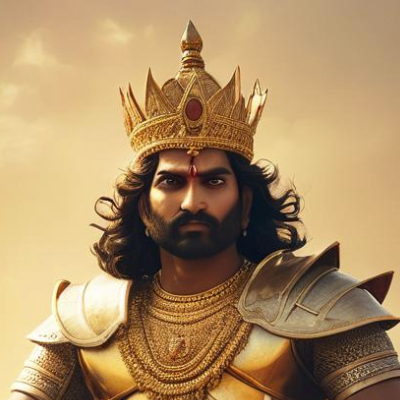
Shalya — King of Madra, Brother of Madri, Commander of the Kauravas, and Charioteer of Karna
Shalya · Madraraj · Madraraja · Karnasarathi · Pandava-mata-bhrata · Yudhishthira-nihatah · Artayani
Shalya is the king of the Madra kingdom — a realm in the northwestern region of the subcontinent, identified in the tradition with the territory of the Punjab — and the brother of Madri, the second wife of Pandu and the mother of the twin Pandavas Nakula and Sahadeva. He is one of the great warrior-kings of the Mahabharata's world, described in the primary texts as comparable in martial stature to Indra himself and as one of the foremost wielders of the mace and the spear among the kings of his age. Despite being the maternal uncle of two of the five Pandavas and despite his army having originally set out to join the Pandava cause, Shalya was maneuvred through Duryodhana's stratagem of lavish hospitality into fighting on the Kaurava side — one of the Mahabharata's recurring instances of political obligation overriding personal loyalty. He served as the charioteer of Karna on the seventeenth day of the Kurukshetra war — a role he fulfilled in a manner the Mahabharata presents as simultaneously technically competent and psychologically devastating to Karna, since Shalya, covertly sympathetic to the Pandavas, used his position to demoralise Karna repeatedly through disparaging speeches. After Karna's death he served briefly as the supreme commander of the Kaurava forces on the eighteenth day before being killed in single combat by Yudhishthira — the eldest Pandava and his own nephew's half-brother — with a spear in the final stages of the war. Shalya appears across the Mahabharata from the Udyoga Parva through the Shalya Parva, and is referenced in the Vishnu Purana and Bhagavata Purana in genealogical contexts.
✦ The Names
The name Shalya derives from the Sanskrit shalya, which carries the meaning of a dart, an arrow, a thorn, a splinter, or any sharp piercing object — and by extension the sense of a cause of pain or affliction. The name thus designates him as a sharp, piercing figure — a warrior whose weapon is his defining attribute. The word shalya also appears in medical literature as the term for a foreign body lodged in flesh that must be extracted — the specialty of the surgeon Shalya-tantra. Whether the name was intended to carry this resonance in the context of the warrior-king is not elaborated in the primary texts, but the range of meanings gives the name a distinctive quality. The designation Madraraj or Madraraja means "king of Madra." Karnasarathi means "charioteer of Karna." Pandava-mata-bhrata means "brother of the Pandavas' mother" — identifying his relationship to Nakula and Sahadeva through Madri. Yudhishthira-nihatah means "the one killed by Yudhishthira."
✦ Lineage
- Dynasty: Shalya is a king of the Madra dynasty — a royal line of the northwestern subcontinent. The Madra kingdom is identified in the Mahabharata as a region of considerable military strength and of a cultural character that the text occasionally notes as distinct from the more eastern Kuru-Panchala cultural world. The Mahabharata contains a passage — attributed to Karna in the context of his request that Shalya serve as his charioteer — that characterises the Madra people as frank to the point of bluntness and as having customs that differ from the standards of the eastern kingdoms. This passage has attracted scholarly attention as one of the Mahabharata's regional cultural characterisations and should be read in the context of Karna's complex relationship with Shalya rather than as a straightforward ethnographic statement by the text itself. The primary texts do not give Shalya's father's name with full consistency across all passages.
- Sister: Madri — the second wife of Pandu, king of Hastinapura. Madri bore Nakula and Sahadeva — the fourth and fifth Pandavas — through her invocation of the divine twin physicians the Ashvins, using the mantra that Kunti shared with her. Madri died by self-immolation on Pandu's funeral pyre on the day that Pandu died from the fulfilment of Kindama's curse. Madri is thus Shalya's deceased sister, and Nakula and Sahadeva — who fought against him at Kurukshetra on the Pandava side — are her sons and his nephews.
- Son: The Mahabharata names Rukmaratha as a son of Shalya who fought in the Kurukshetra war on the Kaurava side. Rukmaratha was killed in the war by Abhimanyu — the son of Arjuna and grandson of Kunti — during Abhimanyu's celebrated and devastating single-handed assault on the Kaurava formation on the thirteenth day before his own eventual encirclement and death. The Mahabharata records Rukmaratha's death as one of the many distinguished warriors who fell at Abhimanyu's hands during that assault.
- Daughter: Some secondary sources identify a daughter of Shalya without providing consistent naming across primary texts. The Mahabharata does not give a prominently named daughter of Shalya in its central narrative.
✦ Shalya's Martial Character and Standing
The Mahabharata consistently characterises Shalya as a warrior of the very first rank — a figure whose martial ability is explicitly placed by the text alongside the greatest warriors of the generation. The Udyoga Parva's martial catalogue compares him favourably to Indra in single combat and identifies him as one of the foremost wielders of the mace among the kings assembled for the war. He is specifically noted as a great chariot-fighter and as a wielder of the spear with extraordinary precision — the spear being the weapon with which he eventually kills Salva in one narrative and with which Yudhishthira kills him in the war's final stages. His strength is described in the Mahabharata as comparable to that of Balarama — Krishna's elder brother and the foremost mace-fighter of the age — with whom he had trained and whom the text identifies as among the greatest warriors of the generation. The Mahabharata's assessment of Shalya is thus unambiguous: he is among the four or five greatest warrior-kings of the war's generation, and his presence on the Kaurava side was a significant reinforcement of their martial strength.
✦ Duryodhana's Stratagem and Shalya's Entrapment
The Udyoga Parva narrates in detail how Shalya came to fight on the Kaurava side despite having set out with his army to join the Pandavas. When news reached the Madra kingdom that war was approaching and that both sides were gathering their forces, Shalya assembled a large and powerful army and began the march toward Upaplavya — the city where the Pandavas were based — to add his strength to their cause. He was the uncle of Nakula and Sahadeva through his sister Madri; his sympathy was naturally with the Pandavas.
Duryodhana, informed of Shalya's march, moved to intercept him through a stratagem of extraordinary generosity. He arranged rest houses along Shalya's route of march that were stocked with lavish provisions — food, drink, entertainment, and every comfort — and staffed with attendants so skilled and so well supplied that Shalya assumed this hospitality could only be the work of Yudhishthira, whose reputation for generosity was legendary. When Shalya sent a message to Yudhishthira asking what boon he might grant in return for such magnificent hospitality, the messenger who returned was Duryodhana's — not Yudhishthira's. Duryodhana appeared before Shalya and revealed that the hospitality had been his. He then asked Shalya to grant him the boon he had offered to give. Shalya, having accepted the hospitality and having publicly offered a boon, was bound by the norms of the tradition's understanding of gift-obligation and gratitude. He could not refuse the boon once offered and once the hospitality had been accepted. Duryodhana asked that Shalya fight on the Kaurava side, and Shalya was compelled to agree.
Shalya, trapped, went to the Pandavas before the war's beginning and told Yudhishthira honestly what had happened — that he had been deceived into the commitment and was bound to fight against them, but that he would do the Pandavas one service he was in a position to render: if he was appointed Karna's charioteer on the critical day when Karna met Arjuna in battle, he would use that position to demoralise and undermine Karna throughout their combat. Yudhishthira accepted this offer and asked Shalya to do exactly that.
✦ Shalya as Karna's Charioteer on the Seventeenth Day
The role of the charioteer in the Mahabharata's understanding of warfare is not merely logistical — the charioteer steers the vehicle, manages the horses, and positions the warrior for optimal attack and defence, but crucially in the tradition the charioteer is also the warrior's counsel and companion, whose words and judgments in the heat of battle can steady or unsettle the fighter's mind and aim. This is most dramatically illustrated in the Bhagavad Gita, where Krishna as Arjuna's charioteer provides the supreme philosophical teaching of the tradition during the combat. Shalya, appointed as Karna's charioteer on the seventeenth day, used this position in a manner diametrically opposed to Krishna's role with Arjuna.
The Karna Parva narrates the interactions between Shalya and Karna throughout the seventeenth day in considerable detail. Shalya repeatedly disparaged Karna during the battle — praising Arjuna's qualities, comparing Karna unfavourably to Arjuna, questioning Karna's capacity and courage, and consistently framing their situation in ways calculated to undermine Karna's confidence. Karna, aware of Shalya's covert alignment with the Pandavas, argued back — the two exchanged extensive speeches during the fighting that the Mahabharata records as a secondary drama running alongside the main combat. The tension between the charioteer who was supposed to be his ally but was psychologically working against him and the overwhelming challenge of facing Arjuna — the greatest archer in the world, guided by Krishna — compounded the already exceptional difficulty of Karna's final battle. The Mahabharata does not assign Karna's defeat exclusively to Shalya's demoralisation, but it presents Shalya's conduct as a significant element of the day's events.
The Karna Parva also contains a celebrated extended digression — the tale of the Tripura destruction — told by Shalya to Karna during the battle in which the example of Shiva's destruction of the three demon cities is used as an analogy. This digression, like several others in the Mahabharata's battle books, functions simultaneously as a narrative of immediate relevance to the combatants' situation and as a specimen of the epic's characteristic method of embedding cosmological and theological material within the battle narrative.
✦ Shalya's Command of the Kaurava Forces on the Eighteenth Day
After Karna's death on the seventeenth day, the Kaurava forces were in a state of near-collapse. Most of their greatest warriors were dead — Bhishma had fallen on the tenth day, Drona on the fifteenth, Karna on the seventeenth. Duryodhana, surveying the remnant of his forces, appointed Shalya as the supreme commander of the Kaurava army on the eighteenth and final day of the war. The Shalya Parva narrates this appointment and the final day's fighting under Shalya's command.
Shalya accepted the command and fought with great effectiveness — the Mahabharata records that despite the desperate situation of the Kaurava forces, Shalya's command on the eighteenth day was vigorous and caused significant harm to the Pandava forces. He drove his chariot into the Pandava army with the force of a destroying deity — the text uses imagery of cosmic destruction to characterise his assault on the final day — and the Pandava forces were hard-pressed to contain him.
The combat between Shalya and Yudhishthira is narrated in the Shalya Parva as the central episode of the eighteenth day's fighting. Yudhishthira — the eldest Pandava, a man of dharmic rectitude whose martial ability is consistently rated lower than that of his brothers Bhima and Arjuna — engaged Shalya in single combat. This pairing is one the Mahabharata uses with deliberate irony and moral weight: the most dharmic of the Pandavas facing the king of Madra who was simultaneously his war-enemy and the brother of his nominal father's second wife — the maternal uncle of his brothers Nakula and Sahadeva. The combat was fierce and the Shalya Parva narrates it with the full apparatus of martial description. Yudhishthira, drawing on reserves of will and skill that surprised even his brothers, struck Shalya with a great spear — augmented by mantras and divine power — and killed him. Shalya died on the battlefield of Kurukshetra, having fulfilled his commitment to Duryodhana and his covert service to the Pandavas, with his own nephews' side the victors.
✦ Shalya's Relationship with Balarama
The Mahabharata records that Shalya was a student of Balarama — Krishna's elder brother and the foremost mace-fighter of the age, regarded as an avatar of the cosmic serpent Shesha — in the science of the mace. This relationship is noted in the Udyoga Parva's martial catalogues and in the Shalya Parva's descriptions of Shalya's fighting technique. The training under Balarama is presented as the source of Shalya's exceptional mace-skill and his status as one of the foremost fighters of the generation in that weapon. Balarama, who had taught both Duryodhana and Bhima in mace-fighting and who declined to take any side in the Kurukshetra war — withdrawing on a pilgrimage to the sacred sites along the Sarasvati during the fighting — had thus trained one of the Kaurava side's commanders. The web of teacher-student relationships across the war's generation is one of the Mahabharata's characteristic structural features, and Shalya's training under Balarama is one of its lesser-noted threads.
✦ Shalya's Role in the Narrative of Nakula and Sahadeva
The Mahabharata does not develop extended episodes of direct interaction between Shalya and his nephews Nakula and Sahadeva during the war — their position on opposing sides and the scale of the war's action meant that specific encounters between them are not narrated. The most significant genealogical and moral fact of their relationship is structural: that the twins' only surviving maternal family member — their mother Madri having died before they were old enough to know her, and their maternal uncle Shalya being the sole surviving representative of the Madra royal line for them — was fighting against them across the battle lines. Shalya's death at Yudhishthira's hands means that the twins' maternal uncle was killed by their eldest half-brother in the final day of the same war in which the twins themselves fought. The Mahabharata does not give the twins' emotional response to Shalya's death any extended treatment, but the structural weight of the family division is fully present in the narrative.
✦ The Madra Cultural Characterisation and Its Context
The Karna Parva contains an extended passage in which Karna, requesting that Shalya serve as his charioteer, mentions the qualities of the Madra people — a characterisation that attributes to them certain blunt, direct, and culturally distinctive customs that Karna frames as potentially unsuitable for the refined role of charioteer. Shalya responds with equal directness, criticising the customs of Karna's own community. The exchange has been noted by scholars as an unusual instance of regional cultural characterisation within the epic and has attracted discussion about its origins, its function within the narrative, and the degree to which it reflects actual historical attitudes toward the northwestern regions. The passage should be understood within its immediate narrative context — a highly charged confrontation between two warriors on the eve of a critical battle, each using cultural disparagement as a form of psychological combat — rather than as a straightforward statement of the text's considered views. The Mahabharata elsewhere treats Madri — who is from the same Madra culture — with complete dignity and honour, and Nakula and Sahadeva — her sons — are presented as figures of the highest personal quality throughout the epic.
✦ Textual Variants and Inconsistencies
Shalya's parentage: The Mahabharata does not give Shalya's father's name with full consistency across all passages, and different secondary and Puranic sources give different names for the Madra king who was Shalya's and Madri's father. This profile accordingly does not name that figure beyond identifying his royal position, as the primary texts do not resolve this question uniformly.
The terms of Shalya's agreement with Yudhishthira: The Udyoga Parva's account of Shalya's visit to Yudhishthira and his offer to serve as a demoralising influence on Karna is present in the critical edition and in most major manuscript traditions. Some regional recensions of the Mahabharata vary the terms of this agreement or give a less elaborate account of it. The critical edition treats the passage as part of the received text.
The weapon with which Yudhishthira killed Shalya: The Shalya Parva specifies a spear augmented with mantras as the weapon of Yudhishthira's killing stroke. Some variant passages and later retellings describe different weapons or different configurations of the final exchange. The spear account is consistent across the major manuscript traditions and is the account given in the critical edition.
✦ Theological and Philosophical Significance
Shalya's theological significance in the Mahabharata is primarily structural and moral rather than devotional or cosmological. He embodies one of the epic's most persistent themes: the entrapment of a good person in an unjust cause through the mechanism of social obligation and the conventions of gift-acceptance and gratitude. He did not choose to fight against his nephews; he was maneuvred into it by a stratagem that exploited the rules of hospitality — rules that the tradition itself regards as sacred and binding. His situation is thus one of genuine moral constraint: fighting against the side he knew was just, for a cause he did not believe in, because the conventions of the world he inhabited gave him no honourable path of refusal once the gift had been accepted and the offer made.
His covert service to the Pandavas through his demoralisation of Karna represents the one space of freedom he retained within his impossible constraint — he could not refuse to fight on the Kaurava side, but he could fight in a way that minimised his usefulness to them and maximised his service to the side he secretly favoured. The Mahabharata does not judge this conduct as treacherous — rather, it is presented as the most honourable available path within an impossible situation, one that Yudhishthira himself endorsed in accepting Shalya's offer. Shalya thus joins the company of figures like Bhishma — who also fought on the Kaurava side while believing the Pandavas' cause just and while covertly serving them — in the Mahabharata's sustained exploration of the conflict between institutional obligation and personal moral judgment.
His death at Yudhishthira's hands is one of the war's most morally resonant killings. Yudhishthira — whose dharmic commitment is the defining characteristic of his identity — killed the man who was his brothers' maternal uncle. The tradition does not frame this as a moral failure on Yudhishthira's part; Shalya was a commander of the enemy forces on the war's final day, and his death in battle was the consequence of a war whose justice Yudhishthira had fought to establish. But the specific pairing of killer and killed — the most dharmic of the Pandavas killing the family member of his most devoted brothers' mother's line — is characteristic of the Mahabharata's method of ensuring that even the just side's victories are purchased at a cost that the text does not allow its readers to overlook.
✦ Connection to the Wider Genealogy
Through his sister Madri and her sons Nakula and Sahadeva, Shalya is connected to the Pandava lineage as the twins' maternal uncle. Through Nakula and Sahadeva's nominal father Pandu and the Kuru-Paurava line, he is connected by marriage to the Chandravamsha. Through the Madra royal dynasty, he belongs to the northwestern royal tradition of the subcontinent. His son Rukmaratha — killed by Abhimanyu — connects him to the generation of Kaurava-allied sons who fell in the war, and his own death at Yudhishthira's hands closes the Madra royal line's direct participation in the Mahabharata's narrative. The Madra kingdom passes from the narrative after Shalya's death, its king gone and its army consumed in the war that was not its conflict but that the conventions of hospitality had made inescapable for its ruler.
✦ References
Primary Sources
- Mahabharata, Udyoga Parva, sections 8–10 (Shalya's entrapment): The primary account of Duryodhana's stratagem of lavish hospitality along Shalya's route of march, Shalya's offer of a boon, Duryodhana's revelation of his identity, and Shalya's binding commitment to fight on the Kaurava side.
- Mahabharata, Udyoga Parva, sections 11–12 (Shalya's visit to Yudhishthira): Shalya's honest disclosure to Yudhishthira of his entrapment; his offer to serve as a demoralising influence on Karna when appointed as his charioteer; Yudhishthira's acceptance of the offer.
- Mahabharata, Udyoga Parva, martial catalogues (sections 155–170): Shalya's martial characterisation and his placement among the foremost warriors of the generation; the comparison to Indra and the identification of his training under Balarama.
- Mahabharata, Karna Parva (Book 8) in its entirety: The seventeenth day of battle under Karna's command; Shalya's appointment as Karna's charioteer; the extended exchanges between Shalya and Karna during the fighting; the demoralising speeches; the narrative of the battle culminating in Karna's death at Arjuna's hands. The primary source for Shalya's role as charioteer and its consequences.
- Mahabharata, Shalya Parva (Book 9) in its entirety: The eighteenth day of battle under Shalya's supreme command; the fighting of the final day; the single combat between Shalya and Yudhishthira; Shalya's death at Yudhishthira's hands with the mantra-augmented spear. The primary source for Shalya's command and death.
- Mahabharata, Adi Parva, sections 112–128: The narrative of Madri — Shalya's sister — providing the primary source for the family relationship that makes Shalya Nakula and Sahadeva's maternal uncle.
- Mahabharata, Drona Parva, sections 47–52 (Abhimanyu's death): The killing of Shalya's son Rukmaratha by Abhimanyu during the great warrior's single-handed assault on the Kaurava formation on the thirteenth day.
- Vishnu Purana, Book 4, chapters 20–21: Genealogical references to the Madra royal line within the broader dynastic framework confirming Shalya's position as the Madra king.
- Bhagavata Purana, Book 9, chapter 22: References to the Madra connection in the context of the Kuru-Pandava genealogy.
Modern Reference Works
- Vettam Mani, Puranic Encyclopaedia (1975): Entry on Shalya; comprehensive collation of primary references across the Mahabharata, the Puranas, and the Harivamsa; summarises the principal episodes of his biography and notes his relationship to both the Pandava and Kaurava sides.
- J. A. B. van Buitenen (translator), The Mahabharata, Volume 3 (1978): Critical translation of the Udyoga Parva with scholarly notes on the Shalya entrapment episode; the most authoritative English-language treatment of the primary source for how Shalya came to fight on the Kaurava side.
- Alf Hiltebeitel, The Ritual of Battle: Krishna in the Mahabharata (1990): Contains discussion of the charioteer's role in the Mahabharata's battle tradition and analysis relevant to Shalya's unusual position as a demoralising charioteer — the anti-Krishna in relation to Karna's anti-Arjuna.
- Bimal Krishna Matilal (editor), Moral Dilemmas in the Mahabharata (1989): Contains scholarly analysis relevant to Shalya's entrapment through the conventions of hospitality-obligation, situating his case within the broader study of moral constraint and institutional obligation in the epic.
- Irawati Karve, Yuganta: The End of an Epoch (1969): Contains analysis of the war's family-division patterns — including the position of figures like Shalya who were bound to one side while naturally sympathetic to the other — as one of the Mahabharata's most persistent and painful structural features.
- Alf Hiltebeitel, "Shalya as the Worst of Liars" in Essays on the Mahabharata, edited by Arvind Sharma (1991): A focused scholarly study of Shalya's role as Karna's charioteer and the theological and narrative dimensions of his conduct on the seventeenth day, including analysis of the extended verbal exchanges between Shalya and Karna in the Karna Parva.