
About
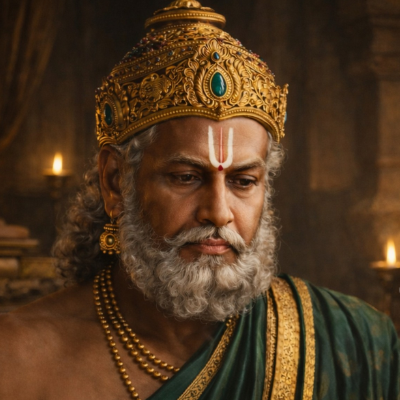
Vidura — Son of Vyasa, Counsellor of the Kuru Court, and Incarnation of Dharma
Vidura · Kshattri · Dharmaja · Vyasaputra · Dharmaputra · Mahatma · Kuruvriddhaprajna · Parajnanin
Vidura is the third of the three sons born of the sage Vyasa's levirate union with the widows and maidservants of Vichitravirya's household — arranged by Satyavati, the queen mother, to continue the Kuru royal line. Unlike his brothers Dhritarashtra and Pandu — born of the two principal queens — Vidura was born of a maidservant who received Vyasa without fear or aversion, and from her composure the child born was of perfect equanimity, extraordinary wisdom, and complete spiritual clarity. Vidura is one of the most ethically exemplary figures in the entire Mahabharata — the counsellor who spoke the truth to power consistently, accurately, and at personal cost, whose warnings to Dhritarashtra about the consequences of Duryodhana's conduct were ignored at every critical moment, and whose life represents the most complete embodiment of dharmic integrity in the Kuru household. He is identified in the Mahabharata as a partial incarnation of the god Dharma himself — specifically as the incarnation of Dharma who was condemned to mortal birth in a low-status womb as a consequence of a curse pronounced by the sage Mandavya. Vidura's teaching to Dhritarashtra — recorded in the Udyoga Parva as the Vidura Niti, one of the Mahabharata's most celebrated wisdom texts — is among the most widely cited statements of political ethics and practical wisdom in the Sanskrit tradition. He appears throughout the Mahabharata and is referenced in the Bhagavata Purana and other texts.
✦ The Names
The name Vidura derives from the Sanskrit root vid — to know — with the suffix ura, yielding the sense of "the knowing one," "the wise one," or "he who knows thoroughly." The name is thus a direct designation of his defining quality — wisdom and knowledge — in the same way that Pandu's name encoded his pallor and Dhritarashtra's name encoded his royal function. Vidura knows — he knows what is right, what will happen, and what must be done — and the tragedy of his role in the Mahabharata is that his knowledge is consistently present, consistently articulated, and consistently ignored by those with the power to act on it. The epithet Kshattri identifies him by his social birth-status — the son of a woman of the serving class — which placed him outside the full privileges of Kshatriya birth despite his royal father. This social ambiguity is a persistent feature of Vidura's position in the Kuru court: he is in the household as a full member by virtue of his father Vyasa and his royal brothers, but his birth from a maidservant placed him below the level of full royal status. Dharmaja and Dharmaputra mean "son of Dharma" — reflecting his identification as an incarnation of the god Dharma. Mahatma means "the great-souled one."
✦ Lineage
- Biological father: Vyasa — born Krishna Dvaipayana, son of Satyavati and the sage Parashara, composer of the Mahabharata. Vyasa came to the maidservant as a third visit arranged by Satyavati after the births of Dhritarashtra and Pandu, to produce a further son for the Kuru line. The maidservant received Vyasa with equanimity and without the terror that had marked Ambika's and Ambalika's responses, and the child born of this composed reception was Vidura — of complete intelligence, perfect equanimity, and dharmic clarity from birth.
- Mother: A maidservant of Ambika in the Kuru royal household, whose name is not given in the primary texts. She is described only by her social function and by her composed reception of Vyasa, which is the direct cause of Vidura's exceptional qualities. The primary texts are explicit that her low social status was the reason Vidura's birth placed him outside the full Kshatriya rank despite his father being a brahmin sage and his brothers being kings.
- Divine identity — Dharma under curse: The Mahabharata's Adi Parva narrates the story of the sage Mandavya's curse that explains why the god Dharma was born as Vidura. Mandavya — a great and righteous sage — was mistakenly arrested by the king's soldiers as a thief, impaled, and subjected to severe punishment before his innocence was recognised. Even after his release, the impalement stake remained in his body and he lived with it transfixed through him. Mandavya, in his suffering, went to the realm of Dharma and challenged him: asking what sin he, Mandavya, had committed in any birth to deserve such punishment. Dharma examined his records and found that as a child Mandavya had once pierced a small insect with a blade of grass — a trivial act of childhood — which had produced this karma. Mandavya was outraged: the punishment of severe suffering for an act committed in ignorant childhood was wholly disproportionate, and he declared that Dharma had violated the principle that children below the age of twelve should not be held fully accountable for their acts. He cursed Dharma to be born in a human womb of low status — specifically in a shudra womb — as punishment for this unjust accounting. Dharma accepted the curse and was born as Vidura in the maidservant's womb.
- Elder brothers: Dhritarashtra — the blind king of Hastinapura — and Pandu — the pale king who ruled briefly and died in the forest. Both are Vidura's brothers through their common biological father Vyasa.
- Wife: The Mahabharata does not name Vidura's wife explicitly in most passages. Some passages and later texts identify her as a daughter of the sage Devaka. She is not a figure of significant narrative development in the primary sources.
- The Mahabharata does not record Vidura's children as figures of narrative significance. His legacy is intellectual and moral rather than dynastic.
✦ Vidura's Role as Counsellor and the Vidura Niti
Vidura served as the chief minister and counsellor of the Kuru court throughout Dhritarashtra's reign. His position gave him both access to and obligation toward the king, and the Mahabharata records a sustained series of encounters in which Vidura used this access to speak truths that no one else in the court was willing to state. He warned Dhritarashtra against the plot to burn the Pandavas alive at Varanavata — and covertly arranged for the Pandavas to be warned of the danger through a trusted messenger. He spoke against the dice game before it was held, during it when Draupadi was humiliated, and after it when its consequences were clear. He warned Dhritarashtra repeatedly and in the most direct terms that supporting Duryodhana's injustice would lead to the destruction of the dynasty.
The Udyoga Parva of the Mahabharata contains the text known as the Vidura Niti — Vidura's counsel to Dhritarashtra on the eve of the war, delivered in a series of evening conversations. This text is one of the most comprehensive and carefully structured statements of practical ethics, political wisdom, and personal virtue in the Sanskrit canon. Vidura addresses the qualities of the wise person and the fool, the nature of true prosperity and true poverty, the obligations of kings, the consequences of injustice, the nature of friends and enemies, the importance of truth-telling, and the principles of governance that lead to a kingdom's flourishing or destruction. Throughout, he applies these principles directly to Dhritarashtra's specific situation without euphemism, making the practical stakes of the philosophical argument explicit. Dhritarashtra listened to all of it, acknowledged repeatedly that Vidura was right, and did nothing. The Vidura Niti thus stands as one of the Mahabharata's most poignant documents — wisdom fully articulated, fully acknowledged, and fully ignored.
✦ Vidura's Protection of the Pandavas
Beyond his role as counsellor, Vidura took concrete protective action on behalf of the Pandavas at several points in the narrative. When the plot to burn the Pandavas in the house of lac at Varanavata was being prepared by Duryodhana and Purochana, Vidura learned of the conspiracy and — unable to prevent it openly without being disloyal to the king — found a way to warn Yudhishthira through coded language and through a trusted messenger who arranged for an underground tunnel to be dug beneath the burning house, providing an escape route. The Mahabharata presents this as an act of covert moral courage — Vidura could not speak openly to protect the Pandavas without risking his position in the court, but he ensured their safety through the means available to him.
Vidura also served as a host and friend to the Pandavas during the years before the war. The Mahabharata records that when the Pandavas returned from exile and Krishna came as their envoy to Hastinapura to negotiate a settlement, Krishna stayed at Vidura's house rather than in the royal palace — a gesture that the tradition interprets as both an expression of Krishna's affection for Vidura and a statement of his alignment with the just cause that Vidura had consistently represented.
✦ Vidura's Departure and the Merging with Yudhishthira
The Ashramavasika Parva narrates that Vidura, following the end of the war and after counselling Dhritarashtra to withdraw to the forest, himself departed to the forest before the other elders. The Mahabharata records a remarkable episode in which Yudhishthira — walking in the forest — found Vidura, who had reduced his body to a skeleton through austerities, sitting in meditation. As Yudhishthira approached and looked at Vidura, Vidura transferred his entire life-force — his pranas — into Yudhishthira's body through his eyes. This transfer caused Vidura to die in the physical sense while his consciousness merged into Yudhishthira. The text explains this as the return of the god Dharma — who was Vidura's true identity — into his cosmic function through the body of Yudhishthira, who was himself the son of Dharma. Dharma had been born as Vidura under Mandavya's curse; the curse was now fulfilled, and Dharma returned to himself through the son he had fathered in Yudhishthira's birth. This episode is one of the Mahabharata's most theologically dense — the god of cosmic order, having lived an entire human life as the wisest and most just man in the Kuru court, dissolved back into his divine identity through a transfer of consciousness to the son he had himself fathered.
✦ Vidura in the Bhagavata Purana
The Bhagavata Purana — particularly its first, third, and fourth books — gives Vidura a significant role as a seeker of wisdom and a devotee of Vishnu. The Bhagavata Purana's first book narrates that it was Vidura who, after the war, told Dhritarashtra directly and without diplomatic softening that his time in the household was over — that he was an old man living on charity in a house where his sons had been killed by the inhabitants, and that he should retire to the forest and prepare for death rather than clinging to the comfort of the court. This direct speech is presented as the catalyst for Dhritarashtra's forest retirement. The third book of the Bhagavata Purana narrates Vidura's pilgrimage to various sacred sites and his encounter with the sage Maitreya at the banks of the Yamuna, in whose company he receives extended teachings on cosmology, creation, and Vishnu's nature that form a substantial portion of the third book's content. These passages present Vidura as a sincere and serious spiritual seeker whose quest for knowledge extends beyond political wisdom to the deepest questions of cosmic existence.
✦ Textual Variants and Inconsistencies
The Mandavya curse account: The narrative of the sage Mandavya's curse on Dharma, which caused Dharma to be born as Vidura, is given in the Mahabharata's Adi Parva as a brief but complete episode. Some later and devotional texts expand this story or vary certain details — particularly the specifics of what Mandavya challenged Dharma about and the exact terms of the curse. The Mahabharata's own account is the authoritative primary source and is consistent across the major manuscript traditions.
The merging with Yudhishthira: The episode of Vidura's life-force merging into Yudhishthira through the eyes is given in the Ashramavasika Parva and is theologically significant but narratively brief. Some later texts and commentaries elaborate the theological implications of this transfer at greater length. The Mahabharata's own narrative of the episode is the foundational source.
Vidura's wife: The primary texts of the Mahabharata do not consistently name Vidura's wife. Some passages mention her existence; others give a name — occasionally as a daughter of Devaka — but this is not universally confirmed. The Mahabharata's silence on this point is genuine, and this profile makes no claim about her identity beyond what the text clearly states.
✦ Theological and Philosophical Significance
Vidura is among the most theologically significant figures in the Mahabharata precisely because his significance is ethical rather than martial or cosmological. He is not an avatar, not a divine warrior, not a sage of extraordinary austerities or magical powers. He is the wisest man in a court of powerful people — the one who sees clearly, speaks honestly, acts rightly within the constraints of his position, and is consistently ignored. His identification as an incarnation of Dharma gives this ethical portrait a theological grounding: the god of cosmic order, born in a low-status womb under a curse, spent his mortal life doing exactly what the god of cosmic order should do — articulating what is just, protecting the just from harm, and witnessing with perfect clarity the consequences of injustice. That his counsel was ignored does not diminish Dharma's role; it demonstrates the autonomy of human choice even in the presence of perfect wisdom.
The Vidura Niti stands alongside the Bhagavad Gita and the Shanti Parva as one of the three great philosophical and ethical statements of the Mahabharata. Where the Gita is addressed to a warrior on the point of battle and the Shanti Parva is delivered by a dying man from a bed of arrows, the Vidura Niti is the counsel of the wisest man in the kingdom to its king on the eve of a catastrophe that the king has the power to prevent. Its placement immediately before the war — the wisdom that was present and available and unused — gives it a tragic quality unique in the tradition.
✦ Connection to the Wider Genealogy
Through his biological father Vyasa, Vidura is the son of the sage who composed the Mahabharata and the grandson of Satyavati and the sage Parashara. Through his brothers Dhritarashtra and Pandu, he is the uncle of the Kauravas and the Pandavas — the two sides of the Mahabharata's central conflict. Through his divine identity as Dharma, he is simultaneously the father of Yudhishthira — the eldest Pandava, born of Kunti and the god Dharma — making Vidura-as-Dharma the divine father of the most dharmic of the Pandavas. The episode of Vidura's life-force merging into Yudhishthira at the end of life completes this theological genealogical circle: Dharma, who had fathered Yudhishthira as a god, returned to himself through Yudhishthira's body as a man at the end of his mortal existence. His social exclusion from full Kshatriya status — the consequence of his mother's low social standing — is also genealogically significant: it placed him in a position of permanent institutional marginality in the Kuru court, which paradoxically gave him the moral freedom to speak truths that those more deeply invested in the court's political structures could not afford to articulate.
✦ References
Primary Sources
- Mahabharata, Adi Parva, sections 100–116: The birth of Vidura from the maidservant and Vyasa; the Mandavya curse account explaining his identity as an incarnation of Dharma; his childhood and education alongside Dhritarashtra and Pandu.
- Mahabharata, Adi Parva, sections 130–138 (Varanavata episode): Vidura's warning to Yudhishthira about the burning-house plot and his covert arrangements for the Pandavas' escape through the tunnel; the primary narrative source for his protective action on their behalf.
- Mahabharata, Sabha Parva, sections 45–79: Vidura's protests during the dice game and Draupadi's humiliation; his interventions and their failure to prevent the outcomes.
- Mahabharata, Udyoga Parva, sections 33–40 (the Vidura Niti): The extended evening conversations between Vidura and Dhritarashtra on the eve of the war; the most comprehensive statement of practical ethics and political wisdom in the Mahabharata. The primary source for Vidura's philosophical significance.
- Mahabharata, Ashramavasika Parva (Book 15), chapters 1–5: Vidura's speech to Dhritarashtra urging him to retire to the forest; the forest retirement of Dhritarashtra, Gandhari, Kunti, and Vidura; the episode of Vidura's life-force merging into Yudhishthira; Vidura's death.
- Bhagavata Purana, Book 1, chapters 13–15: The Bhagavata Purana's account of Vidura's counsel to Dhritarashtra — his direct speech about the king's situation — which is presented as the catalyst for Dhritarashtra's decision to retire to the forest. One of the most dramatically concentrated presentations of Vidura's character in any primary source.
- Bhagavata Purana, Book 3, chapters 1–4: Vidura's pilgrimage to sacred sites after the war; his encounter with Uddhava — a devotee of Krishna — and his learning of Krishna's departure from the world; his journey to the Yamuna and his encounter with the sage Maitreya, from whom he receives cosmological teachings that form the substance of much of the third book.
- Bhagavata Purana, Book 4, chapters 1–29: The cosmological and genealogical teachings given to Vidura by Maitreya; the primary source for Vidura's role as a receiver of wisdom in the Bhagavata Purana tradition.
- Harivamsa, chapters 32–34: Genealogical material on Vidura within the broader Kuru royal line.
Modern Reference Works
- Vettam Mani, Puranic Encyclopaedia (1975): Entry on Vidura; comprehensive collation of all primary references across the Mahabharata, Bhagavata Purana, and Harivamsa; essential reference for cross-checking the full range of narrative appearances.
- J. A. B. van Buitenen (translator), The Mahabharata, Volumes 1–3 (1973–1978): Critical translations of the Adi, Sabha, and Vana Parvas with scholarly notes; the authoritative primary source for Vidura's early biography, protective actions, and role in the dice game.
- Bimal Krishna Matilal (editor), Moral Dilemmas in the Mahabharata (1989): Contains analysis of Vidura's ethical position — the man who consistently identifies the right course and is consistently ignored — within the broader exploration of moral dilemmas in the epic.
- Irawati Karve, Yuganta: The End of an Epoch (1969): Contains a sustained analysis of Vidura's character and his moral position in the Kuru court, examining the constraints of his social status and the nature of his relationship with Dhritarashtra.
- Alf Hiltebeitel, Dharma: Its Early History in Law, Religion, and Narrative (2011): Contains discussion of the Mandavya-Dharma narrative and Vidura's identity as Dharma incarnate, situating these within the Mahabharata's broader exploration of the concept of dharma as both cosmic principle and personal practice.
- Wendy Doniger O'Flaherty, The Origins of Evil in Hindu Mythology (1976): Contains analysis of the Mandavya curse episode and its theological implications for the question of how a god of cosmic order could administer unjust punishment, relevant to understanding Vidura's divine identity and its origin.