
About
Karkati — Rakshasi of the Himalayas, Figure of the Yoga Vasishtha
Karkati · Suchimukhi · Visuchika · Rakshasi · Himavatkanya
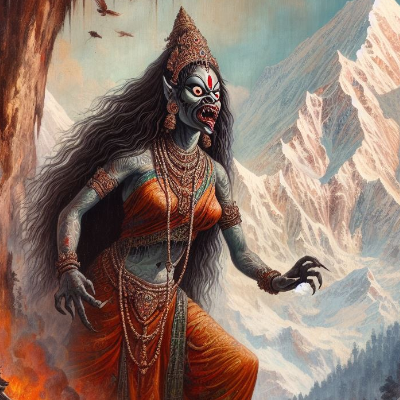
Karkati is a female Rakshasa — a Rakshasi — who appears as the central figure of an extended narrative episode in the Yoga Vasishtha, a major philosophical text of the Advaita Vedanta tradition attributed to the sage Vasishtha and addressed to the prince Rama of Ayodhya. The Yoga Vasishtha is not counted among the eighteen Mahapuranas but is a significant text of the broader Puranic and philosophical canon, associated primarily with the Kashmir region and composed in an elaborate Sanskrit literary style. Karkati's episode in the Yoga Vasishtha is an extended philosophical parable in which a Rakshasi of great power and hunger undertakes severe austerities, obtains a boon from Brahma, is transformed into a microscopic entity that enters human beings as the disease Visuchika (identified with cholera or a severe gastric illness), lives within human bodies for a vast period of time, reflects on the nature of existence and consciousness from within this experience, attains a state of profound philosophical realisation, and is eventually questioned by two kings in the Himalayan forest who engage her in an extended philosophical dialogue. The episode spans several sections of the Yoga Vasishtha's Utpatti Prakarana and Sthiti Prakarana and is among the text's most celebrated narrative parables. Karkati does not appear in the Mahabharata, the Ramayana, or the eighteen Mahapuranas in this specific form, and her profile is drawn entirely from the Yoga Vasishtha.
✦ The Names
The name Karkati derives from the Sanskrit karka or karkata, associated with the crab — the zodiacal sign of Cancer is called Karkata in Sanskrit — and carries connotations of a pinching, gripping, or seizing quality. The name may also be connected to a reddish or whitish colour in some usages, though the primary texts do not elaborate this etymological dimension. In the context of the Yoga Vasishtha's narrative, the name functions as a proper name for this specific Rakshasi without sustained etymological commentary. The epithet Suchimukhi means "needle-faced" or "she whose face is like a needle" — a name that refers to the form she took after Brahma's boon transformed her into a microscopic needle-like entity capable of entering the bodies of living beings. Visuchika is the name of the disease entity she became — the Sanskrit term for a condition identified in classical Indian medicine as a severe intestinal illness with symptoms including intense pain, vomiting, and prostration, which corresponds in modern identification to conditions like cholera or severe gastroenteritis. The epithet Himavatkanya means "daughter of the Himalayas" or "she who dwells in the Himalayan region."
✦ Lineage
- Identity: Karkati is described in the Yoga Vasishtha as a Rakshasi — a female member of the Rakshasa race — who lived in the forests of the northern Himalayan region. The text does not specify her parentage or the particular branch of the Rakshasa lineage to which she belongs. She is introduced simply as a Rakshasi of great size, power, and appetite whose fundamental problem was an insatiable hunger — a hunger so extreme that the entire animal kingdom of the Himalayas was insufficient to satisfy it.
- The Yoga Vasishtha does not record Karkati's parents, husband, or children. Her narrative is entirely individual — a single being's spiritual journey from demonic hunger through austerity, transformation, and philosophical realisation to eventual liberation or near-liberation. Her significance is philosophical rather than genealogical.
✦ Karkati's Hunger and Her Austerities
The Yoga Vasishtha narrates that Karkati was a Rakshasi of enormous physical size — described in the text as comparable in stature to the mountain itself — whose appetite was so immense that she could not satisfy it despite consuming vast quantities of game and other living beings from the Himalayan forests. The animals, birds, and other creatures of the mountain were insufficient to appease her hunger, and she was driven into a state of constant dissatisfied craving. Tormented by this insatiable desire and unable to find relief through the ordinary means available to a being of her kind, Karkati resolved to undertake austerities and seek a boon from Brahma that would transform her situation.
She performed austerities of extraordinary intensity — standing motionless in the Himalayan winter, enduring cold, heat, and fasting — for a thousand years, with her entire consciousness fixed on the object of her request. At the end of this period, Brahma appeared before her and offered her a boon. Karkati asked to be transformed into a microscopic form — specifically into a needle-like entity — capable of entering the bodies of human beings as the disease Visuchika, so that she could satisfy her hunger from within living hosts. The Yoga Vasishtha records that this was the form of her requested boon: not to be freed from hunger or to be given greater external resources for it, but to be transformed so that her hunger could be satisfied from within the beings of the world at a level too small to be perceived or resisted.
Brahma granted the boon. Karkati was transformed into the microscopic entity Visuchika — described in the Yoga Vasishtha as a needle (suchi) capable of penetrating the bodies of living beings and dwelling within them as a disease — and she entered this new existence for a period of immense duration.
✦ Karkati's Existence as Visuchika and Her Philosophical Awakening
The most philosophically significant portion of Karkati's narrative in the Yoga Vasishtha concerns her experience as Visuchika within human bodies. The text narrates that during the vast period of her existence as the disease entity, inhabiting the bodies of countless human beings from within, Karkati had ample occasion for reflection. She existed at the most intimate possible proximity to human consciousness — dwelling within the physical form of living persons, experiencing their sensations and mental states from within — and this extended inward existence became the occasion of her philosophical transformation.
The Yoga Vasishtha narrates that through this long period of interior existence, Karkati arrived at a deep contemplative understanding of the nature of consciousness — specifically of the Advaita Vedanta understanding that the individual self (jiva) and the supreme consciousness (Brahman or Chit) are not ultimately distinct, and that all apparent multiplicity of beings is a manifestation of a single undivided awareness. She reflected on the fact that within every being she inhabited, the same fundamental awareness was present — that the life-force that animated each person's body was the same principle she encountered in every host. This realisation — approached not through scriptural study or yoga in the conventional sense but through the extraordinary experience of living within other beings' bodies for thousands of years — is presented in the Yoga Vasishtha as a genuine philosophical awakening that transformed Karkati's understanding of her own nature and of the nature of existence.
✦ The Return to Rakshasi Form and the Encounter with the Two Kings
After her long existence as Visuchika, Karkati resumed her Rakshasi form in the Himalayan forest. The Yoga Vasishtha narrates that she now walked through the forest at night — her appetite still present but now understood differently in light of her philosophical realisation — and encountered two kings who were also moving through the same forest. These two kings — the Yoga Vasishtha identifies them as figures engaged in their own quest for understanding — came upon the enormous Rakshasi in the darkness and were naturally terrified. Karkati, however, now spoke to them with the voice of a philosophical teacher rather than of a predator. The kings, recovering from their initial terror, engaged her in an extended dialogue about the nature of consciousness, the self, liberation, and the relationship between individual beings and the ultimate reality.
The dialogue between Karkati and the two kings forms one of the Yoga Vasishtha's characteristic philosophical conversations — extended exchanges in which a figure of unexpected wisdom imparts the understanding of non-dual consciousness to interlocutors who come to the encounter without expecting illumination from such a source. The irony of a Rakshasi as a philosophical teacher is entirely deliberate: the Yoga Vasishtha consistently uses unexpected figures and unexpected circumstances as occasions for its philosophical teaching, and Karkati — who began as a being of insatiable appetite and was transformed through an extraordinary interior journey into a figure of genuine realisation — is one of the text's most vivid illustrations of the principle that liberation is not the preserve of the conventionally virtuous but is available to any consciousness capable of the necessary inquiry.
The Yoga Vasishtha records that at the conclusion of the dialogue, Karkati had fully articulated her understanding of the non-dual nature of consciousness and had demonstrated in her own transformed existence the possibility of philosophical realisation arising from the most unexpected forms of experience. The text presents this as a complete philosophical episode — a parable of the nature of liberation — rather than as the beginning of a further biographical development for Karkati. She does not appear again in the subsequent portions of the Yoga Vasishtha as an active narrative figure.
✦ Karkati in the Context of the Yoga Vasishtha
The Yoga Vasishtha — also called the Maha Ramayana or the Vasishtha Ramayana — is a philosophical text of the non-dual Vedanta tradition, presented as a dialogue between the sage Vasishtha and the young prince Rama before Rama's exile. The text is immense in scale and addresses the nature of consciousness, the illusory character of the phenomenal world, the path to liberation through the inquiry into the nature of the self, and the relationship between waking, dreaming, and deep sleep as three modes of consciousness. It uses an extraordinary range of narrative parables — stories of kings, sages, demons, gods, and fantastic beings — as vehicles for its philosophical teaching. Karkati's episode is one of these parables, and its specific philosophical contribution to the Yoga Vasishtha's overall argument is the demonstration that liberation can arise through any form of sustained interior experience that brings a being into contact with the nature of consciousness as such — even the experience of a disease entity inhabiting human bodies from within.
The Yoga Vasishtha is not universally classified as a Purana — it belongs rather to the category of philosophical and poetic literature — and it has not been as consistently transmitted or commented upon as the eighteen Mahapuranas. However, it is a text of great importance in the Advaita Vedanta tradition and has been widely read, commented upon, and cited across the tradition for over a thousand years. Karkati's episode is among its most frequently cited parables.
✦ Textual Variants and Inconsistencies
The Yoga Vasishtha exists in several recensions of different lengths — the most commonly circulated version is called the Laghu Yoga Vasishtha, a significantly abridged version of the full text. The Karkati episode appears in both the full Yoga Vasishtha and in the Laghu Yoga Vasishtha, though with varying degrees of elaboration. The full text's version of the philosophical dialogues between Karkati and the two kings is considerably longer and more detailed than the abridged version. Both versions present the same essential philosophical content and the same narrative arc. There are no major variant accounts of Karkati in any other primary source that would contradict the Yoga Vasishtha's account — she is a figure specific to this text, and the question of textual variants is internal to the Yoga Vasishtha's own manuscript tradition rather than a question of competing accounts across different texts.
It should be noted clearly that the name Karkati appears in other contexts in Sanskrit literature — there is a figure named Karkati in some Puranic lists of Rakshasas, and there are other uses of similar names in different narratives — but these should not be conflated with the philosophical Karkati of the Yoga Vasishtha, who is a distinct figure with a specific and elaborated narrative entirely her own.
✦ Theological and Philosophical Significance
Karkati's theological significance is entirely philosophical and belongs to the Advaita Vedanta tradition rather than to the genealogical or cosmological frameworks of the Puranic and epic traditions. Her narrative is a parable of the path to liberation conceived in the most radically non-conventional terms: the vehicle of realisation is not the practice of virtue, not the performance of sacrifice, not the study of scripture in the conventional sense, but the extended contemplative experience of intimate contact with consciousness in its most varied forms. Her transformation from a Rakshasi of insatiable appetite — a being defined by craving and by the desire to consume — to a figure of philosophical wisdom and equanimity through the interior experience of dwelling within other beings represents one of the Yoga Vasishtha's characteristic demonstrations of the principle that liberation is not the property of any particular being-type or social category but is accessible through any genuine inquiry into the nature of consciousness.
The identification of her disease-form as Visuchika — a specific illness known to classical Indian medicine — gives the narrative a grounding in the concrete that the Yoga Vasishtha characteristically employs: philosophical parables in this text frequently use precise, specific, even medical or anatomical details as anchors for their abstract arguments. Karkati's existence as a disease entity is not a vague spiritual metaphor but a specific claim about what it might mean for a consciousness to inhabit a human body from within at a sub-perceptual level, and the philosophical reflections that arise from this specific form of existence are treated with corresponding precision.
✦ Connection to the Wider Genealogy
Karkati has no recorded genealogical connections to other named figures in the Hindu canonical tradition. Her parentage is not given, her children are not recorded, and her relationship to the broader Rakshasa genealogical lineages — such as those traced through Sukesa and Sumali to Ravana — is not established in the Yoga Vasishtha or in any other primary source. She is a figure whose significance is entirely internal to her own narrative and philosophical tradition rather than genealogical. She is included in the canon of figures from the broader Hindu scriptural tradition by virtue of her appearance in the Yoga Vasishtha — a text widely regarded as canonical within the Vedanta tradition — and her profile is honestly limited to what that text records about her.
✦ References
Primary Sources
- Yoga Vasishtha (Maha Ramayana), Utpatti Prakarana and Sthiti Prakarana, Karkati episodes: The sole primary source for Karkati's biography; narrates her original form as a Rakshasi of insatiable hunger, her austerities, Brahma's boon, her transformation into the disease entity Visuchika, her interior philosophical realisation through the experience of inhabiting human bodies, her return to Rakshasi form, and her philosophical dialogue with the two kings in the Himalayan forest.
- Laghu Yoga Vasishtha, corresponding sections: The abridged version of the Yoga Vasishtha that condenses the Karkati episode; useful for comparison with the full text's version and for identifying the core narrative elements that are treated as essential across both recensions.
Modern Reference Works
- Vettam Mani, Puranic Encyclopaedia (1975): Entry on Karkati; identifies her as the Rakshasi of the Yoga Vasishtha and provides a summary of her narrative and philosophical significance.
- Swami Venkatesananda (translator), The Supreme Yoga: Yoga Vasistha (1984): An English translation of the full Yoga Vasishtha; contains the Karkati episode with the translator's framing notes; one of the most widely used English translations of the primary source.
- Wendy Doniger O'Flaherty, Dreams, Illusion, and Other Realities (1984): Contains analysis of the Yoga Vasishtha's philosophical parables including the use of unusual beings and unusual experiences as vehicles for non-dual philosophical teaching; relevant to understanding Karkati's episode within the text's broader theological and narrative strategy.
- Christopher Chapple, introduction to The Concise Yoga Vasistha (1984): Contains scholarly contextualisation of the Yoga Vasishtha's philosophical tradition and its use of narrative parables, relevant to situating Karkati's episode within the text's overall argument.