
About
Kamadeva — God of Desire, Lord of Love, and the Bodiless One
Kamadeva · Kama · Manmatha · Ananga · Madana · Kandarpa · Smara · Pushpadhanvan · Makaradhvaja · Pradyumna-purvajanma · Ragavrinta · Atanu · Panchasara
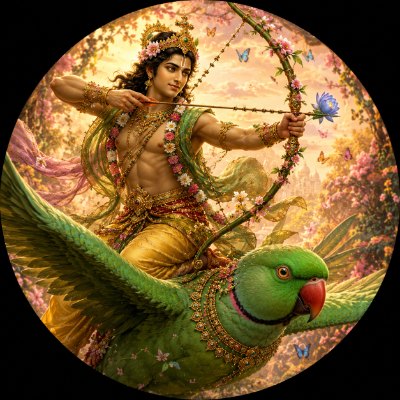
Kamadeva is the god of desire, love, and erotic longing in the Hindu tradition — the divine principle of kama, the first of the four aims of human life (purusharthas) and simultaneously the cosmic force of creative attraction that drives the continuation of all living existence. He is one of the most ancient and pervasive divine figures in the tradition, present in the Rigveda as a primordial cosmic principle, elaborated across the Puranas as a personal deity of great beauty and power, and the subject of one of the tradition's most dramatically consequential narratives: his incineration by Shiva's third eye, which reduced him to a bodiless state and which is the mythological origin of both the eternal absence of embodied Kama from the world and the tradition of his rebirth as Pradyumna — the son of Krishna and Rukmini who is himself one of the four Vyuha emanations of Vishnu in Pancharatra theology. Kamadeva's wife is Rati — the goddess of pleasure and erotic delight — and together they represent the divine couple of desire and fulfilment. He is armed with a bow of sugarcane strung with a line of bees and tipped with five flower-arrows, and he rides or is accompanied by a makara — the sea-creature of Indian iconography. Kamadeva appears across the Rigveda, the Atharvaveda, the Mahabharata, the Ramayana, the Bhagavata Purana, the Shiva Purana, the Matsya Purana, and virtually every major text of the tradition in one form or another. His significance spans the cosmological, the theological, the philosophical, and the erotic dimensions of the tradition simultaneously.
✦ The Names
Kamadeva's extraordinary range of names reflects the multiple dimensions of his identity across different textual and theological contexts. Kama — his most fundamental name — derives from the Sanskrit root kam, meaning to desire, to wish, or to long for, and designates him directly as the personification of desire itself. Manmatha — one of his most commonly used names in the literary tradition — is a compound of man (mind) and matha (churner or agitator), meaning "he who churns or disturbs the mind" — a name that captures the disruptive, overwhelming quality of desire as experienced by those it afflicts. Ananga — the bodiless one — is the name he received after Shiva's incineration destroyed his physical form; it means "he who has no body" or "the incorporeal one," from an (without) and anga (body or limb). This name is among the most theologically significant, encoding his post-incineration state permanently into his identity. Madana derives from the root mad, meaning to be intoxicated, exhilarated, or maddened, and means "he who intoxicates" or "the maddening one." Kandarpa is a name of uncertain etymology in the primary texts — some commentators connect it to kanda (bulb, tuber, or the bulbous base of a plant) and arpa (throwing, casting), giving the sense of one who casts the seed of desire; others connect it to a sense of pride or arrogance — and it is one of his most commonly used literary names. Smara derives from smr, to remember or to recall, and means "he who is remembered" or "the one who causes the remembrance of pleasure" — a name that captures the haunting quality of desire as the mental image that returns unbidden. Pushpadhanvan means "he whose bow is made of flowers," from pushpa (flower) and dhanvan (bow-bearer). Makaradhvaja means "he whose banner bears the makara," the mythological sea-creature. Atanu means "the bodyless one" — parallel to Ananga. Panchasara means "he of the five arrows," from pancha (five) and sara (arrow), referring to his five flower-tipped arrows, each associated with a different flower and a different quality of erotic feeling.
✦ Lineage
- Origin — variant accounts: The parentage of Kamadeva is one of the most genuinely inconsistent aspects of his biography across the primary sources, and the several accounts deserve separate statement rather than a single attributed parentage.
- The Rigveda's cosmogonic hymn — the Nasadiya Sukta — identifies Kama as the first seed of mind, born from the primordial darkness and void at the beginning of creation, prior to the gods themselves and prior to Brahma's creative act. In this oldest account, Kama is a pre-divine cosmogonic principle rather than a god with parents.
- The Atharvasiras Upanishad and related texts identify Kama as the first being to arise — the primordial desire that is the impulse behind all creative activity, prior to and generative of the Brahma-Vishnu-Shiva triad itself.
- The Bhagavata Purana in one passage identifies Kamadeva as born from the heart of Brahma — arising spontaneously from the creator's own desire at the beginning of creation. In this account he has no mother and his father is Brahma in the sense that he arises from Brahma's creative impulse.
- The Vishnu Purana and some passages of the Mahabharata identify Kamadeva as the son of Dharma — the god of cosmic order — and Shraddha (faith or devotion) or in other passages of Dharma and another divine mother. In this genealogical framework he has a more conventional parentage within the divine family structure.
- The Bhagavata Purana in other passages identifies Kamadeva as an emanation or partial manifestation of Vishnu himself — specifically of the attractive, desire-inspiring quality of Vishnu's divine nature. This identification is theologically significant in the Vaishnava tradition and is the theological foundation for the episode of Kamadeva's rebirth as Pradyumna, Vishnu's own son.
- Some Shaiva texts identify Kama as born of the cosmic desire of Shiva and Parvati — a deeply ironic genealogy given that Shiva later incinerated him. These accounts are minority positions in the broader tradition.
- Wife: Rati — the goddess of pleasure, erotic delight, and sensory enjoyment, whose name derives from the Sanskrit root ram, meaning to be pleased or to enjoy. Rati is Kamadeva's inseparable companion and consort — she is present with him in iconographic representations, in poetic invocations, and in the narrative of the incineration episode where her grief at her husband's destruction is one of the most moving passages in the tradition. She is identified in the Puranic genealogical tradition as a daughter of Daksha in some accounts, or as born of the sweat of Prajapati, or as generated by Brahma specifically as a companion for Kama. When Kama was incinerated, Rati performed austerities and waited for his rebirth in human form as Pradyumna, inhabiting the form of Mayavati — the woman in Shambara's household — to be present at the moment of Pradyumna's discovery of his true identity. She is thus the constant across both of Kama's existences — the cosmic divine wife who accompanies him through death and rebirth.
- Companion: Vasanta — the god of spring — is consistently paired with Kamadeva as his minister or companion. Spring is the season most associated with erotic awakening in the Sanskrit poetic tradition, and Vasanta-Kama as a paired divine force is a standard figure in Sanskrit kavi poetry as well as in the ritual tradition.
- Rebirth as Pradyumna: After his incineration by Shiva, Kamadeva was reborn as Pradyumna — the son of Krishna and Rukmini. The full narrative of this rebirth is given in the Pradyumna profile in this series. For the purposes of the present profile, the essential fact is that Kamadeva's identity as a distinct divine being was replaced by his reincarnation in the human-divine body of Pradyumna, and the tradition acknowledges both identities as belonging to the same continuous stream of consciousness — Kama in his cosmic form and Pradyumna in his human-divine form are the same being at different stages of an existence interrupted by Shiva's fire.
✦ Kamadeva in the Vedic Tradition
The Rigveda's Nasadiya Sukta — the hymn of creation — contains one of the most celebrated and philosophically resonant passages in the entire Vedic corpus, in which the moment of creation's beginning is described in terms of the arising of Kama from the primordial darkness. The text states that Kama was the first seed of mind — the primordial impulse that broke the undifferentiated unity of pre-creation. In this cosmogonic formulation, Kama is not a personal deity in the conventional sense but the first principle of differentiation itself — the desire that transforms the undivided into the divided, the potential into the actual, the void into the world. This extraordinarily archaic and philosophically sophisticated understanding of Kama as a cosmogonic principle is the foundation for all subsequent theological elaboration of the deity and gives him a status in the tradition that is prior to and more fundamental than that of any personal god.
The Atharvaveda contains hymns addressed to Kama in his capacity as a divine power whose assistance is sought in matters of erotic desire — hymns for the attraction of a lover, for success in courtship, and for the binding of a beloved person's affections. These hymns present a much more personal and immediate Kama — a deity who can be invoked and whose power can be directed toward specific human desires. This Atharvavedic Kama, the patron of erotic magic and the assistant in matters of love, coexists in the tradition with the Rigvedic Kama as cosmogonic principle without either displacing the other.
✦ The Iconography and the Five Arrows
Kamadeva's iconography is among the most elaborately described in the Sanskrit textual tradition and is consistent across a wide range of primary sources. He is universally depicted as a young man of extraordinary physical beauty — often described as the most beautiful being in existence — with a luminous golden complexion or in some descriptions a dark complexion of great attractiveness. He bears a bow made of sugarcane strung with a line of buzzing bees, and his five arrows are each tipped with a different flower: the white lotus, the ashoka flower, the mango blossom, the blue lotus, and the jasmine or nilotpala. Each arrow is associated with a different quality or stage of erotic feeling in the Sanskrit poetic tradition — some commentators identify the five arrows with the five stages of attraction, excitement, longing, fever, and destruction of reason, though different texts give different assignments. His vehicle or associated creature is the parrot — the bird of erotic conversations and messages — and his banner bears the makara, the mythological sea-creature. He is accompanied by Rati his wife and Vasanta the spring god. In his post-incineration bodiless form he is invoked but not depicted in physical terms — his presence is felt rather than seen.
✦ The Incineration by Shiva
The central and most dramatically consequential narrative episode in Kamadeva's biography — narrated most fully in the Shiva Purana, the Matsya Purana, the Bhagavata Purana, and the Mahabharata — concerns his incineration by Shiva's third eye and its cosmic consequences. The narrative context is this: the demon Taraka had obtained a boon from Brahma that he could be killed only by a son of Shiva. Shiva, however, was deep in meditation following the death of his first wife Sati — who had immolated herself when her father Daksha had refused to give Shiva the honour due to him at his great sacrifice — and had withdrawn from the world into a state of absolute yogic withdrawal with no interest in any worldly or erotic engagement whatsoever. The gods, knowing that only Shiva's son could kill Taraka, needed Shiva to emerge from his meditation and to father that son — specifically with Parvati, the daughter of Himavat and Mena, who was Sati's reincarnation and who had been born for the specific purpose of becoming Shiva's wife.
The gods, unable to break Shiva's meditation by any other means, sent Kamadeva to the Himalayan forest where Shiva was seated in deep trance. Kamadeva came with Rati and Vasanta, his bow strung and his flower-arrows at the ready. He found Shiva seated in the most perfect stillness, his consciousness entirely withdrawn from the world. He approached, took careful aim, and released an arrow of flower-tipped erotic power directly at Shiva's heart. The arrow struck. For a single moment — a moment of cosmic consequence — Shiva's concentration was broken. His eyes opened. He saw Parvati standing nearby. Desire arose.
Then Shiva's eyes turned and saw Kamadeva — the source of the disturbance. The third eye — the eye of fire, the eye of yogic power and cosmic destruction — opened. A column of flame erupted from it and struck Kamadeva, incinerating him instantly. His body was reduced to ash. Kamadeva was gone — not dead in the ordinary sense but annihilated, his physical form consumed by the most concentrated fire of yogic consciousness in the cosmos. Rati, witnessing her husband's incineration, broke into a grief so extreme that the tradition describes it as shaking the three worlds. She prostrated herself before Shiva and Parvati and pleaded for her husband's restoration. Shiva, mollified by her grief and by the successful awakening of his own desire for Parvati that the arrow had after all accomplished — the gods' purpose had been served, even if the instrument was destroyed in the serving of it — consented to a partial remedy: Kama would be restored but without his body. He would exist as an invisible force — felt but not seen, present but not embodied — until he was reborn as the son of a divine being in a future age. This is the origin of the name Ananga — the bodiless one.
The Bhagavata Purana and Vishnu Purana identify the future rebirth of Kamadeva as Pradyumna — the son of Krishna and Rukmini — and the entire Pradyumna narrative cycle in those texts is the continuation and resolution of the Kamadeva incineration episode. The son of Shambara-slayer and rescuer of Rukmini — Pradyumna, profiled separately in this series — is Kamadeva restored to embodied existence through the vehicle of Vishnu's own family.
✦ Rati's Grief and Its Consequences
The grief of Rati at Kamadeva's incineration is treated in several primary sources as a narrative of considerable emotional and theological weight. The Shiva Purana narrates her lamentation in extended verse — she cries out to the three worlds, to the gods who sent her husband to his death, to Shiva himself who destroyed him, and to Parvati who was the indirect cause of his mission. Her grief is presented not as weakness but as the appropriate and profound response to the destruction of the principle of pleasure and love — when Kama died, the texts suggest, something essential went out of the world's experience, and Rati's grief is the world's own mourning for that loss.
Rati's subsequent patience — her agreement to wait in the form of Mayavati in Shambara's household until Pradyumna arrived and could be united with her as his wife — is presented in the Bhagavata Purana as an act of extraordinary devotion and fidelity. She maintained the knowledge of who she was and who Pradyumna was throughout the long years in the demon's kitchen, resisting her own exposure until the moment was right. This dimension of Rati's biography — the devoted wife who waited through a cosmic interval for the return of her husband in a new body — gives her a significance in the devotional tradition analogous to that of the human models of devoted wifehood celebrated elsewhere in the tradition.
✦ Kamadeva and the Philosophical Tradition
The figure of Kamadeva occupies a distinctive position in the Hindu philosophical tradition because desire — kama — is simultaneously one of the four legitimate aims of human life (purushartha) and one of the three primary causes of human bondage (kama, krodha, and lobha — desire, anger, and greed) in the tradition's ethical and soteriological frameworks. Kamadeva as a deity thus embodies an inherently ambivalent principle: he is the divine patron of one of the legitimate aims of existence and simultaneously the personalisation of the force that most consistently pulls human consciousness away from liberation. The Bhagavad Gita's teaching — that desire must be transcended for liberation to be possible — places Kama among the primary obstacles to the spiritual path, and the Gita's Krishna identifies kama as the enemy of the wise. At the same time, the Kamasutra tradition — whose foundational text is attributed to the sage Vatsyayana — treats the proper pursuit of kama as a legitimate and artful dimension of human life requiring its own systematic cultivation.
Shiva's incineration of Kamadeva has been read in the philosophical tradition as a mythological encoding of the principle that the highest yogic consciousness — represented by Shiva's meditation — must and does overcome desire. The arrow of Kama struck even Shiva momentarily, demonstrating that the force of desire is cosmic in scope and affects even the greatest yogi; but Shiva's ultimate response — the third eye's fire — demonstrates that the power of pure awareness exceeds the power of desire and can annihilate it. The post-incineration world — the world of the bodiless Kama — is the world of desire present as an invisible force rather than an embodied power, which some commentators have read as the tradition's acknowledgement that desire does not entirely disappear from the world even when its most manifest form is transcended.
✦ Kamadeva in the Sanskrit Poetic Tradition
Kamadeva is one of the most frequently invoked figures in Sanskrit kavya poetry — the classical literary tradition that spans from Kalidasa in the Gupta period through the medieval Sanskrit poets. His names — Manmatha, Madana, Smara, Kandarpa, Ananga — appear constantly in poetic descriptions of erotic feeling, of the beauty of the beloved, and of the suffering of the separated lover. The standard poetic vocabulary of erotic description is saturated with Kamadeva's imagery: the sugarcane bow, the bee-string, the five flower-arrows, the spring companion Vasanta, the parrot vehicle, the makara banner. Kalidasa's Kumarasambhava — the birth of the war-god Kumara — narrates the incineration episode in one of its most celebrated sections, giving the story a literary form of extraordinary beauty and emotional power that became the standard treatment of the episode for subsequent generations of Sanskrit poets. The Gitagovinda of Jayadeva identifies Kamadeva's power with the attraction of Krishna's flute music and his presence in the forest of Vrindavana, integrating the erotic divine into the highest Vaishnava devotional register.
✦ Worship and Iconography
Kamadeva's worship — called Kama-puja or Ananga-puja — is associated particularly with the spring season and with the festival of Holi, in which the burning of the demon Holika is conflated in some regional traditions with the burning of Kama. The Madana-panchami — the fifth day of the bright fortnight of certain months — is observed in some traditions as a day of Kamadeva's worship. His worship is also integrated into marriage ceremonies and into the ritual associated with conjugal life. In South Indian traditions, particularly in Kerala, Ananga worship has its own specific ritual forms.
Kamadeva is depicted in sculptural and pictorial traditions as a beautiful young man with the characteristic attributes already described — the sugarcane bow, the flower arrows, the parrot vehicle or banner, and Rati at his side. The bodiless form — Ananga — is by definition not depicted directly in iconographic traditions, though his presence is invoked in ritual and poetic contexts through his names. Some South Indian sculptural traditions do depict Kamadeva alongside Rati with considerable elaboration and beauty.
✦ Textual Variants and Inconsistencies
The parentage of Kamadeva: As detailed in the Lineage section, the parentage of Kamadeva is one of the most genuinely inconsistent aspects of his tradition across primary sources. The Rigvedic cosmogonic account — in which Kama is a pre-divine principle arising from the void — is irreconcilable with the Puranic genealogical accounts that give him a father (Brahma, Dharma, or Vishnu in different texts) and sometimes a mother. The tradition does not attempt to reconcile these accounts, and they represent genuinely different theological frameworks — the cosmogonic, the genealogical, and the devotional — that coexist without harmonisation.
Whether Shiva consented or was forced to open his meditation: The incineration narrative's moral framing varies across texts. Some accounts present Shiva as entirely within his rights in destroying the intruder who violated his meditation — the incineration was just. Others present it as an overreaction whose consequences — the bodilessness of Kama and the grief of Rati — required some form of partial redress. The Shiva Purana gives the fullest account of Rati's appeal to Shiva and his partial response, and this is the primary source for the subsequent mitigation. The Kumarasambhava gives the literary version that emphasises the cosmic poignancy of the episode without resolving the moral question.
The identity of Kama in the Bhagavad Gita: The Bhagavad Gita's Krishna identifies himself in the Vibhuti Yoga section with "Kandarpa among the progenitors" — identifying himself with the power of Kamadeva among the Prajapatis. This self-identification of Krishna with Kama has been interpreted in different ways by commentators in the Vaishnava tradition: some read it as affirming that righteous desire — desire in conformity with dharma — is divine; others read it as indicating that Kama is one of the forms through which the supreme deity manifests in the world. This passage is relevant to the broader Vaishnava theological integration of Kamadeva into the Vishnu-Krishna theological framework.
✦ Theological and Philosophical Significance
Kamadeva's theological significance in the tradition is of unusual complexity because the principle he embodies — desire — is simultaneously affirmed and problematised across virtually every strand of the tradition. He is the first of the four purusharthas — desire is a legitimate aim of human life — and he is also the enemy of liberation — desire is the primary obstacle to moksha. He is a deity whose worship is appropriate for certain stages and conditions of life and whose transcendence is the mark of the highest spiritual achievement. This ambivalence is not a contradiction to be resolved but a tension the tradition deliberately maintains, reflecting the genuine complexity of desire as a feature of conscious existence.
The incineration episode encodes this ambivalence in narrative form with extraordinary precision. Kama's arrow achieved its intended purpose — Shiva's desire for Parvati arose, and from that desire the war-god Kartikeya was eventually born to destroy Taraka. The gods' mission succeeded. But the instrument of its success was destroyed in the very moment of its achievement. Kamadeva was the necessary sacrifice — the divine force that had to be destroyed in order for the cosmic purpose to be accomplished. His destruction was both just (he violated Shiva's meditation) and useful (the violation produced the desired result), and the two judgments do not cancel each other. The theological tradition has meditated on this episode as one of the most searching explorations of the relationship between divine purpose, individual consequence, and the cosmic governance of desire across all time.
✦ Connection to the Wider Genealogy
Kamadeva's connection to the wider genealogical tradition of the Puranas and epics is primarily through his rebirth as Pradyumna. Through Pradyumna and his son Aniruddha, Kamadeva-reborn is embedded in the Yadava royal lineage — the Chandravamsha through the Yadava branch — as a grandson of Krishna and a great-grandson of Vasudeva. Through the Pancharatra Vyuha theology, Pradyumna-Kamadeva is the third of the four divine emanations of Vishnu, positioned between Sankarshana (Balarama) and Aniruddha in the cosmological unfolding of divine consciousness. His wife Rati — reborn as Mayavati — represents the continuity of the conjugal relationship between desire and pleasure across the cosmic interval of Kama's bodiless existence, and the reunion of Pradyumna and Mayavati in Shambara's household is the mythological completion of the arc that began with Rati's grief at Kama's incineration. The entire genealogical and narrative chain — from Shiva's fire to Rati's grief to Kama's bodiless wandering to his rebirth as Pradyumna to the defeat of Shambara to the reunion with Rati-as-Mayavati — is one of the tradition's most sustained individual mythological sequences, spanning cosmic time and connecting the Shaiva theological world of Shiva's fire to the Vaishnava theological world of Vishnu's avatar through the single figure of desire.
✦ References
Primary Sources
- Rigveda, Mandala 10, hymn 129 (Nasadiya Sukta): The cosmogonic hymn that identifies Kama as the first seed of mind arising from primordial darkness; the oldest and most philosophically fundamental statement of Kama's nature in the tradition.
- Atharvaveda, Books 3, 6, and 9: Hymns addressed to Kama for assistance in erotic desire, love magic, and the binding of a beloved's affections; the Atharvavedic elaboration of Kama as a personal deity of practical erotic power.
- Shiva Purana, Rudra Samhita, Kumara Khanda: The most elaborate Puranic account of the incineration episode — Indra's embassy to Kamadeva, his approach to Shiva in the Himalayan forest, the firing of the flower-arrow, Shiva's opening of the third eye, Kamadeva's incineration, Rati's grief and lamentation, and Shiva's partial remedy of the bodiless existence. The primary source for the fullest narrative treatment of this episode.
- Bhagavata Purana, Book 10, chapters 55–56: The account of Kamadeva's rebirth as Pradyumna — his abduction by Shambara, upbringing by Rati-as-Mayavati, defeat of Shambara, and return to Dvaraka. The primary Vaishnava theological source for the completion of the Kamadeva narrative arc through Pradyumna.
- Matsya Purana, chapters 154–156: Contains a version of the incineration episode with its own distinctive details and the account of Rati's appeal to Shiva.
- Mahabharata, Shanti Parva and Anushasana Parva: Contains philosophical passages that discuss Kama as one of the primary obstacles to liberation and as a cosmic force requiring transcendence.
- Bhagavad Gita, chapter 10, verse 28: Krishna's self-identification with Kandarpa among the Prajapatis; theologically significant for the Vaishnava integration of Kamadeva into the Krishna-centred devotional framework.
- Kalidasa, Kumarasambhava (The Birth of the War-God), cantos 3 and 4: The most celebrated literary treatment of the Kamadeva incineration episode; gives the narrative poetic form of extraordinary beauty and emotional sophistication that became the canonical literary version for subsequent Sanskrit poets. A primary source for the cultural and literary dimension of Kamadeva's significance.
- Vishnu Purana, Book 1, chapters 9–10: Genealogical material giving one account of Kamadeva's origin within the Vishnu Purana's framework.
- Vatsyayana, Kamasutra, Book 1: The foundational text of the kama-shastra tradition; opens with a discussion of Kamadeva's place within the four-purushartha framework and establishes the theoretical basis for the systematic treatment of erotic life as a legitimate aim of human existence.
Modern Reference Works
- Vettam Mani, Puranic Encyclopaedia (1975): Entry on Kamadeva; comprehensive collation of all primary references across the Vedas, Puranas, and epics; notes the variant parentage accounts and summarises the principal narrative episodes.
- Wendy Doniger O'Flaherty, Shiva: The Erotic Ascetic (1973): Contains the most sustained and scholarly analysis in modern secondary literature of the Kamadeva incineration episode, examining it from the perspectives of mythological structure, theological ambivalence, and the tradition's complex treatment of the relationship between erotic desire and yogic asceticism. Essential for understanding the theological significance of the episode.
- A. A. Macdonell, Vedic Mythology (1897): Analyses the Rigvedic Kama and its relationship to the cosmogonic tradition; establishes the Vedic stratum of Kama's identity prior to the Puranic elaboration.
- David Shulman, The Hungry God: Hindu Tales of Filicide and Devotion (1993): Contains analysis of the Kamadeva episode within the broader study of the relationship between divine appetite, desire, and destruction in the Shaiva tradition.
- Ludo Rocher, The Puranas (1986): Provides the scholarly context for the Puranic treatment of Kamadeva across the major texts and notes the divergences between different Puranic accounts of his parentage and biography.
- Barbara Stoler Miller (translator), The Gitagovinda of Jayadeva (1977): Contains the translated text of Jayadeva's devotional poem in which Kamadeva's erotic power is integrated into the Vaishnava devotional register of Krishna's forest love; essential for understanding the literary dimension of Kamadeva's cultural significance.