
About
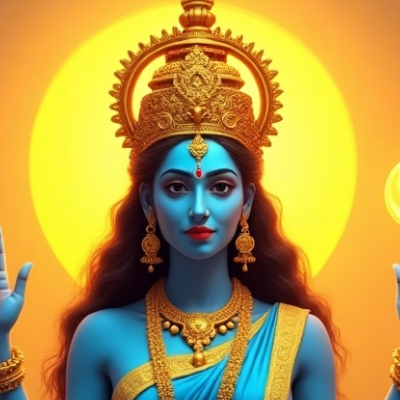
Rati — Goddess of Pleasure, Wife of Kamadeva, and Devoted Seeker of Her Husband's Rebirth
Rati · Kamapatni · Mayavati · Priti · Revati · Kama-sahachara · Pradyumnapatni · Anangasahita
Rati is the goddess of pleasure, erotic delight, and sensory enjoyment — the divine consort and inseparable companion of Kamadeva, the god of desire. Her name derives directly from the Sanskrit root ram, meaning to be pleased, to enjoy, or to delight, yielding rati as the noun of pleasure and sensory fulfilment. She is one of the most consistently present feminine divine figures across the Sanskrit literary, Puranic, and epic traditions — invoked alongside her husband in every erotic and devotional context, depicted in iconography as his inseparable companion, and the subject of a biography that spans the most dramatic episode in Kamadeva's own story. When Shiva incinerated Kamadeva with the fire of his third eye, Rati's grief was so overwhelming that it shook the three worlds; her lamentation before Shiva is one of the most emotionally resonant passages in the Shiva Purana and in Kalidasa's Kumarasambhava. She then waited — for cosmic ages — for her husband's rebirth, inhabiting the form of Mayavati in the household of the demon Shambara, until Kamadeva was reborn as Pradyumna, the son of Krishna and Rukmini, grew to young manhood in that very household, and she could reveal his identity to him and be reunited with him as his wife. Rati's biography is thus a story of cosmic devotion and extraordinary patience — a wife who traversed the gap between her husband's death and his rebirth in a new body without losing her identity, her memory, or her love. She appears in the Shiva Purana, the Bhagavata Purana, the Vishnu Purana, the Matsya Purana, the Mahabharata, the Harivamsa, and Kalidasa's Kumarasambhava.
✦ The Names
The name Rati — from the root ram, to enjoy — designates her directly as the personification of pleasure, enjoyment, and sensory delight. The name encompasses both the physical and emotional dimensions of the experience it names — the joy of union, the pleasure of the senses, and the delight of mutual attraction — making Rati the divine embodiment of the experiential complement to Kama's creative impulse. Where Kama is the desire that reaches toward its object, Rati is the pleasure of the reaching's fulfilment. The two together constitute a complete account of the erotic and pleasurable dimension of conscious existence. The name Mayavati — meaning "she who possesses maya" or "she of illusion" — is the form she assumed in Shambara's household, a name that encodes the deceptive concealment of her true identity during the long years of waiting for Pradyumna. The name Priti means "love," "affection," or "fondness" — a softer, more intimate variant of her divine identity used in some texts. Revati is a name associated with her in certain Puranic contexts. Kamapatni means "wife of Kama." Anangasahita means "she who accompanies the bodiless one."
✦ Lineage and Origin
- Origin — variant accounts: As with Kamadeva's parentage, the origin of Rati is given differently across different primary sources, reflecting the multiple theological frameworks within which she is understood.
- The Bhagavata Purana identifies Rati as born of Daksha — the primordial progenitor lord and Prajapati — making her one of Daksha's daughters in the same genealogical framework that makes her sisters of Aditi, Diti, and the other wives of Kashyapa. In this account she belongs to the Daksha-Kashyapa genealogical household as a daughter given to Kamadeva rather than to the sage Kashyapa.
- The Vishnu Purana gives a different account in which Rati was generated from the sweat of Daksha — arising from the perspiration that fell from Daksha's body during his creative activity — rather than born as a conventional daughter. This variant gives her a more unusual origin while still associating her with Daksha.
- The Shiva Purana and other texts give yet another account in which Rati was created by Brahma specifically as a companion for Kamadeva — that Brahma, having created Kama, recognised that the god of desire required a consort who embodied the pleasure that is desire's object, and fashioned Rati for this purpose. In this account she has no parents in the conventional sense but was created directly by the creator for a specific cosmic function.
- Some passages associate her more loosely with the Prajapati tradition without specifying a particular father, treating her as one of the feminine divine principles generated in the early phases of Brahma's creation to populate the divine world with its appropriate members.
- Husband: Kamadeva — the god of desire, the bodiless one, whose biography is given in full in the Kamadeva profile in this series. Their union is the central fact of Rati's divine identity — she is defined in relation to Kama as his consort and complement, and her biography's most significant episodes all arise from events in his.
- Husband in rebirth form: Pradyumna — the son of Krishna and Rukmini, born as the reincarnation of Kamadeva after Shiva's incineration, and identified in Pancharatra Vaishnava theology as the third of the four Vyuha emanations of Vishnu, associated with the principle of mind. After Kamadeva's incineration, Rati inhabited the form of Mayavati in Shambara's household and became Pradyumna's foster mother and eventual wife. The reunion with Pradyumna as her husband in a new body is the climax of the narrative arc that began with Kama's destruction.
✦ Rati's Role Alongside Kamadeva
In the Sanskrit literary and Puranic tradition, Rati is not a subordinate figure to Kamadeva but his divine complement — the other half of a paired divine principle without whom Kama's function is incomplete. Just as Kama is the desire that moves toward its object, Rati is the pleasure that rewards the movement's fulfilment. Without Rati, Kama would be pure longing without satisfaction — pure desire unaccompanied by the experience of its object. Without Kama, Rati would be pure pleasure without the creative tension that generates it. Together they constitute the divine personification of the complete erotic experience — approach and arrival, yearning and fulfilment, the reaching and the reaching's reward.
She accompanies Kamadeva in all of his depictions and is invoked alongside him in all erotic ritual and literary contexts. The standard Puranic and literary descriptions of Kamadeva consistently place Rati at his side — she is part of the complete divine image of the god of love, not an optional addition. In the narrative of the incineration episode she was physically present with Kamadeva in the Himalayan forest — she had accompanied him on his mission to break Shiva's meditation — and her presence as the witness of his destruction makes her lamentation the first and most immediate human-scale response to the cosmic event of Kama's incineration.
✦ Rati's Lamentation at the Incineration
The lamentation of Rati at Kamadeva's incineration is given extended treatment in several primary sources and has been called by the Sanskrit literary tradition one of the most moving passages in the entire body of devotional and mythological verse. The Shiva Purana narrates that when Shiva's third eye opened and the column of fire struck Kamadeva and reduced him to ash, Rati witnessed the entire event. Her husband — the most beautiful being in existence, the divine principle of desire itself — was gone in an instant, his physical form utterly consumed. Rati collapsed in grief.
The Shiva Purana's account of her lamentation gives her a voice that moves between personal grief and cosmic accusation. She cried out to the three worlds, naming the loss — not merely a personal loss but a cosmic one: without embodied Kama, desire would wander the world as an invisible force, love would be felt but not seen, and the creative principle that drives the continuation of all life would be disembodied and thus in some sense homeless. She addressed the gods who had sent her husband to this death — pointing out that they had used him as an instrument of their purpose and discarded him in the moment of his usefulness. She addressed Parvati — the woman for whose sake the mission had been undertaken — and implored her to intercede with Shiva. And she addressed Shiva himself, throwing herself prostrate before him and appealing to his grace.
Kalidasa's Kumarasambhava — the great Sanskrit epic poem about the birth of the war-god — devotes an entire canto to Rati's lamentation, giving it a literary form of extraordinary poetic beauty. The Kumarasambhava's Rati speaks in verses of intensely personal grief, describing what she has lost in terms of specific sensory memories — the sound of her husband's laughter, the warmth of his presence, the fragrance associated with him — and these concrete details give her lamentation an emotional immediacy that the more cosmologically framed Puranic accounts do not always achieve. Kalidasa's treatment became the canonical literary version of the lamentation episode and is one of the most frequently cited passages in discussions of Sanskrit erotic and grief poetry.
Shiva's eventual response to Rati's grief — mollified by her distress and by Parvati's intercession, and acknowledging that Kama's mission had after all succeeded in its purpose — was a partial restoration: Kama would be restored to life but without his body, and would eventually be reborn in a divine household. He asked Rati to be patient. Rati, having no other recourse and receiving this partial consolation, accepted and began her long wait.
✦ Rati as Mayavati in Shambara's Household
The Bhagavata Purana's tenth book narrates the episode of Rati's inhabitation of the form of Mayavati in the household of the demon Shambara — one of the most unusual biographical episodes in the divine feminine tradition of the Sanskrit canon. Shambara was a demon of great power whose primary skill was in the art of illusion — maya — and who maintained a large household including many women who served in various domestic roles. When Kamadeva was reborn as Pradyumna and Shambara abducted the infant from Krishna's household in Dvaraka — knowing from divine foreknowledge that Pradyumna would eventually destroy him — he cast the infant into the ocean to drown him. A great fish swallowed the infant; the fish was caught in Shambara's own fishermen's nets; when it was cut open in Shambara's kitchen the living infant was found inside.
It was at this point that Rati — who had been waiting for Kamadeva's rebirth and who knew through her divine knowledge that Pradyumna was her husband reborn — entered Shambara's household in the form of Mayavati and received the infant. She took charge of him in the kitchen, raising him in Shambara's household without revealing his true identity to anyone. The name Mayavati — she of maya — was appropriate to the deceptive nature of her presence in the demon's household: she was not what she appeared to be to anyone around her, and her role as the infant's caregiver concealed the cosmic significance of the being she was tending.
The Bhagavata Purana narrates that Rati-as-Mayavati raised Pradyumna through his childhood and into young manhood, watching the extraordinary being who was her husband reborn grow in power and beauty. The relationship between the woman who appeared to be his foster mother and the young man she was raising was thus charged with a knowledge only she possessed — that this was not a mother-son relationship but the temporary concealment of a husband-wife relationship awaiting its proper disclosure.
When the time came — when Pradyumna had grown into the fullness of his power — Rati revealed the truth to him. She told him who he was: that he was the son of Krishna and Rukmini, that he had been abducted as an infant by Shambara, that she herself was Rati the wife of Kamadeva and that he was Kamadeva reborn, and that Shambara was his mortal enemy whose destruction was his destiny. She also gave him the Mahama-ya — the great power of illusion — so that he could counter Shambara's own mastery of maya in the battle that was to follow. Pradyumna, hearing all of this, went to confront Shambara. After a prolonged battle in which Shambara's illusory powers were countered by the Maha-maya Rati had given, Pradyumna killed Shambara. He then rose into the sky with Rati — who had now resumed her divine form — and flew to Dvaraka, where they descended to Krishna's household and the reunion of the lost son with his parents was achieved.
✦ The Reunion in Dvaraka and Rati's Recognition
The Bhagavata Purana's account of Pradyumna's arrival in Dvaraka with Mayavati-Rati notes that the women of Krishna's household were initially struck by Pradyumna's extraordinary resemblance to Krishna — so close was the resemblance that some of them, seeing this young man descend from the sky in the company of a beautiful woman, experienced conflicting and confused feelings. Rukmini herself — Pradyumna's biological mother — felt a profound emotional stirring at the sight of him before she knew who he was. The sage Narada then appeared and explained the full situation: that the young man was Pradyumna, their son who had been abducted as an infant and had now returned; that the woman with him was Mayavati, his wife; and that she was in truth Rati, the goddess who had been his consort in his previous divine existence as Kamadeva. The household received both Pradyumna and Rati with great joy. The narrative of Rati's long wait — from the moment of Kama's incineration through her inhabitation of Mayavati's form, through the raising of the infant Pradyumna, through the revelation of his identity and the defeat of Shambara — thus reached its resolution in the domestic joy of Dvaraka's household.
✦ Rati in the Sanskrit Poetic Tradition
Rati is one of the most frequently invoked goddesses in Sanskrit kavya poetry, always paired with Kamadeva as the divine couple of erotic experience. The poets of the classical Sanskrit tradition — Kalidasa, Bharavi, Magha, Sriharsha — use Rati as a standard point of comparison for female beauty: a woman of extraordinary beauty is compared to Rati, a woman of extraordinary grace is said to rival Rati, and the highest compliment that Sanskrit poetry can pay to feminine beauty is to suggest that Rati herself might feel challenged by it. She is the divine standard of feminine physical perfection in the Sanskrit aesthetic tradition. The Kumarasambhava's treatment of her lamentation gave her a literary depth and emotional resonance that complemented this aesthetic function — she was not merely beautiful but capable of the most profound grief and the most sustained devotion, qualities that the Sanskrit tradition regarded as essential dimensions of the complete feminine ideal.
✦ Rati and the Worship of Kamadeva
In the ritual tradition associated with Kamadeva's worship, Rati is invariably present alongside him. She is worshipped as his consort and as the goddess of pleasure in her own right. The puja offered to the divine couple is associated with marriage, conjugal happiness, and the proper pursuit of kama — the first of the four human aims — within the framework of dharmic social life. South Indian temple traditions in particular give Rati a significant devotional presence, and several temples associated with Kamadeva worship in Tamil Nadu and Kerala include Rati as a co-deity of the shrine. The Ananga-puja and Madana-puja traditions that honour Kamadeva include the paired honouring of Rati as his inseparable divine companion.
✦ Textual Variants and Inconsistencies
The origin of Rati: As detailed in the Lineage section, the origin of Rati is given differently across different primary sources — as a daughter of Daksha, as born from Daksha's sweat, and as created directly by Brahma as a companion for Kama. These three accounts belong to different theological frameworks and are not reconciled within the primary sources. The Daksha's-daughter account makes her a member of the same genealogical household as Aditi, Diti, and the other wives of Kashyapa, which places her within the Puranic genealogical system's most systematised framework. The Brahma-created account gives her a more cosmogonically immediate origin appropriate to her function as the complement of the primordial creative force of desire.
Whether Shiva told Rati of Kama's future rebirth: The Shiva Purana and the Bhagavata Purana both involve Rati's appeal to Shiva and his partial consolation, but they describe the consolation somewhat differently. The Shiva Purana presents Shiva's promise of Kama's eventual rebirth as a specific assurance given in response to Rati's grief. The Bhagavata Purana's account of Rati-as-Mayavati in Shambara's household implies that she possessed the knowledge of Pradyumna's true identity without necessarily specifying exactly when and how that knowledge was given to her. Some manuscript traditions of the relevant passages fill in this gap differently, and the precise mechanism by which Rati came to know of Kama's rebirth as Pradyumna is not entirely consistently stated across all texts.
The nature of the Mayavati-Pradyumna relationship: The Bhagavata Purana is explicit that Rati in the form of Mayavati functioned as Pradyumna's foster mother while he was an infant and child in Shambara's household, and that this relationship was transformed into the husband-wife relationship upon the revelation of his true identity. Some later commentators and regional traditions have found the transition from foster-mother to wife uncomfortable and have handled the episode differently. The Bhagavata Purana's account is the primary canonical source and it handles the transformation without apology, treating it as a necessary feature of the cosmic arrangement that brought Rati and the reborn Kama back together.
✦ Theological and Philosophical Significance
Rati's theological significance in the tradition is of a distinctive kind — she is not the protagonist of a large cosmological or martial narrative but the embodiment of a specific quality of consciousness and experience, and her biography's significance lies in what it demonstrates about that quality rather than in the events themselves. As the goddess of pleasure she represents the divine validation of sensory experience within its proper context — the tradition does not treat pleasure as inherently sinful or spiritually irrelevant but as one of the legitimate dimensions of human life when pursued within the framework of dharma. Rati's divinity is the tradition's affirmation that the experience of pleasure is cosmically grounded — that it has a divine counterpart, a divine patron, and a divine quality that makes it more than merely biological.
Her biography's most significant theological contribution, however, is not in this affirmative dimension but in the episode of her cosmic patience. Rati traversed the gap between her husband's incineration and his rebirth without abandoning her identity, her memory, or her devotion. She inhabited a false form — Mayavati in a demon's household — for what the tradition implies was an extraordinarily long period, maintaining the knowledge of who she was and who Pradyumna was throughout the concealment. This sustained faithfulness across the most difficult possible conditions — the death of the beloved, the long wait, the concealed identity, the paradoxical relationship with the reborn husband as his foster mother before becoming his wife again — gives Rati a profile of devotional perseverance that the tradition places alongside the great devoted wives of the epic and Puranic tradition. She is in some sense the divine model for all the human stories of women who wait for their husbands to return across vast distances of time and circumstance.
In the Pancharatra Vaishnava theological framework, Rati's identity as Mayavati — the woman who gave Pradyumna the Maha-maya to defeat Shambara — connects her to the Shakti dimension of Vaishnava theology: the divine feminine power that enables the avatar's specific mission, analogous in certain respects to the role of Lakshmi as the enabling divine feminine presence in Vishnu's cosmic activity.
✦ Connection to the Wider Genealogy
If the Daksha's-daughter account of Rati's origin is followed, she connects to the primordial progenitor Daksha and through him to the line of Brahma, placing her within the same genealogical household as Aditi — mother of the Adityas — and the many other daughters of Daksha who populate the Puranic cosmos. Through her husband Kamadeva-reborn-as-Pradyumna, she connects to the Yadava royal lineage — the Chandravamsha through the Yadava branch — as the daughter-in-law of Krishna and Rukmini and as the daughter-in-law of Vasudeva and Devaki, and through Pradyumna's son Aniruddha as the grandmother of a further generation of the divine Yadava line. Through the Pancharatra Vyuha theology, Rati-as-Mayavati's enabling of Pradyumna's mission places her within the cosmological framework of the four Vyuha emanations of Vishnu as the feminine complement of the third Vyuha. Her continuous presence across both of Kama's existences — as Rati alongside Kamadeva in his divine form and as Mayavati alongside Pradyumna in his human-divine form — makes her the single constant in the most extended individual narrative arc that spans from the cosmic to the domestic in the Bhagavata Purana's tradition.
✦ References
Primary Sources
- Shiva Purana, Rudra Samhita, Kumara Khanda: The most elaborate Puranic source for Rati's lamentation at Kamadeva's incineration; contains the extended account of her grief, her appeal to Shiva, her address to Parvati and the gods, and Shiva's partial consolation with the promise of Kama's eventual rebirth. The primary narrative source for the lamentation episode.
- Bhagavata Purana, Book 10, chapters 55–56: The primary Vaishnava source for Rati's inhabitation of the form of Mayavati in Shambara's household; her raising of the infant Pradyumna; the revelation of his identity; her giving of the Maha-maya; Pradyumna's defeat of Shambara; and the return to Dvaraka with the reunion of Pradyumna with his parents. The foundational Vaishnava text for the Rati-Mayavati narrative arc.
- Vishnu Purana, Book 5, chapters 27–28: A parallel account of the Pradyumna-Shambara-Mayavati episode broadly consistent with the Bhagavata Purana's version; provides comparison for the treatment of Rati's role in the Vishnu Purana framework.
- Matsya Purana, chapters 154–156: Contains a version of the incineration episode including Rati's lamentation and the partial restoration of Kama to a bodiless form.
- Kalidasa, Kumarasambhava, canto 4: The most celebrated literary treatment of Rati's lamentation — her grief at Kamadeva's incineration given in verses of extraordinary poetic beauty and emotional depth. One of the primary sources for Rati's significance in the Sanskrit literary and cultural tradition as well as in the mythological tradition; the standard against which all subsequent literary treatments of Rati's grief are measured.
- Harivamsa, chapters 79–82: Contains material on Pradyumna and Mayavati that provides supplementary genealogical and narrative details for the episode in which Rati plays her central role.
- Bhagavata Purana, Book 6, chapter 6: Contains genealogical material potentially relevant to Rati's origin as a daughter of Daksha within the Bhagavata Purana's genealogical framework.
Modern Reference Works
- Vettam Mani, Puranic Encyclopaedia (1975): Entry on Rati; comprehensive collation of all primary references across the Puranas, the epics, and the literary tradition; notes the variant accounts of her origin and summarises the principal episodes of her biography.
- Wendy Doniger O'Flaherty, Shiva: The Erotic Ascetic (1973): Contains the most sustained scholarly analysis in modern secondary literature of the Kamadeva incineration episode and Rati's lamentation within it; essential for understanding the theological and structural significance of the episode and Rati's role in it.
- Barbara Stoler Miller (translator), The Kumarasambhava of Kalidasa (1983): Critical translation with scholarly notes; the most authoritative English-language treatment of Kalidasa's account of Rati's lamentation, which is one of the primary sources for Rati's significance in the literary tradition.
- David Shulman, The Hungry God: Hindu Tales of Filicide and Devotion (1993): Contains analysis relevant to the themes of divine loss, lamentation, and restoration that structure Rati's biography within the Shaiva mythological tradition.
- Jan Gonda, Aspects of Early Visnuism (1954): Contains discussion relevant to the Vaishnava integration of Kama and Rati through the Pradyumna narrative within the broader framework of Vishnu's cosmological activity; essential for understanding the Pancharatra theological dimension of Rati-as-Mayavati's role.
- Ludo Rocher, The Puranas (1986): Provides scholarly context for the treatment of Rati across the major Puranic texts and notes the divergences between different accounts of her origin and biography.