
About
Harsha — Divine Personification of Joy in the Hindu Tradition
Harsha · Ananda · Harshadeva · Dharmaja · Kamaja
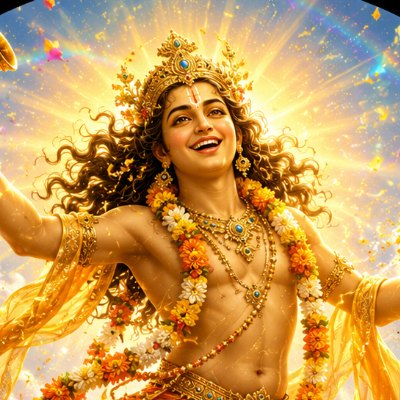
Harsha is the divine personification of joy, delight, and exultation in the Hindu tradition. He is not a narrative deity in the manner of the major Puranic gods but rather a cosmic abstraction given personal form — a personified principle whose existence is invoked to account for the presence of joy as a force woven into the structure of the universe. His name in Sanskrit carries the meanings of joy, pleasure, happiness, and the particular thrill of exultation. He appears in two distinct genealogical contexts across the primary Hindu texts: in the Mahabharata's Adi Parva he is the son of Dharma — the cosmic principle of righteousness — and is thus a brother to Kama, the god of desire; in the Vishnu Purana and the Harivamsa he is the son of Kama and Rati and thus belongs to the household of love rather than to the household of cosmic order. These two positions reflect different theological frameworks for understanding the origin of joy, and the primary texts do not reconcile them. Harsha appears in the Mahabharata, the Harivamsa, and the Vishnu Purana.
✦ The Name
The Sanskrit word harsha derives from the root hrish, meaning to be excited, to bristle with pleasure, or to be thrilled. It encompasses a range of meanings from mild happiness through intense delight to the physical sensation of hair standing on end in a moment of ecstasy — what Sanskrit poetics calls romancha. The word is used widely across Sanskrit literature as a common noun for joy and as a divine name for its personification. In its divine application it designates the being in whom this quality is fully and permanently embodied rather than experienced fleetingly as humans experience it.
✦ Lineage — Two Traditions
The primary texts preserve two distinct and irreconcilable accounts of Harsha's parentage, reflecting different cosmological frameworks operative in the Mahabharata on the one hand and in the Puranic literature on the other.
Lineage A — Son of Dharma (Mahabharata tradition):
- Father: Dharma, the divine personification of cosmic order, righteousness, and duty, who in the Mahabharata's cosmological sections is described as one of the primal beings generated from Brahma.
- Brothers: Kama, the god of desire and love; and Shama, the personification of tranquillity or inner peace — both born alongside Harsha as sons of Dharma.
- Spouse: Nanda, a divine personification whose name means delight, prosperity, or bliss.
Lineage B — Son of Kama and Rati (Puranic tradition):
- Father: Kama, also called Kamadeva, the god of love, desire, and attraction, one of the most widely venerated deities in the Hindu tradition and a figure who appears prominently in the Puranas and the epics.
- Mother: Rati, the goddess of love, passion, and carnal desire, and the principal consort of Kama.
- Sister: Yashas, a personification of glory, fame, or grace, recorded in the Harivamsa as a daughter born to Kama and Rati alongside Harsha. The Vishnu Purana in some passages records Harsha as the sole child of Rati without mentioning Yashas; the Harivamsa adds her as a sibling.
✦ Textual Variants and Inconsistencies
The two genealogical traditions represent a substantive theological divergence rather than a minor scribal discrepancy, and each reflects a coherent internal logic.
The Mahabharata's Adi Parva, in its cosmological enumeration of the progeny of Brahma's mind-born sons, places Harsha as a son of Dharma — the deity of cosmic order — alongside Kama and Shama. In this framework joy is understood as a product of righteousness: it arises when the moral order of the universe is properly sustained. Harsha in this account marries Nanda, extending the genealogy of divine abstractions. This tradition makes Harsha a sibling of Kama rather than his offspring, situating them at the same cosmological level as co-products of a prior divine principle.
The Vishnu Purana presents a different account in which Rati, the consort of Kama, gave birth to a son named Harsha. The Harivamsa, the appendix to the Mahabharata concerned with the lineage and deeds of Krishna, expands this to record that Kama and Rati together produced two children — Harsha as a son and Yashas as a daughter. In this framework joy is understood as the offspring of love and passion: it is the natural product that arises from their union. This account places Harsha one generation below Kama rather than at the same level, and it gives him a cosmological origin in the household of desire rather than in the household of righteousness.
The two traditions are not harmonised in any primary text. Both are represented in authoritative sources and reflect genuinely different ways of thinking about the metaphysical origins of joy within the Hindu philosophical tradition.
✦ Theological and Philosophical Significance
Harsha occupies a distinctive position among the personalised abstractions of the Hindu tradition. Unlike the major deities, he has no independent mythology — no narrative episodes of his own, no temples built in his name, no iconographic tradition that specifies his form, no hymns addressed to him in the Vedic corpus. His theological function is entirely structural: he exists within genealogical and cosmological lists to give ontological weight to the claim that joy is not merely a human emotion but a cosmic principle with a defined place in the architecture of existence.
The divergence between the two genealogical traditions is itself philosophically significant. The Mahabharata's placement of Harsha as a son of Dharma articulates a view in which joy is a consequence of right conduct and the maintenance of cosmic order — a perspective consistent with the dharmic ethics that pervade the epic. The Puranic placement of Harsha as the son of Kama and Rati articulates a view in which joy is the natural outcome of love and desire — a perspective more consistent with the devotional and aesthetic registers of Puranic theology. Together, the two traditions do not so much contradict each other as map joy onto two different causal chains, both of which have deep roots in the tradition's understanding of human and cosmic flourishing.
His spouse Nanda — whose name means delight or bliss — in the Mahabharata tradition extends this symbolic register further: joy and delight are paired as husband and wife, suggesting that they are co-constitutive rather than sequential states. This pairing belongs to the same tradition of naming and genealogising abstract principles that characterises the lists of Dharma's progeny in the Adi Parva more broadly.
✦ References
- Primary Sources
- Mahabharata, Adi Parva, Chapter 66, Verses 31–33 (Critical Edition, BORI): Places Harsha as a son of Dharma and a brother of Kama and Shama, and records his marriage to Nanda; this is the foundational textual source for the Dharma-lineage tradition.
- Vishnu Purana, Book 1 (Genealogical sections): Records Harsha as the son born to Rati, the consort of Kama, establishing the Puranic tradition of Harsha as offspring of the household of love.
- Harivamsa, Khila Parva (Appendix to the Mahabharata): Expands the Puranic genealogy to name both Harsha and Yashas as children of Kama and Rati, adding the sister figure absent from the Vishnu Purana's account.
- Secondary Sources
- Vettam Mani, Puranic Encyclopaedia (Motilal Banarsidass, 1975): Summarises both genealogical traditions for Harsha, distinguishes the Mahabharata and Puranic accounts, and identifies his spouse Nanda.
- Wendy Doniger O'Flaherty, Women, Androgynes, and Other Mythical Beasts (University of Chicago Press, 1980): Provides contextual analysis of the household of Kama and the theological significance of personified abstractions in Puranic genealogical literature.
- A. A. Macdonell and A. B. Keith, Vedic Index of Names and Subjects (John Murray, 1912): Provides etymological and contextual background for the Sanskrit term harsha and its range of meanings in classical literature.