
About
Anjana — Apsara Reborn as Vanara, Wife of Kesari, and Mother of Hanuman
Anjana · Anjani · Punjikastala · Managarva · Kesaripatni · Hanumat-mata · Anjaneya-janani · Kunjara-putri · Vayuprasada-grahini
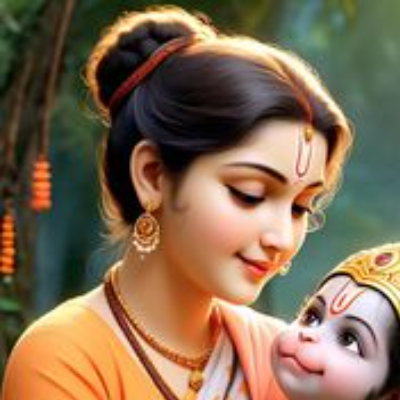
Anjana is the mother of Hanuman — the great vanara devotee of Rama, the remover of obstacles, the Chiranjivi who is present wherever the Ramayana is recited — and one of the most significant female figures in the Ramayana's supporting genealogy. She is a celestial being who in her original divine identity was the Apsara Punjikastala — or in another account the Apsara Managarva — and who was cursed to be born on earth in vanara form, with the condition that her curse would be lifted only upon the birth of a son of extraordinary power and divine quality. She was married to Kesari — the son of Brihaspati, the king of Sumeru and a mighty vanara warrior — and from their union, through the divine intervention of Vayu the wind god, Hanuman was born. The tradition gives Hanuman a triple paternity — Kesari as his earthly father, Vayu as the divine agent of his conception, and Shiva as the cosmic identity whose portion of power was transmitted through Vayu into Anjana's womb — and Anjana is the mother through whom all three of these paternal dimensions converge in the body of a single extraordinary being. At Hanuman's birth Anjana was released from her curse and ascended back to the divine realm, but her identity as Anjaneya's mother — the woman from whom Hanuman takes his most personal name — remains one of the most devotionally charged maternal identities in the tradition. Anjana appears in the Valmiki Ramayana's Kishkindha Kanda, the Shiva Purana, the Skanda Purana, various regional Ramayana traditions, and in the Anjana Upakhyana passages found embedded in Puranic contexts.
✦ The Names
The name Anjana is of uncertain but suggestive etymology. The Sanskrit word anjana — also spelled anchjana — designates a dark collyrium or eye-ointment made from antimony, used to line the eyes and regarded in the tradition as both beautifying and protective. The name thus carries connotations of dark beauty, of the lining of the eye's vision with a clarifying and protective substance, and by extension of a being associated with beauty and with the enhancement of sight. As the mother of Hanuman — whose role in the Ramayana is repeatedly that of the one who sees clearly when others cannot, who crosses the ocean when all others hesitate, who finds Sita when she cannot be found — the name Anjana resonates with the theme of vision and clarity even if this etymological connection is not explicitly drawn in the primary texts. The alternative name Anjani is the same name in a variant nominal form. The divine identity Punjikastala — her name as an Apsara in her pre-curse celestial existence — is the name given in the Valmiki Ramayana's account. The alternative divine identity Managarva — given in some Puranic accounts — means "she of pride in the mind" from mana (mind, pride) and garva (pride, arrogance). Kunjara-putri means "daughter of Kunjara" — the vanara leader identified as her father in the Puranic tradition. The epithet Anjaneya-janani means "mother of Anjaneya" — Anjaneya being Hanuman's most personal name, formed directly from his mother's name and meaning "son of Anjana."
✦ Lineage and Pre-Curse Identity
- Original identity as an Apsara — variant accounts: The tradition gives two different names for Anjana's pre-curse celestial identity, reflecting different textual lineages of the same essential narrative.
- The Valmiki Ramayana's Kishkindha Kanda identifies her as the Apsara Punjikastala — a celestial being of divine beauty who was born on earth in vanara form as the result of a curse. The Valmiki Ramayana specifies that the curse was pronounced by Brihaspati — though some accounts within this tradition attribute the curse to Durvasa or to another sage. The curse's condition — that she would be released from the vanara birth upon bearing a son of extraordinary power — is the structuring fact of her earthly biography.
- Certain Puranic accounts — including the version preserved in the ISVARA tradition citing the Valmiki Ramayana's Kishkindha Kanda sarga 66 — give her divine name as Managarva. In this account Brahma cursed the celestial woman Managarva and transformed her into a female vanara who came to be known as Anjana and became the wife of Kesari. The Managarva account gives Brahma rather than Brihaspati or Durvasa as the agent of the curse.
- Father in vanara birth: Kunjara — identified in several Puranic sources as the vanara leader who was Anjana's father in her earthly vanara existence. Kunjara means "elephant" in Sanskrit — a name of power and magnitude appropriate for a vanara leader. This identification places Anjana as the daughter of a significant figure within the vanara social world of the tradition.
- Husband: Kesari — the son of Brihaspati the divine preceptor of the gods, king of the Sumeru mountain, and a mighty vanara warrior. The Valmiki Ramayana's Kishkindha Kanda identifies Kesari as Brihaspati's son explicitly — making him the half-brother of Bharadvaja in the Brihaspati lineage, and therefore connecting the vanara world to the Angirasa divine tradition through Kesari's paternity. Kesari was a warrior of great valour celebrated in the tradition for killing the demon Shambasadana at the sacred shrine near the Gokarna mountain by the seashore — an act of dharmic warfare performed on behalf of the gods and sages who were being harassed by that demon. He and Anjana together performed intense austerities directed toward Shiva in order to obtain the boon of a child after a long period of childlessness.
- Son: Hanuman — born of Anjana through the divine intervention of Vayu the wind god, carrying the power of Shiva as transmitted through Vayu, and identified as Kesari's earthly son. Hanuman is the great vanara devotee of Rama, the hero of the Sundara Kanda, the figure who leapt across the ocean to Lanka, found Sita in Ravana's Ashoka grove, burned Lanka, and served as Rama's supreme instrument throughout the war. He is a Chiranjivi — one of the immortal survivors — and is present wherever the Ramayana is recited. From his mother's name he takes his most intimate personal epithet: Anjaneya, the son of Anjana.
✦ The Nature of the Curse and Its Condition
The tradition is consistent in its structural account of Anjana's curse even when the details vary across different primary sources. An Apsara of celestial beauty — named Punjikastala or Managarva depending on the textual tradition — committed some act of transgression or impropriety that attracted the anger of a great divine being whose curse transformed her into a vanara and caused her to be born on earth. The specific nature of the transgression varies across accounts — some give a slight toward a sage, others give a disruption of a divine ritual, others give the curse as arising from an act of carelessness or disrespect in the divine assembly. The condition of liberation from the curse was consistent: she would regain her divine form and return to the celestial realm upon giving birth to a son of extraordinary power and virtue who would serve the divine will.
This structural pattern — the curse that sends a celestial being to earth in a reduced form, the condition that determines the terms of release, and the birth of a divine child that fulfils the condition — is one of the most widely used narrative frameworks in the Puranic and epic tradition. It appears in the stories of the Vasus who became Bhishma's brothers, in the story of Tara and the Tarakamaya war, and in numerous other birth narratives. Anjana's curse follows the same pattern but with a specific and cosmically significant elaboration: the child whose birth would free her was not merely any child but the specific being needed by the cosmic order of the age — the divine instrument through whom Vishnu's avatar Rama would be able to accomplish the task of Ravana's destruction that he could not have accomplished alone.
✦ The Austerities of Anjana and Kesari
The tradition narrates that Anjana and Kesari — living in the Sumeru region as a married couple without children — performed intense austerities directed toward Shiva in order to obtain the boon of a son. The austerities are described in various accounts as prolonged and severe — involving fasting, standing postures, exposure to the elements, and the sustained concentration of consciousness on Shiva's divine form. Shiva was pleased by their devotion and granted the boon of a son who would be of extraordinary power and virtue.
The divine mechanism by which Shiva's boon was fulfilled is given in two main variants in the tradition. In the Shaiva account — given in the Shiva Purana and preserved in several regional Ramayana traditions — Shiva and Parvati were at that time engaged in sport in the forest in the forms of vanaras. When the gods sent Vayu to find them, Parvati was found to be pregnant in vanara form and was unwilling to bring a child born in that form to Kailasha. Shiva instructed that the embryo be given to Vayu, and Vayu transferred it to the womb of Anjana — who was engaged in her own devotional austerities at that time. In the Vaishnava account — given in the Valmiki Ramayana and in accounts connected to the Putrakameshti yagna narrative — Vayu carried the divine portion of the sacred payasam from Dasharatha's sacrifice to Anjana's outstretched hands, and Hanuman was born from her consumption of that divinely charged food.
✦ The Triple Paternity of Hanuman and Anjana's Role
The tradition gives Hanuman a triple paternity that the primary sources acknowledge without fully harmonising — Kesari as his earthly father, Vayu as the divine agent of his conception, and Shiva as the cosmic source whose power was transmitted through Vayu. Anjana is the single maternal figure through whom all three of these paternal identities converge. It is in and through her womb — her body, her austerities, her devotion — that the extraordinary combination of vanara earthly vitality, wind-god divine force, and Shaiva cosmic power was contained and given form as a single being.
This concentration of cosmic significance in Anjana's maternal role gives her an importance that exceeds what her relatively brief narrative presence in the primary texts might suggest. She is not a figure who acts throughout a long narrative — her story is complete with Hanuman's birth — but the act of bearing that particular child, in those particular circumstances, with those particular divine dimensions converging in her body, makes her one of the most theologically charged maternal figures in the tradition. The Ramayana's outcome — Sita's rescue, Ravana's defeat, the restoration of cosmic order — depends on Hanuman, and Hanuman's existence depends on Anjana's austerities, her body, and her willingness to be the vessel through which the cosmic need of the age was met.
✦ Anjana's Departure After Hanuman's Birth
The Valmiki Ramayana's Kishkindha Kanda and the Puranic accounts consistent with it record that at the moment of Hanuman's birth Anjana was released from her curse — the condition that had structured her entire earthly existence was fulfilled, and she was free to return to the divine realm. The ISVARA source citing the Kishkindha Kanda records a brief and emotionally charged exchange between the newborn Hanuman and his departing mother: Hanuman cried for milk, and Anjana told him that monkeys eat red ripe fruits and that he should eat whatever he found in red colour. Having given this last instruction to her son, Anjana transformed herself back into her divine Apsara form and ascended to heaven.
This departure — almost immediate after the birth, the mother leaving the infant with the most minimal of instructions before ascending — gives Anjana's story a poignancy that the tradition preserves without elaborating at length. The child born to fulfil her liberation liberated her in the very moment of his birth, and the liberation was immediate and complete: she did not stay to raise him, she did not accompany him through his extraordinary life, she did not witness the leap across the ocean or the burning of Lanka or the reunion with Rama. Her role was the bearing of the child; once that role was complete, her earthly existence was concluded. The infant Hanuman was left with Kesari and with the instruction about red fruits — and from that minimal beginning the greatest of the tradition's devotees shaped his extraordinary life.
✦ The Location of Hanuman's Birth
The tradition gives multiple locations as the birthplace of Hanuman — and by extension as the place of Anjana's lying-in and the scene of her liberation. The primary sources identify the birth as occurring in a valley on the southern side of Mahameru, in the region of Sumeru where Kesari ruled. Regional traditions have identified specific geographical sites across the subcontinent as the birthplace — including Anjaneya Hill near Hampi in Karnataka, the Anjaneri mountain near Trimbakeshwar in Maharashtra, a cave near Gokarna in Karnataka, and various sites in Bihar and elsewhere. The multiplicity of claimed birthplaces reflects the tradition's wide distribution and the devotional importance of connecting specific sacred geographies to the central figures of the Ramayana.
✦ Textual Variants and Inconsistencies
The name and identity of Anjana's pre-curse celestial self: The Valmiki Ramayana gives Punjikastala; the ISVARA source citing the Kishkindha Kanda gives Managarva; other regional traditions give yet other names. These represent genuinely different textual lineages rather than simple scribal variants, and the tradition does not resolve the question with a single authoritative identification.
The agent of the curse: The tradition gives Brihaspati, Durvasa, and Brahma as the curse-givers in different accounts. Some accounts connect the Brihaspati identification to the fact that Kesari — Anjana's husband — was himself Brihaspati's son: the convergence of Brihaspati as both the curser of Anjana and the father of Kesari is a suggestive genealogical irony that some traditions preserve without elaborating.
The mechanism of conception — Shaiva versus Vaishnava accounts: The Shaiva account (Shiva and Parvati's embryo transferred through Vayu to Anjana's womb) and the Vaishnava account (Vayu carrying the sacred payasam from Dasharatha's yagna to Anjana) are both attested primary source accounts and they are not reconcilable with each other in their literal details. The tradition maintains both without choosing between them, understanding them as different theological framings of the same cosmic event rather than competing historical accounts.
The divine identity of Hanuman — Shiva avatar versus Vayu son: The Shiva Purana presents Hanuman as an avatar of Shiva. Most Vaishnava Puranas and the Valmiki Ramayana present him as the spiritual son and incarnation of Vayu. The Dvaita Vedanta tradition of Madhvacharya presents him as the chief manifestation of Mukhya Prana — the primordial life force. These theological identifications coexist in the tradition and reflect the different theological frameworks of different communities rather than a single canonical resolution. Anjana as Hanuman's mother is consistent across all these frameworks — it is only the theological identity of the divine father that varies.
✦ Theological and Philosophical Significance
Anjana's theological significance is concentrated in her function as the maternal vessel through which the cosmic need of the age was met. The Ramayana's central action — the defeat of Ravana — required Hanuman. Hanuman's existence required Anjana's austerities, her body, and her curse's specific structural condition. The tradition thus presents Anjana's earthly life — the entire experience of being born in vanara form, living without a child, performing austerities, receiving the divine gift of conception, bearing the child — as a cosmically purposive sequence whose meaning was always beyond what Anjana herself could have understood while living through it. She performed the austerities in order to obtain a child; the tradition reveals that the specific child she obtained was the being upon whom the outcome of the entire Ramayana depended.
This pattern — the individual's devotional act whose cosmic significance exceeds what the actor can see — is one of the Ramayana tradition's most characteristic theological structures. Anjana embodies it in her maternal dimension with particular completeness: she acted in pure devotion, she received the fruit of that devotion, she bore the fruit and was immediately released. The brevity of her earthly role after the birth — the single instruction about red fruits before her departure — paradoxically amplifies rather than diminishes her significance. She gave everything that was needed and nothing that was not, and the tradition honours this precision by naming the greatest of all devotees after her.
✦ Connection to the Wider Genealogy
Through her father Kunjara in her vanara birth, Anjana is embedded in the vanara social world of the Kishkindha tradition. Through her husband Kesari — the son of Brihaspati — she is connected by marriage to the Angirasa divine lineage through Brihaspati, to Angiras the primordial sage, and thus to the creative line of Brahma. Through Vayu's divine paternity of Hanuman, she is connected to the wind god who is elsewhere the father of Bhima — the Pandava warrior — making Hanuman and Bhima sons of the same divine father through different mothers and connecting the Ramayana's greatest vanara hero to the Mahabharata's greatest human warrior through shared divine paternity. Through her son Hanuman — the Chiranjivi who is present wherever the Ramayana is recited — Anjana's maternal identity extends across all times and all places where the tradition lives, making her name the most continuously invoked maternal epithet in the devotional tradition of Hanuman's worship. The name Anjaneya — son of Anjana — is how Hanuman is most personally addressed by his devotees across the entire tradition.
✦ References
Primary Sources
- Valmiki Ramayana, Kishkindha Kanda, sarga 66: The primary canonical source for Anjana's identity — Jambavan's narration of Hanuman's origin to him, identifying Anjana as the Apsara born in vanara form as the result of a curse, her marriage to Kesari, Vayu's role in the conception, and the birth of Hanuman. The most authoritative primary epic source for the Anjana narrative.
- Valmiki Ramayana, Sundara Kanda, sarga 35: Hanuman's own account of his birth and parentage given to Sita when he first meets her in Lanka's Ashoka grove — a significant internal account that confirms the key facts of Anjana's identity and Kesari's paternity from Hanuman's own testimony.
- Shiva Purana, Rudra Samhita: The primary Shaiva source for the account of Shiva and Parvati taking vanara form, the transfer of the embryo through Vayu to Anjana's womb, and Hanuman's identification as a Shiva avatar. Essential for the Shaiva theological dimension of the birth narrative.
- Skanda Purana: Contains the Anjana Upakhyana — the extended narrative of Anjana's history, her curse, her austerities, and the circumstances of Hanuman's birth — which provides the most elaborated Puranic account of her biography.
- Eknath's Bhavartha Ramayana (16th century CE): A significant regional Marathi Ramayana that contains the account connecting Anjana's receiving of the sacred payasam to Dasharatha's Putrakameshti yagna through Vayu's divine delivery; the primary source for the Vaishnava-inflected version of the birth narrative that connects Rama's birth and Hanuman's birth as parallel cosmic events.
Modern Reference Works
- Vettam Mani, Puranic Encyclopaedia (1975): Entry on Anjana; collates primary references across the Valmiki Ramayana, the Puranas, and the regional traditions; notes the variant accounts of her curse's origin and the different divine paternity traditions for Hanuman.
- Robert P. Goldman and Sally J. Sutherland Goldman (translators), The Ramayana of Valmiki — Kishkindha Kanda (1994): Critical translation with scholarly notes on the Hanuman origin passage in sarga 66 including the identification of Anjana and the genealogical details of Kesari's Brihaspati-son identity.
- Philip Lutgendorf, Hanuman's Tale: The Messages of a Divine Monkey (2007): The most comprehensive modern scholarly study of the Hanuman tradition in all its dimensions — literary, devotional, iconographic, and regional; contains extended discussion of the Anjana birth narrative across its many variant forms and the theological implications of Hanuman's triple paternity.
- Wendy Doniger O'Flaherty, Shiva: The Erotic Ascetic (1973): Contains analysis relevant to the Shaiva dimension of Hanuman's birth — the Shiva-Parvati monkey-form episode and its theological significance in the broader framework of Shaiva creative mythology.