
About
Sharadvana — Son of Gautama, Father of Kripacharya and Kripi, and Sage of the Angirasa Tradition
Sharadvana · Sharadvan · Gautamiputra · Shatanika-pitamaha · Kripacharya-pita · Kripi-mata · Sarachapa-janman · Janapadi-samveda
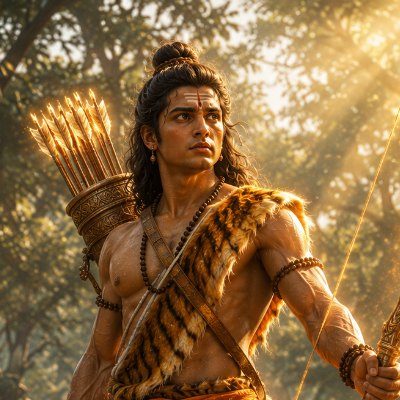
Sharadvana — also called Sharadvan — is the son of the great sage Gautama Maharishi and a figure of extraordinary martial and ascetic standing in the Mahabharata tradition. He is remarkable in the primary sources for having been born already holding a bow and arrows — the Mahabharata presents this as a mark of his exceptional combined military and ascetic power present from birth — and for the extraordinary manner in which his own two children, Kripacharya and Kripi, came into the world. When the Apsara Janapadi was sent by Indra to break Sharadvana's meditation, his ascetic concentration was disrupted and his seed was involuntarily discharged onto a clump of sharavana reeds — the specific reed plant from which the name Sharadvana is derived — and from this seed the twin children Kripa and Kripi were born. Kripacharya became one of the greatest teachers of arms in the Mahabharata's generation, trained the Kaurava and Pandava princes alongside Drona, fought in the Kurukshetra war, and is one of the seven Chiranjivis — the immortal survivors who are understood to continue existing beyond the war. Kripi became the wife of Drona and the mother of Ashvatthama — one of the most powerful and morally complex warriors of the war generation. Sharadvana appears primarily in the Mahabharata's Adi Parva and is referenced in the Vishnu Purana and Bhagavata Purana in genealogical contexts.
✦ The Name
The name Sharadvana is directly connected to the Sanskrit word sharavana — a clump or grove of shara reeds, the specific tall reeds that grow along river banks and in marshy areas. The name thus means "he of the reed-grove" or "the one born of the reeds" — encoding directly the account of his children's birth from the seed that fell upon a clump of sharavana reeds when his meditation was disturbed by Janapadi. The tradition's naming convention here follows the pattern of naming the figure by the defining circumstance of his biographical narrative — as Dirghatamas was named for the long darkness of his blindness, Sharadvana is named for the reeds that became the cradle of his children. The patronymic Gautamiputra means "son of Gautama." Sarachapa-janman means "born holding bow and arrows" — a reference to his extraordinary birth with weapons already in his hands. Janapadi-samveda means "the one encountered by Janapadi."
✦ Lineage
- Father: Gautama Maharishi — one of the seven Saptarishis, a figure of immense ascetic standing, and the husband of Ahalya. His profile is given separately in this series.
- Mother: The primary texts are not consistent in identifying Sharadvana's mother. Some accounts treat him as born of Ahalya and Gautama; others leave the mother unnamed; the Mahabharata's Adi Parva account of Sharadvana's extraordinary birth holding a bow and arrows does not specify his mother with the same consistency as it specifies Gautama as his father. This uncertainty is noted in the Gautama profile in this series.
- Half-brother: Shatananda — born of Gautama and Ahalya, purohita of Janaka's court and narrator of Vishvamitra's biography in the Ramayana; profiled separately in this series.
- Half-brother (attributed): Chirakari — attributed as a son of Gautama and Ahalya in the Mahabharata's Shanti Parva; profiled separately in this series.
- Son — Kripacharya (born from the reeds): Born of the seed that fell upon the sharavana reeds when Indra's Apsara Janapadi disrupted Sharadvana's meditation. Kripacharya — also simply called Kripa — was found as an infant by King Shantanu's hunters in the reed-grove and was brought to Hastinapura, where he was raised in the royal household. He became the first teacher of arms for the Kaurava and Pandava princes — training them in the basic martial sciences before Drona took over the more advanced instruction — and later served as one of the foremost commanders in the Kurukshetra war on the Kaurava side. As one of the seven Chiranjivis — the immortal survivors of the Mahabharata's central catastrophe — Kripacharya is understood in the tradition to continue existing in the present age.
- Daughter — Kripi (born from the reeds, twin of Kripacharya): Kripi was born simultaneously with Kripacharya from the same miraculous birth in the reeds. She was raised alongside her brother in Shantanu's household at Hastinapura. She subsequently married Drona — the great teacher of arms who had been Kripacharya's fellow student under Agnivesha — and bore him the son Ashvatthama, one of the seven Chiranjivis and one of the most dramatically powerful figures of the war's final phase. Through Kripi and her son Ashvatthama, Sharadvana's lineage connects directly to the most terrible events of the Mahabharata's conclusion — the night attack on the Pandava camp, the killing of the sleeping sons of the Pandavas, and the launching of the Brahmastra against the unborn Parikshit.
✦ The Birth with Bow and Arrows
The Mahabharata's Adi Parva records that Sharadvana was born already holding a bow and arrows in his hands — a detail that the tradition presents as a mark of his extraordinary nature combining ascetic and martial power from the moment of his emergence into the world. This birth with weapons is parallel to certain other extraordinary births in the tradition — Drona's son Ashvatthama was born with a jewel in his forehead, and Karna was born with divine armour and earrings — in which the physical circumstances of birth encode the defining qualities of the being born. For Sharadvana, the bow and arrows mark him from birth as a warrior-sage — a figure in whom the martial tradition and the ascetic tradition coexist in a single body, and who will eventually transmit that combined inheritance to his children Kripacharya and Kripi.
The Mahabharata notes that Sharadvana's possession of weapons from birth alarmed Indra — the lord of the gods — who perceived in this unusual child a figure whose accumulated spiritual power could become a threat to the divine order. It was this alarm that prompted Indra to send the Apsara Janapadi to break Sharadvana's meditation and thus dissipate the spiritual power he was accumulating. The strategy worked in terms of disrupting the meditation, but its consequence — the birth of Kripacharya and Kripi from the discharged seed — produced in the next generation two figures whose influence on the Mahabharata's events was of immense consequence, including one — Kripacharya — who as a Chiranjivi carries Sharadvana's lineage forward beyond the tradition's primary narrative into the cosmic future.
✦ The Episode of Janapadi and the Birth of the Twin Children
The Mahabharata's Adi Parva narrates that Indra, alarmed by the intensity of Sharadvana's ascetic practice and the power it was generating, sent the Apsara Janapadi to break his concentration. Janapadi was a celestial being of extraordinary beauty and she approached Sharadvana in the forest while he was deep in meditation. The sight of her beauty broke through Sharadvana's concentration — not through any act of volition on his part but through the involuntary response of his body to a stimulus that overwhelmed his yogic discipline in that moment. His seed was discharged involuntarily onto a clump of sharavana reeds growing nearby. Sharadvana, recognising what had happened and deeply distressed at the break in his meditation, immediately left the forest without looking at Janapadi or at the reeds. He went to another forest and resumed his austerities elsewhere.
The seed that fell upon the sharavana reeds split into two. From the two halves of the divided seed the twin children were born — a boy and a girl — lying among the reeds. King Shantanu of Hastinapura was hunting in the region and his hunters found the two infants lying in the reed-grove. Shantanu, recognising from the weapons lying nearby — bows and arrows that had accompanied the children from birth as markers of their father's extraordinary nature — that these were the children of a great warrior-sage, brought them to Hastinapura. He raised them in his household with compassion. The boy was named Kripa — from kripa, compassion, because the king had taken pity on him — and later came to be known as Kripacharya as a great teacher of arms. The girl was named Kripi.
Sharadvana eventually learned of the fate of his children — the Mahabharata records that he came to Hastinapura himself, recognised the children as his own, and instructed Kripacharya personally in all the Vedas and in the complete science of arms — archery, the use of all weapons, and the application of divine weapons (astras). This instruction by his own father gave Kripacharya the fullest possible transmission of the Gautama-Angirasa lineage's combined ascetic and martial knowledge.
✦ Sharadvana's Instruction of Kripacharya
The Mahabharata records that after coming to Hastinapura and recognising his children, Sharadvana took Kripacharya under his direct instruction and gave him a comprehensive education in the Vedas and in the dharmic and martial sciences. This transmission — from the sage born with a bow in his hand to the son who would become the first teacher of the Kuru princes — established the specific tradition of arms instruction that would shape the most consequential generation of warriors in the Mahabharata's world. Kripacharya's instruction of the princes preceded Drona's, and his status as the first teacher of arms in the Kuru household gave him a foundational role in the princes' martial formation that Drona subsequently built upon.
✦ Textual Variants and Inconsistencies
The mother of Sharadvana: As noted in the Lineage section, the primary texts do not consistently name Sharadvana's mother. Some accounts identify him as Ahalya's son alongside Shatananda; others simply name Gautama as his father without specifying the mother. The Mahabharata's account of his extraordinary birth holding weapons does not name his mother in the passage. This uncertainty is acknowledged rather than resolved.
The naming of Kripa: Different versions of the Mahabharata's account give slightly different explanations for the name Kripa — most consistently connecting it to the compassion (kripa) that Shantanu felt for the abandoned infants, but some accounts connect the name to other circumstances. The Adi Parva's account of Shantanu's compassionate adoption is the primary canonical version.
✦ Theological and Narrative Significance
Sharadvana's theological significance is concentrated in the episode of Janapadi and its consequences. The episode demonstrates the tradition's consistent principle that even the most advanced ascetic practice is vulnerable to the specific form of disruption that Indra's agents were sent to create — the beauty of an Apsara could break through the discipline of the most austere sage at the moment when the sage's accumulated power was approaching a level that threatened the divine order. The involuntary nature of Sharadvana's response — he did not choose to break his meditation — is essential to the tradition's moral accounting of the episode: this was not a failure of will but a physiological response to an overwhelming stimulus. The consequence of that response — the birth of Kripacharya and Kripi — was entirely independent of any intention on Sharadvana's part, and yet it produced two beings whose influence on the tradition's central narrative was enormous.
The figure of Kripacharya as a Chiranjivi — one of the immortal survivors — gives Sharadvana's lineage a specifically cosmic dimension: the son born from his disrupted meditation continues to exist in the present age of the world, carrying the Gautama-Angirasa combined martial and ascetic tradition forward across the ages as one of the tradition's permanent living inheritances.
✦ Connection to the Wider Genealogy
Through his father Gautama and grandfather Angiras, Sharadvana connects to the primordial Angirasa lineage and through it to the mind-born son of Brahma. Through his son Kripacharya — a Chiranjivi who trained the Kaurava and Pandava princes — Sharadvana is the grandfather of the instruction that shaped the Mahabharata's central warrior generation. Through his daughter Kripi's marriage to Drona and the birth of Ashvatthama — Sharadvana's grandson — the Gautama lineage produced one of the seven Chiranjivis of the tradition and the figure responsible for the most morally devastating acts of the Mahabharata's final phase. Through Kripi as Drona's wife, the Gautama lineage is directly connected to the Bharadvaja-Brihaspati lineage through which Drona descends, making Sharadvana's family a genealogical link between two of the most ancient sage traditions of the Vedic world.
✦ References
Primary Sources
- Mahabharata, Adi Parva, sections 129–131: The primary source for Sharadvana's biography — his extraordinary birth holding bow and arrows, Indra's alarm, the sending of Janapadi, the disruption of his meditation, the seed falling on sharavana reeds, the twin birth of Kripa and Kripi, Shantanu's discovery and adoption of the infants, and Sharadvana's subsequent identification and instruction of his son Kripacharya.
- Vishnu Purana, Book 4, chapter 19: Genealogical confirmation of Sharadvana as Gautama's son and of Kripacharya and Kripi as his children.
Modern Reference Works
- Vettam Mani, Puranic Encyclopaedia (1975): Entry on Sharadvana; collates primary references and summarises the birth episode, the Janapadi encounter, and the birth of Kripacharya and Kripi.
- J. A. B. van Buitenen (translator), The Mahabharata, Volume 1 (1973): Critical translation of the Adi Parva with scholarly notes on the Sharadvana-Kripacharya birth narrative.