
About
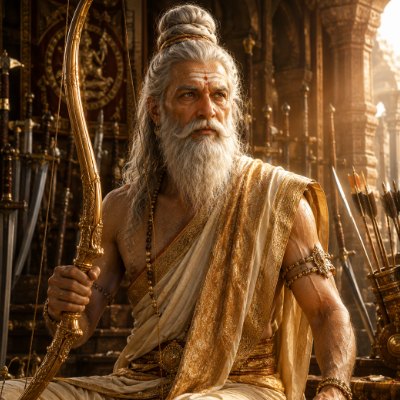
Kripacharya — Son of Sharadvana, First Teacher of the Kuru Princes, Mahabharata Warrior, and Chiranjivi
Kripacharya · Kripa · Gautamiputra · Sharadvanaputra · Sharadvatanaya · Kaurava-prathama-acharya · Ashvatthama-mama · Chiranjivi · Kurupitamaha-acharya
Kripacharya is one of the most consistently present figures across the entire span of the Mahabharata — a warrior and teacher of immense standing who appears from the epic's earliest genealogical passages through the war's final night, and who as one of the seven Chiranjivis is understood to continue existing in the present age. He is the son of Sharadvana — the son of Gautama Maharishi who was born already holding a bow and arrows — and the twin brother of Kripi, who became the wife of Drona and the mother of Ashvatthama. His birth is one of the Mahabharata's most unusual — born from the involuntary discharge of Sharadvana's seed upon a clump of sharavana reeds when Indra sent the Apsara Janapadi to disrupt his meditation, Kripacharya and Kripi were found as infants by King Shantanu's hunting party and raised in the Kuru royal household at Hastinapura. He received his name Kripa — meaning compassion — because Shantanu took pity on the abandoned infants. He was subsequently identified and instructed by his own father Sharadvana in the complete science of the Vedas and the martial arts. Kripacharya became the first teacher of arms of the Kaurava and Pandava princes — their initial instructor in archery and warfare before Drona assumed the more advanced instruction — and served the Kuru household across multiple generations with a loyalty and continuity unmatched by any other figure in the epic. He fought on the Kaurava side through all eighteen days of the Kurukshetra war and survived it as one of only three Kaurava warriors — alongside Ashvatthama and Kritavarman — to remain alive after the war's conclusion. He participated in the catastrophic night attack on the Pandava camp led by Ashvatthama. After the war he served Yudhishthira's court at Hastinapura and subsequently became the teacher of Parikshit — the grandson of Arjuna and the last surviving Pandava-line king — continuing his role as the Kuru household's preceptor into the next generation. He appears throughout the Mahabharata and is referenced in the Vishnu Purana and Bhagavata Purana in genealogical contexts.
✦ The Names
The name Kripa derives from the Sanskrit root krp, meaning compassion, mercy, or pity — the noun kripa designating the quality of feeling compassion for another's suffering. The name was given to him by King Shantanu who found the abandoned twin infants in the reed-grove and felt compassion for them — the name is thus a memorial of the act of adoption and care that defined his earliest childhood. The fuller designation Kripacharya — "Kripa the acharya," the Kripa who is a teacher — is the most common form used in the tradition once his teaching role was established. The patronymic Sharadvanaputra means "son of Sharadvana." Gautamiputra means "son or descendant of Gautama" — indicating his lineage through Sharadvana to Gautama Maharishi. Kaurava-prathama-acharya means "the first teacher of the Kauravas." Ashvatthama-mama means "maternal uncle of Ashvatthama" — since Kripi was Ashvatthama's mother and Kripacharya was Kripi's twin. Chiranjivi identifies him as one of the immortal survivors.
✦ Lineage
- Father: Sharadvana — the son of Gautama Maharishi, born already holding a bow and arrows as a mark of his combined martial and ascetic standing, who came to Hastinapura to identify and instruct his children after their adoption by Shantanu. His profile is given separately in this series.
- Paternal grandfather: Gautama Maharishi — one of the seven Saptarishis, husband of Ahalya. His profile is given separately in this series.
- Twin sister: Kripi — who married Drona and was the mother of Ashvatthama. Her profile is given separately in this series.
- Adoptive father: Shantanu — the king of Hastinapura, who found the twins in the reed-grove and raised them in the royal household with full compassion and care. Shantanu's household thus became Kripacharya's home and the Kuru royal family became his adopted family — a relationship that structured his entire subsequent biography, binding him to the Kuru household through personal devotion and institutional loyalty across every change of political fortune that the household underwent.
- Nephew: Ashvatthama — the son of Drona and Kripi, one of the seven Chiranjivis of the tradition and one of the most powerfully armed warriors of the Mahabharata's generation. Kripacharya's relationship with Ashvatthama as his maternal uncle was close and emotionally significant — it was in response to Drona's killing that Ashvatthama's most terrible acts were committed, and Kripacharya was present as a witness and participant in the events of the war's final phase in which Ashvatthama was the driving force.
- Wife: The primary texts do not give Kripacharya a wife or children with any consistency. The tradition treats him as a brahmachari-type figure — his identity is defined by his role as teacher and warrior rather than by domestic or dynastic relationships — and no son or daughter of Kripacharya is mentioned in the Mahabharata or principal Puranic sources.
✦ Birth and Adoption
The full account of Kripacharya's birth — through the involuntary discharge of Sharadvana's seed upon the sharavana reeds when Janapadi disrupted his meditation, the splitting of the seed into two children, and Shantanu's discovery and adoption of the twins — is given in the Sharadvana profile in this series. From Kripacharya's perspective, the circumstances of his birth placed him immediately in a condition of abandonment and subsequent adoption — found without parents in a forest by a king who had no prior relationship with him, named after the king's own compassionate impulse, and raised in the royal household of a dynasty to which he had no biological connection. This origin — found, named, and adopted — gave Kripacharya a relationship with the Kuru household that was chosen rather than inherited, and the tradition presents the quality of his lifelong service to that household as the appropriate expression of a commitment freely given rather than biologically assumed.
✦ Instruction by Sharadvana and Establishment as Teacher
The Mahabharata records that Sharadvana eventually came to Hastinapura, identified the twins as his children, and personally instructed Kripacharya in the full range of the Vedic sciences and in the complete science of arms — archery in all its forms, the use of every category of weapon, the application of divine weapons (astras) through their specific mantras, and the tactical and strategic knowledge that constituted the martial science of the age. This instruction from his own father gave Kripacharya the most complete possible transmission of the Gautama-Angirasa lineage's combined sacred learning and martial tradition. The tradition notes that after this instruction was complete, Shantanu formally acknowledged Kripacharya as the teacher of the Kuru princes — a role that established him as an institution of the Kuru household rather than merely a guest or adoptee within it.
As the first acharya of the Kuru princes, Kripacharya gave the children who would become the Pandavas and Kauravas their foundational martial education. The more advanced and specialised instruction came later from Drona — whose arrival at Hastinapura as the princes' teacher was itself arranged through an incident involving Drona's poverty and his appeal to Drupada, narrated in the Adi Parva — but the basic martial formation of the Kuru princes had already been shaped by Kripacharya before Drona arrived. His role as the prior teacher whose foundation Drona built upon is a structural fact of the princes' education that the Mahabharata preserves without elaborating at length.
✦ Kripacharya at the Tournament
The Mahabharata's Adi Parva narrates the great tournament — the rangabhoomi — at which the Kuru princes demonstrated their martial skills before the assembled court and public after the completion of their education under Drona. This tournament is one of the Adi Parva's most celebrated episodes — it is the occasion of Karna's first public appearance, his confrontation with Arjuna, Duryodhana's elevation of Karna to the kingship of Anga, and the first public crystallisation of the conflict that would eventually produce the Kurukshetra war. Kripacharya's role at this tournament is specifically that of the master of ceremonies and the adjudicator of the martial display — he is the presiding figure who oversees the competition and who at the critical moment of Karna's challenge to Arjuna raises the question of lineage, asking Karna to identify his own parentage before being permitted to compete with the Pandava princes. This act — raising the question of lineage in the context of a martial competition — is one of the decisive moments in the tradition's account of Karna's humiliation and his subsequent enmity toward the Pandavas. Kripacharya's role was not malicious — the question of lineage was legitimately relevant to the ranking of competitors in the tradition's understanding of kshatriya competition — but its effect was devastating to Karna, and the tradition notes this without sparing the reader the weight of what Kripacharya's question helped to accomplish.
✦ Kripacharya's Role in the Kurukshetra War
Kripacharya fought on the Kaurava side throughout all eighteen days of the Kurukshetra war — one of the foremost warriors in the Kaurava formation alongside Bhishma, Drona, Karna, Ashvatthama, and Shalya. His presence on the Kaurava side rather than the Pandava side was not a matter of personal enthusiasm for Duryodhana's cause — unlike many of the war's combatants who chose their sides based on political allegiance or personal preference, Kripacharya's position was determined by institutional loyalty: he was the acharya of the Kuru household at Hastinapura, and the Kaurava side represented the political authority of that household. His service was to the institution of the Kuru dynasty rather than to any individual within it.
The Udyoga Parva records that before the war began, when various figures counselled Duryodhana to make peace with the Pandavas, Kripacharya was among those who gave Duryodhana honest counsel — he told Duryodhana with complete directness that the Pandava side was stronger, that Krishna's presence made their victory likely, and that war was unwise. This advice was ignored, as was the similar advice given by Bhishma, Drona, Vidura, and others. Kripacharya's willingness to give honest counsel that his master did not wish to hear — even when he knew it would be disregarded — is one of the tradition's portraits of him as a figure of integrity who did his duty as a counsellor fully even within his institutional role on the Kaurava side.
On the individual battlefield level, Kripacharya engaged in combat with many of the Pandava side's principal warriors across the war's eighteen days. He fought Satyaki, Shikhandi, the twins Nakula and Sahadeva, and others. He was wounded on several occasions and returned to the field. He participated in the formation of the Chakravyuha on the thirteenth day and was present during the controversial battle in which multiple Kaurava commanders attacked Abhimanyu simultaneously — an episode the tradition presents as the war's most clearly dharmic violation — though the Mahabharata does not single out Kripacharya for special condemnation in this episode.
✦ The Night Attack — Kripacharya and Ashvatthama
The Sauptika Parva — the Book of the Sleeping Warriors — narrates the events of the war's final night, and Kripacharya is one of its three protagonists alongside Ashvatthama and Kritavarman. After the final day's battle in which Duryodhana was fatally wounded by Bhima's mace strike to the thighs — itself a violation of mace-fighting rules — Ashvatthama was consumed with rage at his father Drona's killing and at the apparent humiliation of the Kaurava cause. He resolved to attack the Pandava camp in the night while its inhabitants slept. Kripacharya and Kritavarman accompanied him.
The Mahabharata records that at the entrance of the Pandava camp Kripacharya and Kritavarman paused and raised objections to Ashvatthama's plan. Kripacharya's objection was specifically on dharmic grounds — attacking sleeping men was a violation of the rules of warfare, a cowardly and unrighteous act that would bring shame rather than honour, and that the true warrior's response to defeat was to engage the enemy again in open combat rather than to slaughter them in their sleep. The Sauptika Parva gives Kripacharya's counsel at some length — it is one of the tradition's most explicit statements of the kshatriya code of warrior ethics, placed in the mouth of the Kuru household's acharya in the moment of the code's most catastrophic violation. Ashvatthama rejected the counsel, citing the dharmic violations already committed by the Pandava side — the killing of Drona through Yudhishthira's lie about Ashvatthama's death — and pressed forward. Kripacharya and Kritavarman, unable to stop him, remained at the camp's entrance while Ashvatthama entered and killed the Panchalas and Draupadi's five sons while they slept.
Kripacharya's position in this episode is morally complex and the tradition does not simplify it. He objected to the attack, gave his full dharmic counsel against it, and then did not physically restrain Ashvatthama — whether because he lacked the power to do so or because his institutional relationship with Ashvatthama as his maternal uncle prevented him from using force against his nephew is not explicitly stated. He remained at the entrance while the killings occurred and thus became by presence if not by action a participant in one of the tradition's most condemned acts of warfare.
✦ Survival, Service to Yudhishthira, and Teaching of Parikshit
Kripacharya survived the Kurukshetra war as one of only three warriors on the Kaurava side — the others being Ashvatthama and Kritavarman — to remain alive after the war's conclusion. After Yudhishthira's coronation at Hastinapura, Kripacharya continued his role as the Kuru household's acharya — now serving the victorious Pandava administration with the same institutional loyalty with which he had served the Kaurava authority. The tradition presents this continuity of service not as opportunism but as the appropriate expression of a role defined by relationship to the institution rather than to any particular political faction within it.
The Mahabharata and the Bhagavata Purana both record that Kripacharya became the teacher of Parikshit — the son of Abhimanyu and the grandson of Arjuna, the last surviving descendant of the Pandava line after Ashvatthama's Brahmastra killed the other foetuses in the womb. Parikshit's survival — protected by Vishnu's intervention in the womb against the Brahmastra — and his subsequent coronation as the king of Hastinapura was the event around which the Mahabharata's frame narrative of the Bhagavata Purana is structured. That Kripacharya — who had been the first teacher of Parikshit's grandfather Arjuna's generation — continued the Kuru household's educational tradition by teaching Parikshit demonstrates the extraordinary span of his service: he was the teacher of three successive generations of the Kuru household, from the princes of Dhritarashtra's and Pandu's generation through the post-war reconstruction.
✦ Kripacharya as Chiranjivi
Kripacharya is included in the tradition's canonical list of the seven Chiranjivis — the immortal survivors who are understood to continue existing in the present age. The seven Chiranjivis are Ashvatthama, Bali, Vyasa, Hanuman, Vibhishana, Kripacharya, and Parashurama — figures whose immortality was granted either as a divine gift, as the result of specific boons, or as a consequence of their role in the cosmic order that required their continued presence across the ages. Kripacharya's inclusion in this list — alongside figures of cosmic divine standing such as Hanuman and Vyasa — is a mark of his extraordinary significance in the tradition. The specific reason given for his immortality in most accounts is the grace of the gods, acknowledging his role as the preceptor of the Kuru dynasty across its most consequential generation. The invocation of the seven Chiranjivis' names — Ashvatthama Bali Vyaso Hanumansh cha Vibhishana Krupachaarya cha Parashuramah — is a daily recitation practice in certain devotional traditions, and Kripacharya's name is permanently embedded in this invocation as one of the seven immortal presences of the tradition.
✦ Textual Variants and Inconsistencies
The mother of Kripacharya and Kripi: As noted in the Sharadvana profile, the primary texts do not consistently name Sharadvana's mother — and therefore the question of whether Kripacharya's paternal grandmother was Ahalya or another of Gautama's wives is not resolved in the primary sources. The Mahabharata's Adi Parva gives Gautama as Sharadvana's father and describes the extraordinary circumstances of Kripacharya's birth from the sharavana reeds without specifying Sharadvana's mother in the same passage.
The nature of Kripacharya's participation in the night attack: Different manuscript traditions of the Sauptika Parva give somewhat different levels of Kripacharya's involvement in the events of the night attack — some versions emphasise more strongly his objection and his remaining outside while Ashvatthama entered, others are less specific about whether he remained at the entrance throughout. The critical edition's account of Kripacharya's counsel against the attack and his subsequent presence at the camp's entrance is treated as the authoritative version.
✦ Theological and Philosophical Significance
Kripacharya's theological significance is concentrated in his role as the Mahabharata's most sustained embodiment of institutional loyalty — the figure who served the Kuru household across multiple generations, through its most extreme transformations of fortune, without transferring his allegiance to whoever happened to hold power at any given moment. His loyalty was to the institution of the household itself rather than to any individual within it, and this quality — which the tradition presents as a specifically brahminical form of dharmic steadiness — is what enabled him to serve Dhritarashtra's court, to fight on the Kaurava side, to give honest counsel against the war's worst excesses, and then to serve Yudhishthira's court and teach Parikshit without contradiction or compromise of integrity.
His Chiranjivi status gives this institutional loyalty a cosmic dimension — the tradition's designation of him as an immortal survivor affirms that the quality of devoted educational service to the Kuru household's successive generations was of cosmic value, warranting permanent preservation in the present age. As a Chiranjivi he carries the Gautama-Sharadvana-Angirasa tradition of combined martial and sacred learning forward across the ages — the tradition that began with Angiras and was transmitted through Gautama, Sharadvana, and Kripacharya himself to three generations of the Kuru household continues in his immortal presence.
✦ Connection to the Wider Genealogy
Through his father Sharadvana and grandfather Gautama, Kripacharya descends from the Angirasa lineage and through Angiras from the primordial creative line of Brahma. Through his twin sister Kripi's marriage to Drona — the son of Bharadvaja who was himself the son of Brihaspati — Kripacharya is connected by affinity to the Brihaspati-Bharadvaja-Drona lineage, making his family a junction between two of the most ancient sage traditions of the Vedic world. Through his nephew Ashvatthama — one of the seven Chiranjivis — Kripacharya shares the tradition of immortal survival with the most powerful and morally complex warrior of the Mahabharata's final phase. Through his teaching of Parikshit he is the educational link between the Mahabharata's generation and the post-war reconstruction of the Kuru dynasty. As a Chiranjivi he carries all these connections forward into the present age.
✦ References
Primary Sources
- Mahabharata, Adi Parva, sections 129–131: The primary source for Kripacharya's birth from the sharavana reeds, Shantanu's discovery and adoption, the naming, Sharadvana's subsequent identification and instruction, and Kripacharya's establishment as the first teacher of the Kuru princes.
- Mahabharata, Adi Parva, sections 124–127 (Rangabhoomi or tournament episode): Kripacharya's role as the presiding authority at the martial tournament — his question about Karna's lineage and its consequences for the tournament's outcome.
- Mahabharata, Udyoga Parva: Kripacharya's counsel to Duryodhana before the war advising peace and acknowledging the Pandava side's superior strength.
- Mahabharata, Drona Parva, Karna Parva, Shalya Parva: Kripacharya's participation in the war's fighting across the middle and final days.
- Mahabharata, Sauptika Parva (Book 10) in its entirety: The night attack — Kripacharya's dharmic counsel against it, his presence at the camp entrance, and the killing of the sleeping Panchalas and Draupadi's sons by Ashvatthama. The primary source for the most morally complex episode of Kripacharya's biography.
- Vishnu Purana, Book 4, chapter 19: Genealogical confirmation of Kripacharya as Sharadvana's son.
- Bhagavata Purana, Book 1, chapter 7: References to the Sauptika Parva events and Kripacharya's post-war presence; confirms his teaching of Parikshit.
Modern Reference Works
- Vettam Mani, Puranic Encyclopaedia (1975): Entry on Kripacharya; comprehensive collation of all primary references across the Mahabharata and Puranas.
- J. A. B. van Buitenen (translator), The Mahabharata, Volumes 1–3 (1973–1978): Critical translations of the Adi, Sabha, and Vana Parvas with scholarly notes on the episodes in which Kripacharya plays significant roles.
- Alf Hiltebeitel, The Ritual of Battle: Krishna in the Mahabharata (1990): Contains analysis of the Kuru household's educational tradition and Kripacharya's role within it.