
About
Drona — Son of Bharadvaja, Supreme Teacher of Arms, Commander of the Kauravas, and the Guru Whose Death Undid the War's Rules
Drona · Dronacharya · Bharadvaja · Dronipita · Dronavasa · Kaurava-senadhipati · Sastrashastravid · Brahmanayodha · Acharya · Kripipatih
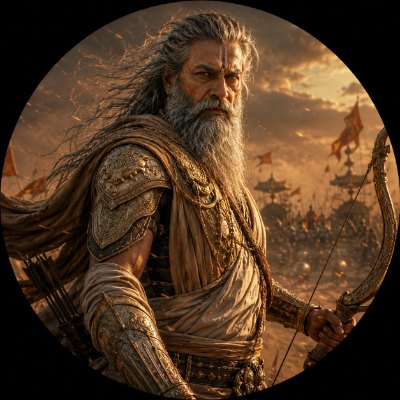
Drona is the supreme teacher of arms of the Mahabharata's central generation — the acharya who trained both the Kaurava and Pandava princes in the complete science of warfare and whose relationship with each of his students shaped the war's outcome in ways that could not have been predicted from any single act of instruction. He is the son of Bharadvaja — the great Rigvedic sage of the Angirasa tradition and the founder of one of the most widely distributed brahminical gotras — and was born through an extraordinary mechanism: Bharadvaja's involuntary seed discharge at the sight of the Apsara Ghritachi was preserved in a drona vessel, and from this preserved seed Drona was born — his name directly encoding the vessel of his origin. He is a brahmin by lineage and a warrior by vocation — a combination that the tradition regards as one of the most powerful and most morally complex possible, since the brahminical sacred tradition and the kshatriya martial tradition were understood as operating under different and sometimes conflicting dharmic obligations. His friendship with Drupada — later curdled into the most consequential enmity of the Mahabharata's generation — was the personal thread around which the entire teacher-student relationship and the Panchala-Kuru conflict revolved. His marriage to Kripi — Kripacharya's twin sister — connected the Bharadvaja lineage to the Gautama-Angirasa tradition. His son Ashvatthama was one of the war generation's most powerful warriors and one of the seven Chiranjivis. He commanded the Kaurava forces for five days — days eleven through fifteen — with devastating effect, his military genius producing formations of extraordinary complexity. His death on the fifteenth day — through a stratagem in which Yudhishthira announced the false news of Ashvatthama's death, causing Drona to lower his weapons in grief and despair, allowing Dhrishtadyumna to kill him — is one of the Mahabharata's most debated acts of deliberate dharmic violation by the nominally virtuous side. Drona appears throughout the Mahabharata from the Adi Parva through the Drona Parva and the Sauptika Parva, and in genealogical contexts across the principal Puranas.
✦ The Names
The name Drona derives directly from the Sanskrit drona — a specific type of wooden vessel or trough used for various domestic and ritual purposes. The name encodes the circumstances of his birth with complete directness: he was the being born from a drona vessel in which his father's seed had been preserved. As a personal name it is unusual — most Sanskrit personal names encode aspirational qualities, divine associations, or physical characteristics rather than the vessel in which the person gestated — and this directness is characteristic of the Mahabharata's genealogical naming tradition in which extraordinary birth circumstances become permanent name-markers. The fuller designation Dronacharya — "Drona the acharya," the teacher — is the most common form used in the tradition once his teaching role was established, and the suffix acharya (one who teaches through personal example and conduct, from achar, proper conduct) indicates the specific quality of teaching as conduct-modelling rather than mere instruction. The patronymic Bharadvaja identifies him as Bharadvaja's son. Kripipatih means "husband of Kripi."
✦ Lineage
- Father: Bharadvaja — the great sage of the Angirasa tradition, son of Brihaspati, Rigvedic hymn-composer, founder of the Bharadvaja gotra, and the sage at whose ashrama near Prayaga Rama and Sita stopped during their forest exile. His profile is given separately in this series.
- Paternal grandfather: Brihaspati — the divine preceptor of the gods, son of Angiras, lord of sacred speech, and the deity identified with Jupiter. His profile is given separately in this series.
- Wife: Kripi — the twin sister of Kripacharya, daughter of Sharadvana and granddaughter of Gautama Maharishi, found as an infant in the sharavana reed-grove and raised in the Kuru household. Her profile is given separately in this series. The marriage of Drona and Kripi is narrated in the Adi Parva — it was a marriage of poverty in its early years, the two living in conditions of genuine material hardship before Drona's recognition as a teacher changed their circumstances.
- Son: Ashvatthama — born of Drona and Kripi, named for the horse's cry that was heard at his birth, born with a divine jewel in his forehead, one of the foremost warriors of the war generation, and one of the seven Chiranjivis. His profile is given separately in this series.
- Childhood companion and later enemy: Drupada — the crown prince of Panchala who studied under Agnivesha alongside Drona, befriended him during their shared studentship, and subsequently became the cause and object of Drona's most personal and consequential enmity after he refused to acknowledge Drona as an equal upon becoming king.
✦ Birth and Early Life
The Mahabharata's Adi Parva narrates that Bharadvaja was on one occasion performing austerities near a river when he saw the Apsara Ghritachi emerge from her bath. Her beauty at that moment was of such extraordinary power — perhaps enhanced by the deliberate intention of Indra who was wary of Bharadvaja's accumulating ascetic power, as the tradition implies — that Bharadvaja's meditation was broken and his seed was involuntarily discharged. Rather than allowing the seed to fall wasted on the ground, Bharadvaja collected it in a wooden vessel — the drona — and from this preserved seed the child grew. Drona was born from the vessel already endowed with divine grace and with the complete Vedic knowledge that his father's line carried — he emerged from the drona-vessel into the world as the heir of the most ancient brahminical learning tradition of the Vedic world.
In his youth Drona studied under the sage Agnivesha — a master of the astras, the divine weapons invoked through mantras — alongside several other students, including Drupada the crown prince of Panchala. Drona and Drupada formed a close friendship during their student years, and Drupada — with the generosity natural to a royal prince in the context of this friendship — told Drona that when he became king he would share half his kingdom with Drona. This promise, made in the informal context of student friendship, became the source of the most consequential enmity of Drona's adult life.
Drona also — in a circumstance narrated in different ways across the tradition — received the knowledge of the Brahmastra from Parashurama, the avatar of Vishnu who had in a previous age destroyed the kshatriya race twenty-one times. Parashurama at this period was distributing his wealth and giving away everything he possessed, and Drona approached him and asked for the knowledge of all weapons. Parashurama gave him the Brahmastra — the most powerful of all divine weapons — and instruction in all the divine weapons along with their specific mantras for invocation and withdrawal. This gift made Drona the most completely armed brahmin warrior in the tradition — a figure who combined supreme brahminical learning with the most powerful martial knowledge available in the cosmos.
✦ The Humiliation by Drupada and Its Consequences
After completing his studies Drona married Kripi and the two lived in poverty — their son Ashvatthama's inability to obtain milk in childhood being the most humanly acute expression of this poverty, as narrated in the Kripi profile in this series. Hearing that his old friend Drupada had become king of Panchala, Drona went to him and invoked the memory of their friendship and Drupada's promise to share half his kingdom. The reception he received was devastating. Drupada — surrounded by his court and in the full authority of his kingship — told Drona with icy precision that a king and a poor brahmin could not be friends in any meaningful sense; that the friendship of student days was a matter of youth and circumstance, not of permanent social equality; that he could offer Drona a brahmin's gift of food or charity but could not acknowledge him as an equal or fulfil any kingdom-sharing promise made in student camaraderie. He dismissed Drona.
The humiliation was complete and Drona accepted it in silence before Drupada's court. He left and resolved that the appropriate response was not immediate confrontation but patient preparation — he would acquire a means of revenge that Drupada's military power could not resist. The means he eventually acquired was the very students he taught. When he arrived at Hastinapura and was accepted as the preceptor of the Kuru princes, he trained them with this specific future purpose partly in view — and when the princes had completed their education, his guru-dakshina was exactly what the tradition narrates with great irony: he asked his students to conquer Drupada and bring him before Drona as a captive. Arjuna accomplished this. Drona faced his old friend — now captive, humiliated — and delivered a precise and symmetrical response: he took half of Drupada's kingdom, leaving the other half to him, so that Drupada could no longer claim they were unequal in terms of territorial possession. He then released Drupada. The act was legally and poetically exact. It was also, as the Mahabharata's subsequent narrative demonstrates, insufficient to end the enmity — Drupada's humiliation was so deep that he performed a sacrifice specifically to obtain a son and daughter who would avenge him, and from that sacrifice Dhrishtadyumna and Draupadi were born. Dhrishtadyumna was the one who would eventually kill Drona.
✦ Arrival at Hastinapura and the Teaching of the Princes
Drona's arrival at Hastinapura and his acceptance as the preceptor of the Kuru princes is narrated in the Adi Parva through a revealing incident. The young princes were playing with a ball that fell into a dry well and they could not retrieve it. Drona, passing by and watching them attempt ineffectually to recover it, offered to show them how the ball could be retrieved using a series of grass blades thrown with precision — each blade stuck into the one before, forming a chain that reached the ball and allowed it to be drawn up. The princes were amazed. When they reported to Bhishma what they had seen, Bhishma immediately recognised that this was a brahmin of exceptional skill and martial knowledge — a being of exactly the quality the Kuru household needed as a preceptor — and arranged for Drona to become the teacher of all the princes.
Drona taught the princes with great thoroughness and systematic intent. He trained them in archery, in the use of all categories of weapons, in chariot-fighting, in mace-fighting, in the application of divine weapons. The teaching was not uniform — he gave different students different levels and types of instruction according to their individual abilities and his own intentions. Arjuna became his greatest student — Drona's special relationship with Arjuna is one of the Mahabharata's most sustained portraits of the teacher-student bond, in which the teacher recognised in one student a capability that exceeded all others and directed his deepest teaching toward that student's formation. Drona's stated ambition — that Arjuna would become the greatest archer in the world, surpassing all — shaped everything about the advanced instruction Arjuna received.
✦ The Ekalavya Episode
The most morally debated act of Drona's teaching career is the episode of Ekalavya — a Nishada prince who came to Drona and asked to be accepted as a student. Drona refused — the tradition gives different reasons across different commentarial and textual traditions, with the most common being that Drona only taught the kshatriya princes of the Kuru household and could not accept a Nishada student — and Ekalavya departed. He then went into the forest, made a clay image of Drona and practised archery before it as his guru, and through this self-directed training under the conceptual guidance of Drona's image became an archer of extraordinary — and by some measures surpassing — skill. When Drona eventually saw Ekalavya's shooting he recognised immediately that this archer was of a quality that would destroy his guarantee to make Arjuna the greatest archer in the world. He asked Ekalavya for the traditional guru-dakshina — the gift made to a teacher at the conclusion of instruction — and Ekalavya, regarding Drona as his guru through the image, said he would give anything Drona asked. Drona asked for the thumb of his right hand. Ekalavya cut it off and gave it without hesitation. This act — using the socially obligatory convention of guru-dakshina to cripple a student who had never formally been his student and who had done nothing wrong — is the Mahabharata's most concentrated portrait of Drona's willingness to compromise dharmic standards when Arjuna's supremacy was threatened. The tradition does not soften it. Ekalavya's act of giving his thumb is one of the tradition's most celebrated acts of devotion; Drona's request for it is one of its most morally uncomfortable acts of self-interested manipulation.
✦ Drona's Command of the Kaurava Forces
After Bhishma fell on the tenth day, Drona was appointed supreme commander of the Kaurava forces — a position he held from the eleventh through the fifteenth day. His five days of command were characterised by extraordinary military invention — he arrayed the Kaurava forces in formations of unprecedented complexity designed to achieve specific tactical objectives. The most consequential of these was the Chakravyuha on the thirteenth day — the wheel formation specifically designed to capture Yudhishthira, arranged on a day when Arjuna had been drawn to the distant part of the battlefield. The Chakravyuha's deployment produced the death of Abhimanyu — the most grievous single loss the Pandavas suffered — and established Drona's military genius at its most devastating.
Throughout his command Drona fought with extraordinary individual martial capability in addition to his strategic direction of the army. He killed vast numbers of warriors and was engaged by many of the Pandava side's principal figures — Dhrishtadyumna repeatedly sought him out because Dhrishtadyumna had been born specifically to kill Drona, and the Drona Parva narrates their many encounters. Drona always held Dhrishtadyumna off, recognising the specific threat he represented and never allowing him an opening for the killing.
✦ The Death of Drona
The fifteenth day of battle and the killing of Drona is one of the Mahabharata's most sustained and explicit examinations of the relationship between victory and dharma — whether a just cause justifies unjust means, and at what cost to the victorious side's own dharmic integrity. Krishna devised the stratagem. An elephant named Ashvatthama was killed and the news spread that "Ashvatthama has fallen." When this reached Drona on the battlefield he did not believe it — he knew his son's power and regarded his survival as certain — but the uncertainty created by the rumour was enough to make him waver. He called out to Yudhishthira — the one man in the Pandava army whose commitment to truth was so absolute that he had never spoken a lie — and asked him directly whether it was true that Ashvatthama was dead. Krishna had urged Yudhishthira to confirm the falsehood; the alternative was to allow Drona to continue fighting, which would cost thousands of lives daily and might tip the battle irreversibly toward the Kaurava side. Yudhishthira, in the most agonised act of his life, said "Ashvatthama is dead" — and then added, in a lowered voice that Drona could not hear, "the elephant." The moment this statement was made and heard the tradition notes that Yudhishthira's chariot, which had until that point always remained slightly above the ground in acknowledgement of his perfect dharmic conduct, descended and touched the earth — the physical sign of his dharmic fall.
Drona, hearing from Yudhishthira's own mouth what he had feared, was overwhelmed. He lowered his bow. He entered a state of grief-induced withdrawal — a yogic dissolution of his fighting will. Dhrishtadyumna, seeing the opportunity that had never opened before, rushed at Drona and cut off his head. Drona died on the battlefield in a state of yogic absorption, having lowered his weapons in response to a deception that the tradition records was deliberately engineered by Krishna and enacted by Yudhishthira. The Drona Parva records tremendous debate within the Pandava army — many of the warriors objected to the stratagem even after its success, feeling that Drona had been killed in a manner unworthy of the man — and the tradition does not present the killing as simply just.
✦ Textual Variants and Inconsistencies
The specific mechanism of Drona's death: Different manuscript traditions of the Drona Parva vary in the specific detail of how Dhrishtadyumna killed Drona — whether he cut off his head with a sword while Drona was in the yogic state, or whether he accomplished it in a more contested manner. The critical edition's account of the sword beheading of the yogically withdrawn Drona is the standard canonical version. The specific words of Yudhishthira's announcement — particularly the degree to which the qualifying "the elephant" clause was audible — are also subject to variation across manuscript traditions.
The Ekalavya episode's moral framing: Different commentarial traditions of the Mahabharata have framed the Ekalavya episode in radically different ways — from seeing Drona's request as a legitimately exercised guru's right to seeing it as a calculated injustice. The primary text presents both the act and its consequences without resolving the moral question for the reader, which is characteristic of the Mahabharata's method of embedding its most difficult ethical questions in biography rather than in explicit philosophical argument.
✦ Theological and Philosophical Significance
Drona's theological significance is concentrated in three related dimensions. The first is the teacher-student relationship — Drona is the Mahabharata's supreme embodiment of the acharya whose students became the agents of a cosmic catastrophe, and whose own teaching excellence was inseparable from the moral complications of that excellence. The second is the brahmin-warrior tension — Drona occupied the most charged intersection of brahminical dharma and kshatriya dharma in the tradition's social world, and every major episode of his biography — the humiliation by Drupada, the Ekalavya episode, the teaching of divine weapons to students who would use them against each other, his command of the Kaurava forces — is an episode in which the tensions between these two dharmic frameworks became acute and unresolvable. The third is his death — one of the Mahabharata's most explicit meditations on the relationship between just ends and unjust means, on whether the necessity of a result can justify the violation of the process by which it is achieved.
✦ Connection to the Wider Genealogy
Through his father Bharadvaja and grandfather Brihaspati, Drona descends from the Angirasa lineage through Brihaspati and through Angiras from the primordial creative line of Brahma. Through his wife Kripi and her father Sharadvana and grandfather Gautama, he is connected by marriage to the Gautama-Angirasa sage tradition. Through his son Ashvatthama — one of the seven Chiranjivis — Drona's lineage continues as an immortal presence. Through his student Arjuna — the greatest archer in the world by Drona's own making — he is the teacher of the figure whose prowess was the decisive military factor in the Pandava victory. Through the Bharadvaja gotra — one of the most widely distributed brahminical lineages — his ancestral tradition extends across the entire brahminical social world.
✦ References
Primary Sources
- Mahabharata, Adi Parva, sections 121–136: Drona's birth from the drona vessel, his studentship under Agnivesha alongside Drupada, his marriage to Kripi, his poverty, the rice-flour milk episode, his arrival at Hastinapura through the well-and-grass-blades incident, his establishment as teacher of the Kuru princes, the training of the princes including the special instruction of Arjuna, the Ekalavya episode, and the guru-dakshina of half of Drupada's kingdom.
- Mahabharata, Drona Parva (Book 7) in its entirety: Drona's five days as supreme commander of the Kaurava forces — the formation strategies, the Chakravyuha, Abhimanyu's death, the continued fighting, and the fifteenth day's killing of Drona through Yudhishthira's announcement and Dhrishtadyumna's beheading.
- Mahabharata, Sauptika Parva (Book 10): The aftermath of Drona's death — Ashvatthama's rage, the night attack, and the events that flowed from Drona's killing.
- Vishnu Purana, Book 4, chapter 19: Genealogical confirmation of Drona as Bharadvaja's son.
Modern Reference Works
- Vettam Mani, Puranic Encyclopaedia (1975): Entry on Drona; comprehensive collation of all primary references.
- J. A. B. van Buitenen (translator), The Mahabharata, Volumes 1–3 (1973–1978): Critical translations with scholarly notes on the principal Drona episodes.
- Bimal Krishna Matilal (editor), Moral Dilemmas in the Mahabharata (1989): Contains scholarly analysis of the Ekalavya episode and the killing of Drona as two of the Mahabharata's most sustained presentations of moral dilemmas in a biographical context.
- Alf Hiltebeitel, The Ritual of Battle: Krishna in the Mahabharata (1990): Contains analysis of Drona's military strategy, his role in the Chakravyuha, and the theological dimensions of his death.