
About
Ashvatthama — Son of Drona, Bearer of the Forehead Jewel, Perpetrator of the Night Attack, and the Wounded Chiranjivi
Ashvatthama · Dronaputra · Dronasuta · Manimat · Brahmastra-prayokta · Sauptika-karta · Uttarajanma-ghatin · Chiranjivi · Krishnashaptika · Kapardin · Mahadeva-amsha
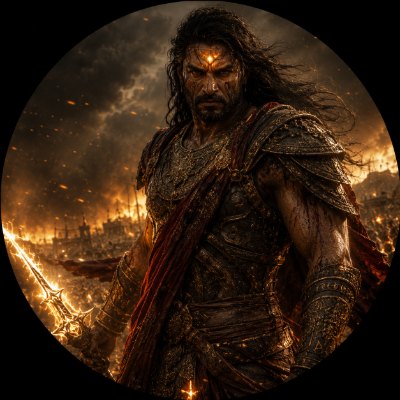
Ashvatthama is the son of Drona — the supreme teacher of arms — and of Kripi — the twin sister of Kripacharya — and one of the most powerful, most morally complex, and most theologically charged figures in the entire Mahabharata. He is born with a divine jewel embedded in his forehead — a natural mani given to him at birth by Brahma as a gift of protection from disease, hunger, and fear — and his name is derived from the cry of a horse (ashva) that was heard at the moment of his birth. He is identified in certain passages as a partial incarnation of Mahadeva — Shiva — the cosmic power of destruction taking human form. He fought on the Kaurava side throughout the Kurukshetra war and was one of only three survivors on that side — alongside Kripacharya and Kritavarman — when the war ended. After his father Drona's killing through Yudhishthira's deceptive announcement, Ashvatthama in a state of consuming rage led the night attack on the Pandava camp in which he killed Draupadi's five sons, Dhrishtadyumna, Shikhandi, and many other warriors while they slept — one of the Mahabharata's most catastrophic acts of dharmic violation. Subsequently, when Arjuna and the Pandavas pursued him and he faced Arjuna's Brahmastra with his own, he launched his Brahmastra specifically against the womb of Uttara — the wife of the dead Abhimanyu — intending to extinguish the last of the Pandava line before it could be born. This act — the targeting of an unborn child — was the final act of the Brahmastra conflict. Vishnu intervened and preserved the foetus — who became Parikshit — but the Brahmastra could not be recalled by Ashvatthama, who lacked the knowledge to withdraw it. Krishna then pronounced the curse that defines Ashvatthama's immortality: he would live for three thousand years wandering the earth, his forehead jewel torn away, his wound never healing, rejected by all human habitation, bearing the full weight of his act as a living punishment without the relief of death. As a Chiranjivi he is understood to continue existing in this cursed state in the present age. Ashvatthama appears throughout the Mahabharata from the Adi Parva through the Sauptika Parva, and is referenced across the principal Puranas and in regional traditions.
✦ The Names
The name Ashvatthama is a compound of ashva — horse — and sthama or sthaman — cry, voice, sound, or strength — yielding the sense of "he whose birth was announced by a horse's cry" or "he of the horse's power." The Mahabharata narrates that at the moment of Ashvatthama's birth a celestial horse cried out — a divine sound that announced the arrival of an extraordinary being. The name Manimat means "the jewel-bearing one" or "he who possesses the divine gem" — the mani in his forehead given at birth by Brahma. The epithet Brahmastra-prayokta means "the one who launched the Brahmastra." Sauptika-karta means "the perpetrator of the sleeping-warrior attack." Uttarajanma-ghatin means "the attacker of Uttara's unborn child." The designation Mahadeva-amsha means "the partial incarnation of Mahadeva" — identifying the cosmic dimension of his divine identity.
✦ Lineage
- Father: Drona — the supreme teacher of arms, son of Bharadvaja, commander of the Kaurava forces for five days. His profile is given separately in this series.
- Mother: Kripi — the twin sister of Kripacharya, daughter of Sharadvana, granddaughter of Gautama Maharishi. Her profile is given separately in this series.
- Maternal uncle: Kripacharya — the first teacher of the Kuru princes, the Chiranjivi. His profile is given separately in this series.
- Paternal grandfather: Bharadvaja — the great Rigvedic sage. His profile is given separately in this series.
- Paternal great-grandfather: Brihaspati — the divine preceptor of the gods. His profile is given separately in this series.
- Divine identity: The Mahabharata identifies Ashvatthama as a partial incarnation — an amsha — of Mahadeva Shiva, specifically of the Rudra aspect of Shiva that governs destruction and dissolution. This identification gives his acts — including the night attack and the Brahmastra against the unborn child — a cosmic dimension that the tradition acknowledges while not using it to exonerate him: the partial Shiva-nature explains the quality of destruction in his acts without providing dharmic justification for those specific acts.
- The primary texts do not record Ashvatthama's wife or children. His immortal existence after Krishna's curse is described as solitary — wandering the wilderness, rejected by all human habitation, the wound on his forehead never healing.
✦ Birth and the Forehead Jewel
The Mahabharata's Adi Parva narrates that at Ashvatthama's birth a celestial horse cried out and that the child was born with a natural jewel — mani — embedded in his forehead. This jewel was Brahma's gift, and it conferred upon Ashvatthama protection from several categories of mortal threat — protection from hunger, from disease, and from the fear that these causes of suffering normally produce in living beings. It made him materially secure in a way that ordinary mortals were not, and it marked him from birth as a being of exceptional divine favour and extraordinary destiny. The mani in his forehead became the object of the final conflict of the Sauptika Parva — when Krishna demanded it as the price of Ashvatthama's continued existence after the Brahmastra episode, the removal of the jewel was the most extreme act of humiliation possible for a figure whose divine protection had been encoded in that gem from birth.
✦ Youth, Training, and the Teacher's Son
Growing up as Drona's son in the Kuru household's atmosphere of martial training gave Ashvatthama access to instruction of the highest possible quality — his father was the supreme teacher of his generation, possessed of the Brahmastra and of the complete knowledge of divine weapons, and Ashvatthama was trained personally by Drona with the fullness of this knowledge. He mastered the complete science of weapons alongside the Kaurava and Pandava princes and received specific instruction in the divine weapons including the Brahmastra that would later define his most catastrophic act.
The Mahabharata presents Ashvatthama as a warrior of extraordinary capability who was recognised by both sides as one of the foremost fighters of his generation — someone against whom even the greatest Pandava warriors were cautious. His relationship with Duryodhana was that of a close companion and ally — the son of the Kaurava household's preceptor who had grown up alongside the princes and whose martial capability gave Duryodhana a personal friend of the highest martial quality. This relationship, combined with his father's institutional role on the Kaurava side, determined his alignment in the war without requiring any political choice on his part.
✦ The War — Ashvatthama's Combat Record
Ashvatthama fought through all eighteen days of the Kurukshetra war as one of the Kaurava army's foremost individual warriors. He engaged with Arjuna, Bhima, Satyaki, Dhrishtadyumna, and many other principal Pandava commanders across the war's duration. His individual combat capabilities were consistently rated in the tradition alongside those of the war's greatest warriors — the Adi Parva's martial catalogue places him among the foremost atirathi fighters, those capable of engaging multiple opponents simultaneously. He was wounded on several occasions and continued fighting, and the Mahabharata's battle books give him a sustained presence as a dangerous and formidable Kaurava warrior throughout.
The false announcement of his death on the fifteenth day — made by Yudhishthira in the stratagem to break Drona's fighting will — was one of the most consequential individual acts of the war. The announcement was not merely a tactical deception; it was a deliberate use of Drona's love for his son as a weapon against him — targeting the specific vulnerability that a father's love creates in a warrior who is otherwise invulnerable. When the true outcome emerged — that Ashvatthama had not died, that the announcement referred to an elephant — it confirmed for Ashvatthama that his father had been killed through a lie that exploited the deepest human bond.
✦ The Night Attack — the Sauptika Parva
The Sauptika Parva — the Book of the Sleeping Warriors, named after the sleepers who were killed — is the primary source for Ashvatthama's most terrible acts and one of the Mahabharata's most disturbing books. After the final day's battle in which Duryodhana was fatally wounded, Ashvatthama — in a state of consuming and absolute rage at his father's killing and at the perceived comprehensive violation of dharma by the Pandava side — resolved to attack the Pandava camp in the night. He came to the sleeping Pandava camp with Kripacharya and Kritavarman. The full narrative of Kripacharya's dharmic objection to the plan and his remaining at the entrance is given in the Kripacharya profile in this series.
Ashvatthama entered the camp alone. At the entrance he encountered a monstrous figure blocking his path — the Sauptika Parva gives a remarkable visionary passage in which Ashvatthama sees a cosmic form of terrible aspect, all-consuming, that his weapons cannot harm. He tried every weapon he possessed and none took effect against this presence. Eventually Ashvatthama offered himself in sacrifice to the presence — committing himself entirely to its will — and the figure withdrew or dissolved, allowing him to enter. The tradition identifies this figure as Shiva himself in his terrible aspect, testing Ashvatthama's resolve and ultimately empowering the destruction that was to follow.
Inside the camp Ashvatthama killed Dhrishtadyumna first — the man who had killed his father — with great violence and without mercy. He then went through the camp killing the sleeping warriors — Shikhandi, the sons of Draupadi by the five Pandavas, and many others. The five Pandavas themselves survived because they were not in the main camp that night — they had gone to Dhritarashtra's camp. Draupadi's five sons — Prativindhya, Srutasoma, Srutakirti, Satanika, and Srutakarman — were killed while sleeping.
When Draupadi learned what had happened she collapsed in grief. The killing of her five sons — the only children she had — was the most devastating personal blow the war had dealt to the Pandava household. She demanded that Ashvatthama be brought before her and that the jewel from his forehead be taken as a form of vengeful justice. Bhima and Arjuna went in pursuit of Ashvatthama. The confrontation that followed — the Brahmastra conflict — is one of the Mahabharata's most cosmically charged episodes.
✦ The Brahmastra Confrontation and the Attack on the Unborn Parikshit
When Arjuna caught up with Ashvatthama on the banks of the Ganga, Ashvatthama — facing Arjuna's Brahmastra with his own — invoked his Brahmastra in the knowledge that he did not possess the knowledge to withdraw it once launched. He aimed it not at Arjuna but at the womb of Uttara — the wife of Abhimanyu — where the last surviving descendant of the Pandava line lay as an unborn child. This decision — to destroy the Pandava line at its root rather than to fight Arjuna directly — was the final expression of the absolute and comprehensive destructive intent that had driven all his acts since Drona's death.
The two Brahmastras converging threatened cosmic destruction — the sages present told both warriors to withdraw their weapons immediately. Arjuna was able to recall his. Ashvatthama could not — he lacked the knowledge of withdrawal that Drona had possessed and that Arjuna had received from Drona. Unable to withdraw the weapon, he redirected it specifically toward Uttara's womb. Vishnu intervened directly — protecting the foetus within the womb from the Brahmastra — and the child survived to be born as Parikshit, the last Pandava-line king.
Krishna then pronounced judgment on Ashvatthama. He decreed that Ashvatthama would live for three thousand years — not in honour but in a specifically degraded immortality. He would wander the earth without any human being willing to dwell with him, rejected from all human habitation, bearing wounds that would not heal. The mani — the protective jewel in his forehead that Brahma had given him at birth — was torn away from his forehead, leaving a wound that would bleed and suppurate permanently without healing. He would carry the weight of his acts — the night attack, the killing of sleeping warriors, the attack on the unborn child — as a living punishment, unable to die and unable to escape the consciousness of what he had done. The Bhagavata Purana confirms this curse and presents it as a specific form of divine justice — the immortality that should have been a gift became through Ashvatthama's acts an unending punishment.
✦ The Post-War Traditions — Ashvatthama in the Present Age
As one of the seven Chiranjivis, Ashvatthama is understood in the tradition to continue existing in the present age. Unlike Hanuman whose immortality is joyful and whose presence at Ramayana recitations is regarded as a blessing, or Kripacharya whose immortality is honourable, Ashvatthama's immortality is the specific form of cursed survival that Krishna pronounced upon him. The tradition's accounts of encounters with Ashvatthama in the present age — found in various regional and devotional literature — describe him as a wanderer in remote forest regions, his forehead wound visible and never healed, his physical appearance reflecting centuries of cursed existence. Some accounts place him in specific geographical locations — the forests of central India, the Himalayas, remote hermitages — where he is glimpsed and recognised by sages or by ordinary people who flee in terror when they understand who they have seen. He is one of the tradition's most haunting figures precisely because his immortality is not a transcendence of his acts but a permanent embodiment of their consequences.
✦ Textual Variants and Inconsistencies
The cosmic figure at the camp entrance: The Sauptika Parva's visionary episode in which Ashvatthama encounters an all-consuming cosmic form before entering the Pandava camp is one of the most discussed passages in the book. Different manuscript traditions vary in the degree of elaboration given to this vision and in the precise identification of the figure. The critical edition presents it as a Shiva-form empowering Ashvatthama for the destruction to follow; some other traditions present it differently. The passage raises the question of the tradition's moral accounting of the night attack — if Shiva himself empowered Ashvatthama's entry, the act cannot be simply the product of individual criminal intent, and the tradition's moral complexity is embedded in this ambiguity.
The length of the cursed existence: Different passages and Puranic accounts give different durations for Ashvatthama's cursed wandering — three thousand years in the most common version, other periods in variant accounts. The essential fact of the cursed immortality with the unhealing wound is consistent across all major traditions.
Whether Ashvatthama's Brahmastra targeted Uttara's womb from the beginning: Some manuscript traditions present Ashvatthama's initial Brahmastra as aimed at Arjuna directly and only redirected to Uttara's womb when he was unable to withdraw it. Others present the redirection as the initial intent. The critical edition's account is the primary scholarly reference; the distinction matters for the tradition's moral accounting of whether the attack on Parikshit was planned from the outset or was a desperate improvisation.
✦ Theological and Philosophical Significance
Ashvatthama's theological significance is among the most complex of any figure in the Mahabharata. He is the tradition's supreme embodiment of what happens when genuine grief — the grief of a son for a beloved father killed unjustly — is allowed to consume dharmic discrimination entirely. Every act Ashvatthama committed from Drona's death onward was motivated by the purest possible personal grief and the most complete possible outrage at the violations of dharma that preceded it. The killing of Drona through a lie, the mutilation of his body, the entire pattern of dharmic violation by the Pandava side that Ashvatthama had observed across the war — these were real and the grief and outrage they produced in him were proportionate. But the acts his grief produced — the night attack on sleeping warriors, the killing of Draupadi's sons, the Brahmastra against an unborn child — were each a further step beyond dharmic acceptability, each one compounding the original wrong rather than responding to it with justice.
The tradition's treatment of Ashvatthama does not require the reader to be unmoved by his grief or to dismiss his outrage as unjustified. It simply follows the consequences of allowing grief to override dharmic discrimination with absolute consistency — each act has its consequence, each step beyond dharma produces a further consequence, and the end of the chain is the cursed immortality in which the acts' consequences are permanently embodied. Ashvatthama's Chiranjivi status makes this theological statement permanent and visible in the present age — he is not a figure of the past whose consequences are historical but a figure of the present whose wound continues to bleed, making the tradition's moral of his story not a lesson from history but a present fact.
✦ Connection to the Wider Genealogy
Through his father Drona and grandfather Bharadvaja, Ashvatthama descends from the Angirasa lineage through Brihaspati and Angiras to the primordial creative line of Brahma. Through his mother Kripi and her father Sharadvana and grandfather Gautama, he is connected to the Gautama-Angirasa sage tradition. Through his maternal uncle Kripacharya — the other Chiranjivi of the tradition's post-war world — he shares the condition of immortal survival with a figure whose moral standing is entirely different from his own. His attack on Parikshit in the womb — and Vishnu's intervention to preserve Parikshit — connects him directly to the event that frames the entire Bhagavata Purana's recitation: Parikshit's survival and his subsequent encounter with the snake's curse, his seven-day fast before death, and the Bhagavata Purana's recitation to him by Shuka — all of these derive from the fact that Ashvatthama's Brahmastra failed to kill the foetus Parikshit. Ashvatthama is thus, in the most indirect and perverse way possible, the occasion without which the Bhagavata Purana's own narrative frame would not exist.
✦ References
Primary Sources
- Mahabharata, Adi Parva, sections 130–134: Ashvatthama's birth with the divine jewel and the horse's cry, his training by Drona, his establishment as one of the foremost warriors of his generation.
- Mahabharata, Drona Parva (Book 7): Ashvatthama's combat across the war's middle days, his response to his father's strategic situation, and the false announcement of his own death that was used to break Drona's fighting will.
- Mahabharata, Sauptika Parva (Book 10) in its entirety: The night attack — the cosmic figure at the camp entrance, the entry into the sleeping camp, the killing of Dhrishtadyumna, Shikhandi, and Draupadi's sons, the return, and the Brahmastra confrontation with Arjuna culminating in the attack on Parikshit in the womb and Krishna's curse. The primary source for the entirety of Ashvatthama's most significant and most debated acts.
- Mahabharata, Stri Parva (Book 11): The aftermath of the night attack — Draupadi's grief, the demand for justice, and the events that led to the Brahmastra confrontation.
- Bhagavata Purana, Book 1, chapters 7–8: The Bhagavata Purana's account of the Brahmastra episode, Vishnu's protection of Parikshit in the womb, and Krishna's curse on Ashvatthama; confirms the cursed immortality and the removal of the forehead jewel.
- Vishnu Purana, Book 4, chapter 19: Genealogical confirmation of Ashvatthama as Drona's son.
Modern Reference Works
- Vettam Mani, Puranic Encyclopaedia (1975): Entry on Ashvatthama; comprehensive collation of all primary references across the Mahabharata and Puranas.
- J. A. B. van Buitenen (translator), The Mahabharata, Volume 3 (1978): Critical translation of the Sauptika Parva with scholarly notes — the most authoritative English-language treatment of the primary source for the night attack and the Brahmastra episode.
- Bimal Krishna Matilal (editor), Moral Dilemmas in the Mahabharata (1989): Contains scholarly analysis of the night attack and the Brahmastra episode as two of the Mahabharata's most extreme presentations of acts committed under grief and their dharmic consequences.
- Alf Hiltebeitel, The Ritual of Battle: Krishna in the Mahabharata (1990): Contains analysis of Ashvatthama's cosmic identity as a Shiva-amsha and the theological significance of the Sauptika Parva's visionary encounter at the camp entrance.
- Irawati Karve, Yuganta: The End of an Epoch (1969): Contains the most sustained character analysis of Ashvatthama in modern secondary literature — examining the logic of his rage, the legitimacy of his grievances, and the catastrophic consequences of his choices with both intellectual rigour and emotional intelligence.