
About
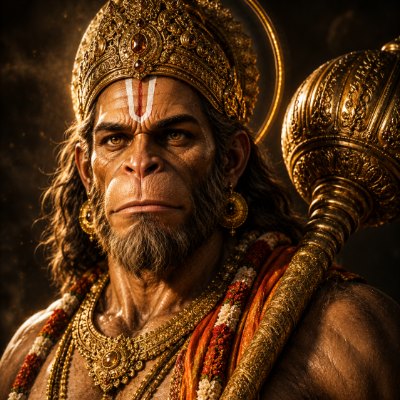
Hanuman — Son of Anjana and Kesari, Vayuputra, Devotee of Rama, and the Immortal Presence of the Ramayana
Hanuman · Anjaneya · Kesarinandan · Vayuputra · Maruti · Bajrangabali · Mahavira · Sankatamochana · Pavanaputra · Rudra-avatara · Ramaduta · Chiranjivi · Sundara · Kapishvara · Dashagrievadarpa-nashana
Hanuman is the great vanara devotee of Rama — the supreme embodiment of bhakti in the Hindu tradition, the exemplar of devoted service without ego, the figure of inexhaustible strength placed entirely at the disposal of the divine — and one of the most universally present and actively worshipped beings in the entire pantheon. He is the son of Anjana the Apsara reborn in vanara form and of Kesari the vanara king of Sumeru who was himself the son of Brihaspati; through Vayu the wind god who was the divine agent of his conception he is called Vayuputra or Pavanaputra; and in the Shaiva tradition he is the avatar of Shiva himself, the cosmic ascetic's power of renunciation and service taking embodied form in the world of the Ramayana. He is the only book of the Valmiki Ramayana — the Sundara Kanda — that is named after him rather than after the place or event it describes, and this fact alone signals his singular position in the epic's architecture: of the seven kandas, one belongs entirely to Hanuman. He is a Chiranjivi — one of the immortal survivors — who is present wherever the Ramayana is recited and who is understood to continue living in the present age as an active divine presence. His names are among the most invoked in the tradition — Anjaneya, Maruti, Bajrangabali, Mahavira, Sankatamochana — and the Hanuman Chalisa composed by Tulsidas in the sixteenth century is among the most widely recited devotional texts in the Hindu world. He appears in the Valmiki Ramayana across the Kishkindha Kanda, the Sundara Kanda, and the Yuddha Kanda; in the Mahabharata's Vana Parva in the encounter with Bhima; in the Bhagavata Purana; in the Skanda Purana and Shiva Purana; in regional vernacular Ramayanas across virtually every language of the subcontinent; and in the independent Hanuman-centred texts including the Hanuman Chalisa, the Bajrang Baan, and the Hanuman Ashtottara.
✦ The Names
Hanuman's names constitute one of the most extensive and theologically charged name-repertoires of any figure in the tradition. The name Hanuman itself has been interpreted in several ways. The most commonly given derivation connects it to hanu — jaw — and man — disfigured, broken, or prominently marked — yielding the sense of "he of the broken jaw" or "he whose jaw was disfigured." The reference is to the childhood episode in which Indra struck the young Hanuman with his thunderbolt when the child attempted to seize the sun, mistaking it for a ripe fruit, and the blow struck Hanuman's jaw. A second derivation connects the name to the Jain tradition in which Hanuman is a toponym — the name of the place where his birth occurred. A third derivation, found in certain commentarial traditions, connects the name to han (killing or destroying) and mana (pride or ego) — yielding "the destroyer of pride" — which is theologically resonant with Hanuman's identity as the embodiment of ego-free service. The name Anjaneya — his most personal name — means "son of Anjana," formed directly from his mother's name. Kesarinandan means "son of Kesari." Vayuputra and Pavanaputra both mean "son of Vayu the wind god." Maruti means "son of Marut" — a variant name for Vayu. Bajrangabali means "the strong one of the vajra-like body" — from bajra or vajra (diamond, thunderbolt) and ang (body) and bali (powerful), referring to his invulnerable body that Indra's own thunderbolt could not harm. Mahavira means "the great hero." Sankatamochana means "the remover of difficulties and crises." Ramaduta means "the messenger of Rama." Sundara means "the beautiful one" — the name his mother Anjana used for him affectionately, from which the Sundara Kanda takes its name. Kapishvara means "lord of the vanaras." Chiranjivi designates him as an immortal survivor.
✦ Lineage and Birth
- Mother: Anjana — the Apsara Punjikastala reborn in vanara form as the result of a sage's curse, wife of Kesari, who with Kesari performed austerities directed toward Shiva for a son and was the womb through which the divine power of Vayu entered the world as Hanuman. Her profile is given separately in this series.
- Earthly father: Kesari — the son of Brihaspati, king of Sumeru, a vanara warrior of exceptional courage and dharmic standing who killed the demon Shambasadana at the Gokarna sacred shrine. His profile is given separately in this series.
- Divine father — Vayu: The wind god, one of the eight Vasus, the cosmic principle of breath, movement, and life-force, who was the divine agent of Hanuman's conception. Through Vayu, Hanuman is the half-brother of Bhima — the second Pandava — who was also born of Vayu through Kunti in the Mahabharata tradition. The Valmiki Ramayana's Kishkindha Kanda identifies Hanuman as born through Vayu's power entering Anjana's womb.
- Divine identity — Shiva: The Shiva Purana identifies Hanuman as an avatar of Shiva — specifically as the eleventh Rudra, Shiva's power of renunciation and service taking embodied form in the age of the Ramayana. This identification is the dominant Shaiva theological position and is also accepted in many traditions that simultaneously recognise his Vayu paternity — the two theological identifications being understood not as contradictory but as operating at different levels, with Shiva providing the cosmic inner identity and Vayu the divine medium of earthly manifestation.
- Paternal grandfather: Brihaspati — the divine preceptor of the gods, through Kesari's paternity. His profile is given separately in this series.
✦ Childhood and the Boons of the Gods
The childhood of Hanuman is narrated most fully in the Valmiki Ramayana's Kishkindha Kanda and in later Puranic elaborations. From his very earliest days Hanuman displayed extraordinary physical power and an equally extraordinary fearlessness that was not yet disciplined by the wisdom of devoted service — qualities that in combination created both the conditions for the famous childhood incident and the conditions for the subsequent gifts that made those qualities permanently safe for the world and for Hanuman himself.
The most celebrated episode of Hanuman's childhood is his attempt to seize the sun. One morning, hungry and seeing the golden orb of the sun rising above the horizon, the child Hanuman — who had not yet learned to distinguish between a fruit and a celestial body — leaped into the sky with the intention of eating the sun as one would eat a ripe fruit. His leap was of extraordinary power and he rose through the sky at tremendous speed toward the sun. Indra, the lord of the gods, alarmed at the sight of this extraordinary child attacking the cosmic source of light and life, intervened and struck Hanuman with his thunderbolt — the Vajra. The blow struck Hanuman on his jaw and he fell from the sky to the earth, dead or grievously injured according to different accounts.
Vayu — the wind god, Hanuman's divine father — witnessed his son struck down and in grief and rage withdrew all the air from the world. Without Vayu's breath the three worlds began to suffocate — no living being could breathe, the fires went out, and a terrible stillness fell over the cosmos. The gods and all living beings were brought to the point of extinction by the absence of air. Brahma intervened — he restored Hanuman to life and health and pacified Vayu sufficiently for Vayu to release the air back into the world. In gratitude and in compensation for the injury done to the child, the gods granted Hanuman a series of extraordinary boons that transformed his already exceptional body into a form of near-absolute invulnerability and power.
The boons granted to Hanuman by the assembled gods are enumerated in the primary sources as follows. Indra — who had struck him — granted that his body would be as hard and impervious as Indra's own Vajra, and that Indra's Vajra could never harm him again. Agni the fire god granted that fire would never harm him. Varuna the lord of the waters granted that water would never harm him. Vayu granted that Hanuman would be as swift as the wind itself. Brahma granted that no weapon used against him in battle could kill him and that he would be immune from Brahma's own weapon. Shiva granted his protection. Vishvakarma the divine craftsman granted that no weapon of his making could harm Hanuman. Surya the sun god — the very being Hanuman had attacked — was placated and granted him a portion of his own splendour and the capacity to change his form at will. Yama the lord of death granted that death would never come to Hanuman by disease or violence.
These accumulated boons established the physical and cosmic basis for everything Hanuman subsequently accomplished in the Ramayana — his ability to cross the ocean, to survive in Lanka, to carry the mountain of medicinal herbs, to endure the burning of his tail and use it to burn Lanka, and to perform every act of service to Rama that the mission required. The tradition presents the childhood incident as providential: Indra's strike, though it injured Hanuman, was the occasion through which all the divine boons were assembled in a single being.
✦ The Curse of Forgotten Power
The Valmiki Ramayana and the Puranic tradition record that despite his extraordinary boons, Hanuman passed through a significant portion of his childhood and youth unaware of the full extent of his powers. The tradition explains this through a curse — or in some accounts a voluntary suppression — that caused Hanuman to forget his divine capabilities until they were needed and reminded to him. The specific account of the curse varies across traditions: some attribute it to a sage whose meditation Hanuman disturbed in his powerful and exuberant childhood play; others present it as a voluntary humility given to him by the gods so that he would not exercise his powers wastefully before the moment of Rama's need. The consequence was the same: Hanuman lived with his power dormant, unaware of what he truly was, until the moment of the Kishkindha assembly when Jambavan — the ancient bear chief who had been present at the gods' boon-giving at Hanuman's birth and who remembered everything that had been given — reminded him of all his capabilities. This reminder — Jambavan's speech to Hanuman before the leap across the ocean — is one of the Ramayana's most dramatic moments of recognition: the being who had forgotten his own nature was reminded, and the full power assembled by all the gods in his infancy became available for Rama's service.
✦ Education Under Surya
The tradition records that Hanuman received his education from Surya the sun god himself — the very deity he had attacked as an infant and whose grace had subsequently been given to him as a boon. Hanuman approached Surya as a student and asked him to serve as his teacher in the Vedas, grammar, and all sacred learning. Surya initially refused, explaining that he was always in motion — crossing the sky from east to west — and could not stop to teach in the conventional manner. Hanuman resolved this difficulty by flying ahead of Surya — facing the sun from the front while matching the sun's movement through the sky — so that he was always in the sun's presence and Surya could teach him while continuing his daily journey. In this manner Hanuman mastered the sixty-four arts and sciences in the time it takes the sun to complete a prescribed number of circuits. When asked to name his guru-dakshina — the payment of honour due to a teacher at the end of instruction — Surya asked only that Hanuman serve as the guardian and support of his son Sugriva, the vanara prince. This request was the specific thread that would eventually draw Hanuman into the orbit of Rama's mission — it was Surya who arranged, through this guru-dakshina, that Hanuman would be bound to serve Sugriva, and it was through Sugriva that Hanuman would meet Rama.
✦ The First Meeting with Rama
The Valmiki Ramayana's Kishkindha Kanda narrates the first meeting between Hanuman and Rama with carefully crafted detail. Sugriva — exiled from Kishkindha by his elder brother Vali, living on the Rishyamuka mountain beyond the reach of Vali's curse — had seen two warriors approaching and was uncertain of their identity and intent. He sent Hanuman in the disguise of a brahmin to approach the strangers and determine who they were and what they sought. Hanuman went to Rama and Lakshmana and engaged them in conversation — his speech so perfectly grammatically formed, so well-modulated and so full of characteristic learning that Rama himself remarked to Lakshmana that the man before them could only have mastered the Vedas, the Vedangas, and all the sciences of language to speak as he did. Rama's recognition of Hanuman's speech as the mark of supreme learning — before knowing who Hanuman was — is the tradition's first indication of the extraordinary quality that Hanuman brought to his relationship with Rama.
When Hanuman revealed himself and explained Sugriva's situation, Rama was immediately struck by the quality of this being before him. The alliance between Rama and Sugriva was formed through Hanuman's mediation, and from that alliance the entire subsequent course of the Ramayana's action became possible. Hanuman was the author of the alliance — not merely its servant — and it was his judgment, his assurance to Sugriva about Rama's character and his assurance to Rama about Sugriva's need, that brought the two together. The Ramayana's central military alliance was created by Hanuman before he had done any of the acts for which he is most celebrated.
✦ The Southern Search and Jambavan's Reminder
After the alliance with Sugriva and the killing of Vali, Sugriva organised search parties to find Sita in the four directions. The northern, eastern, and western parties all returned without success. The southern party — led by Angada, including Hanuman, Jambavan, Nila, Kesari, and other chieftains — journeyed to the southern shore of the subcontinent and learned from the eagle Sampati — the elder brother of Jatayu who had died defending Sita — that Sita was being held in Lanka across the ocean. The ocean's width was a hundred yojanas — an immense distance that no vanara in the party could cross except, Sampati suggested, perhaps one.
Jambavan — the ancient bear chief of immense wisdom and experience, who had been present at Brahma's creation and at the gods' assembly that gave Hanuman his boons — turned to Hanuman and spoke the words that awakened the sleeping power. He reminded Hanuman of his birth, of his divine fathers Vayu and Shiva, of the boons given by all the gods at his birth, of his education under Surya, of his leap in childhood toward the sun that had demonstrated the natural magnitude of his capability. He told Hanuman that he alone among all the beings assembled was capable of crossing the ocean. He asked Hanuman why he sat in silence when the mission required precisely the quality that he alone possessed.
As Jambavan spoke, Hanuman felt the power rise within him. His body began to grow — expanding to a size that dwarfed the mountain on which they stood. He declared that he would leap to Lanka and find Sita, and he climbed to the summit of the Mahendra mountain, compressed his body in preparation for the spring, and launched himself across the ocean with a force that crushed the mountain's peak beneath his feet and sent shockwaves through the sea.
✦ The Sundara Kanda — the Journey to Lanka
The Sundara Kanda — the fifth book of the Valmiki Ramayana and the only book named after Hanuman — narrates the entirety of his journey to Lanka, his search for Sita, his meeting with her, and his burning of the city. It is the most concentrated sustained narrative of Hanuman's capabilities, intelligence, courage, and devotion in the entire tradition.
During the flight across the ocean Hanuman encountered three challenges. The first was Mainaka — the mountain that had been submerged in the ocean by Indra's command — who rose from the sea and offered Hanuman a resting place. Hanuman declined, gently touching the mountain with his hand in acknowledgement of the gesture but insisting that he could not rest before his mission was accomplished. The second was the sea-demoness Surasa — who appeared in the form of a vast creature whose open mouth was prescribed as the path through which any being crossing the ocean must pass. Hanuman increased his size, Surasa increased the size of her mouth to match, Hanuman continued to grow, and then in a sudden reversal shrank to the size of a thumb, entered and exited through her ear, and departed before she could react — fulfilling the condition through intelligence rather than force. The tradition notes that Surasa was in fact testing Hanuman on the gods' behalf and blessed him when he passed the test. The third challenge was the demoness Simhika who seized his shadow from below and attempted to pull him into the sea — Hanuman defeated her in combat.
In Lanka Hanuman reduced himself to a tiny form and entered the city at night. He searched the palaces and gardens of Lanka systematically — the Sundara Kanda's account of his search is one of the most detailed architectural and descriptive passages in the Ramayana, giving the reader the full visual world of Ravana's court through Hanuman's observing eyes. He found Ravana sleeping, saw the beauty of Lanka's women, observed Ravana's warriors and weapons, and finally found Sita sitting in the Ashoka grove under a Shimshapa tree, surrounded by Rakshasa women set to guard her, in a state of emaciated grief but unbroken resolve.
Hanuman's approach to Sita required extraordinary delicacy — he could not simply appear to her in his full vanara form without terrifying her, and any premature revelation might endanger both of them. He first recited Rama's story from a branch above her head in a voice she could hear, and then revealed himself. Sita's recognition of Hanuman as Rama's messenger is narrated with great emotional precision — her movement from terror to relief to joy to sorrow at her continued captivity to the fierce pride of her refusal to be carried back by anyone other than Rama himself. Hanuman offered to carry her. Sita refused with a dignity that the Ramayana treats as one of her defining characteristics: Rama must come himself, must fight and defeat Ravana, and must restore her to her proper place in the heroic world — she would not accept a rescue that bypassed the honour of her husband's own agency.
Sita gave Hanuman her hair ornament — the chudamani, the crest jewel — as a token for Rama. Hanuman received it and prepared to depart. Before leaving Lanka he chose to announce his presence more loudly — he ate the fruits of the Ashoka grove, destroyed the garden, and killed the Rakshasa guardians sent against him. When Indrajit — Ravana's son, the great warrior who had bested Indra himself — came against him with the Brahmastra, Hanuman allowed himself to be bound by it out of respect for Brahma's weapon, calculating that being captured and brought before Ravana would give him the opportunity to speak with the demon king directly.
Before Ravana's court Hanuman presented himself as Rama's ambassador and delivered the message: release Sita or face annihilation. Ravana ordered his death. Vibhishana — Ravana's righteous younger brother — reminded Ravana that ambassadors could not be killed according to the rules of war and of dharmic conduct. Ravana changed the sentence to humiliation: he ordered that Hanuman's tail be wrapped in cloth soaked in oil and set on fire. The Rakshasas did so and paraded Hanuman through the streets of Lanka with his burning tail — which, by the grace of his divine boons, did not harm him at all. Hanuman used the tour of the city to observe its streets, defences, and layout systematically, filing away information for the war to come. Then, at the moment of his choosing, he leaped into the sky and used his burning tail to set fire to the buildings of Lanka — house after house, palace after palace, the city's splendour was consumed in a conflagration that Hanuman's burning tail ignited and Vayu his father fanned into a catastrophe. Only Sita's Ashoka grove and Vibhishana's home were spared.
Hanuman then extinguished his tail in the ocean, returned to Sita to reassure her that the next time she saw him it would be with Rama himself, and leaped back across the ocean to his waiting companions. His return to the southern shore — his joyful reunion with Angada, Jambavan, and the search party — is narrated with great warmth in the Sundara Kanda. He flew to Rama and placed the crest jewel in his hands. Rama wept and held the jewel to his heart. The moment is the emotional climax of the Sundara Kanda and one of the most affecting passages in the entire Ramayana.
✦ The Yuddha Kanda — the War at Lanka
Throughout the Yuddha Kanda Hanuman is the central figure of Rama's army — the being on whom the most critical missions fell and whose capabilities made possible what would otherwise have been impossible. His roles across the war narrative are too numerous to narrate individually but the most significant may be summarised.
The most celebrated episode of the war narrative — celebrated in all traditions of the Ramayana regardless of regional or theological variation — is the bringing of the Sanjeevani mountain. When Lakshmana was struck by Indrajit's serpent weapons and lay dying on the battlefield, the physician Sushena of Lanka (who had been brought to Rama's camp by Hanuman) told Rama that four specific medicinal herbs growing on the Dronagiri mountain in the Himalayas could restore Lakshmana to life — but they must be obtained before dawn. Hanuman flew to the Himalayas at impossible speed and found the mountain but could not identify the specific herbs in the darkness. Rather than delay or return empty-handed, he uprooted the entire Dronagiri mountain — lifting it bodily from the earth and carrying it through the sky back to Lanka. The physicians identified the herbs and Lakshmana was revived. This single act — lifting an entire mountain because he could not afford the time to identify individual herbs — is one of the tradition's most celebrated images of Hanuman and is the basis for the iconic iconographic form in which he is depicted carrying a mountain.
On two additional occasions during the war Lakshmana was incapacitated — once by Ravana's power and once near the war's end — and on each occasion Hanuman flew to the Himalayas and brought the herbs that restored him. His willingness to undertake these journeys — each one requiring the crossing of an ocean, the traversal of the subcontinent, and a flight into the Himalayas within a prescribed time — without hesitation, without negotiation, without any consideration of personal cost, is the Ramayana's sustained demonstration of what selfless devoted service looks like in practice.
Hanuman also fought in the direct battle on the field of Lanka — killing Rakshasa generals and warriors, tearing up trees as weapons, fighting with the mountain and the boulder and the mace and his own fists. The Yuddha Kanda gives accounts of his individual combats against Ravana's principal warriors and of his strength in battle that are consistent with the boons given to him in infancy — no weapon of any kind could harm him, and his physical strength was without limit. He was struck by Ravana's own weapons and survived every encounter.
When Ravana used his magical powers to create the illusion of Rama's severed head and present it to Sita — to break her resolve through the suggestion that Rama had been killed — it was Hanuman who was present in the court and who saw through the illusion, and whose calm assurance to Sita that Rama lived prevented her from breaking. His role was not only physical but psychological — the sustainer of faith and resolve in the face of illusion.
✦ Hanuman's Meeting with Bhima in the Mahabharata
The Mahabharata's Vana Parva contains the tradition's most significant episode involving Hanuman outside the Ramayana — his encounter with Bhima, the second Pandava, who was his half-brother through their shared divine father Vayu. The episode occurs during the Pandavas' forest exile. Bhima was travelling toward the Gandhamadana mountain following the route of a fallen divine lotus to obtain more for Draupadi when he encountered an aged monkey lying across the path whose tail blocked the way. Bhima, accustomed to moving any obstacle by force and proud of his own extraordinary strength, commanded the monkey to move its tail. The monkey declined — pleading old age — and suggested that Bhima simply lift the tail out of the way himself if he wished to pass.
Bhima — one of the most physically powerful beings in the world — gripped the tail and attempted to move it. It would not move. He put his full strength into the effort — the strength of a man born of Vayu, capable of lifting mountains and uprooting forests — and still the tail lay immovable. The humbling of Bhima before this modest-seeming old monkey is narrated in the Mahabharata with great skill — the progressive recognition in Bhima that he was in the presence of something that exceeded his understanding, the shift from arrogance to awe, and finally the request to know who this being was. The monkey revealed himself as Hanuman and the two half-brothers recognised each other — Bhima with devotion and wonder, Hanuman with affection and the dignity of an elder. Hanuman showed Bhima his cosmic form — the immense size he had taken for the leap across the ocean — which Bhima could not bear to look at fully. Hanuman blessed Bhima and told him that in the coming war he would sit on Arjuna's banner as a war-cry that would strike terror into the Kauravas. This promise is fulfilled in the Mahabharata's Bhishma Parva, where Hanuman's presence on Arjuna's banner is noted.
✦ After the War — Return to Ayodhya and the Tearing of the Necklace
After Ravana's defeat and Rama's coronation in Ayodhya, Sita gave Hanuman a magnificent necklace of pearls as a gift. Hanuman received it and immediately began to test each pearl between his teeth — inspecting it and then discarding it. The courtiers watching were puzzled and some were offended — why was Hanuman destroying a gift from Sita? Hanuman explained that he was looking in each pearl for Rama and Sita — if they were not present within the pearl, the pearl was of no value to him. Some mocked him, saying his devotion could not be as deep as he claimed. Hanuman calmly tore open his own chest — revealing that within his body, within his heart, Rama and Sita were literally present. The image of the opened chest — the divine couple visible within Hanuman's heart — is one of the most iconic in the entire tradition and one of the most frequently depicted in Hanuman iconography.
✦ The Immortality and Continuing Presence
At Rama's request Hanuman was granted immortality — the gift of continued existence as long as Rama's story was told anywhere in the world. As a Chiranjivi he is understood to be present in the current age of the world, specifically present wherever the Ramayana is recited. The tradition states that when the Ramayana is recited Hanuman comes and listens, seated invisibly among the listeners. The Ramcharitmanas of Tulsidas records this belief explicitly and with great devotional warmth — every Ramayana recitation is attended by Hanuman, and the recitation is an act of simultaneous service to Rama and to his greatest devotee.
The tradition also records a Treta Yuga episode in which Hanuman composed the Hanuman Ramayana — an account of Rama's story written on the rocks of a mountain in a script of such perfect beauty and force that Valmiki, on seeing it, despaired that his own Ramayana could not match it. Hanuman, seeing Valmiki's distress, threw his inscribed rocks into the sea so that Valmiki's text would be the primary version. This story — present in regional traditions and referenced in the Hanuman Chalisa's devotional world — establishes Hanuman as the first and greatest Ramayana-composer as well as its most faithful embodiment.
✦ Iconography
Hanuman's iconography is among the most richly varied in the tradition. The earliest known sculptural representations date from the Gupta period around the fifth century CE, and by the seventh century free-standing murtis were established. The most common iconographic forms depict him with one hand raised — often holding the Dronagiri mountain with its medicinal herbs — with an erect tail curved behind his head, with a mace, and with an expression of fierce devotion. The chest-opening iconography — the interior of his chest revealing Rama and Sita within his heart — is one of the most devotionally charged images in all of Hindu iconography. He is depicted as orange or red in colour in most North Indian traditions — connecting him to the sacred fire and to the sun — and as dark or black in some South Indian traditions. He is depicted in five-faced form — the Panchamukha Hanuman — in certain specific worship contexts, with the five faces being those of Hanuman himself, Narasimha, Garuda, Hayagriva, and Varaha — five divine forms whose combined power is invoked for specific protective purposes.
✦ Theological Identity Across Traditions
Hanuman's theological identity is one of the most richly layered in the tradition and the different layers are maintained simultaneously rather than being resolved into a single authoritative statement. In the Valmiki Ramayana he is a vanara of divine parentage — Vayu's son — whose devotion to Rama is the central fact of his character. In the Shaiva tradition he is the eleventh Rudra, Shiva's specific power of devotional service taking human-scale embodied form in the age of Rama. In the Vaishnava tradition he is the supreme devotee — the bhakta par excellence — through whose example the entire theology of devoted service (bhakti) is demonstrated. In the Dvaita Vedanta of Madhvacharya he is the chief manifestation of Mukhya Prana — the primary life-force — whose nature as both eternal servant and cosmic power is a specific theological category. In the late medieval and early modern devotional tradition exemplified by the Ramcharitmanas of Tulsidas, he is the ideal companion of Rama, whose love for Rama is the model of what all human beings should aspire to in their relationship with the divine. These theological identifications are not contradictory within the tradition's own understanding but reflect the different dimensions of a being whose nature exceeds any single framework.
✦ Textual Variants and Inconsistencies
The Shaiva versus Vaishnava account of the birth: As noted in the Anjana profile and discussed above, the Shaiva account of Hanuman as a Shiva avatar born of Shiva and Parvati's embryo transferred through Vayu and the Vaishnava account of his birth from Anjana's consumption of the sacred payasam from Dasharatha's yagna are two distinct theological traditions that both claim primary source authority. The Valmiki Ramayana's own account — the most authoritative canonical source — presents Vayu's direct role in Anjana's conception without specifying the Shaiva or the yagna mechanism, and the two elaborated theological accounts are later traditions that fill in the Valmiki text's mechanism from their own frameworks.
The number of times Hanuman brought herbs from the Himalayas: The Valmiki Ramayana's Yuddha Kanda specifies two occasions on which Hanuman brought the Sanjeevani or related herbs — for Lakshmana's first incapacitation and for the incapacitation near the war's end. Some regional and vernacular Ramayana traditions give three or four occasions. The Valmiki text is the primary authority.
The Hanuman Ramayana tradition: The story of Hanuman's own composition of a Ramayana and its casting into the sea to spare Valmiki's feelings is a tradition recorded in regional and vernacular contexts — notably in references from the Ananda Ramayana and in oral traditions — but does not appear in the Valmiki Ramayana's critical edition. It is a theologically significant later elaboration rather than a primary canonical episode.
Hanuman in the Ramacharitmanas: Tulsidas's Ramacharitmanas of the sixteenth century gives Hanuman a significantly more central and theologically elaborated role than the Valmiki Ramayana's own account — in Tulsidas the devotional dimension of Hanuman's character is at the forefront in a way that the Valmiki text's more narrative-focused account does not always explicitly foreground. The Ramacharitmanas is not one of the eighteen Mahapuranas or a Vedic text, but it is among the most widely read and recited texts in the tradition's living practice and its portrait of Hanuman has shaped popular understanding as profoundly as or more profoundly than the Valmiki text in many parts of North India.
✦ Connection to the Wider Genealogy
Through his mother Anjana — the Apsara Punjikastala reborn in vanara form — Hanuman connects to the celestial Apsara tradition and through Anjana's father Kunjara to the vanara social world of Kishkindha. Through his earthly father Kesari — the son of Brihaspati — Hanuman connects to the Angirasa divine lineage through Brihaspati, through Angiras to the primordial creative line of Brahma, and through Brihaspati's other son Bharadvaja to the lineage that produced Drona and Ashvatthama of the Mahabharata. Through his divine father Vayu — who is also the father of Bhima the Pandava — Hanuman is the half-brother of one of the Mahabharata's greatest warriors, connecting the two great epics through shared divine paternity. Through Shiva's avatar identity — in the Shaiva theological tradition — Hanuman is connected to the supreme cosmic principle of the Shaiva world. Through his education under Surya and his patron relationship with Sugriva — the son of Surya — he is connected to the Solar divine lineage. As a Chiranjivi, Hanuman's genealogical connections extend beyond the mythological past into the living present — he carries all these lineages forward in his continuing existence.
✦ References
Primary Sources
- Valmiki Ramayana, Kishkindha Kanda in its entirety: Hanuman's first meeting with Rama, his mediation of the alliance between Rama and Sugriva, Jambavan's reminder of his powers, and his participation in the southern search party. The foundational primary source for all of Hanuman's biography in the Ramayana tradition.
- Valmiki Ramayana, Sundara Kanda in its entirety: The complete narrative of Hanuman's journey to Lanka — the leap across the ocean, the challenges en route, the search of Lanka, the meeting with Sita, the meeting with Ravana, the burning of Lanka, and the return with the crest jewel. The most concentrated and dramatically complete primary source for Hanuman's character and capabilities.
- Valmiki Ramayana, Yuddha Kanda in its entirety: Hanuman's role in the Lanka war — the Sanjeevani mountain episode, his individual battles, his psychological support of Sita against Ravana's illusion, and his presence through the war's conclusion.
- Valmiki Ramayana, Uttara Kanda: Hanuman's continued presence at Ayodhya after Rama's coronation; the crest jewel and necklace episodes; the granting of immortality as long as Rama's story is told.
- Mahabharata, Vana Parva, sections 147–150: Hanuman's encounter with Bhima on the path to Gandhamadana — the humbling of Bhima, the revelation of Hanuman's identity, the showing of the cosmic form, and the promise to sit on Arjuna's banner at Kurukshetra.
- Mahabharata, Bhishma Parva: The fulfilment of Hanuman's promise to Bhima — his presence on Arjuna's war-banner during the Kurukshetra war.
- Shiva Purana, Rudra Samhita: The primary Shaiva source for Hanuman's identification as the eleventh Rudra and for the Shaiva account of his conception from Shiva and Parvati's embryo transmitted through Vayu.
- Skanda Purana: Contains extended Hanuman hagiographical material including accounts of his childhood, his education, the boons of the gods, and his devotional practices.
- Tulsidas, Ramcharitmanas (c. 1575 CE): The most widely read and recited vernacular Ramayana in the tradition's living practice; presents Hanuman with the fullest devotional elaboration of any pre-modern Ramayana text; the Sundara Kanda of the Ramcharitmanas is among the most recited religious texts in North India.
- Tulsidas, Hanuman Chalisa (c. 16th century CE): The forty-verse devotional hymn to Hanuman that is among the most widely memorised and recited short texts in the Hindu tradition; an important document of Hanuman devotion though a secondary rather than primary source for his biography.
- Adhyatma Ramayana: A later Sanskrit Ramayana text that gives theologically elaborated accounts of Hanuman's role with strong Advaita Vedanta colouring; significant for the tradition's philosophical reception of Hanuman's character.
Modern Reference Works
- Vettam Mani, Puranic Encyclopaedia (1975): Entry on Hanuman; comprehensive collation of all primary references across the Ramayana, Mahabharata, and Puranas; notes the key episodes, the variant birth traditions, and the theological identifications.
- Philip Lutgendorf, Hanuman's Tale: The Messages of a Divine Monkey (2007): The most comprehensive and authoritative modern scholarly study of the Hanuman tradition — its literary, historical, devotional, iconographic, regional, and theological dimensions across two millennia; essential reading for any serious engagement with Hanuman's significance across the tradition.
- Robert P. Goldman and Sally J. Sutherland Goldman (translators), The Ramayana of Valmiki — Kishkindha Kanda (1994) and Sundara Kanda (1996): The critical translations of the two kandas in which Hanuman is the central figure; the most authoritative English-language scholarly treatment of the primary source text for his biography.
- Wendy Doniger O'Flaherty, Shiva: The Erotic Ascetic (1973): Contains analysis of the Shaiva dimension of Hanuman's birth narrative and the theological significance of the Shiva-avatar identification.
- John Stratton Hawley and Mark Juergensmeyer, Songs of the Saints of India (1988): Contains material relevant to the devotional tradition of Hanuman in the context of the bhakti movement and Tulsidas's Ramcharitmanas.
- A. K. Ramanujan, "Three Hundred Ramayanas" (1991): Contains comparative analysis of how different regional Ramayana traditions handle Hanuman's character and biography; essential for understanding the diversity of the tradition's reception of Hanuman across languages and cultures.